June 24 - The tech sector slipped lower today ahead of this week's key inflation data, while the Dow Jones Industrial Average surged to one-month highs. The VIX is trading near 13 at midday, while the dollar index is trading near 105.5. Yields on 10-year Treasuries are trading near 4.26%, while yields on 2-year Treasuries are trading near 4.74% as the Treasury market consolidates ahead of Friday's inflation data. Crude oil prices are more than 1% higher at midday after bouncing off support above the psychological $80 level on expectations of improving demand in the third quarter, while the grain and oilseed markets are mixed ahead of Friday's USDA stocks and acreage reports.
Soybean prices found chart support near recent lows as nearby soymeal prices surged higher on fresh export demand. Bull spreading supported both soybeans and soymeal prices, while soyoil got the short end of the crush spread. Wheat prices were again under pressure today as yields continue to impress in previously dry areas of the Plains, and as early Russian yields come in better than expected, which then also adds pressure to corn prices. Momentum trading Algos have really punished wheat and corn prices recently, although we are seeing some support emerge from profit taking on the selloff as prices approach areas of chart support.
Despite the news stories of flooding in the northwestern Midwest, there are more areas of the Midwest that have been drying out over the past 30 days than flooding, especially from central Iowa east through Ohio. However, the weather pattern looks to be changing, with the hot high pressure drifting to the west, bringing a northwesterly flow across much of the Midwest in the days ahead if the forecast verifies. It's too early yet to tell if this northwesterly flow will lock in place for the remainder of the summer, but this is what many forecasters had seen as the primary pattern for the summer. Such a pattern favors cluster storms that bring good moisture to most areas, although the randomness of the storms can allow for flash drought conditions in localized areas. The positive of these cluster storms is that they provide moisture to support yields. The negative is that they sometimes contain high winds that damage crops and property. The market really doesn't have anything currently to excite the bulls, with flooding restricted to 10% or less of the Midwest thus far, but we may see some squaring of positions ahead of Friday's stocks and acreage reports. Fund managers struggle to make sense of USDA's acreage logic, so unless there is a big surprise on Friday, the primary focus will likely be on the day's quarterly stocks report. It's not unusual to see significant surprises in these numbers, especially for corn, with the direction of the surprise often defying logic.
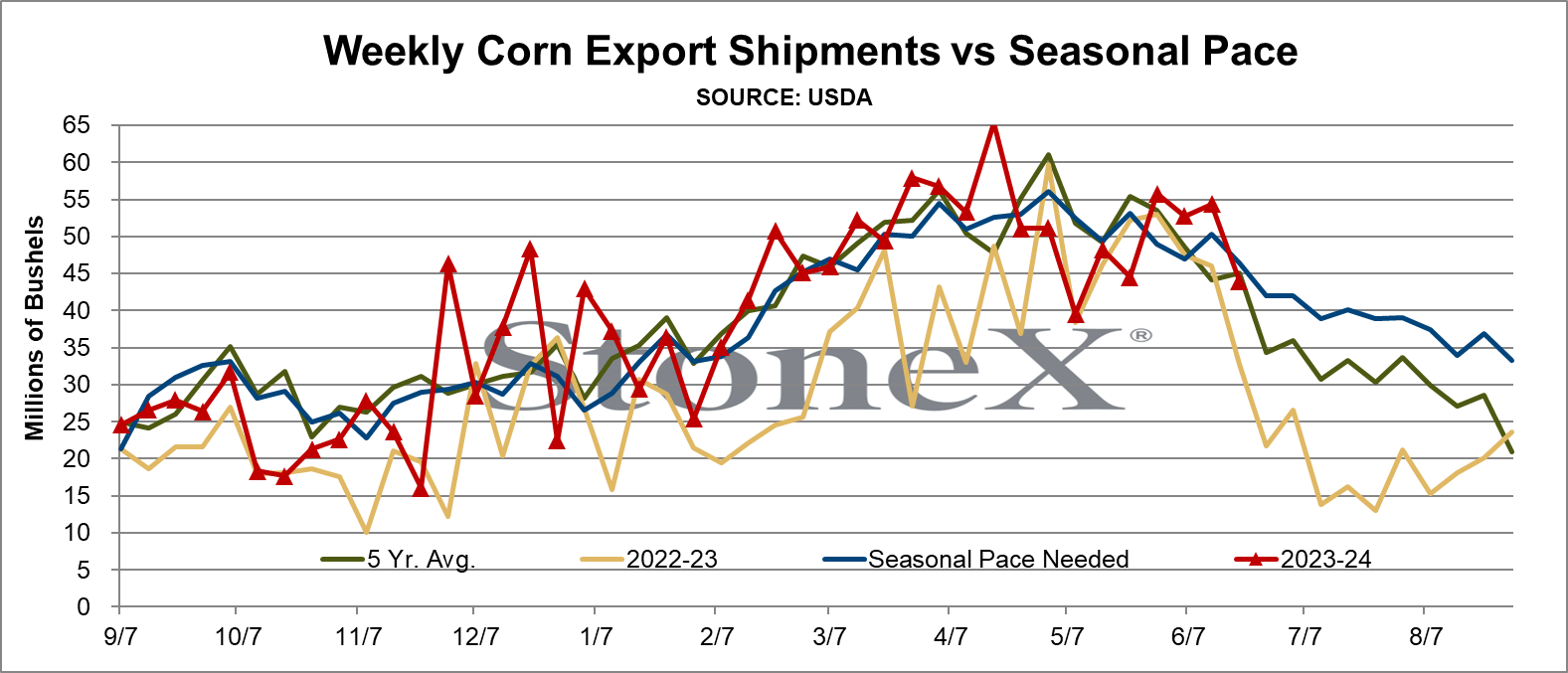
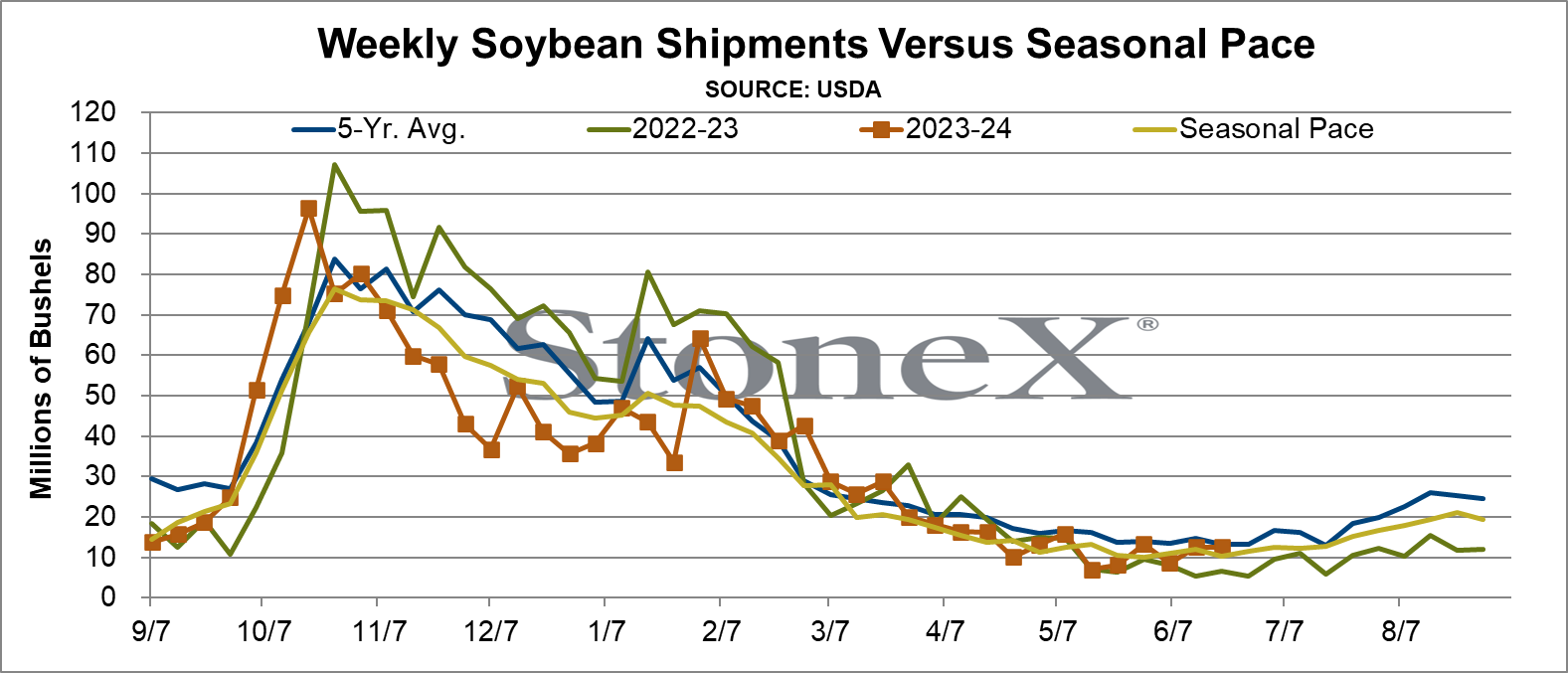
USDA inspected 44 million bushels of corn for export shipment in the week ending June 20, as shown below, along with 12.6 million bushels each of soybeans and wheat, and just 0.04 million bushels of grain sorghum. The portion of the above that was inspected specifically for shipment to China included 2.7 million bushels of corn, 0.2 million bushels of soybeans, 0.005 million bushels of wheat, and zero grain sorghum. Marketing year to date corn export inspections to all destinations total 1.639 billion bushels, up 360 million bushels or 28% from the previous year's pace, and 28 million bushels above the seasonal pace needed to hit USDA's target for the year. Marketing year to date soybean export inspections total 1.515 billion bushels, down 292 million bushels or 16% from the previous year's pace, although they are still 30 million bushels above the seasonal pace needed to hit USDA's target for the year.