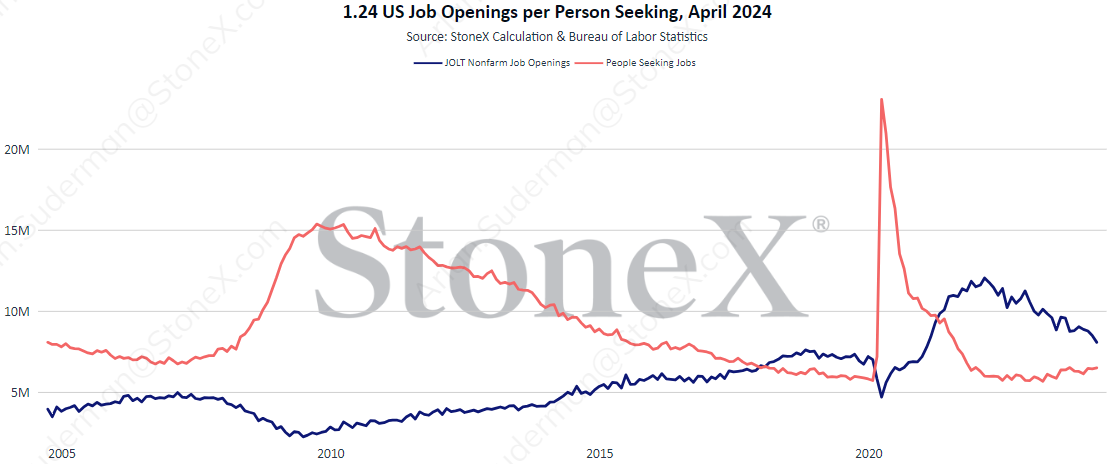
June 4 - Jobs are the primary topic of conversation this morning, or rather the decline in job openings. The Bureau of Labor Statistics reported this morning that there were a seasonally adjusted 8.059 million posted job openings at the end of April, down from a downwardly revised 8.355 million the previous month and down from analyst expectations of 8.4 million. That's down from the 12 million job openings posted when the Federal Reserve started hiking interest rates in March 2022. We had roughly two job openings for every person looking for a job at that point. Bidding for employees supports wage inflation when you have more than one opening per person looking. That number is closer to 1.24 openings per person looking currently.
Wall Street saw this morning's JOLTS report on posted job openings as a move in the right direction for getting the Fed to cut interest rates this morning - at least initially. Treasury yields immediately fell on the data release, but then they quickly recovered closer to pre-report levels. It was interesting to see yields on 10-year Treasuries, which were sitting near the 200-day moving average of 4.35% when the report was released, quickly break through that support in the minutes following the data release. However, yields then found support at the 100-day moving average, which is currently near 4.33% and trending upward toward a possible crossing of the 200-day moving average. Yields are also just above the May 16 low near 4.31%. Is the market defining a floor to a broad sideways trading range? Is this merely a pause before breaking lower, or perhaps an area that provides a base for higher rates ahead? The days ahead will likely tell us a great deal about the next chapter of Treasury yields.
The purpose of rate hikes is to slow the economy, which tends to slow hiring to reduce wage inflation while also reducing consumer demand for goods and services. Today's numbers on job openings suggest that we are moving in that direction. We still need to see that number drop closer to 6 million job postings or lower. Is this enough to suggest that the Fed will cut rates later this year? I don't think so, unless we see better progress on inflation itself. That means a reduction in shelter costs, transportation costs, medical costs, etc., where the Fed has less influence. It does have some influence on shelter costs, but it's biggest problem there is the roughly 2.5 million unit shortfall in supply relative to demand. It has very little influence on what's causing medical costs or car insurance costs to soar.
Stocks are posting modest losses at midday on the above concerns, while commodity prices are generally coming off of early big losses. The VIX is trading near 14 at midday, while the dollar index is trading near 104.1. Yields on 10-year Treasuries are trading near 4.34%, while yields on 2-year Treasuries are trading near 4.77%. Crude oil prices better than 1% lower at four-month lows on demand concerns, while the grain and oilseed markets are mostly weaker as well, although well off their lows in most cases. We should note that China bought another 26 cargoes of soybeans last week, mostly from Brazil for June and July shipment, although a few were again for next year's shipment. China has also purchased 4.5 million metric tons of Argentine soybeans that work into its reserve requirements that could be used to displace U.S. soybeans six months from now. China remains very reluctant to commit to U.S. new-crop soybeans yet at this point, even though this is normally the time of year when they are beginning to do so. U.S. new-crop sales to all destinations total just 35 million bushels currently, which is one-third of the previous year's pace, and even slower than the trade war year pace of 2018. Fund managers are currently reluctant to push corn and soybean prices lower, but they still lack a reason to build ownership with current fundamentals.