Quarterly Commodities Outlook is available for free now.  Download your report  →

StoneX logo

Perspective: Mid-Day Commentary for March 19

By: Arlan Suderman, Chief Commodities Economist

March 19 – The major stock indexes are now trading at their lowest level since November, with the Dow Jones and Nasdaq both down ~0.9% at the time of writing while the S&P 500 is down 0.75%. The VIX has come off its morning highs in the mid 27’s but remains in the green on the day, hovering near the 25.4 level. The dollar has faded through the morning, now trading around the 99.8 level, though this remains elevated compared to early 2026 trade. Treasuries remain up notably on the day, with 10-year yields at 4.28% and 2-year yields at 3.86%. WTI crude oil has reversed course from morning losses to now break back into the green, hovering right around the $100/barrel mark at midday, while Brent crude remains up roughly 5% on the day to sit around $113/barrel. The ags have turned mixed after their higher start, with portions of the wheat complex now in the red and the livestock sector now selling off fairly aggressively, led down by feeder cattle.  

New home sales in the U.S. tanked in January, falling 17.6% month-on-month to a seasonally adjusted annualized rate of only 587k. That’s the sharpest monthly decline in new home sales seen since 2013 and the weakest annualized rate seen since October 2022. Part of this dramatic drop was likely influenced by the widespread winter storms in the month, as the Northeast (-44%) and Midwest (-33.9%) saw by far the sharpest drops, but the weakness was widespread, as the West (-21.6%) and South (-8.1%) were both notably softer. Analyst expectations were for only a slight drop in the month to an annualized rate of 720k (with the low-end being 675k), while December was also revised lower from the 745k initially reported down to 712k. At the same time, U.S. building permits fell 4.7% month-on-month in January, the sharpest drop since March 2024 but not as sharp as the anticipated -5.4% estimate, to a seasonally adjusted annualized rate of 1.386M. Multi-unit permits saw a sharp -12.4% month-on-month drop, while single-family permits were down only 0.6% month-on-month.

U.S. exporters sold only 11.0 million bushels of soybeans in the week ending March 12, below the low-end analyst estimate of 12.9 million and marking a five-week low. China was again the top destination for the week, but at less than 3 million bushels, it’s not exactly enough to make a dent as cumulative ‘25/’26 marketing year to date sales remain 18.7% behind this time last year and the delay to the planned Trump/Xi meeting in Beijing makes USDA’s 1.575 billion bushel export target look more difficult to achieve, especially given hefty stocks in China and significantly cheaper Brazilian new crop supply. Healthy domestic use helps offset this lost export demand, however, and the market still appears more optimistic for the ‘26/’27 balance sheet as new crop soybeans lead the grains and oilseeds higher. Keep in mind this is still contingent on ongoing policy support, but the market does expect to finally get clarity on that next week.

Elsewhere, weekly export sales for the ‘25/’26 marketing year were largely in line with expectations, with corn right in the middle of its expected range at 46.1 million bushels, as were soybean meal (220.9k MT) and soybean oil (5.2k MT). Old crop (‘25/’26) wheat sales of only 7.0 million bushels look ugly on the surface, as that would represent a nine-week low, but new crop (‘26/’27) sales of 7.8 million bushels were significantly stronger than expected, helping cushion the blow. If you combine the two marketing years, total weekly wheat export sales of 14.8 million bushels were effectively right in the middle of analyst estimates. Finally, weekly milo (sorghum) export sales were soft again at only 0.5 million bushels. After running extremely hot through the winter, U.S. milo export sales have really cooled off in the last month.

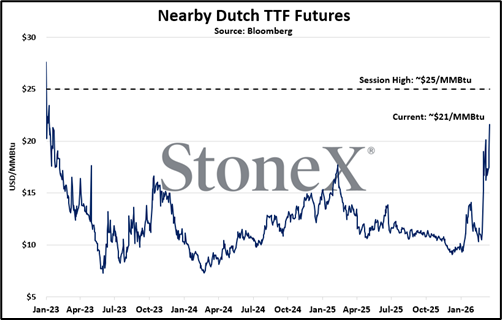
Back-and-forth strikes on natural gas infrastructure in the Middle East sent nearby Dutch TTF prices soaring over 30% higher to touch their highest level since January 2023 to start the session, nearing the $25/MMBtu mark, but has since cooled from the overnight highs. Why did I choose to focus specifically on the European gas market’s reaction? Not just because they’re one of the most vulnerable markets to this conflict from a supply perspective, but because Europe has essentially become the global nitrogen market’s swing producer post-Russia’s invasion of Ukraine. Skyrocketing gas values in Europe mean even worse production economics for European fertilizer producers, leading to increased demand for imports. That becomes more complicated given the ongoing blockage of the Strait and unwillingness to do business with Russia. While this sounds far away from us in the U.S., it’s important to keep in mind that this will force the inland markets to compete more directly with the export markets to keep our tons at home ahead of the heart of the spring season. Obviously, the short-term focus of the ongoing conflict in the Middle East is on movement through the Strait of Hormuz, but the longer-term focus should be on how much energy infrastructure is damaged.

The fertilizer market is a prime example of this. Part of the rise in global urea values in the months prior to the war breaking out was the loss of Iranian production starting in mid-December. That was largely a function of the lingering impact of infrastructure damage in the South Pars field (which was hit again yesterday) that led to domestic gas shortages that ultimately saw the limited supply being prioritized to heat homes over the winter instead of running their fertilizer plants. Iran responded to this attack by striking Qatar’s Ras Laffan complex, the world’s largest LNG production facility, which had already been hit in the first days of the war. QatarEnergy’s CEO said the attack has knocked out 17% of Qatar’s LNG export capacity, causing a potential $20B+ loss in annual revenue potential with the repairs possibly taking as long as three to five years. There are immense longer-term downstream impacts to this kind of infrastructure loss to consider, but until the conflict ends, it’s impossible to know the full extent of the hole the market will be digging out from.

image 128473

  • Grains & Oilseeds

This material should be construed as market commentary and represents the opinions and viewpoints of the author, and does not reflect tailored advice associated with any specific account.


The views are current only through the date stated and are subject to change at any time based upon market or other conditions, and StoneX Group Inc. (“SGI”) disclaims any responsibility to update such views. Actual results, performance, or achievements may differ materially from those expressed or implied. Information is based on data gathered from what we believe are reliable sources. Past performance does not guarantee future results.


The StoneX Group Inc. group of companies provides financial services worldwide through its subsidiaries, including physical commodities, securities, exchange-traded and over-the-counter derivatives, risk management, global payments and foreign exchange products in accordance with applicable law in the jurisdictions where services are provided.


References to certain OTC products or swaps are made on behalf of StoneX Markets, LLC (SXM), a member of the National Futures Association (NFA) and provisionally registered with the U.S. Commodity Futures Trading Commission (CFTC) as a swap dealer. SXM’s products are designed only for individuals or firms who qualify under CFTC rules as an ‘Eligible Contract Participant’ and who have been accepted as customers of SXM.


StoneX Financial Inc. (SFI) is a member of FINRA/NFA/SIPC and registered with the MSRB. SFI is registered with the U.S. Securities and Exchange Commission (SEC) as a Broker-Dealer and with the CFTC as a Futures Commission Merchant and Commodity Trading Advisor. StoneX Financial (Canada) Inc. (SFCI) is registered in Canada and is a member of CIRO and CIPF. References to certain securities trading are made on behalf of the BD Division of SFI and are intended only for an audience of institutional clients as defined by FINRA Rule 4512(c). References to certain exchange-traded futures and options are made on behalf of the FCM Division of SFI. Wealth Management is offered through SA Stone Wealth Management Inc., member FINRA/SIPC, and SA Stone Investment Advisors Inc., an SEC-registered investment advisor, both wholly owned subsidiaries of SGI.

R.J. O’Brien & Associates, LLC (RJO) is registered with the CFTC as a Futures Commission Merchant and is a member of NFA.


StoneX Financial Ltd (SFL) is registered in England and Wales, company no. 5616586. SFL is authorized and regulated by the Financial Conduct Authority (FCA) (registration number FRN:446717) to provide services to professional and eligible customers including: arrangement, execution and, where required, clearing derivative transactions in exchange traded futures and options. SFL is also authorized to engage in the arrangement and execution of transactions in certain OTC products, certain securities trading, precious metals trading and payment services to eligible customers. SFL is authorized and regulated by the FCA under the Payment Services Regulations 2017 for the provision of payment services. SFL is a category 1 ring-dealing member of the London Metal Exchange. In addition SFL also engages in other physically delivered commodities business and other general business activities which are unregulated and not required to be authorized by the FCA.


This communication is issued in the European Economic Area by StoneX Financial Europe GmbH (SFEG). StoneX is the trade name used by STONEX GROUP INC. and all its associated entities and subsidiaries. StoneX Financial Europe GmbH (“SFEG”) is a securities trading firm registered in Germany under Company No. HRB 80844.


StoneX APAC Pte. Ltd. (“SAP”) (Co. Reg. No 200616676W) is regulated as a Dealer (PS20190001002) under the Precious Stones and Precious Metals (Prevention of Money Laundering and Terrorism Financing) Act 2019 for purposes of anti-money laundering and countering the financing of terrorism. SAP is an “Approved International Trading Company” authorized to act as a “Spot Commodity Broker” under the Commodity Trading Act.


StoneX Financial Pte Ltd (Co. Reg. No 201130598R) (“SFP”) is regulated by the Monetary Authority of Singapore and is a Capital Markets Service Licence holder (for dealing in capital market products), an Exempt Financial Adviser (for advising on investment products and issuing or promulgating analyses/ reports on investment products) and a Major Payment Institution (for domestic and cross-border money transfer services).


SFP may distribute analysis/report produced by its respective foreign affiliates within the StoneX Group of companies pursuant to an arrangement under Regulation 32C of the Financial Advisers Regulations Recipients should contact SFP at (65) 6309 1000 for any matters arising from, or in connection with, this webinar.


StoneX APAC Pte. Ltd. (“SAP”) (Co. Reg. No 200616676W) is regulated as a Dealer (PS20190001002) under the Precious Stones and Precious Metals (Prevention of Money Laundering and Terrorism Financing) Act 2019 for purposes of anti-money laundering and countering the financing of terrorism.


StoneX Financial (HK) Limited (CE No.: BCQ152) (“SHK”) is regulated by the Hong Kong Securities and Futures Commission for Dealing in Securities and Dealing in Futures Contracts.


StoneX Financial Pty Ltd (ACN 141 774 727) holds an Australian Financial Service License (AFSL: 345646) for Dealing in Securities, Exchange-Traded Derivatives Contracts, OTC Derivatives Contracts and Foreign Exchange Contracts, and is regulated by the Australian Securities and Investments Commission.


StoneX Securities Co., Ltd. (“SSJ”) (Co. Reg. No 010401047199) is regulated by the Japanese Financial Services Agency as a Type-I Financial Instruments Business Operator (Kanto Local Finance Bureau (FIBO)No.291’), is a member of the Financial Futures Association of Japan for dealing and broking FX and FX Option transactions, and is a member of the Japan Securities Dealers Association for dealing and broking stock indices and option transactions.


Trading swaps and over-the-counter derivatives, exchange-traded derivatives and options and securities involves substantial risk and is not suitable for all investors. Past performance of any futures or option is not indicative of future success. Indicators are not a trading system and are not published as a specific trade recommendation. The information herein is not a recommendation to trade nor investment research or an offer to buy or sell any derivative or security. It does not take into account your particular investment objectives, financial situation or needs and does not create a binding obligation on any of the StoneX group of companies to enter into any transaction with you. You are advised to perform an independent investigation of any transaction to determine whether any transaction is suitable for you. No part of this material may be copied, photocopied or duplicated in any form by any means or redistributed without the prior written consent of StoneX Group Inc.


The report/analysis herein is not directed to, or intended for distribution to or use by, any person or entity who is a citizen or resident of or located in any locality, state, country or other jurisdiction where such distribution, publication, availability or use would be contrary to law or regulation.


© 2026 StoneX Group Inc. All Rights Reserved.

Satellite view of Earth at night showing illuminated cities across Asia and the Middle East

Discover more insights

Our subscribers have access to comprehensive market analysis from StoneX spanning commodities, equities, currencies and more.

Related articles for Grains & Oilseeds

Perspective: Morning Commentary for August 7

August 7 – The U.S. economy unexpectedly lost 23k jobs in July, dramatically below market expectations of an 80k increase and marking the worst Non-Farm Payrolls print since February. Furthermore, May and June were both revised sharply downward, with combined revisions showing 103k fewer jobs than previously reported. Outside of the healthcare sector, which added 22k jobs in July, the losses were very broad-based. Government payrolls saw the largest decline, shedding 53k jobs in July, the largest seen since October 2025, while June was revised down to show a loss of 10k jobs as well. The private sector at least saw growth, adding 30k jobs in July, now matching the month prior after it was revised down from the 49k initially reported, and substantially missing forecasts of 78k jobs being added. This is a sharp reversal in course from the largely better than expected U.S. labor data seen earlier this week.

Mike Castle
Mike Castle
  • Grains & Oilseeds
  • Energy
  • Dairy
  • Renewable Fuels
  • Cocoa
  • Coffee
  • Cotton
  • Sugar
  • Meats & Livestock
  • Forest Products

Perspective: Morning Commentary for August 6

August 6 – This morning’s stronger-than-expected U.S. labor data offered markets some relief, reinforcing confidence in the economy while giving the Fed greater flexibility to raise rates should inflationary pressures reaccelerate in next week’s July data. Stock futures are pointing to a mixed open to start the day, with the tech-heavy Nasdaq showing the most weakness. The VIX has fallen notably from yesterday’s spike above 18.4 as it starts the day hovering just below the 16-mark. The dollar is quietly higher as it trades just above 99.8, holding in the tight range seen thus far this week as traders continue to digest data to shape expectations for the Fed’s next move, which we’ll dive into in more depth below. Long-term treasury yields have relaxed slightly from their recent spike, with 30-year yields starting the day trading just above 5.19%, while 10-year yields trade above 4.64%, and 2-year yields sit below 4.22%. Crude oil is modestly higher to start the session after sharp declines earlier in the week, with nearby WTI up 1.8% to trade at $76.40 and nearby Brent up 2.4% to trade at $81.40. Meanwhile, the ags are quietly mixed to start the day.

Mike Castle
Mike Castle
  • Grains & Oilseeds
  • Energy
  • Dairy
  • Renewable Fuels
  • Cocoa
  • Coffee
  • Cotton
  • Sugar
  • Meats & Livestock
  • Forest Products

Perspective: Mid-Day Commentary for August 5

August 5 – The Dow Jones is ripping higher for yet another session, up safely over 500 points at the time of this writing to carve out another record high; the S&P and NASDAQ are a bit less enthusiastic but the former is still making its own record high, while the latter is less than 500 points off its own top thanks to a strong ongoing week of trade. The dollar is churning lower this morning in an effort to re-test Monday’s 1 ½-month low, while the ten-year note has flipped higher in the mid-morning hours. The CME FedWatch tool interesting has market odds of a quarter-point rate hike next month coming closer to a 50-50 proposition as crude oil prices decline.

Mike Castle
Mike Castle
  • Grains & Oilseeds
StoneX: We open markets

Our market expertise, advanced platforms, global reach, culture of full transparency and commitment to our clients’ success all set us apart in the financial marketplace.

Reach

With access to 40+ derivatives exchanges, 180+ foreign exchange markets, nearly every global securities marketplace and numerous bi-lateral liquidity venues, StoneX’s digital network and deep relationships can take clients anywhere they want to go.

Transparency

As a publicly traded company meeting the highest standards of regulatory compliance in the markets we serve; our financials and record of accomplishment are matters of public record. StoneX’s commitment to “doing the right thing over the easy thing” sets us apart in the industry and helps us build respect, client trust and new partnerships.

Expertise

From our proprietary Market Intelligence platform, to “boots on the ground” expertise from award-winning traders and professionals, we connect our clients directly to actionable insights they can use to make more informed decisions and achieve their goals in the global markets.