May 3 - Wall Street is ecstatic about today's jobs report, with stocks rising to fresh two to three week highs as Treasury yields plummeted following the data release. Treasury yields have since come well off their post-report lows, softening a bit of the enthusiasm, but the tone remains upbeat overall on Wall Street. The VIX is trading below 14, while the dollar index is trading near 105.0, after dropping to trade near 104.5 earlier in the session. Yields on 10-year Treasuries are trading near 4.51%, after trading as low as 4.45% post-report. Yields on 2-year Treasuries are trading near 4.81%, after trading below 4.72%. Crude oil prices have been one of the exceptions to the positive tone, with prices down nearly 1% to fresh seven-week lows.
The grain and oilseed market was stronger overnight in follow-through buying, with each of the major grain and oilseeds seeing active buying the instant the job report was released. However, farmer selling and pre-weekend profit taking took the top off of today's corn and soybean rally, while we continue to see double-digit gains for wheat. Today's forecast pulled back on the anticipated Midwest rains for the 6- to 15-day period. That means that we should see the weather open up again for planting later next week, following good rains to finish filling the soil profile with moisture in most areas. That doesn't guarantee big U.S. corn and soybean crops this year, but it would be a big step in that direction if the forecast verifies. USDA will be releasing its first balance sheets for the 2024-25 marketing year next Friday. Look for it to show ample supplies of corn and soybeans, while world wheat supplies tighten again.
Fundamentally, soybean traders point to excessive wet weather in southern Brazil - specifically Rio Grande do Sul. Roughly a quarter of the crop remains in the field, subject to harvest loss and quality loss. Our sources suggest that we might be talking about roughly 125 million bushels of soybeans at risk of loss, although that's still a working number. Put that into perspective of the large gap of nearly 400 million bushels difference between USDA's Brazil production estimate and that of CONAB. Producers hope that CONAB is correct, while Brazil's cash market is behaving more like USDA is correct. Regardless, the fact that the market is looking for an excuse to rally says something, although it's also important to remember that there's still about 3 billion bushels of soybeans in the hands of the Brazilian and U.S. farmer to be sold against this rally, which is one of the reasons why we've seen it come off its highs ahead of the weekend, with similar dynamics working in the corn market as well.
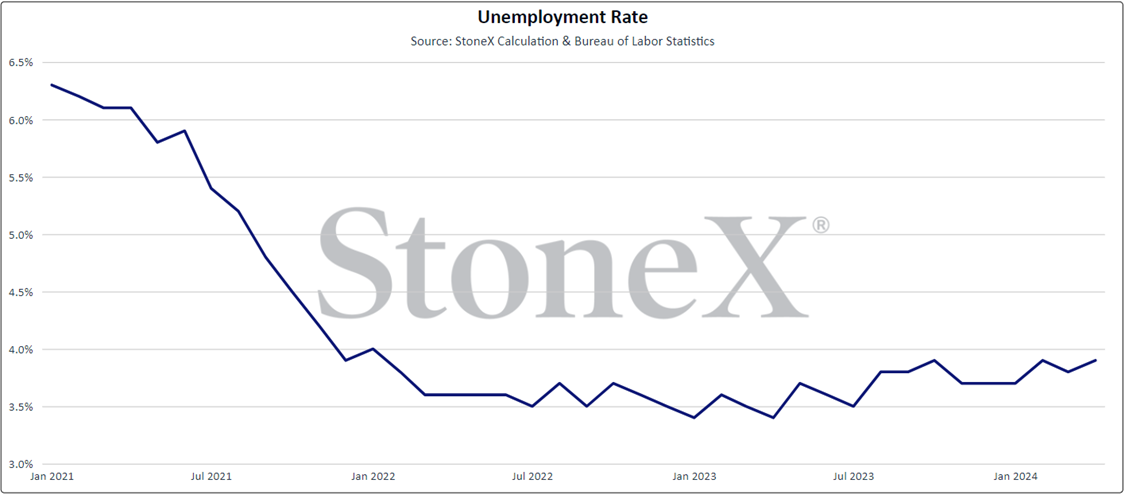
The U.S. unemployment rate ticked up to 3.9% in April, as shown in the graphic below. It's not a big move, but it continues a trend off of our low of 3.4% set a year ago. We've been at 4% or lower for the past 2-1/2 years. Today's risk-on sentiment on Wall Street is largely built on hopes that the Federal Reserve will see this as progress needed as it works toward a rate cut that Federal Reserve Chair Jerome Powell desperately seems to want to justify. Today's number still does not justify a cut, nor does other data released over the past week, but Wall Street sees this as a move in the right direction. This morning's PMI Composite index came in a bit stronger than expected at 51.3, while the ISM Services index came in a bit weaker at 49.4, so those two data points give a mixed message. Even the PMI Composite was still down slightly from the previous month, so Wall Street is still trading expectations of a September rate cut. The commodity sector sees this as a positive, meaning that we are looking ahead toward a reinflation period as demand returns, rather than the disinflation expectations that it's been pricing into the market since June 2022.