May 5 - Are permanent tariffs a possibility? President Trump will not rule that out. His justification is that many companies who want to re-home production are reluctant to do so if they think that President Trump's current tariffs are temporary, or that they'll be wiped out by the next president. What level might those permanent tariffs be? That's anyone's guess at this point, although it's highly unlikely that they would be as high as some of the reciprocal tariffs currently in place. We're also hearing more talk of the possibility of some level of permanent tariff that could be combined with lower income tax rates, although such a plan doesn't appear to have sufficient momentum to pass Congress as this point.
Stocks were generally lower this morning, in line with overnight trade, but also not extending those losses with the Dow actually trading positive at times. Investors are largely concerned about tariffs and this week's Federal Reserve meeting today, while waiting / hoping for an announcement on trade deals. President Trump said that he does not expect to speak to Chinese President Xi Jinping this week, although talks at a low level appear to continue between the two countries. Treasury Secretary Bessent stated midday that we could see substantial progress with China soon, although I remain skeptical of that. Bessent also indicated that he's very optimistic about trade proposals with 17 countries. The president needs solid trade deals soon to keep momentum on his side.
Stocks firmed off early lows, with the Dow solidly into positive territory at midday, while the S&P & Nasdaq trade well off their lows. The VIX is trading near 23 at this hour, while the dollar index is trading near 99.9. Yields on 10-year Treasuries are trading near 4.35%, while yields on 2-year Treasuries are trading near 3.85%. Crude oil prices are nearly 2% lower on signs that OPEC+ intends to increase output by more than 400K barrels per day this month and next, and possibly longer, to punish countries with lower prices that have been over-producing. Meanwhile, producers here in the U.S. are cutting back on production as prices fall below the cost of production. The grain and oilseed sector is largely under pressure as well, lacking a story currently to move against the stream.
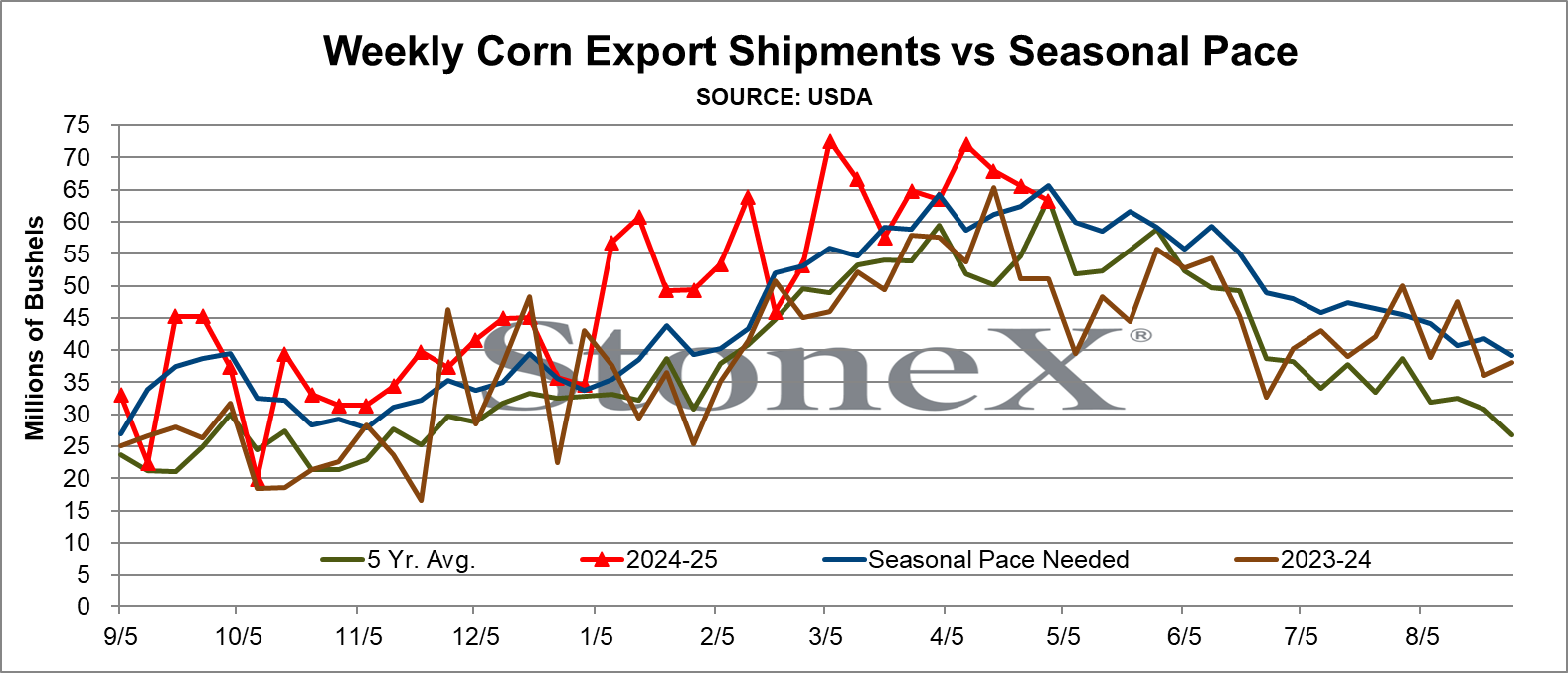
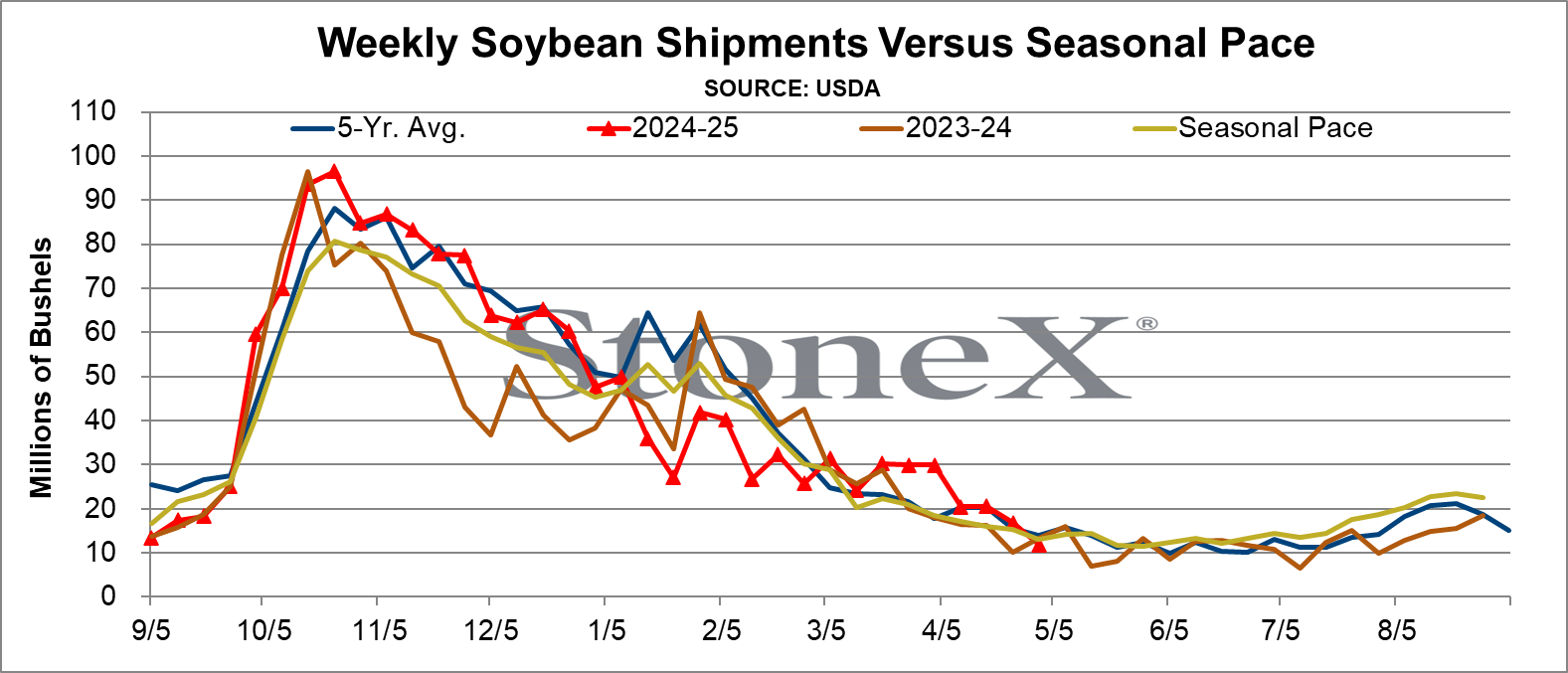
USDA inspected 63.3 million bushels of corn for export shipment in the week ending May 1, as shown below, along with 11.9 million bushels of soybeans, 11.4 million bushels of wheat, and 0.4 million bushels of grain sorghum that went to Mexico. The week's inspections included 2.5 million bushels of soybeans that went to China during the week from a port in the Pacific Northwest. That was believed to be a Sinograin shipment. As a state-grain buying agency, it is essentially immune to the retaliatory tariffs. It can then place the soybeans in its reserve, which can then be sold to crushers later this year when shipments from Brazil slow. Marketing year to date soybean export inspections total 1.597 billion bushels, up 160 million bushels or 11% from the previous year's pace, and up 103 million bushels from the seasonal pace needed to hit USDA's target. Yet, we are falling below that seasonal pace, and we could see that surplus shrink over the next several months as Brazil ships cheaper supplies. But I do like corn demand. Marketing year to date corn export inspections total 1.674 billion bushels, up 374 million bushels or 29% from the previous year's pace, and up 184 million bushels from the seasonal pace needed to hit USDA's target. This is the time of year when that seasonal pace tops out and trends lower as new-crop Argentine supplies hit the world market, so we could see a decline in this strong shipment pace, and still stay ahead of the seasonal pace needed to hit USDA's target, justifying a notable increase in the export target next week.