November 12 - Stocks dipped today as traders began to pocket some profits from the past week's post-election rally ahead of key inflation data out over the next two days. Yet, the VIX continues to trade near 15 at midday. The dollar index remains strong, trading near 106.1, or a new six-month high for the greenback. Yields on 10-year Treasuries are trading near 4.43% following today's sharp gains, while yields on 2-year Treasuries are trading near 4.35%, representing fresh three-month highs. Crude oil prices are modestly higher today, despite OPEC+ rolling back its demand estimates, while the grain and oilseed markets are mostly weaker.
Palm oils prices came under pressure on talk that Indonesia may slow walk its planned increase of biodiesel blending requirements, pressuring soyoil prices, while news that President-Elect Trump will name Lee Zelden to head the Environmental Protection Agency didn't help either. Zelden has a track record of being an opponent of liquid biofuels. Favorable crop prospects for Brazil are also a factor adding pressure to the soybean complex. Cheap Russian wheat prices and yesterday's chart damage brought another day of double-digit losses to that sector today, with corn prices being dragged lower by the big losses in soybeans and wheat. A strong dollar continues to provide headwinds for the commodities as well, although energy and protein prices have thus far been able to stand up against those headwinds as of midday.
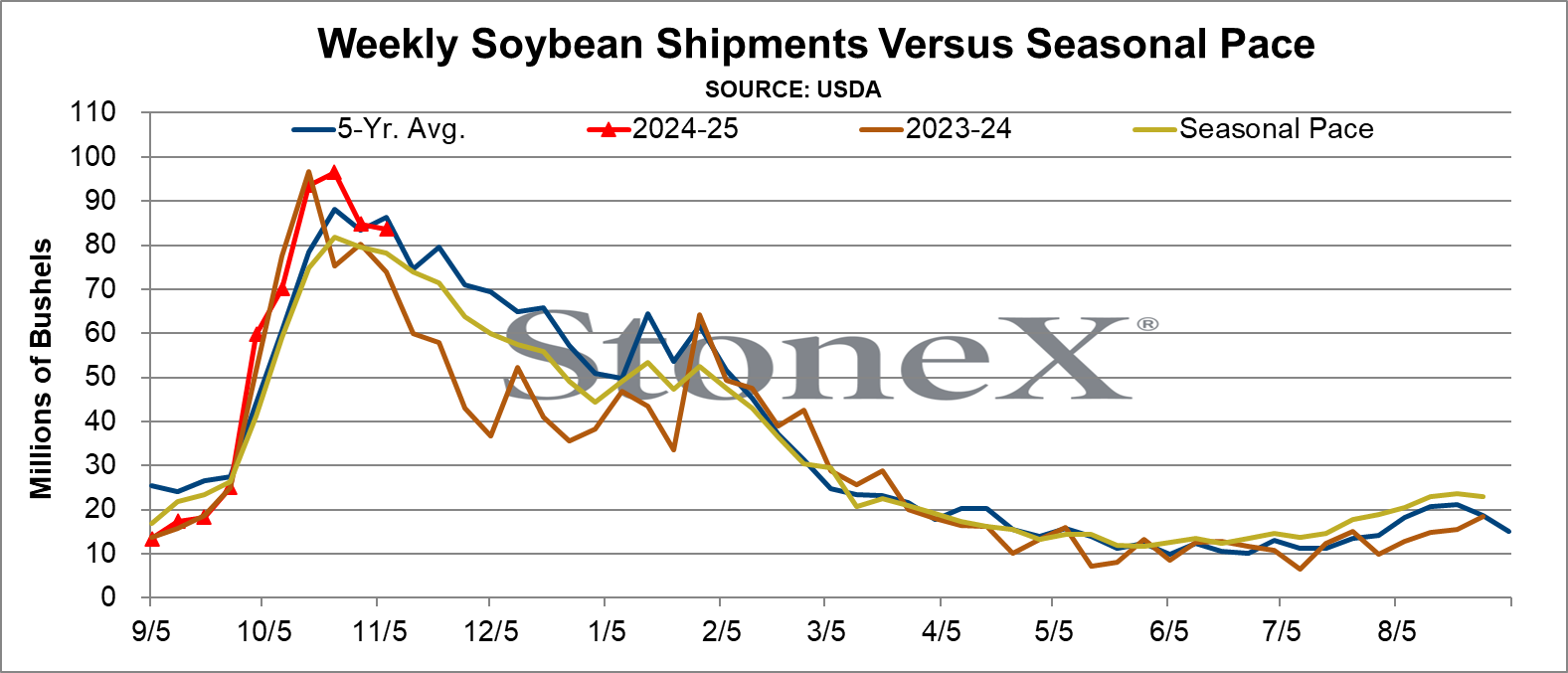
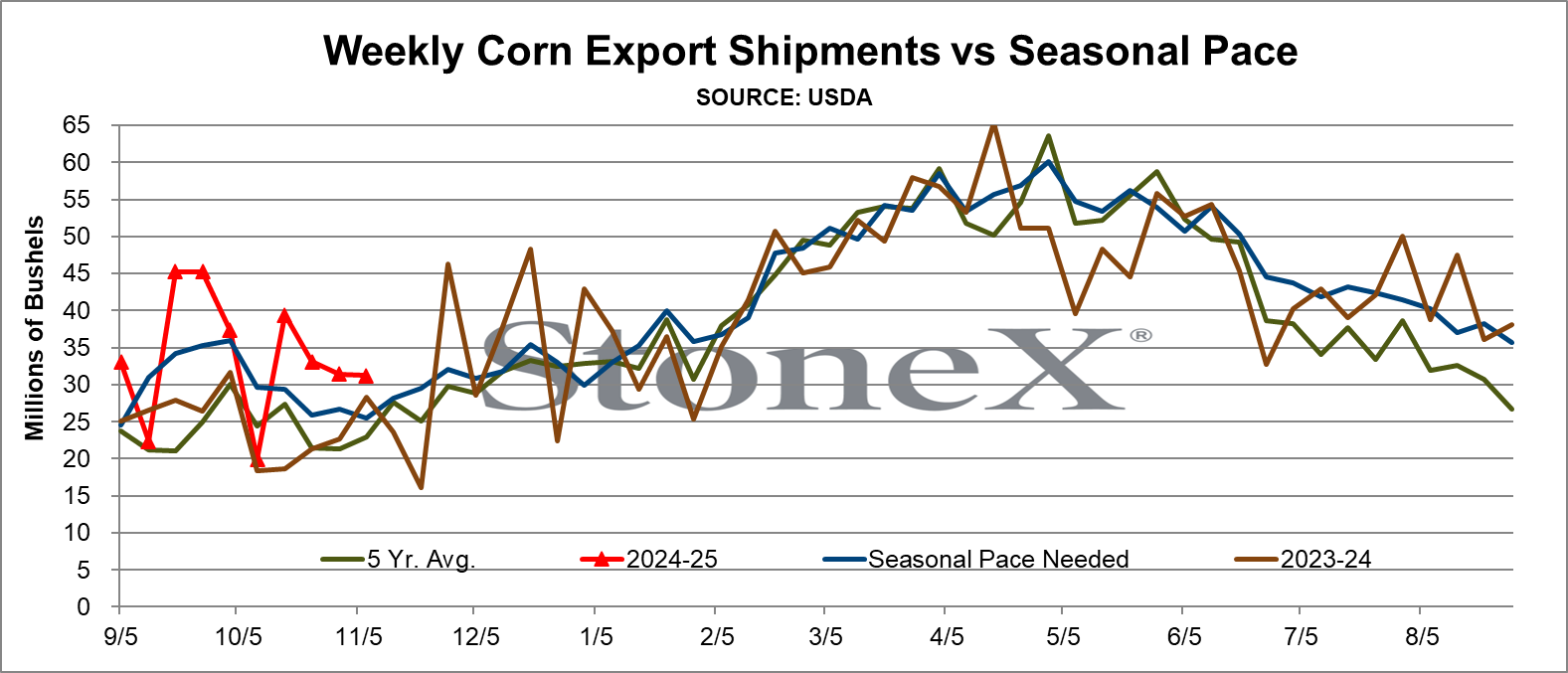
USDA inspected 83.7 million bushels of soybeans for export shipment in the week ending November 7, as shown below, along with 31.2 million bushels of corn, 12.8 million bushels of wheat and 6.6 million bushels of grain sorghum. The portion of the above that was inspected specifically for shipment to China included 58.3 million bushels of soybeans and 2.9 million bushels of grain sorghum. The grain sorghum shipments keep us on the seasonal pace needed to hit USDA's target for the year, including the cargo to China, and a couple of smaller cargoes of USDA donations - one each to Djibouti and one to Ethiopia. Wheat export inspections for the marketing year to date exceed the seasonal pace needed to hit USDA's target by 12 million bushels, with a little positive momentum there of late.
Marketing year to date soybean export inspections total 560 million bushels, up 31 million bushels or 5.9% from the previous year's pace, and 56 million bushels above the seasonal pace needed to hit USDA's target. We're currently exceeding the seasonal pace needed to hit USDA's target, despite China's sluggish buying pace. It still has bought very little of its shipment needs for December and January, with little evidence to this point of a change in the pattern since the election. We hear of fears within China of a pending trade war with the United States following the Trump election win, but there's still ample time to schedule shipments for December and January prior to inauguration day. Soybean shipments are normally strong at this time of year, but they're abnormally strong this year considering the fact that an even larger Brazil crop is expected to supply the world with cheap soybeans in another 60 - 75 days. Corn export inspections have been stronger than normal for this time of year in 8 of the past 10 weeks. Marketing year to date corn export inspections total 324 million bushels, up 77 million bushels or 31% from the previous year's pace, largely due to strong demand from Mexico. The year to date inspections exceed the seasonal pace needed to hit USDA's target by 26 million bushels, and we'll likely find that we've had a larger than normal quantify of corn shipped to Mexico that was not inspected as well.