November 14 - Stocks gapped higher on this morning's soft inflation data that put new energy into Wall Street hopes for a 2024 pivot by the Federal Reserve. The VIX dropped below 14 for the first time since September 20 when the data hit the Street, and the dollar fell with Treasury yields to a fresh nine-week low near 104.4. Yields on 10-year Treasuries are trading near 4.46%, while yields on 2-year Treasuries are trading near 4.86%. The above factors immediately resulted in positive money flow into the broader commodity sector, with crude oil prices reversing early losses to push more than 1% higher, while grain and oilseed prices also erased early losses to move higher. Soybean prices continue to post modest losses, pulling back from yesterday's big gains, while corn and wheat post modest gains from chart-related short-covering / bottom picking.
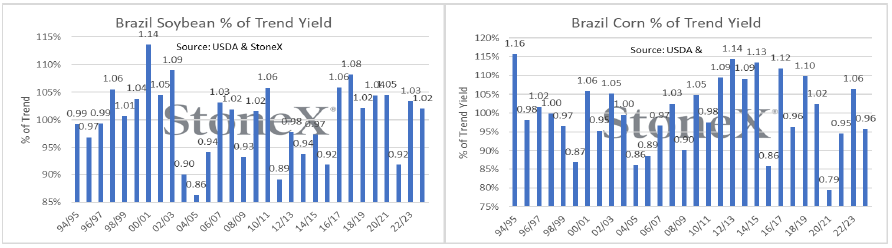
Soybean prices exploded higher on Monday as traders resumed their role of building weather risk premium into the market, while doing the same with soymeal futures. My commentary in recent days has focused on the production risks in Brazil, created by excessive rains in southern Brazil and the lack of rain in the northern Center-West area of production in Brazil. It's my goal to provide some perspective to the risks in Brazil to assist one in measuring the amount of risk premium that's been placed into the market. Keep in mind that the markets generally go to extremes - higher than the fundamentals justify in bull markets, and lower than they justify in bear markets. Knowing something about the fundamentals gives one the ability to recognize these moves, and to take action they deem appropriate. The left graphic below shows the deviation in soybean yields from trend over the past 30 years.
Note that soybean yields have only deviated from trend twice over the past 30 years - coming in at 89% of trend in '11/'12 and 86% of trend in the '04/'05 growing season. This year may be the exception. We don't know that yet, but neither do we have substantive data to show that it will be. A lot hinges on whether soaking rains in the forecast for early next week materialize, along with follow-through rains. Recall my analysis from my Midday commentary on Monday, stating that a 10% drop from trend soybean yields would reflect a 16 million metric ton reduction in production, but that wouldn't necessarily require an increase in U.S. exports, which ultimately would dictate the direction of price necessary to balance supply and demand. As such, this year's yield loss from adverse weather likely needs to be one of the largest of the past 30 years, and maybe it will be. We don't know yet.
Note that corn yields have greater variability to them. And that variability doesn't necessarily match up with the variability in the soybean yields. Brazil grows three corn crops per year - the third crop being quite small, while the second crop (safrinha corn) is the largest at roughly three-fourths of annual production. As such, it's the winter crop planted behind soybean harvesters in February that has the greatest impact on the below right yield graphic. Note that Brazil's average corn yield deviated from trend by 21% in the '20/'21 growing season when dry weather impacted the crop, and something similar can't be ruled out this year as well, although we're still several months from even planting the safrinha crop. This explains why our people in Brazil repeatedly say that their greater concern is the safrinha corn crop, although there is yet no way of knowing what the actual impact will be on the crop. We just know that risks will be higher this year. StoneX Brazil is currently anticipating 128 mmt of production in the upcoming growing season, assuming trend yields, which would be down 11 mmt from the most recent crop. A repeat of conditions seen in the '20/'21 growing season would risk taking an additional 27 mmt off this year's current production estimate. Those are the risks. The soybean crop is currently trading those risks, and then we'll wait to see how things play out for corn.