November 8 - Stocks are moving downward at midday as comments emerging from Federal Reserve members cool hopes of interest rate cuts. Yet, the VIX continues to trade just below 15, while the dollar index trades near 105.5. Yields on 10-year Treasuries are trading near 4.53%, while yields on 2-year Treasuries are trading near 4.92%. Crude oil prices are more than 2% lower at their lowest level since late July, while the grain and oilseed markets are notably higher at midday. Live cattle futures are currently higher after initially making new lows for the move, while lean hog futures are turning lower, taking back a portion of recent gains.
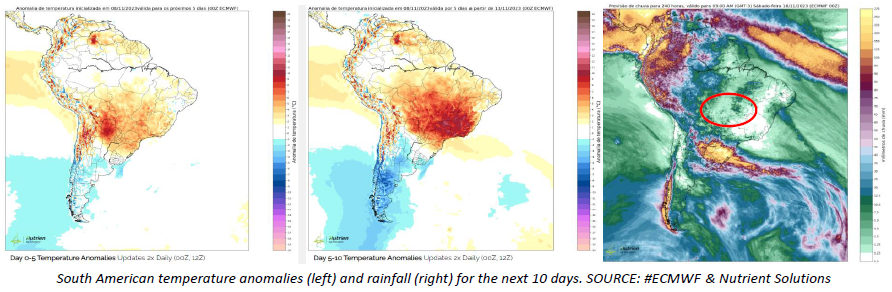
Today's soybean market was all about South American weather, and specifically about weather in Center-West Brazil, as outlined in the right graphic below. It's not that the crop has already failed in Brazil, but the risks are certainly rising. A good soaking rain in Center-West Brazil could still heal a lot of problems, but those rains are not in the forecast in the near-term, and temperatures are warming up. The right graphic below reflects expectations of more heavy rains in southern Brazil over the next 10 days, with moisture improving in Argentina as well. However, Center-West Brazil is mostly dry for the next 10 days, with some models now saying that rainfall may remain limited into next month. The graphic on the left shows temperature anomalies for the next five days, with the center graphic showing expected anomalies for days 6 to 10, when readings in Center-West Brazil are expected to soar well over 100°F.
Mato Grosso makes up the bulk - not all - of the Center-West region of Brazil. It is 1.3 times the size of Texas. Our StoneX Brazil team's customer survey revealed expectations for farmers to plant 12.123 million hectares (30 million acres) to soybeans in Mato Grosso in the current growing season, up from 11.972 million the previous year. A trend yield would be expected to produce 43.759 million metric tons (1.608 billion bushels). That's more soybeans than we produce in Iowa, Illinois, and Minnesota combined, and it doesn't include the surrounding areas that are also high producers. This would matter much less if the United States had ample supplies, but we don't, because of the short crop we just harvested. Furthermore, it comes at a time when U.S. domestic demand is becoming more inelastic, meaning that demand for soyoil by Renewable Diesel producers makes it more difficult to ration domestic demand with higher prices. I commented yesterday that we had not yet seen evidence of the Chinese buyer starting to panic and chase the market higher with purchases, but that now appears to have changed. Keep in mind that China built its reserves this summer with Brazilian supplies, and that Brazil also still has a lot of surplus old-crop supplies, which will mute China's need to buy U.S. supplies to some extent. Nonetheless, it's hot and dry in Center-West Brazil and the Chinese are buying for now, and that has prices surging higher.
Soybean weather problems in Center-West Brazil translate into increased risks for Brazil's safrinha corn crop as well, even though that crop won't be planted for another several months yet. But the added risk made fund managers who hold large short positions in the corn market nervous when prices held underlying chart support, leading them to cover short positions. A surge in nearby Chicago SRW wheat futures through the 50-day moving average triggered massive short-covering in that market, on a report that a Russian missile hit a civilian vessel in the Black Sea. Strength in wheat spilled over into corn as well as traders re-assess risks with Ukrainian exports of the two commodities in this environment.