September 15 - Stocks are looking to end the week on a negative note, with the major indexes extending their losses into mid-day. The VIX is pushing slightly higher, though it remains quite low near the 13.4 level. The dollar has rebounded from the morning's lows, though it remains in the red near 105.2 at the time of writing. Treasuries continue to show strength, with 10-year yields hanging near 4.33% and 2-year yields near 5.04%. Crude oil remains in the green, though off slightly from this morning's 10-month highs, while the grains are largely mixed.
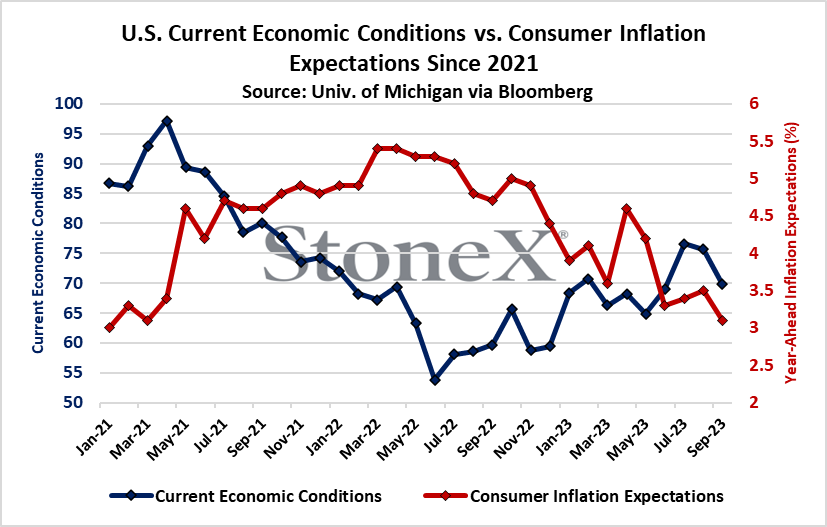
Consumer sentiment in the U.S. is eroding, with this morning's University of Michigan Consumer Sentiment Index falling to 67.7 in September, a drop of 1.8 points from August and well below analyst expectations of a slight decline to a 69.1 reading. The Current Economic Conditions subindex showed the most negativity, with its 5.9 point decline to 69.8 marking the sharpest month-on-month drop seen since November 2022. This was a huge miss compared to market expectations of a narrow decline to 75.3 and well below July's nearly two-year high of 76.6. Considering the higher than expected CPI readings earlier this week, it shouldn't be a huge surprise to see some erosion in sentiment at the consumer level, especially when keeping in mind the sensitivity to rising gas prices. Adding to this, high borrowing costs and a labor market showing some potential signs of cooling are keeping the U.S. consumer somewhat on the defensive at present.
There was a silver lining, however, with consumer year-ahead inflation expectations falling to 3.1%, down from 3.5% in August and marking the lowest level seen since March 2021. Longer-term inflation expectations improved as well, with the 5 - 10 year outlook from the consumer falling 0.3% to 2.7% in September, the lowest level seen since the same month last year. The Index of Consumer Expectations also showed improvement, climbing 0.8 points month-on-month to a 66.3 reading. So, while consumers are feeling some pain right now, their outlook for the economy in the future remains relatively positive. This is consistent with the expectations we've had all along in the Fed's battle with inflation; in order to bring inflationary pressures under control, we knew there would be some bumps in the road along the way. This week's data gives the Fed more to digest for its meeting next week and likely helps solidify expectations of rates to be left alone in this go around, with the market now putting odds of a hike in September below 4%. The real question remains whether or not we will see one more hike before the end of 2023.
The U.S. manufacturing sector showed surprising strength in this morning's data releases, contrasting with the growing negativity related to the UAW strike. The NY Empire State Manufacturing Index showed an expansionary reading of 1.9 for September, a massive jump from August's sharp contractionary reading of -19 and crushing expectations of a moderate improvement to -10. New orders and shipments improved considerably for manufacturers in New York state, with six-month outlooks becoming much more optimistic as well. U.S. industrial production also showed unexpected strength, rising 0.4% month-on-month in August versus expectations of a 0.1% climb. In year-on-year terms, industrial production showed its strongest gain since April after consecutive declines this summer. Capacity utilization in the U.S. was also at its highest since April at 79.7%, well above the forecasted 79.3% while July was upwardly revised to 79.5%. However, escalations from the UAW strike could look to dampen this positivity in the months ahead. With the two sides reportedly far apart, an expansion of the existing strike could have cascading effects throughout the economy, adding to the complexity of achieving a soft landing.