September 6 - Stocks fell as Treasury yields surged on data released this morning indicating that the service sector of our economy - a sector where inflation has been most sticky - gained momentum in August. The VIX is creeping closer to 15 as we approach midday, as stocks slide lower. The dollar index is trading at fresh highs not seen since mid-March, probing above 105.0. Yields on 10-year Treasuries are trading near 4.30%, while yields on 2-year Treasuries are trading near 5.03%. Crude oil prices initially pulled back on the data release, but they are now modestly higher after hitting fresh 9-1/2-month highs on Tuesday. The grain and oilseed markets are currently the exception, as they hold notable gains in the face of these headwinds. The strength is supported by larger-than-expected drops in crop ratings on Tuesday afternoon, combined with turning chart signals that encourage short-covering by fund managers holding large short positions.
The rainy season is coming to an end in Panama, and it's been a disappointing one that failed to restore water levels in the Panama Canal. As such, authorities expect limits to remain on daily transits and drafts through the Canal through the remainder of this year, and likely through most of 2024 as well. Waiting times doubled last month, but they've eased about 20% from those levels as many shippers chose alternate routes around either the southern end of South America or the southern end of Africa, depending on their destination. Those alternate routes costs money, raising shipping costs. Water levels on Gatun Lake, which supplies water for the lock and dam system, is roughly eight feet below normal levels for September, resulting in the restrictions reflecting efforts to conserve water. It takes roughly 51 million gallons of water from the lake to move each vessel through the 50-mile waterway. The higher costs and delays associated with the restrictions are part of the reason that Chinese buyers continue to favor Brazilian corn and soybean supplies over U.S. supplies from the Gulf of Mexico. Brazilian supplies typically travel around Africa, whereas U.S. Gulf shipments must go through the Canal. China is still buying soybeans for fourth-quarter shipment from the United States, but they're supplementing those supplies with some from Brazil to mitigate their risks.
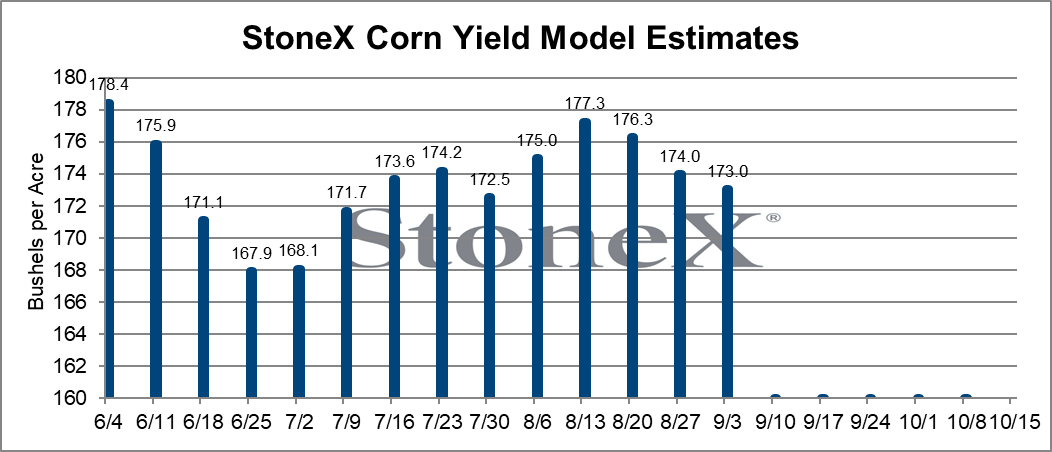
This week's corn condition index score fell to 338 (500=perfect crop), down from 342 the previous week, but identical to the 338 posted on the same week last year. The 10-year average for the week is 363. This week's corn condition index score ties last year's for the lowest score in this week of the growing season since 2012, when it was just 247. This is definitely not 2012, but there are problems with the crop. The graphic below shows my yield model trending lower over the past several weeks, reflecting the adverse weather across the Midwest to close out the growing season. The dryness and periods of extreme heat speed up the maturation process, resulting in a smaller seed than would otherwise be expected, translating into lower yields. But that's the problem. Yield models are not designed to pick up aberrations in seed size. My yield model is currently at 173 bushels per acre, down from 177.3 bpa three weeks ago, but history tells me that the yield is likely less than that, possibly notably less. Ultimately, we won't know until harvest is complete, but USDA's field sampling for its September 12 production estimate should provide some idea of the scope of the problem.
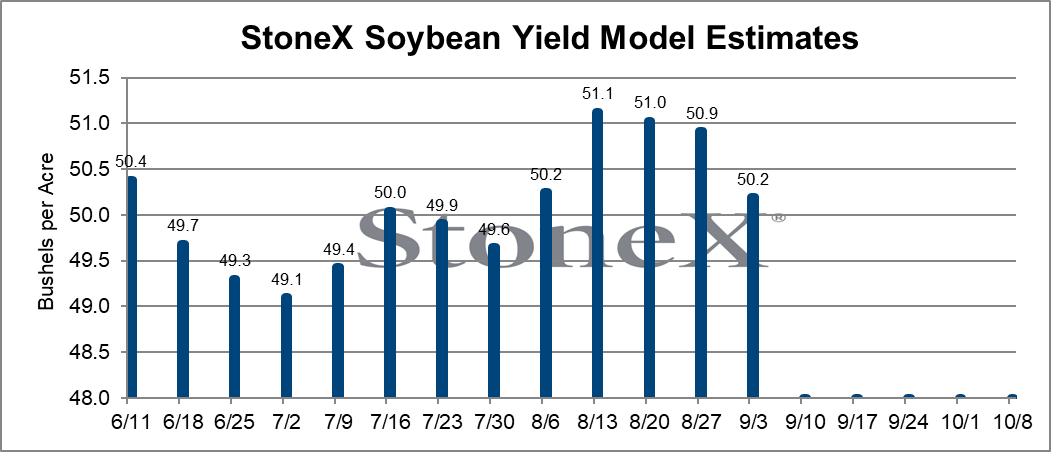
The soybean condition index score fell 10 points this week to 340, down from 348 the previous year, and down from the 10-year average for the week of 361. The index was at 281 in the same week in 2012. My yield model is at 50.2 bpa this week, down from 51.1 bpa three weeks ago. Again, seed size is an issue for soybeans just as it is for corn, and yield models are not designed to pick up seed size aberrations. As such, it is my opinion that the yield is below 50.2 bpa, but that's based on an assumption that the combine will confirm the smaller seed size. We should get an idea of what is happening in the field when USDA releases the results of their field sampling next Tuesday. That data will include estimated pod weights, which give us some idea of seed size. StoneX will be releasing its revised production estimates for corn and soybeans late this afternoon based on what our customers are seeing in the field, absent of the extensive field sampling done by USDA. These monthly customer surveys provide us with our best indication to date of what is happening in the field.