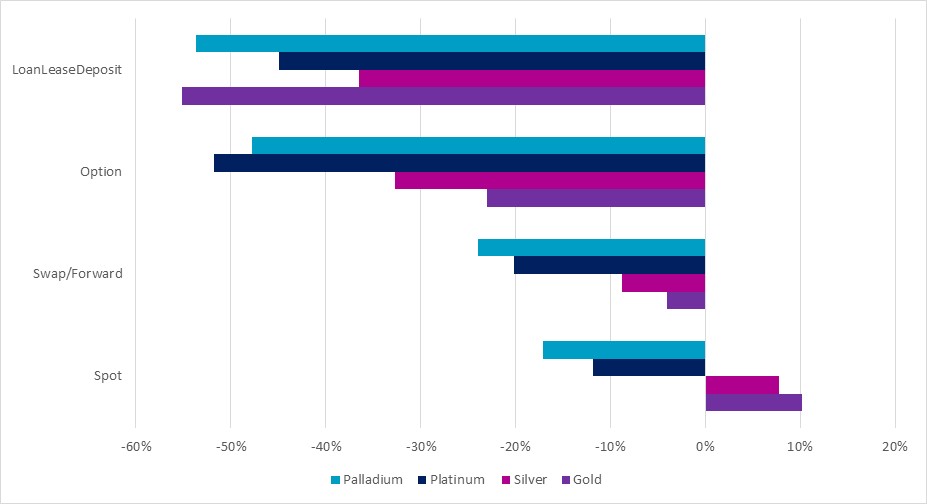
Welcome to our round-up of precious metals activity in June 2022, and a look at the context helping to influence market volumes – and vice versa. When compared with the average for the previous twelve months, volumes were down everywhere except spot in gold and silver. Generally, the largest falls (on a comparable basis) were sustained in the LoanLeaseDeposit volumes in all four metals, probably reflecting the atmosphere surrounding the interest rate profiles, especially in the United States, as rising rates would point towards wider contangoes and so it is possible that, especially with prices broadly subdued, potential forward sellers have been holding back where possible.
In March the LBMA suspended Good Delivery listing for gold and silver from six Russian refineries. The LPPM then announced on 8th April that certain Russian brands would be suspended. In 2021 Russian palladium production accounted for roughly 38% of world total and for platinum, roughly 10%. The impact on the platinum and palladium market of the suspension of the Russian brands was palpable in May, with volumes very substantially down in all segments when compared with the previous twelve months, but volumes picked up in June, with palladium posting a 17% increase in spot volumes, although platinum was down marginally.
Daily average trading volumes in June, compared with June 2021- May 2022
GOLD
Gold spent the first half of June trading in narrow ranges centred on $1,850 and attempted an attack on $1,880 during the second week. This failed and forced an abrupt reversal with a one-day fall from $1,878 to $1,818, and further declines the following day to take spot prices towards $1,800. This fall, and the subsequent correction towards $1,850, came in high volumes. Trading conditions then slowed right down and set the scene for the gradual decline in prices that developed over the second half of the month and generated a drop below $1,800 at month-end. At the time of writing in early July, the $1,800 level has been regained.
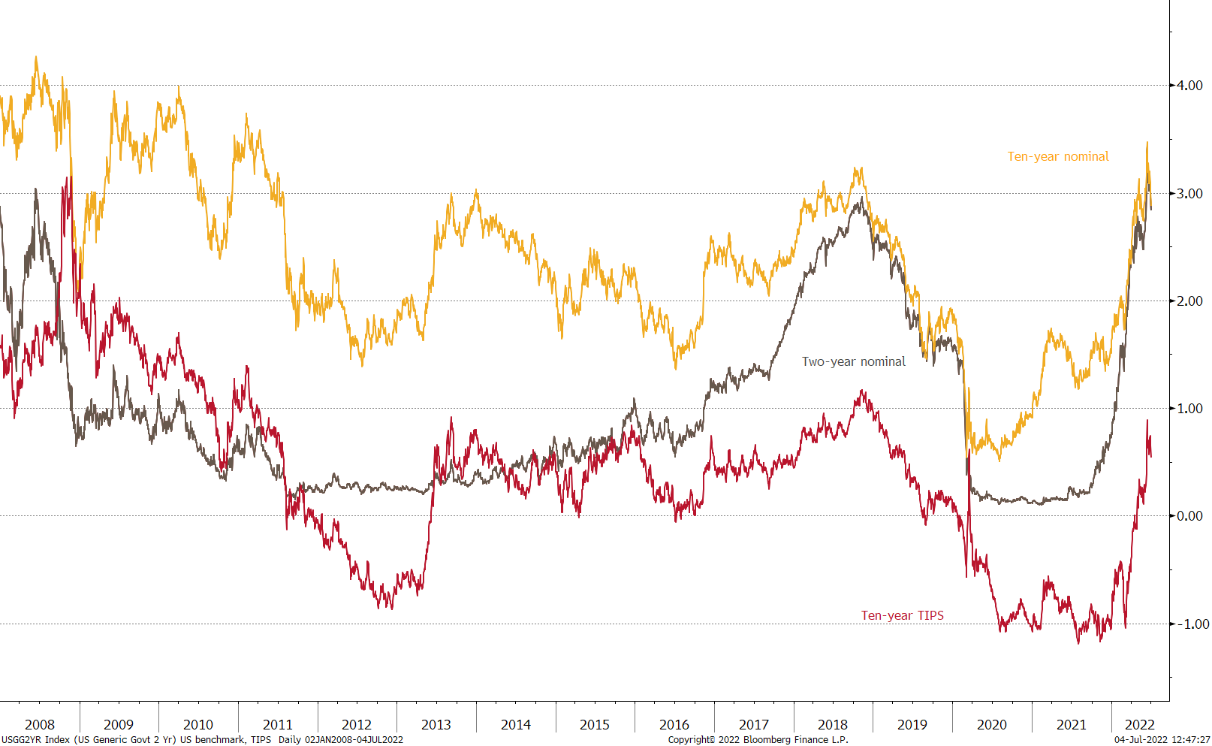
Once again, the Federal Reserve Board was the centre of attention. The June meeting is one of the four meetings in the year (from a total of eight) that carries economic projections and the “dot plot” (where Committee members mark where they expect fed funds to be at year-end for this year, next year and further out) and always attracts attention. In the current environment, with the Fed looking to intensify its rate hikes as well as starting to reduce the balance sheet, the markets were particularly nervous with talk of a 75 basis point hike impeding sentiment across much of the commodities complex, and the word “recession” appearing with increasing frequency. The run-up to the meeting (which took place on 14th-15th) thus saw a strengthening dollar and rising Treasury yields, which between them put gold under pressure. The dollar index was in fact at close to 20-year highs at this point and U.S. yields were close to ten-year highs. The outcome of the meeting saw the Fed raise the fed funds target rate by 75 basis points to a target band of 1.50-1.75%. Since then, there has been much debate as to what is likely to happen at the July meeting; growing fears about a recession are causing some commentators to suggest that the hike in June will be 50 points rather than 75.
In the background the physical markets at the retail level were generally quiet, especially as there was a resurgence in COVID outbreaks in China, which when combined with high fuel prices and consumer caution meant that there was little grass roots gold buying activity. This is to some extent exacerbated by the fact that the younger generation in China is now tending to buy lighter-weight pieces and not necessarily of the highest possible caratage. So to that extent they are looking at jewellery as more of an adornment than an investment, unlike their older counterparts. Meanwhile in India the rupee has been under pressure, which, along with the start of the monsoon season, has kept gold buying in abeyance (although there has been steady interest in silver).
Activity in the LoanLeaseDeposit (LLD) sector was heavily down, off by 73% against the average over the previous twelve months, suggesting that the official sector was not lending much metal and this, combined with an 8% equivalent fall in swaps and forwards, suggests little interest in hedging activity over the month. Activity in LLD was reasonable at the start of the month but certainly fell away with declining prices, while swaps and forwards were mixed; there was some reasonable volume as the price moved sideways in the first half of June and then there was a big dip as the price went into reverse in mid-month and not much improvement thereafter.
The U.S. two-year, ten-year nominal yields and the ten-year TIPS index
Source: Bloomberg, StoneX
SILVER
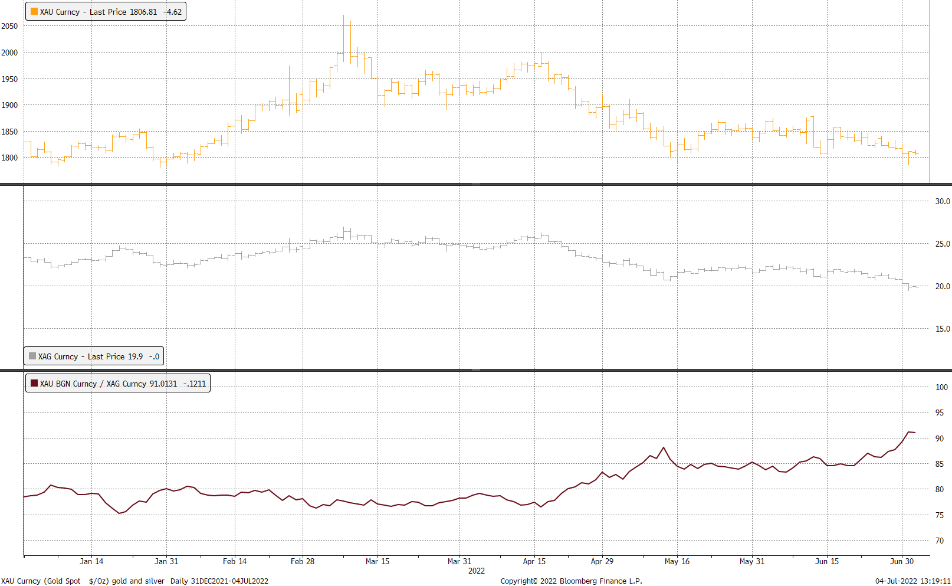
The story remains the same with respect to silver. With gold moving sideways and then sliding lower, silver underperformed; while gold was steady in the first half of the month silver started slipping in the second week. The first few days saw silver move up from $21.40 to $22.50, but that was the high for the month. Prices then fell in line with gold to test support at $21, bounced but then failed at $22 and by month-end spot was heading to $20, which gave way at the start of July. Meanwhile the gold:silver ratio continued to widen (which is normal in a bear phase because of silver’s higher volatility) and has been testing 90.
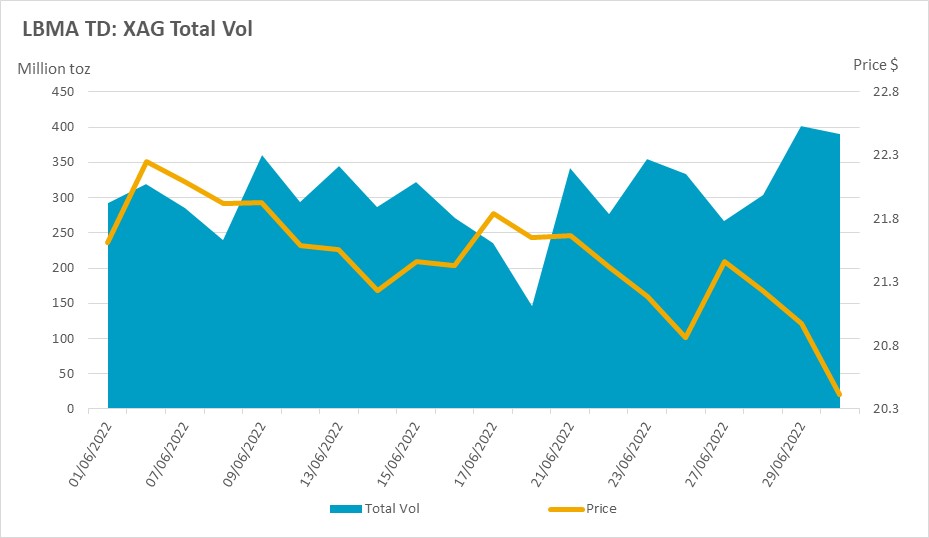
Trading volumes in spot tell us something about the negative sentiment in the silver market (apart from the steady retail demand in India, as noted above). The early rise in prices was in thin conditions, but volumes increased as the trajectory reversed (again, this is not unusual as positions are closed and others are opened). What is particularly telling, however, is the rise in volumes in the second half of the month, suggesting substantial long liquidation – and possibly also some bargain hunting as prices dropped toward $20. Volumes in swaps and forwards were lively at the start of the month, with prices hovering around $22, fell away in mid-month but then picked up smartly as prices dropped sharply. While spot may have been seeing liquidation, the pick-up in the forwards may well suggest that buyers were taking forward cover. Interestingly there was volume in both the options and the LLD sectors on the day of the heavy drop in prices in mid-month, which suggests puts being put in place after the failure at $22.
Gold and silver year-to-date.
Source: Bloomberg
Activity in the futures markets was mixed; there was light long liquidation in the Money Managers sector over the month, while shorts were up, then down, then up again. By the end of the month the net long position was close to neutral, at just 120 tonnes. To put this into context, global silver mine production is roughly 26,000 tonnes.
PLATINUM
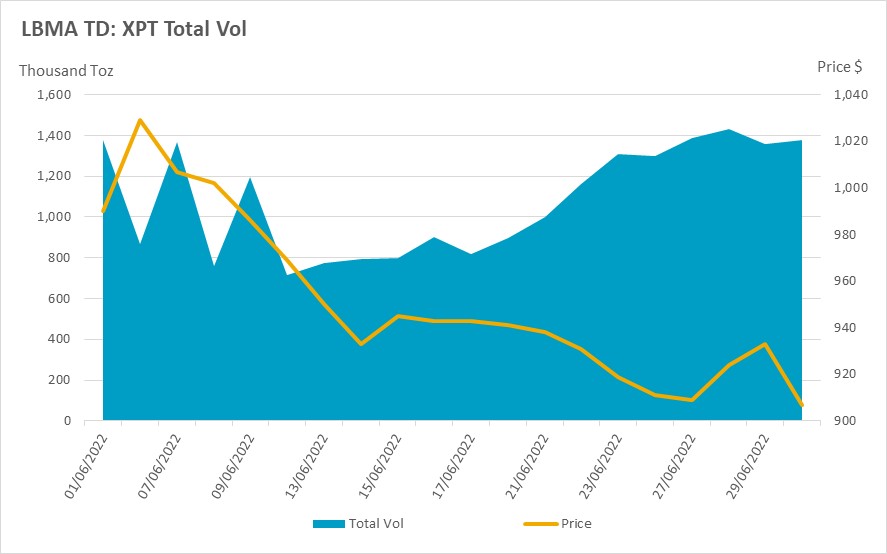
Platinum volumes were heavily down in June, with spot contracting by 12% against the previous twelve months, swaps/forwards by 20%, LLD by 45% and options by 52%. The falls were particularly prominent in the first half of the month and picked up smartly towards month-end; the final week saw an average of 938,000 ounces in spot, against a twelve-month average of roughly 789,000 ounces.
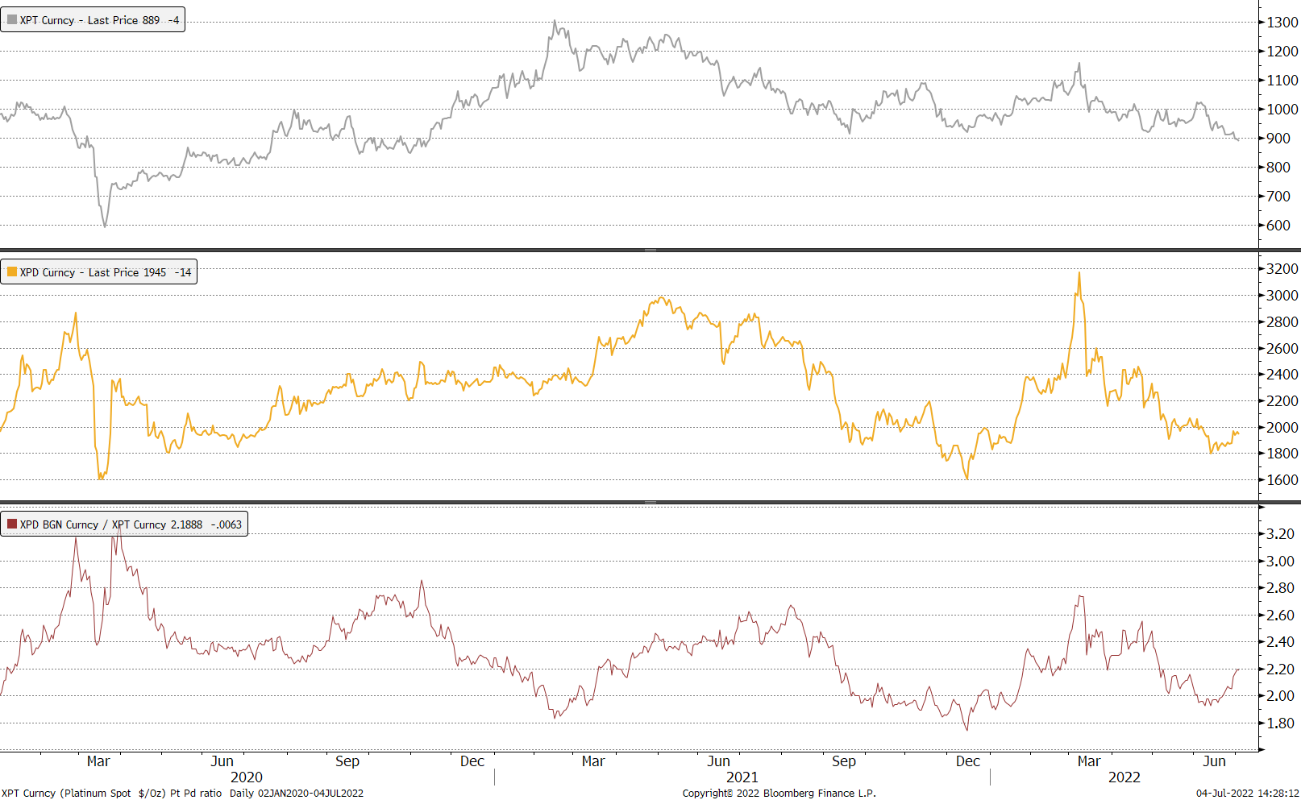
The month started with platinum still in a bullish mood and continuing its upward run that started with a vengeance in late May after $950 had provided consistent support over the rest of the month. The rally was in thin conditions, however and petered out by the end of the first week of June, after touching an intraday high of $1,037, thereby posting a gain of 12% in the space of a fortnight. At this point there was sizeable volume in the swaps/forwards and LLD, suggesting that producers may have wanted to lock in prices over $1,000; then volumes dwindled across the board as prices slid before consolidating briefly in the $950 area.
The was a further decline towards $900 and the figures certainly suggest that bargain hunting developed at this point, not just in spot but in the forwards and in the options market.
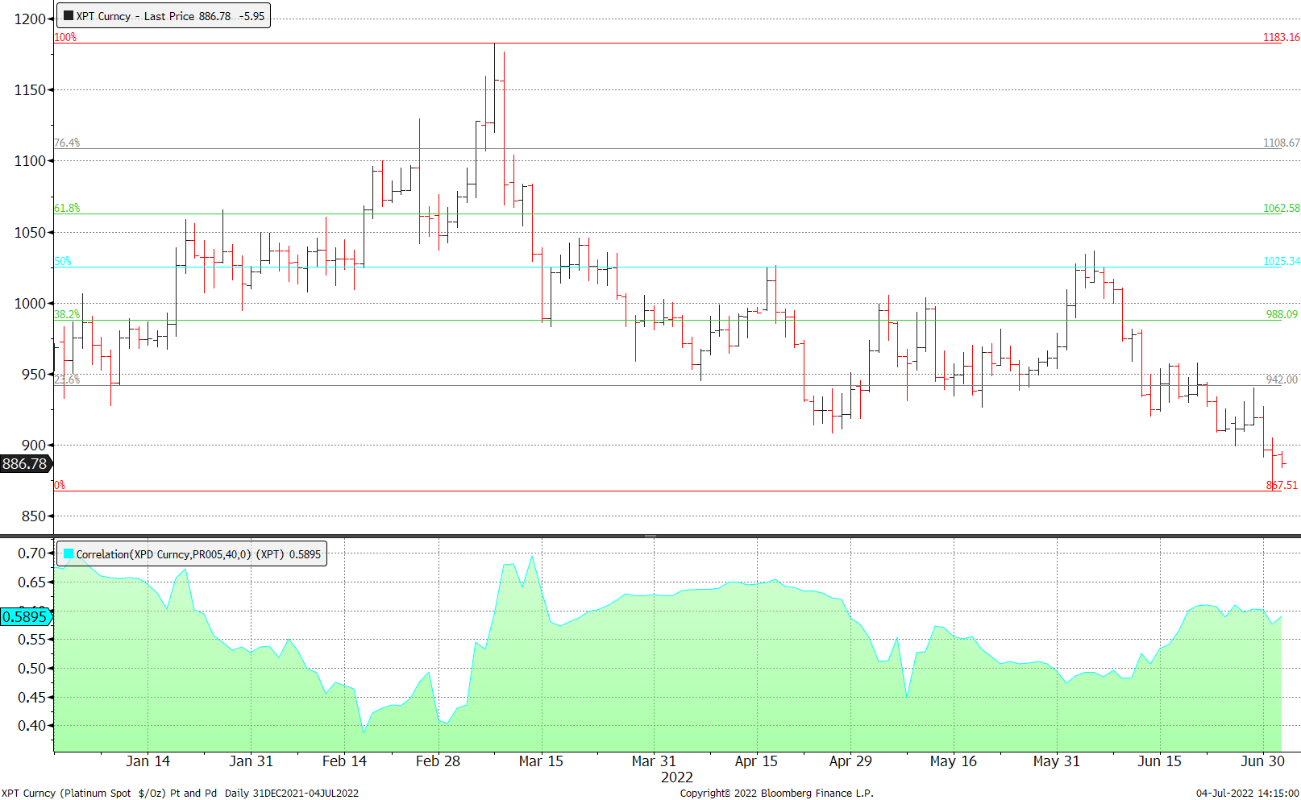
Market sentiment has obviously been undermined by concerns over possible recession and the continued disruption to the global auto sector because of the dislocations in the semiconductor chip supply chains, although there is anecdotal evidence that this is easing to some extent. The market continues to watch the developments in the sector; China is currently implementing a tightening in diesel emissions standards, which favours platinum prices although it is possible that much of the platinum buying has been done. On the other side of the coin, Impala Platinum has signed a five-year wage agreement with the Association of Mineworkers and Construction Union (AMCU) with an approximate 6.5% increase in wages over the period. Amplats signed its wage agreement in late- May.
Spot platinum, January 2021 to early June 2022 and its correlation with palladium
Source: Bloomberg
PALLADIUM
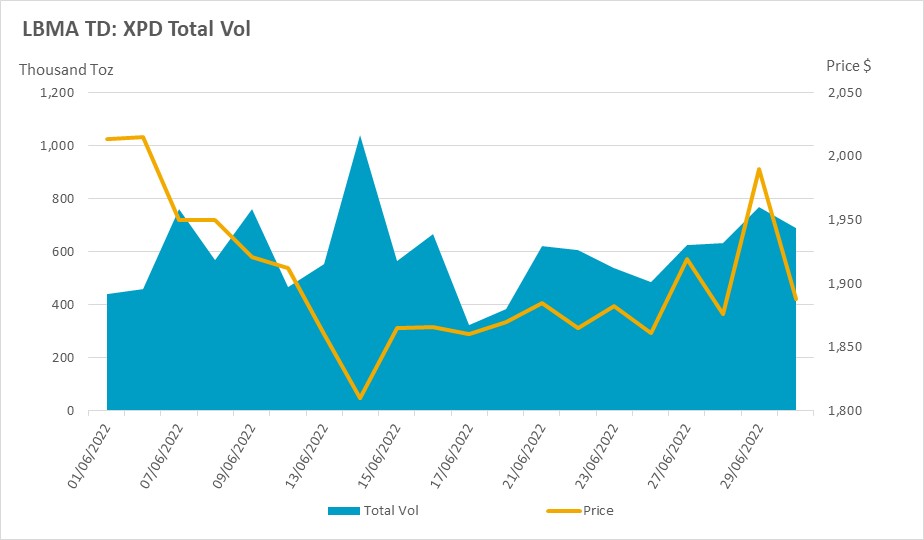
The effect of the LPPM suspension of Russian refinery brands from the Good Delivery list continues to show up in the palladium market, in which Russia is responsible for roughly 38% of global supply. It is widely believed that Russian material is making its way into the market; but it is not being traded through LPPM. Volumes were, however, higher across the board when compared with May.
Trading patterns were patchy, with busy days interspersed with much quieter days, especially in the first half of the month, both in spot and swaps/forwards, but volumes picked up in all four areas in the final week.
After going through a bear run from the record high of $3,442 (intraday) in early March, palladium traded down to $1,794 in mid-June, also dropping in sympathy with the rest of the commodity sector as the dollar and U.S. interest rates rose ahead of the FOMC meeting. Since then palladium has eked out a shallow bull run on the back of some industrial interest picking up, and with palladium sponge moving into a reasonable premium in the United States; and the $2,000 level is again within the market’s sights. Here, too the auto sector is key, with typically 80% of global palladium demand. Industrial demand has been sluggish, but it is worth noting that auto dealer inventories in the United States have been as low as 21 days’ supply against a more normal 63 days. So there is the potential for further price rallies, but for the time being, market sentiment is still very cautious.
The gradual rise in prices in the latter part of June was accompanied by increasing volumes in swaps and forwards, suggesting some forward cover on the part of consumers and possibly some hedging from the supply side. The relatively low volumes in LLD, though, would tend to point to consumer activity rather than producers.
Spot palladium and the ratio with platinum, year-to-early July
Source: Bloomberg