Stocks downs, yields up, curve flattens (again); gold down before during and after…
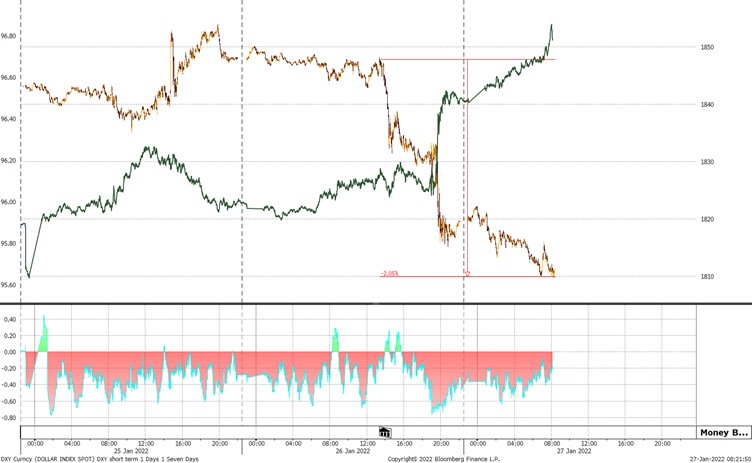
Spot gold and the dollar, three-day view
Source: Bloomberg
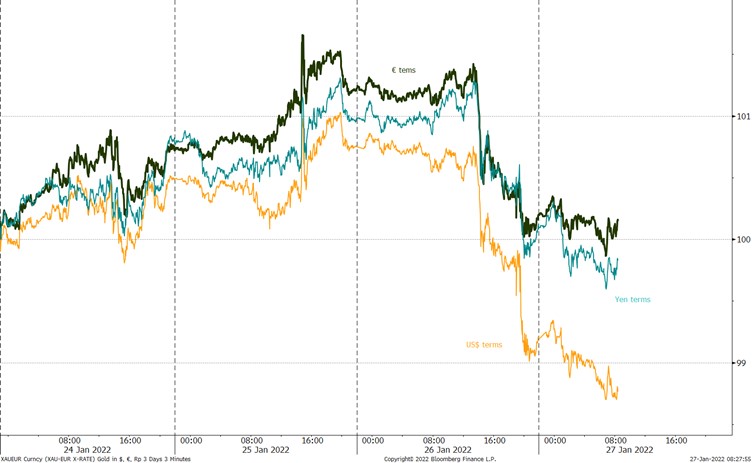
Gold in local currencies, three-day view
Source: Bloomberg
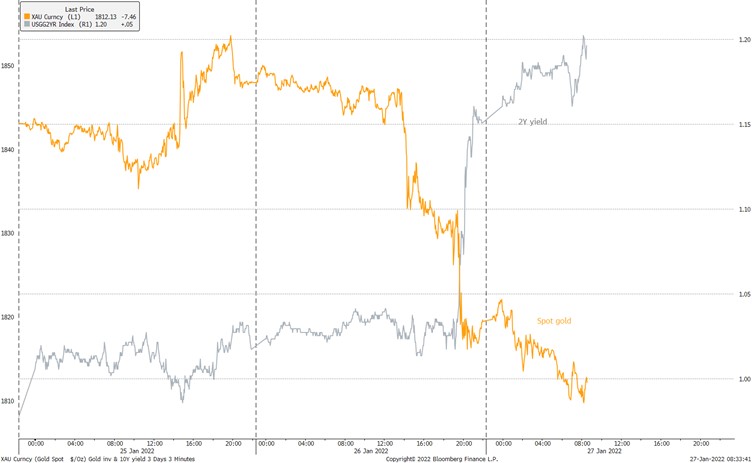
Gold and two-year yield, three-day view
Source: Bloomberg
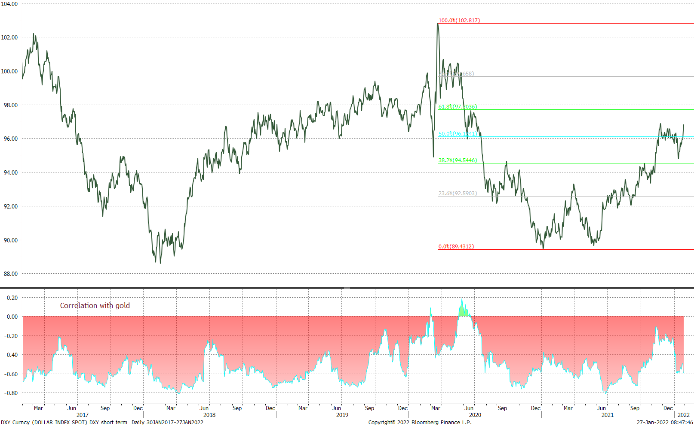
Last night saw the close of the FOMC meeting, the outcome of which was arguably more hawkish than even the bond markets had been expecting. The markets are almost pricing in five rate hikes this year. In principle this can be described as an over-reaction – but we thought that last time. The ten-year U.S. bond yield is now at its highest since 2019, while the weighted dollar index has gone through the 50% retracement level of its fall from the mid-March 2020 peak, when lockdowns widened and forecasts for the US Q2 GDP growth were postulating a record contraction.
The DXY; five-year view
Source: Bloomberg
Have the markets overreacted?
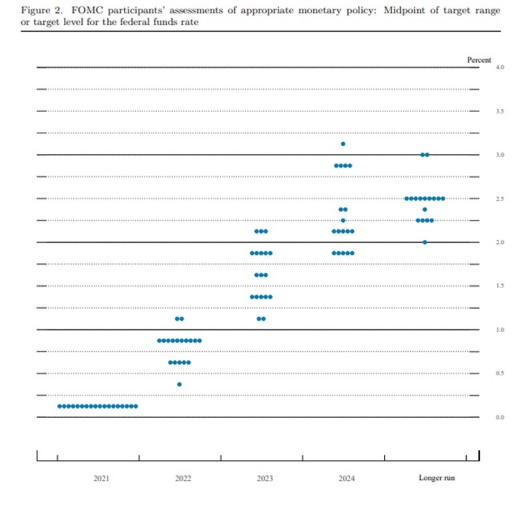
Almost certainly. After the December meeting, when there was (apart from very briefly) no over-reaction to the outcome, it looked as if the markets were starting to take the FOMC in its stride, but no, it’s all happened again. The dot plot for the December meeting (below) implied that by the end of 2023 the fed funds discount rate would be between 100-125 and 200-225 basis points, with five participants looking at just below 1.5% and five at just below 2.0%. The vast majority expected 2022 to end with 0.75 – 1.00%. In other words, a 75-basis point cumulative increase by the end of this year. As we argued in an earlier piece this week here, the number of hikes is less important than the cumulative level of rates as a result.
The Fed December 2021 Dot Plot
Source: The Federal Reserve
So what spooked the markets this time?
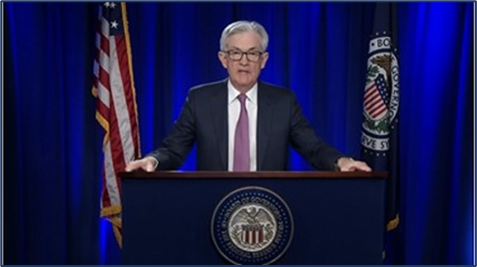
We have The Fed Statement; The Principles for reducing the size of the balance sheet and Jay Powell’s Press Conference Q&A.
In brief: -
Key points noted include the substantial decline in unemployment with solid job gains. Supply and demand imbalances (pandemic-induced) plus the reopening of the economy have supported elevated inflation. Virus still key to the path of the economy, and in principle should support further economic gains and a reduction in inflation.
It will soon [our italics] be appropriate to raise the target range for fed funds. Tapering to end in early March.
So there doesn’t really appear to be that much that was different in the Statement in and of itself.
How about the Press Conference?
- Jay Powell’s Press Conference; key points arising; “strong” was a key theme running through the opening Statement
He kicked off with the point that the Fed will continue to adapt policy to the evolving economic environment. His tone was stronger than hitherto, saying that the economy has shown “great strength and resilience in the face of the ongoing pandemic”. This quarter will clearly be affected by Omicron and health experts expect cases to drop off rapidly; if the wave passes quickly then so should the economic effects, prompting a return to strong growth.
Part of the constraint in the participation rate is workers who want to work, but are still in carer roles. “Over time there are good reasons to expect some further improvements in participation and employment”.
The Fed is attentive to the risks that persistent real wage growth in excess of productivity could put upward pressure on inflation and it will use its tools to prevent higher inflation from becoming entrenched. The Fed will be nimble, is aware of the risk that high inflation is more persistent than expected and is prepared to respond as appropriate to achieve our goals.
- Asked whether hikes were likely in every consecutive meeting, and would the Fed be prepared to front-load?
He said, understandably, that it wasn’t possible to forecast what path would prove most appropriate, so no decisions made as yet. Humility and nimbleness important; and of course to be led by incoming data and evolving outlook.
- Can the Fed raise rates in order to control inflation without hurting jobs and wages?
Both sides of the mandate need the Fed to move steadily away from the previous highly accommodative policy; most FOMC members agree that labour market conditions are consistent with maximum employment in the sense that is consistent with price stability. Also, maximum employment will evolve over the business cycle and may yet increase as participation rises. There are many millions of job openings than there are unemployed, which means there’s quite a bit of room to raise rates without hurting employment.
There are multiple forces that should bring inflation down this year – improvement on the supply side eventually, while fiscal policy will be less supportive of growth as the impulses withdraw.
- What is meant by the “significant reductions” in the balance sheet?
In response he said that the Fed is just turning to that now and pointed to the Principles (as published yesterday and linked to above). He couldn’t elaborate in terms of timing as yet, but there will be more detail in the March meeting. The Balance Sheet is much bigger than last time, the economy is strong and inflation higher, therefore they could well be willing to move sooner and faster than last time around. Principle No. One is that changes in the target fed funds rate are the primary tool, while the balance sheet should decline in a predictable manner, through the adjustment of re-investment.
- How much passive run off equates to a quarter-point hike? (we have also written about this, using the rate hikes as the iron fist and the run-off as the velvet glove; his response backs this up as follows).
Different rules of thumb apply, along with an element of uncertainty around how balance sheet shrinkage affects activity – this, he said, is still a relatively new tool so they’re effectively finding their own way. Advance notice will be forthcoming, and then the programme will run in the background. “That at least is the plan”.
Conclusion: - over-reaction overnight, but expect the same every time a hike comes through. Fed-watching is not going away. So a hawkish but still moderately pragmatic attitude; nothing in there that I can see that justifies the money markets calling for five – or possibly even four, hikes this year. To drive the point home, it is the level of rates that count, but each hike will be bound to generate a response in the markets, no matter how well it appears to be discounted.