We closed yet another week without a clear sense of conviction from the speculative crowds for risk benchmarks like the S&P 500. Despite the hefty docket, the most potent risks are likely to come from unscheduled macro headlines.
Talking Points:
Risk trends are stubbornly holding to technical congestion with benchmarks like the S&P 500 and Dow parked just off record highs
The markets await a dominant theme to align a more systemic move, but traditional themes are lacking traction and the potential ‘grey swans’ remain unpredictable
Top event risk this week for headlines – though not necessarily market movement – includes Chinese GDP; Netflix Earnings and the BOJ rate decision
Watch the Full Video
Why an Exogenous Risk is More Likely to Recharge Markets than Traditional Fundamentals
We have closed another week with the symbolic leaders of the speculative markets refusing to commit to a definitive drive. While some measures tagged new cycle or even record highs in favor of a bid for ‘risk appetite’, the measures with the greatest sway over global sentiment have held to their extended periods of congestion. A good example of the indecision are the major US equity indices. The S&P 500 for example has passed another week working its way deeper into a terminal – though rising – wedge to further deflate an already-tepid realized volatility (via measures like the 20-day ATR). Extended and stretched measures of quiet are like any other ‘extreme’ in that they will eventually normalize, but the period can draw out longer than many may believe likely.
For the risk on-oriented, a lack of volatility isn’t unwelcome. Quiet conditions may blunt momentum that would feed capital gains, but it also represents stability for generating income or yield. Yet, individual groups’ preferences don’t truly represent the ever-evolving conditions of a market reflecting the competing drivers of value and the frontier of collective sentiment. The longer the leaders of speculative appetite are stalled, the louder the concerns will grow from a rising scrutiny of exposure. In the meantime, efforts to reduce risk plied specifically to take advantage of momentum-based position will translate into capital shifts that can escalate a healthy rebalancing into outright concern.
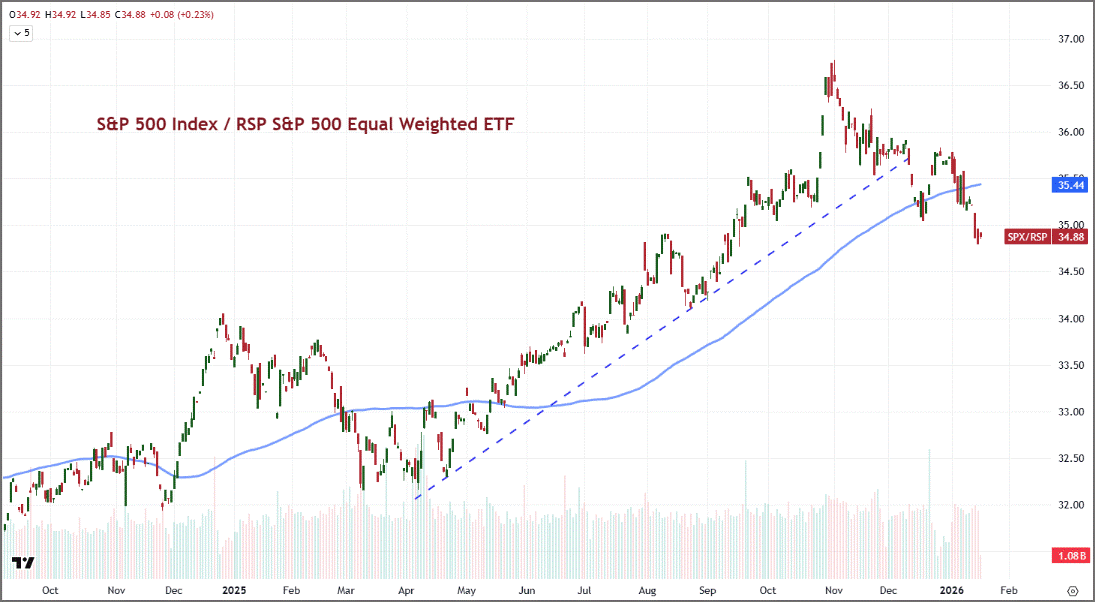
It could be argued that some of the redistribution that is already taking place – tech to broader exposure (Nasdaq 100 to Dow), large cap to small cap (Dow to Russell 2000) or market cap leaders to a wider market (S&P 500 to RSP equal-weighted SPX ETF) – is healthy. But if there is momentum that evolves from the movement of funds out of those heavy concentrations, it is not far-fetched to believe that it can accidently and incidentally lead to a disorderly exit. Such is the evolution of many ‘tops’ of the past.
Chart of Ratio S&P 500 Index and RSP Equal Weighted S&P 500 ETF (Daily) Source: TradingView.com; Standard & Poor’s; Invesco
As far as the list of typical, active themes carrying over from the past year; it is not that these common fundamental matters are resolved or no longer relevant. Rather, the attention around the matters has ebbed, there circumstances have found some measure of balance or the headlines have overloaded the reactionary force within the market. Growth projections for example have found a moderate but positive course through measures like the monthly PMIs while we await the official government quarterly reports. Interest rate forecasts are similarly in a state of balance with wait-and-see stances and time before the next run of central bank gatherings.
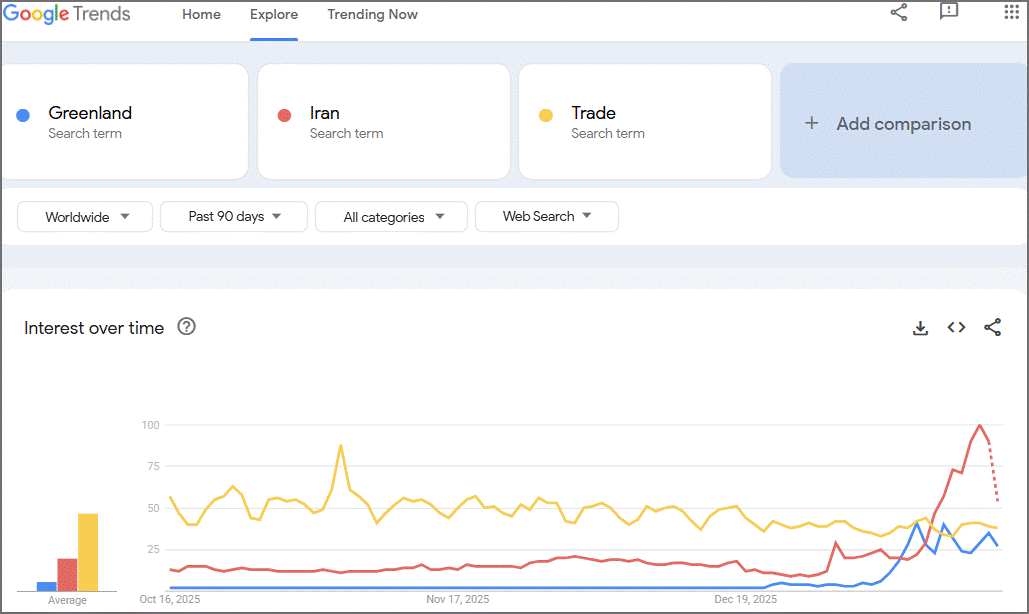
Matters such as ballooning deficits feeding future financial stability risks are certainly heavily discussed but their terms remain too vague. For concentrated impact but lower predictability, we have lingering threats that are growing more tangible week by week. Google Trends shows growing search interest around matters such as “Greenland” (with the US’s threat of buying or taking the nation); “Iran” (as protests continue) and “trade” (as more trade war flare ups have arisen) among other unpredictable factors.
Chart of Worldwide Search for ‘Outlier’ Fundamental Themes (Daily) Source: Google Trends
Considering the Theory: The Gold – And Silver – Rally Are a Sign of a Crumbling Dollar
There is a saying that states ‘correlation is not necessarily causation’. When we are aware of two trends developing in tandem, there is a tendency by pattern recognition-oriented humans to associate the two. However, what if the relationship is happenstance or there are 50 different considerations for which we are unaware where the drive-and-response relationship is actually arising? While there are numerous themes unfolding across the market, perhaps two of the most recognizable are the much talked about Dollar debasement shift and the exceptional performance of gold and silver.
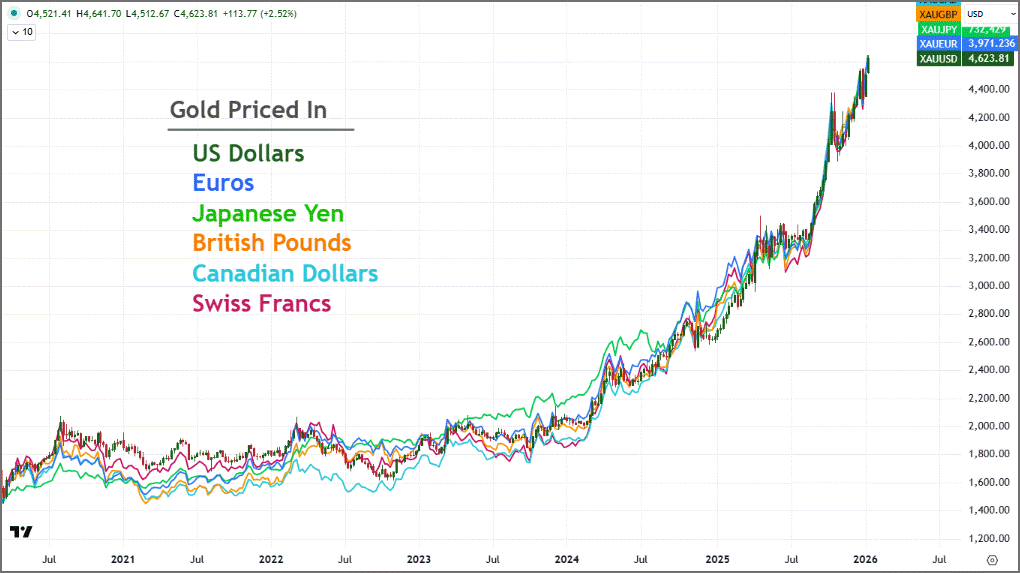
The former is the expectation that the world’s response to aggressive trade pressure by the United States to force more favorable relations will result in a collective diversification away from benchmark US assets such as the Dollar and Treasuries to reduce dependency on the country’s financial controls. This has been a long running expectation. The metals’ rally is self-evident – and earnestly, hard to miss. Gold has charged to a record high through this past year and carrying over into 2026. It’s cheaper peer has followed along and displayed much more of the momentum recently.
It is perhaps not surprising that one of the most heavily discussed fundamental themes – even if fragmented – is associated to the macro market’s stand out performance. I don’t doubt that there is some measure of demand for the precious metals that arises from the concern around a devalued benchmark currency and ‘risk free’ asset (or perhaps a contributing factor), but there are a few reasons to believe it is not the only nor perhaps even the principal motivation. First we should consider the general level of the US Dollar. Looking at something like the DXY Index, the currency seems to have leveled out for an extended period of consolidation rather than reflect a sustained decline as would generally be expected if the currency decline was the lead driver for gold’s climb.
Further, if we were to consider the metal’s performance relative to the other major currencies (Euro, Pound, Yen, Swiss Franc, etc), the same performance and general pace is evident. Gold – and by virtue of its relative association, silver – has been touted as a preferred anti-fiat for centuries; so it could be a universal anti-currency drive with proportional deleveraging, with dollars representing the largest flow. So while it is likely that an anti-dollar factor is contributing to gold’s climb, there is reason to question the depth of that connection – especially when we see the shift in performance in favor of silver which seems to be drawing on innate supply-and-demand factors.
Chart of Gold Priced in Multiple Currencies (Weekly) Source: TradingView.com; John Kicklighter
The Global Macro Calendar Temporarily Shifts Away from Scheduled US Events
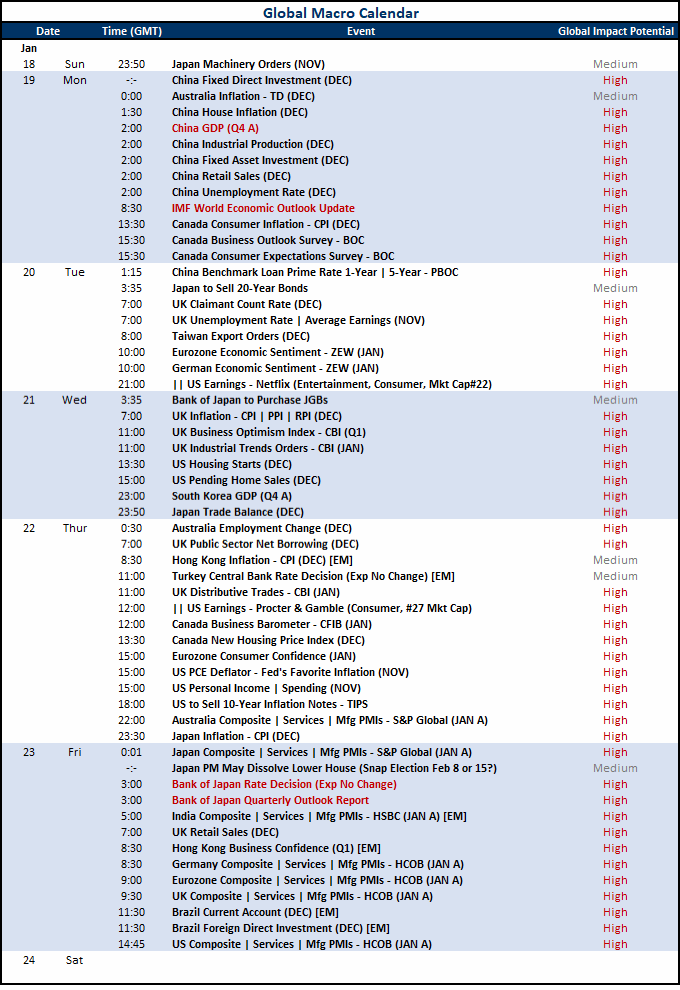
While there are a lot of leading themes to keep track of and the global macro docket ahead carries its fair share of noteworthy releases, there is likely a higher barrier to achieve significant market movement from the list – much less the revival of systemic sentiment trends that have been waylaid for weeks. The capacity to restore traction on wider spread market movements usually depends on event risks’ ability to materially alter the course of a systemically important matter of value. There is plenty of event risk that comes close to this relevance, but there are serious shortcomings to its ultimately capacity.
A good example is the PCE deflator or University of Michigan Consumer Confidence survey due for the United States this week. The PCE is the Fed’s favorite measure of inflation, but the data is for November (a holdover of the government shutdown) and price pressures have been less prominent in the debate over US policy. For the UofM data, consumer confidence is still one of the few areas of concern that cannot be undermined by questions of data accuracy or political bias; but it is a second or final reading with a likely smaller adjustment.
Calendar of Top Global Macro Event Risk Source: John Kicklighter
China Reports Fourth Quarterly Growth and Few Surprises Expected
As far as the top event over the coming week, we finally seem to have a respite from the US dominating the calendar – if not the headlines. For scheduled updates, economic activity will be a matter that will receive multiple updates for a broader insight to benchmark on. The IMF’s World Economic Outlook is due an update from its official Fall release in October. There is value in its breadth and forward-looking nature, but the data does not often produce tangible volatility upon its release. There are also the initial readings of the January PMIs from major developed world economies towards the end of the week, but the trends have generally leveled out towards moderate growth, and market responsiveness has similarly stabilized.
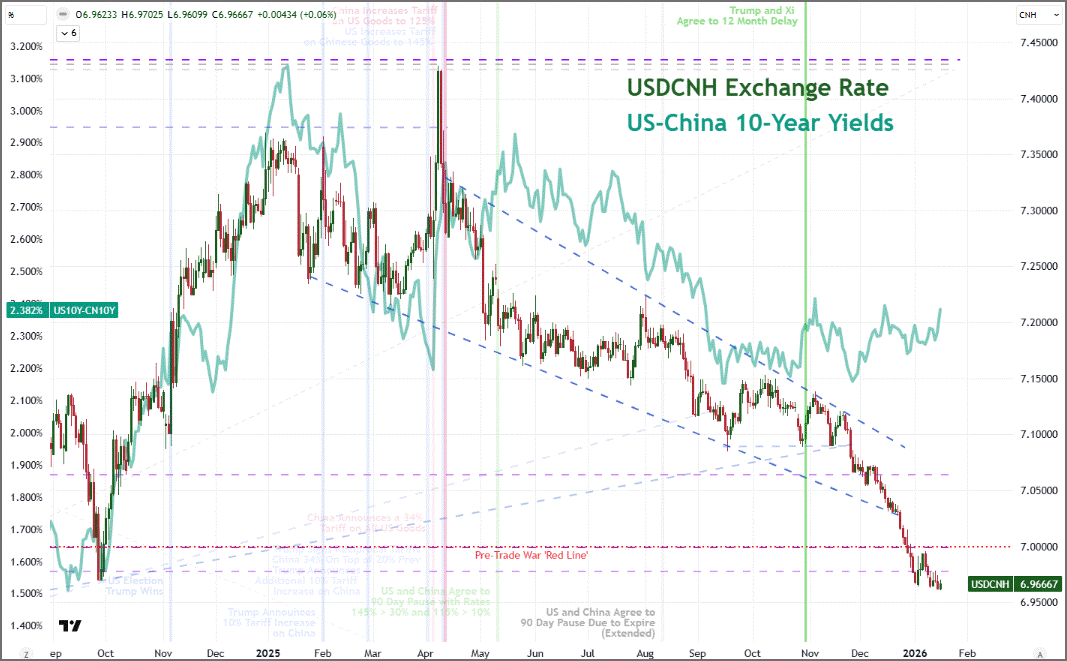
Perhaps generating a more concentrated focus around the economic theme is Monday’s China 4Q GDP reading. This is the first insight from the government into the health and bearing of the second largest economy. The context of renewed US trade tensions through the rendition of Venezuela’s President and Iranian tariff flashpoints put a spotlight on the country’s health moving forward, but the data is backwards looking – and carrying no small amount of inherent skepticism from global observers.
Chart of USDCNH Overlaid with US-China 10-Year Yield Differential (Daily) Source: TradingView.com; John Kicklighter
What Can Netflix Do to Drum Up Interest for Following Week’s Mag7?
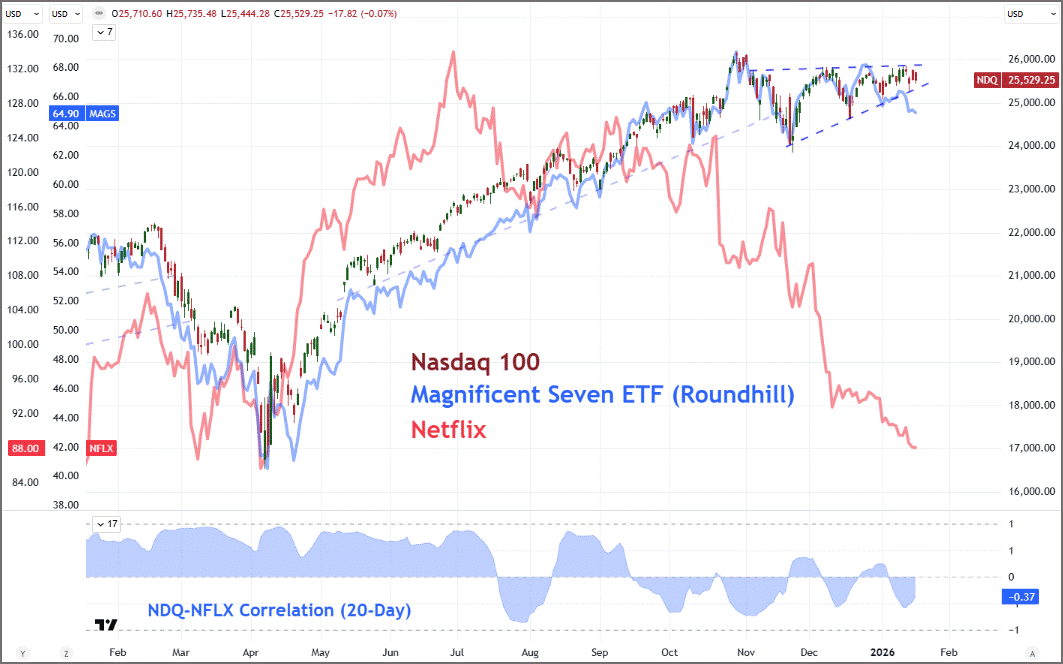
Another familiar macro theme that has a history of seasonal influence to monitor is the continuation of US corporate earnings. There are a number of large names that equity traders will recognize, but the question from a macro perspective is what the capacity to trigger a larger move across larger indices such as the S&P 500 or the Dow Jones Industrial Average. Notably, the earlier release of the largest banks’ performance reports didn’t seem to transmit further beyond the target stocks’ particular tickers (eg JPMorgan) or the financial sector (eg the XLF SPDR Financial Select ETF).
It is that context which suggests the threshold of systemic reach is significantly higher relative to the capacity of influence for the likes of CSX or Johnson & Johnson – even if there are larger stories both tap into. Perhaps the most prominent headline on this front for the week will come from Netflix. While it ultimately depends on its level of surprise and headlines around guidance, the general story around consumer spending and sectorial consolidation are less scalable on the speculative side than its sheer size as the 22nd largest market cap in the US markets and its adjacency to tech, thought that theme has proven less informative of late.
Chart of Nasdaq 100, Netflix Share Price and Magnificent Seven ETF (Dailyy) Source: TradingView; Nasdaq; CBOE; John Kicklighter
Japan is a Volatility Tinder Box and the BOJ Will Tread Lightly
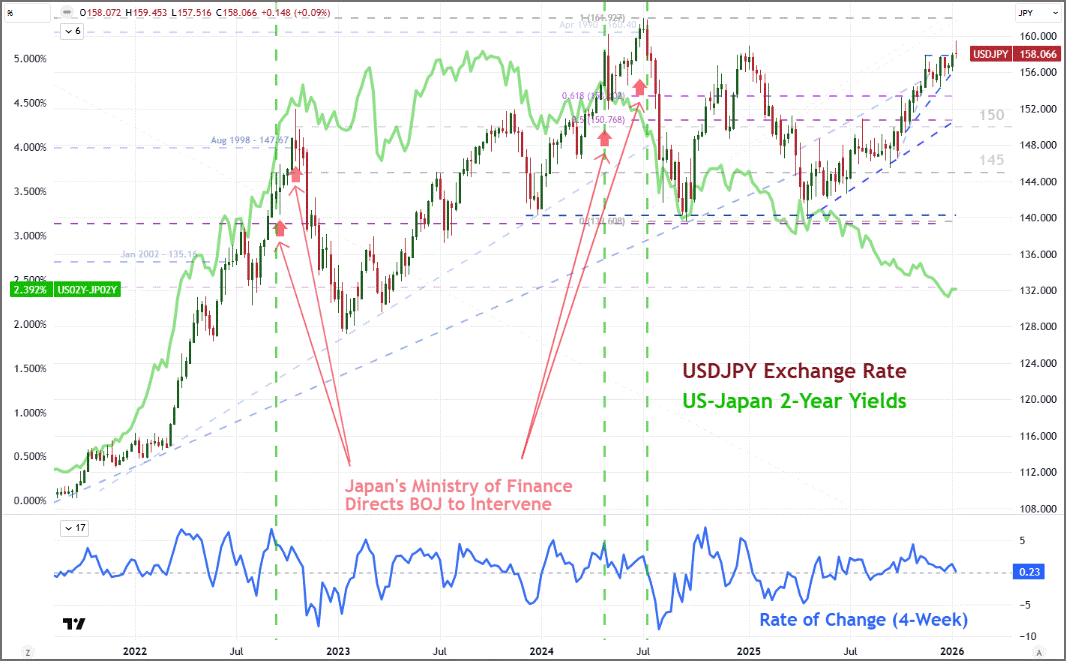
Of all the listings over the coming week, the Bank of Japan’s (BOJ) monetary policy decision and updated outlook arguably carries the most macro weight and capacity to connect to a more systemic trend. The Friday announcement (expected around 3:00 GMT though there is no officially set time) is expected to produce no change of the 0.75 percent benchmark rate following four rate hikes since March 2024. The expectation is for more tightening moving forward given persistent inflation – something Japanese monetary authorities have long sought after decades of deflation – but the reasons for not moving now will carry some significant context. Political pressure on the BOJ to offer support as a tool to a broader struggle for economic, financial and geopolitical stability has been particularly prominent.
Expectations that the Japanese Ministry of Finance will direct the BOJ to intervene on behalf of the weak Yen have held very high with the currencies’ principal exchange rates pushing multi-year and generational highs (the Yen is usually the quote or second currency in a pair). There is also the lingering possibility that Prime Minister Sanae Takaichi calls a snap election. This is monetary policy amid financial uncertainty and intervention risk from the world’s fifth largest economy and a backdrop a slow rate hike course where most of its largest peers are set to dovish or neutral. It will be at least something to monitor for regional influence – if not a lingering potential for spreading volatility wider.
Chart of USDJPY, US-Japan 2-Year Yield Spread and Bank of Japan Interventions (Weekly) Source: TradingView.com; Japan Ministry of Finance
The subsidiaries of StoneX Group Inc. provide financial products and services, including, but not limited to, physical commodities, securities, clearing, global payments, risk management, asset management, foreign exchange, and exchange-traded and over-the-counter derivatives. These financial products and services are offered in accordance with the applicable laws in the jurisdictions in which they are provided and are subject to specific terms, conditions, and restrictions contained in the terms of business applicable to each such offering. Not all products and services are available in all countries. The products and services offered by the StoneX
Group of companies involve risk of loss and may not be suitable for all investors. Full Disclaimer.
This content is not intended for residents of any particular country, and the information herein is not advice nor a recommendation to trade nor does it constitute an offer or solicitation to buy or sell any financial product or service, by any person or entity in any jurisdiction or country where such distribution or use would be contrary to local law or regulation. Please refer to the Regulatory Disclosure section for entity-specific disclosures.
No part of this material may be copied, photocopied or duplicated in any form by any means or redistributed without the prior written consent of StoneX Group Inc. The information herein is provided for informational purposes only. This information is provided on an ‘as-is’ basis and may contain statements and opinions of the StoneX Group of companies as well as excerpts and/or information from public sources and third parties and no warranty, whether express or implied, is given as to its completeness or accuracy. Each company within the StoneX Group of companies (on its own behalf and on behalf of its directors, employees and agents) disclaims any and all liability as well as any third-party claim that may arise from the accuracy and/or completeness of the information detailed herein, as well as the use of or reliance on this information by the recipient, any member of its group or any third party.
Currencies
The subsidiaries of StoneX Group Inc. provide financial products and services, including, but not limited to, physical commodities, securities, clearing, global payments, risk management, asset management, foreign exchange, and exchange-traded and over-the-counter derivatives. These financial products and services are offered in accordance with the applicable laws in the jurisdictions in which they are provided and are subject to specific terms, conditions, and restrictions contained in the terms of business applicable to each such offering. Not all products and services are available in all countries. The products and services offered by the StoneX Group of companies involve risk of loss and may not be suitable for all investors. Full Disclaimer. This content is not intended for residents of any particular country, and the information herein is not advice nor a recommendation to trade nor does it constitute an offer or solicitation to buy or sell any financial product or service, by any person or entity in any jurisdiction or country where such distribution or use would be contrary to local law or regulation. Please refer to the Regulatory Disclosure section for entity-specific disclosures. No part of this material may be copied, photocopied or duplicated in any form by any means or redistributed without the prior written consent of StoneX Group Inc. The information herein is provided for informational purposes only. This information is provided on an ‘as-is’ basis and may contain statements and opinions of the StoneX Group of companies as well as excerpts and/or information from public sources and third parties and no warranty, whether express or implied, is given as to its completeness or accuracy. Each company within the StoneX Group of companies (on its own behalf and on behalf of its directors, employees and agents) disclaims any and all liability as well as any third-party claim that may arise from the accuracy and/or completeness of the information detailed herein, as well as the use of or reliance on this information by the recipient, any member of its group or any third party.
Our market expertise, advanced platforms, global reach, culture of full transparency and commitment to our clients’ success all set us apart in the financial marketplace.
Reach
With access to 40+ derivatives exchanges, 180+ foreign exchange markets, nearly every global securities marketplace and numerous bi-lateral liquidity venues, StoneX’s digital network and deep relationships can take clients anywhere they want to go.
Transparency
As a publicly traded company meeting the highest standards of regulatory compliance in the markets we serve; our financials and record of accomplishment are matters of public record. StoneX’s commitment to “doing the right thing over the easy thing” sets us apart in the industry and helps us build respect, client trust and new partnerships.
Expertise
From our proprietary Market Intelligence platform, to “boots on the ground” expertise from award-winning traders and professionals, we connect our clients directly to actionable insights they can use to make more informed decisions and achieve their goals in the global markets.