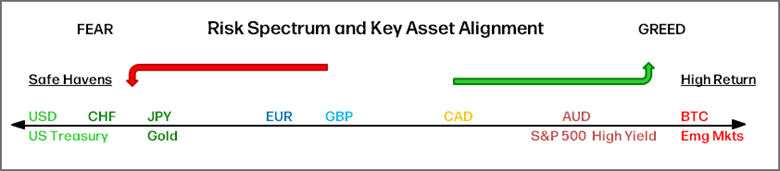
Safe havens are not necessarily safety in an absolute sense, but safety relative to the dominant risk facing markets.
Safe-haven demand does not appear all at once. It often emerges along a spectrum.
At the extreme end of risk aversion, U.S. Treasuries remain the premier safe-haven asset.
When markets are trading near record highs and investor sentiment appears broadly constructive, safe havens can feel like an afterthought. Yet that is precisely when investors and market observers should be thinking most clearly about them.
In the latest episode of the Trading Global Macro Podcast, we discussed the concept of safe havens: what they are, how they behave, and why their role can change depending on the type and intensity of market stress.
To sign up for the Trading Global Macro podcast, find it on your preferred podcast platform: Apple Podcasts, Spotify, or YouTube.
What Is a Safe Haven?
At its core, a safe haven is an asset that market participants tend to favor when they are concerned about riskier or more traditional assets. In other words, it is not safety in an absolute sense, but safety relative to the dominant risk facing markets.
That distinction matters. A growth scare, an inflation shock, a sovereign debt concern, or a liquidity event may each drive different behavior. In a growth scare, investors may gravitate toward U.S. Treasuries or the U.S. dollar. In an inflation scare, assets such as gold, real estate, or other hard assets may be viewed more favorably because cash and fixed-income instruments can lose purchasing power.
Source: John Kicklighter
The Spectrum of Risk Aversion
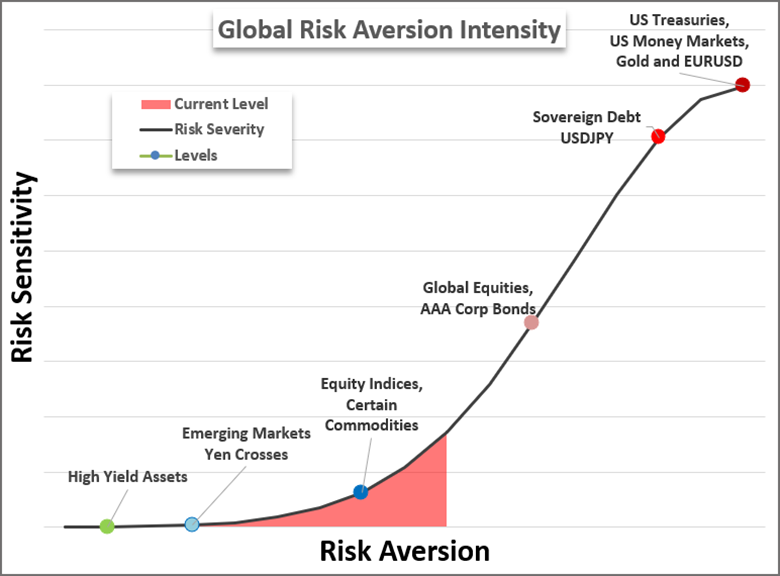
Safe-haven demand does not appear all at once. It often emerges along a spectrum.
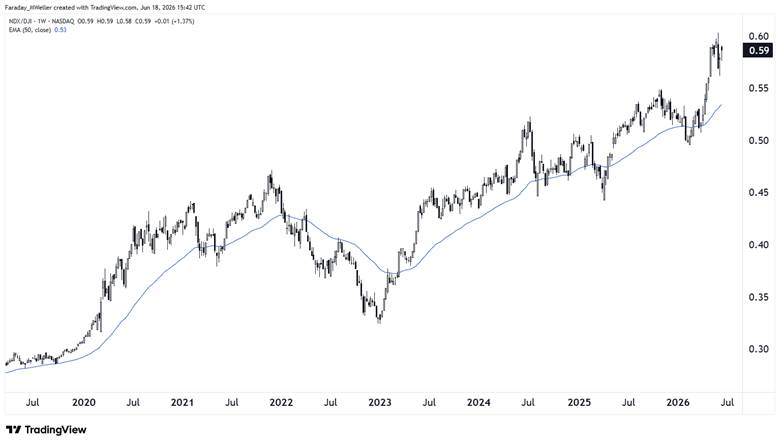
At the mildest end, investors may rotate within equities, favoring blue-chip companies over higher-growth technology stocks. A ratio such as the Nasdaq 100 versus the Dow Jones Industrial Average can offer insight into whether investors are still seeking returns, but with a slightly more defensive tilt.
Source: TradingView, StoneX
The next stage may involve a shift from equities toward bonds. This reflects the traditional capital structure dynamic: bondholders sit above equity holders, so in periods of concern, corporate bonds may be perceived as relatively safer than stocks.
Source: John Kicklighter
Gold’s Changing Role
Gold remains one of the most historically recognizable safe havens, but its behavior has become more nuanced. In recent years, gold has sometimes risen alongside risk assets, suggesting that speculative demand has played a role.
Still, gold’s long-term store-of-value reputation remains important. In periods of inflation concern, currency uncertainty, or more severe market disruption, gold may reassert its traditional safe-haven characteristics.
The Yen and the Carry Trade
The Japanese yen has historically been closely tied to risk sentiment through the carry trade. Investors often borrow or short low-yielding currencies such as the yen to buy higher-yielding currencies. When risk appetite deteriorates, those trades can unwind, creating demand for the yen.
That relationship has been especially visible in pairs such as AUD/JPY, which has often tracked broader risk appetite. However, Japan’s high sovereign debt burden and changing interest-rate environment mean this relationship should continue to be monitored rather than assumed permanent.
Why Treasuries Remain the Benchmark
At the extreme end of risk aversion, U.S. Treasuries remain the central safe-haven asset. The U.S. dollar may rise during severe market stress, but often as a gateway to Treasuries rather than as the final destination itself.
Treasuries continue to anchor the concept of the “risk-free” rate in global finance. When demand for Treasuries accelerates sharply, it often signals a deeper and more urgent form of risk aversion.
The Bottom Line
Safe havens are best considered before markets are under pressure. Their behavior depends on the catalyst, the intensity of risk aversion, and the liquidity of the asset in question. In a strong market environment, understanding that hierarchy can help investors better interpret shifts in sentiment when conditions eventually change.
Access More Global Macro Insights, Forecasts and Tools
Stay connected to timely global macro analysis designed to help market participants navigate shifting economic conditions and evolving risk. Gain access to regular market commentary, updated quarterly forecasts, a comprehensive two-week forward economic event calendar, and specialized tools built to support informed trading and risk management decisions.
StoneX TV content is created, produced, and distributed solely by StoneX Media Ltd (“StoneX TV”) and is provided for informational and educational purposes only. StoneX TV does not provide investment, financial, legal, or tax advice and does not make any recommendation or endorsement of any investment strategy, transaction, or financial instrument. Nothing in this content constitutes, or should be construed as, investment advice or a recommendation to buy, sell, or hold any financial instrument, including securities, futures, derivatives, digital assets, foreign exchange products, or CFDs. This content does not constitute an offer, invitation, or solicitation to engage in any investment activity. The information presented is general in nature and is not tailored to the financial situation, investment objectives, or risk tolerance of any specific person. You should not rely on this content as a substitute for independent professional advice. Investing and trading in financial instruments involves significant risk of loss and is not suitable for all investors. Past performance is not indicative of future results. Any views or opinions expressed are those of the presenter at the time of publication and are subject to change without notice. Such views may not necessarily reflect those of StoneX Media Ltd or its affiliates. StoneX Media Ltd and its affiliates, including StoneX Group Inc., may from time to time have positions in, or engage in transactions involving, the financial instruments referenced. This content may include general market commentary and opinion. It does not constitute independent investment research and has not been prepared in accordance with legal requirements designed to promote the independence of investment research. StoneX Media Ltd is not authorised or regulated to provide investment services and does not act in a fiduciary capacity. StoneX Media Ltd is incorporated in Ireland and operates in accordance with applicable Irish law. It is a wholly owned subsidiary of StoneX Group Inc. and is a separate legal entity from other subsidiaries within the StoneX Group, which may be regulated in various jurisdictions. StoneX Media Ltd does not act on behalf of, or provide services for, any regulated affiliate. This content is not directed at, and may not be distributed to, any person in any jurisdiction where such distribution would be contrary to local laws or regulations. Supporting documentation for any claims, comparisons, statistics, or technical data may be made available upon reasonable request, where applicable.
Discover more insights
Our subscribers have access to comprehensive market analysis from StoneX spanning commodities, equities, currencies and more.
Our market expertise, advanced platforms, global reach, culture of full transparency and commitment to our clients’ success all set us apart in the financial marketplace.
Reach
With access to 40+ derivatives exchanges, 180+ foreign exchange markets, nearly every global securities marketplace and numerous bi-lateral liquidity venues, StoneX’s digital network and deep relationships can take clients anywhere they want to go.
Transparency
As a publicly traded company meeting the highest standards of regulatory compliance in the markets we serve; our financials and record of accomplishment are matters of public record. StoneX’s commitment to “doing the right thing over the easy thing” sets us apart in the industry and helps us build respect, client trust and new partnerships.
Expertise
From our proprietary Market Intelligence platform, to “boots on the ground” expertise from award-winning traders and professionals, we connect our clients directly to actionable insights they can use to make more informed decisions and achieve their goals in the global markets.