Influenced by macroeconomic conditions and technical factors, coffee futures decline during the week
- Bullish
- Strengthening of the Brazilian real against the US dollar;
- Certified stocks at low levels on the New York Stock Exchange;
- Starbucks signals resilience in consumer market with Q4 2025 results.
- Bearish
- Weather forecasts predict above-average rainfall in Brazil's coffee belt over the next 14 days;
- Recovery of the dollar index putting pressure on the commodities complex;
- ABIC confirms weaker total consumption in Brazil for 2025;
- Sumatra region in Indonesia reports a sharp increase in coffee exports in December.
Arabica coffee posted the sharpest declines
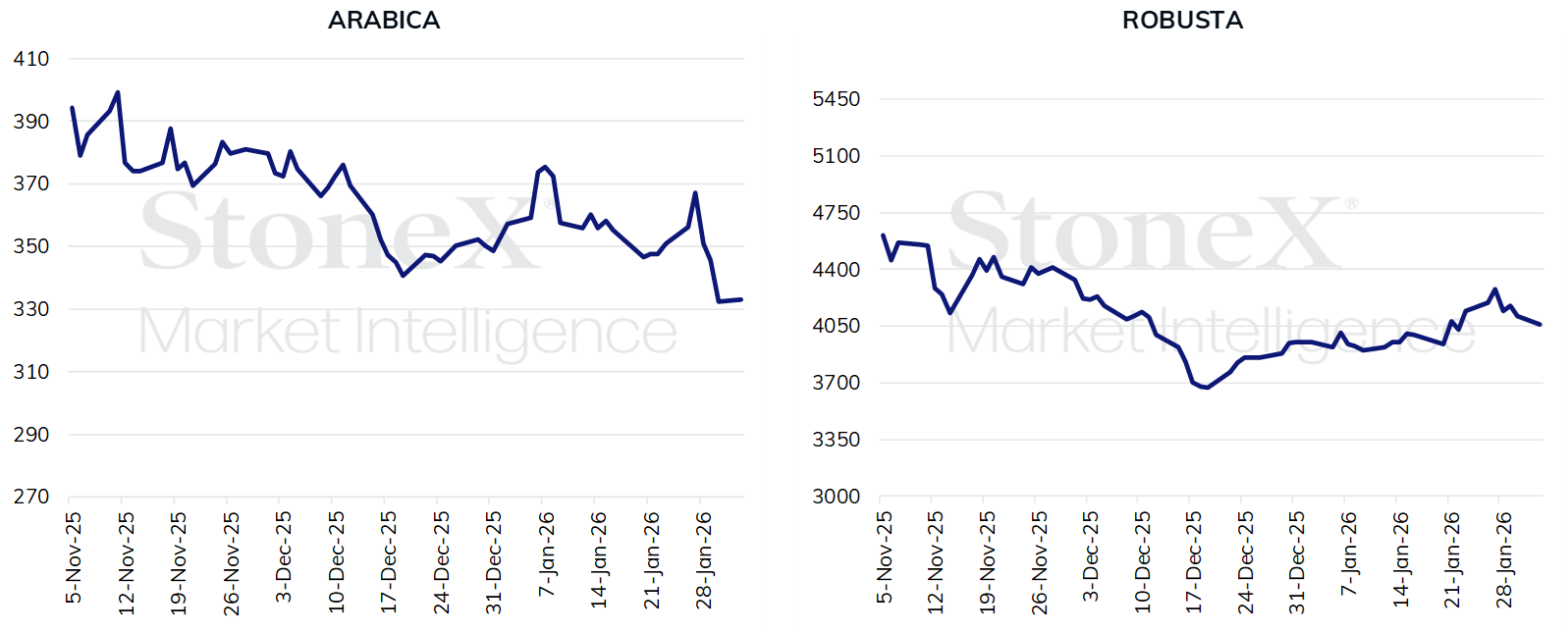
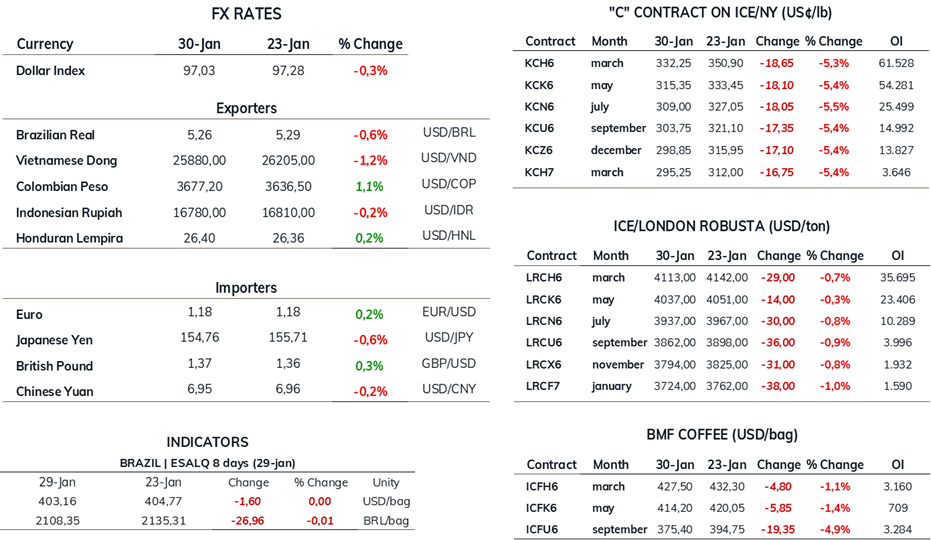
Arabica coffee: The past week saw significant depreciation for arabica coffee futures. After two bullish sessions on Monday and Tuesday—driven by the strong recovery of the Brazilian real against the dollar, which reached its highest levels since May 2024—prices recorded three consecutive sessions of sharp declines. On the weekly balance, the March contract closed at US¢ 338.25/lb, a 5.3% drop.
- The intensity of this movement appears tied to technical factors and the global macroeconomic environment, represented by the behavior of the US dollar in the Dollar Index. This index measures the strength of the dollar against a basket of currencies from advanced economies, serving as an indicator of the currency’s global trend.
- After dropping to its lowest level since May 2022, the Dollar Index began a recovery trajectory, accompanied by a broad decline in commodities. Historically, the index has shown an inverse correlation with the commodities complex; thus, the dollar’s appreciation contributed to widespread price pressure.
- This factor, combined with a fundamentally bearish outlook for coffee—such as favorable weather in Brazil and harvest progress in Central America—led to more intense liquidation by speculative funds. This movement is expected to be reflected in the CFTC report to be released next Friday (6).
Robusta coffee: Robusta coffee prices also ended the week with a slight decline of 0.7%, with the March contract adjusted to USD 4,113/t. Despite the weekly depreciation, the behavior was similar to that observed in New York: gains until Tuesday, reaching the highest levels in about a month and a half, followed by sharp liquidation, particularly on Wednesday.
- The same macroeconomic environment mentioned above, combined with the declines in arabica coffee, contributed to the bearish movement—especially considering the robusta price rally in previous weeks.
- Meanwhile, reports suggesting that Vietnamese producers had stopped withholding commodities gained traction, indicating that the local physical market may be gaining more momentum in negotiations.
Brazilian physical market: The CEPEA Indicator also showed price declines in Brazil, although with greater intensity for robusta coffee, which fell 5.8% to close the period at BRL 1,212/bag. Conversely, arabica coffee ended the week at BRL 2,094.55/bag, a 1.9% decline.
Arabica coffee futures prices (US¢/lb) Robusta coffee futures prices (USD/ton)
Source: ICE. Prepared by: StoneX.
This Monday (2): The nearest arabica coffee contract sought some correction on the New York Stock Exchange, closing the session at US¢ 333.25/lb, up 0.3%. After last week’s sharp liquidation, the market is expected to search for a new equilibrium level while closely tracking fundamental indicators.
Robusta coffee, on the other hand, extended its bearish trajectory and finished at USD 4,029/t, a daily drop of 2.0%. Data released by Indonesia on Monday indicated a 52% increase in December exports from the Sumatra region, reinforcing the perception of elevated supply among Asian producers.
ABIC reports drop in coffee consumption in 2025
The Brazilian Coffee Industry Association (ABIC) released consolidated coffee consumption data for Brazil last week.
- The results marked the weakest consumption in the past three years, totaling 21.4 million bags in total volume and 6.02 kg per capita. These figures represent annual declines of 2.3% and 3.8% compared to 2024.
- Weaker performance in 2025 had already been signaled by partial data released by ABIC throughout the year and by high inflation in Brazil, which peaked at 82% in May.
Why this matters: The result reinforces StoneX's perspective that, despite weaker production in 2025, declining consumption across various regions, mainly Brazil, Japan, and Europe, contributed to a slightly surplus global supply-and-demand balance.
- While this scenario does not eliminate the issue of reduced stocks, it helps position the market entering 2026 in a less critical state than at the start of 2025. Additionally, if expectations for larger harvests in most countries materialize, this year could see further stock growth, bringing relief to stock-to-use ratios and potentially favoring lower average prices compared to last year.
Brazil's annual total and per capita coffee consumption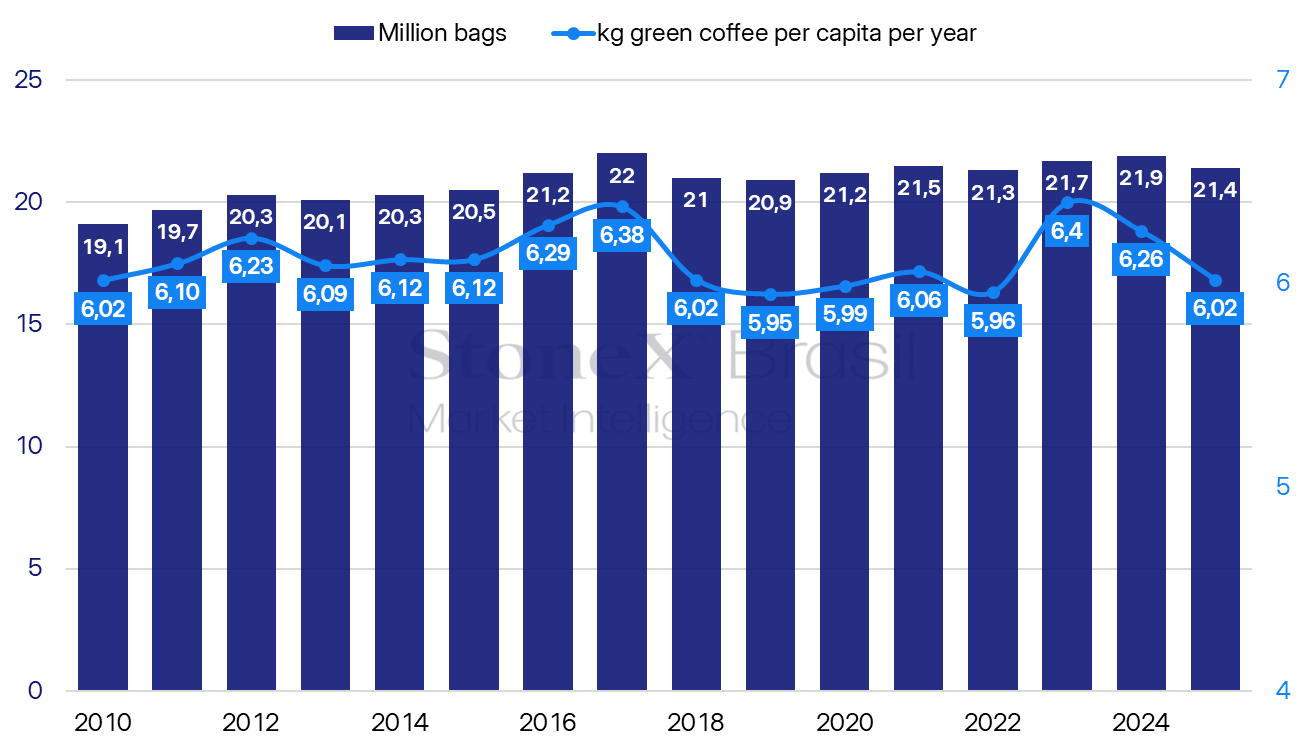
Source: ABIC. Prepared by: StoneX.
Starbucks posts positive Q4 2025 results
Last Wednesday, December 28, the market reacted to Starbucks’ quarterly financial results, which again indicated resilience in global coffee consumption.
- The report shows that both consumption and sales grew in the United States and internationally, despite an environment of operating margin pressure due to high coffee and other input costs.
Why this matters: Starbucks' results are often used as a key indicator of global demand for coffee-based beverages.
- The company operates 41,118 stores across approximately 80 countries, making its operational data highly representative.
- When the report indicates an increase in transaction volumes alongside significant cost pressures, particularly related to coffee, this suggests a resilient demand environment.
- This situation, in turn, tends to reinforce the outlook for greater pressure on stocks and support bullish pressures on international coffee prices.
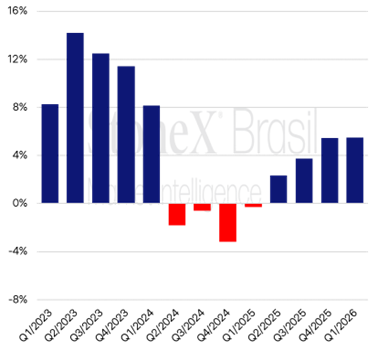
In detail: During the quarter, global comparable sales rose 4%, driven by a 3% increase in transaction numbers and a 1% rise in average ticket size.
- The report also highlighted the first expansion in comparable transactions in the United States in eight quarters, signaling a recovery in customer traffic in the company’s primary market.
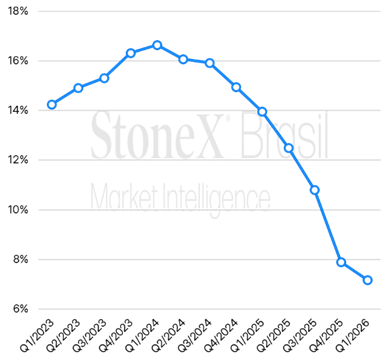
- Meanwhile, Starbucks reported a contraction in GAAP operating margin, primarily attributed to increased labor investments and inflationary pressures, largely linked to high coffee prices and tariff incidence.
- Operationally, the company achieved a net opening of 128 stores during the quarter, ending the period with a total of 41,118 units, further supporting its expansion strategy.
Outlook: For the current fiscal cycle, Starbucks projects a net opening of 600 to 650 new stores throughout the year.
- This plan indicates sustained physical growth of the network and, consequently, structural demand for coffee to supply its operations.
- The report also hints at some expectation of easing input-related costs, particularly with the removal of U.S. government import tariffs imposed on Brazil.
Starbucks’ 12-month rolling operational margin (%)
Source: Starbucks. Prepared by: StoneX.
Starbucks’ quarterly revenue growth year-on-year (%)
Source: Starbucks. Prepared by: StoneX.
Weather outlook in Brazil
Weather conditions in Brazil continue to play a crucial role in mitigating risks to the global coffee supply.
- The occurrence of above-average rainfall in most major producing regions, along with expectations of this pattern continuing in the coming weeks, helps reduce concerns over potential production risks.
- However, given the heavy accumulation of precipitation, market participants are closely monitoring potential stress points caused by excessive rainfall.
- In this regard, some areas in Espírito Santo and Zona da Mata recorded significantly above-average rainfall, which remains a short-term factor of concern.
- Conversely, key production areas like South Minas, Cerrado, and Mogiana continue to exhibit favorable weather outlooks, with no significant signs of production compromise.
- Regarding temperatures, as indicated in StoneX’s latest weekly climate report, February could see isolated anomalies above the average in regions like South Minas and Mogiana. Nonetheless, normalization is expected over subsequent months, likely reducing the potential for significant production impacts.
Rainfall anomaly forecast for the next 14 days (February 2–16)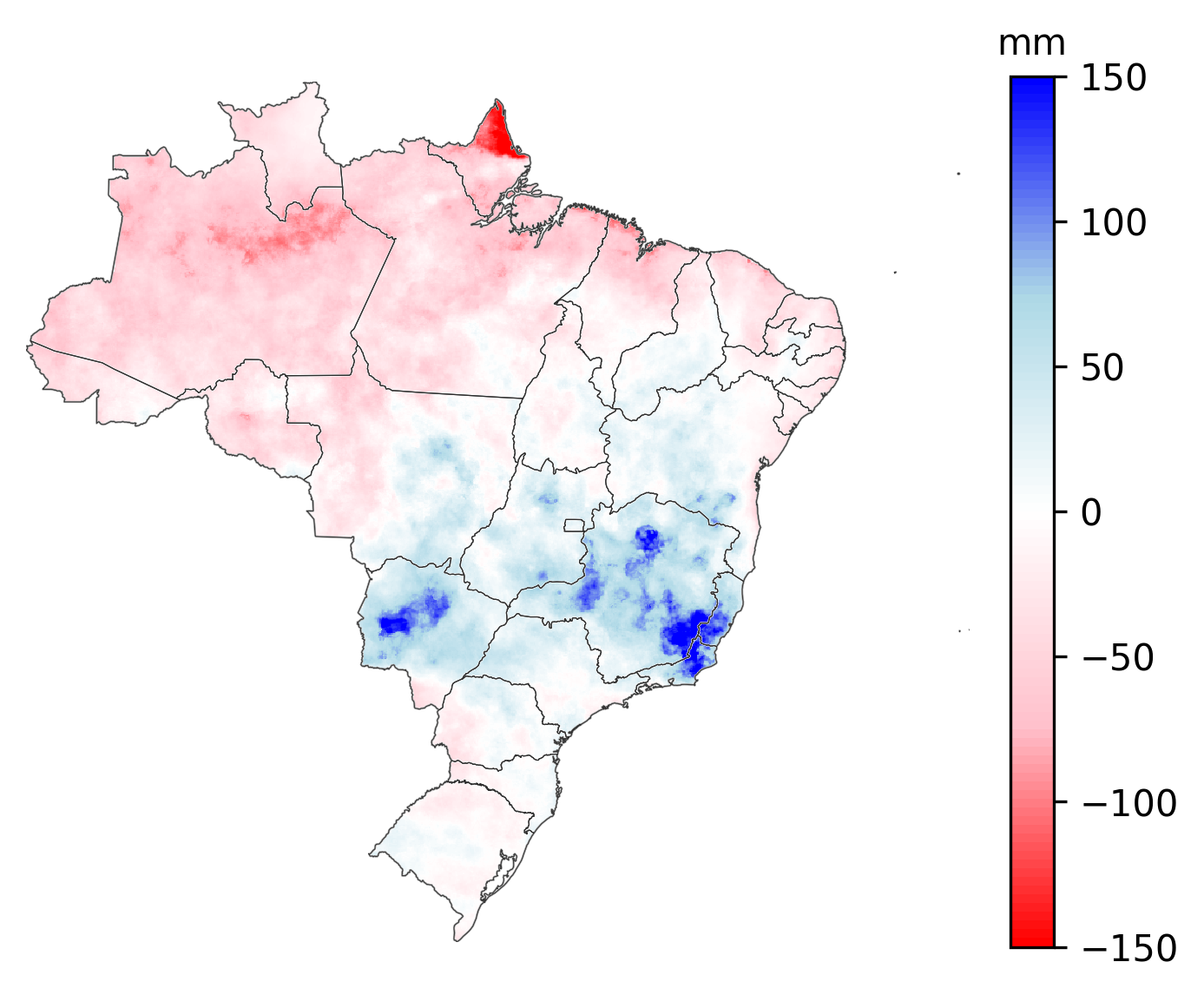
Source: StoneX. Prepared by: StoneX.
INDICATOR TABLE
Sources: ICE/NY; ICE/EU; B3; Commodity Network Trader’s Pro.