Quarterly Commodities Outlook is available for free now.  Download your report  →

StoneX logo

September '23 Farmer Fertilizer Focus - Phosphates

Josh Linville
Josh Linville

Vice President- Fertilizer

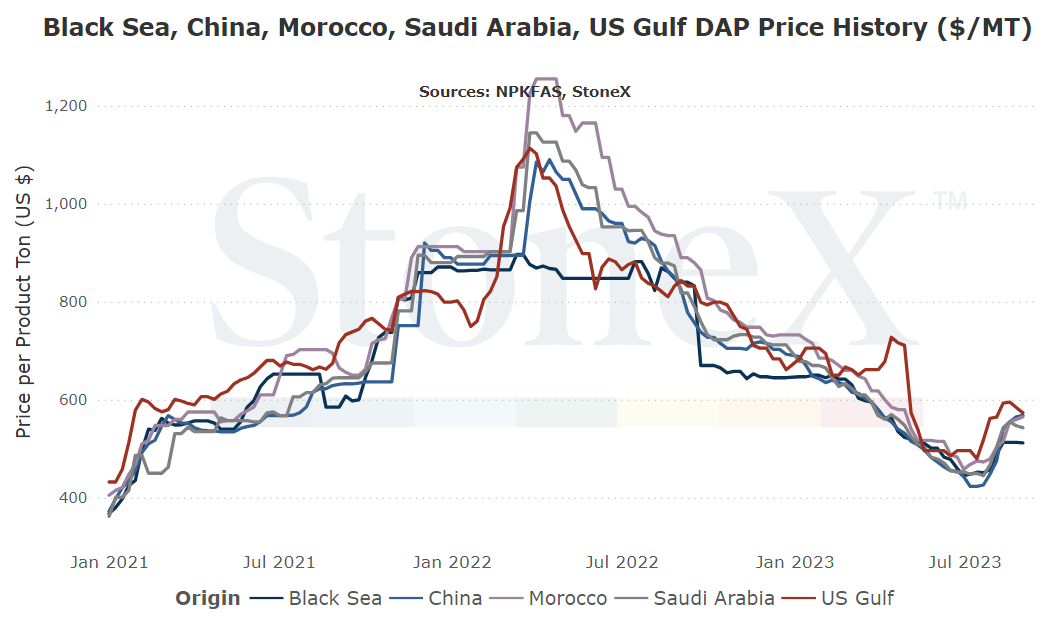
Major global phosphate export location price graphs

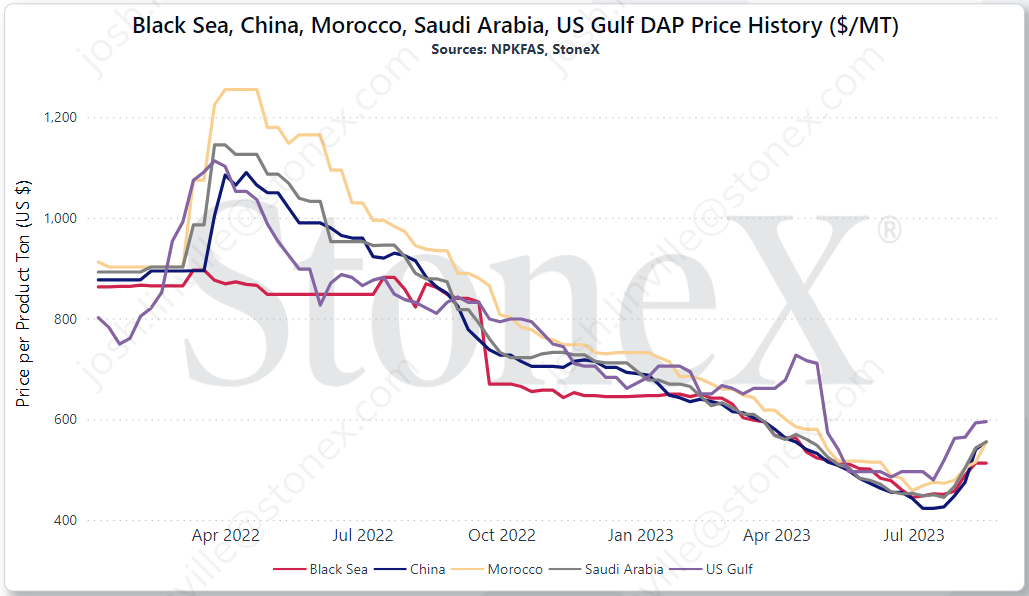
I will say this now and will say it going forward to eternity:  these are the flat price graphs for each individual location.  Your price where you are is going to be different.  There are logistics.  There is the cost of storage/interest/insurance/etc.  These graphs should not be taken as "it shows the price at $700,  why isn't my price $700".  These graphs should be used to give an appreciation for price movements.

All values are in metric tons and USD currency.

image 79290
 
What everyone wants to know first, what do we think will happen going forward
Global
While I never thought phosphate values would drop forever, I thought they would drop further than they did.  We have obviously seen a bounce in recent weeks/months...but I struggle with it.  If Chinese exports are returning and India is well ahead on imports vs average, I think we could slide right back to where we were.
Our outlook remains cautiously bearish going forward.
That isn't to say that we cannot see a bit of a short term tic higher.  Just when I look a bit further on the calendar, there are a lot more reasons to be bearish than bullish today.
North America
N.A. is still in a weird situation as the U.S. continues to effectively block 3 of the biggest phosphate exporters in the world:  China / Russia / Morocco.  That, combined with very low ending inventories from last spring, has the current market tight.  Doesn't help that those in the wheat belt and those reliant on the Upper Mississippi River are backed into a corner with time running out.
Near term should continue to see values flat to bullish.  Longer term should see values starting to slide.
Like the world, I am not confident in the long term view of this marketplace.  Values are too high and major importers ahead of schedule.  Seems to me a slide will resume.
Should you buy your phosphate needs?
If the current values work for your operation/region/etc., then that is your answer.  Your local market needs to be considered as things like supply availability, demand timing and logistical issues can change the view.  Just because we see the market strong or weak going forward does not mean it will translate to where you live.  We are all a part of the world, but we live at home.
Global
Phosphate values are down HUGE from this time last year.  They are down even more when compared to the high's of April 2022.
However, that just looks at that period.  When we look at phosphate values even further back, when times were "normal", they were lower still...and that is where my head is today.
Unless you need the product near term (this calendar year), it is hard for me to get excited about it.
Honestly, I continue to look at the global S&D...and it makes me question why we are so high priced.  I know there is a bit of "well, it is so much higher than last year" but it is still high.  I think there is more downward work to do.
North America
If my POV on the global side is that values are too high, that means worse things for N.A. given how much of a premium NOLA is vs the world.
Be aware that supplies are still snug today, could be tight into fall but longer term/2024, sure looks like values will continue to settle down.
Now, let's put this into context.  I'm not seeing a situation where the price fall hundreds of dollars between today and spring.  Just for the fun of it, let's imagine we think the price will fall $100.  What does that mean on a per acre basis?  The math I ran reflects a cost per acre that is less than 2 bushels of corn.
Now, I know we have to watch every dollar.  Every freaking thing out there costs a ton today.  We have to look at it as a business.  If delaying your fall application into spring might cost you more than 2 bushels of corn per acre top end yield, you might save the $100 flat price but still "lose".  This has to be a region/farmer/field decision.  While I think the price likely trends lower after Christmas, there are a lot of benefits to getting it applied in the fall.
Guess what I'm saying is look at the broad picture.
CME Futures settlement indications

While the fertilizer futures market is far from as liquid as its grain counterparts, it is still active and gives us an insight into what the market is thinking.

Please note that the values below can and will change daily.  This is merely a look at where they are as of writing:

 NOLA DAP
September$517.50
October$507.50
November-
December-
January$482.50
February $482.50
March$482.50


general global dap/map information
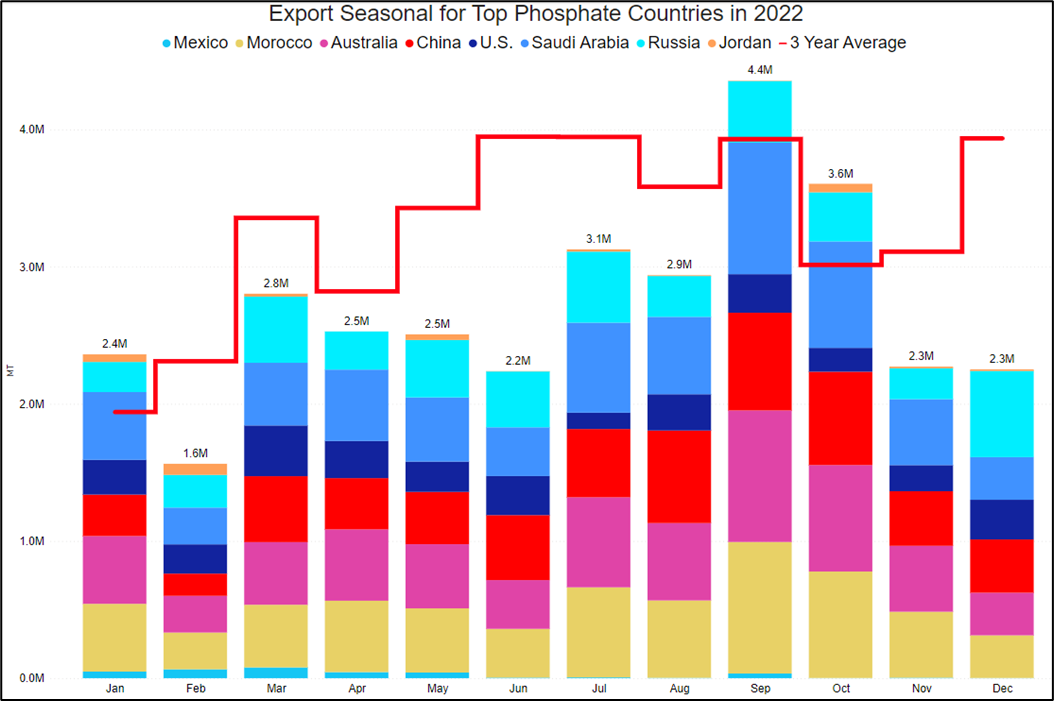
image 73040
image 73037
image 73038
image 73039
What has happened in the last 30 days?
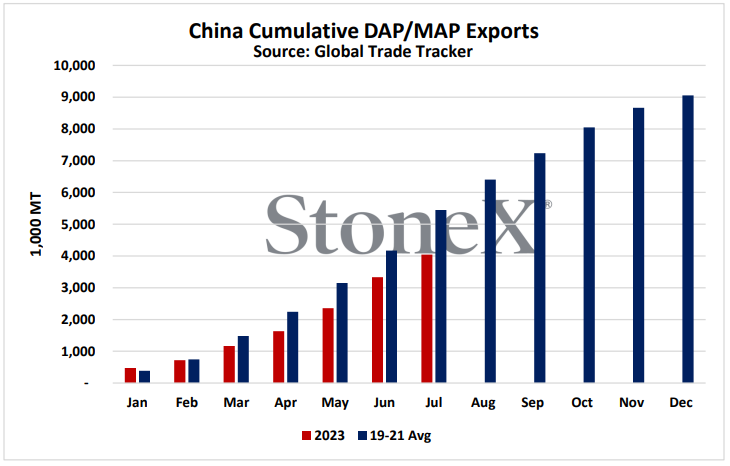
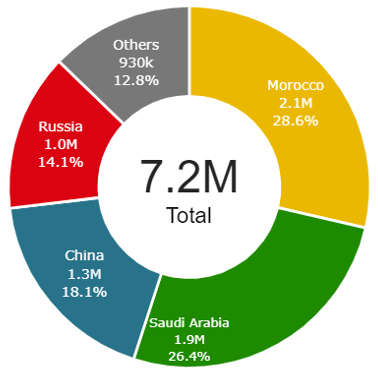
Chinese exports still behind average thru July...but improved over last year
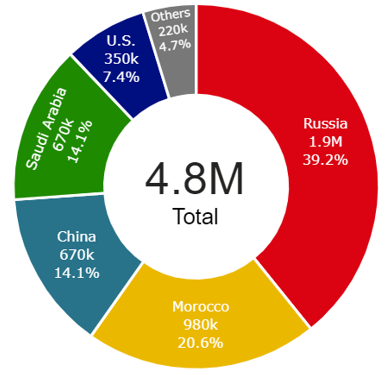
A quick background on China for those new to the newsletter.
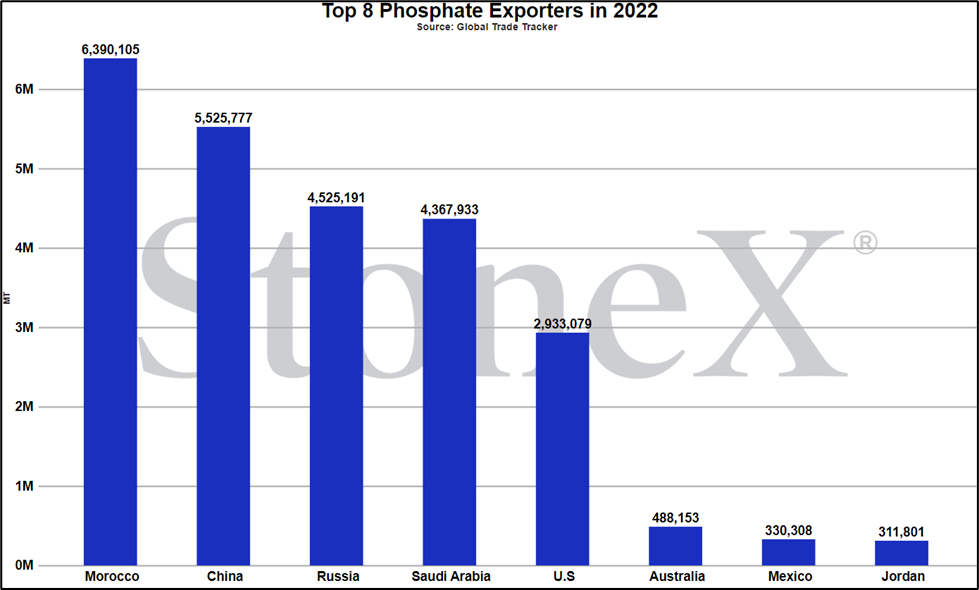
Last year, China was the 2nd largest exporter of DAP/MAP in the world, falling behind Morocco.  However, 2022 was a abnormal year.  Typically, China is by far the world's largest producer and exporter of DAP/MAP and it isn't even close.  The thing that changed 2022 was the Chinese governments restricting exports.  As global phosphate values skyrocketed and product became scarce, the government stepped up and made the restrictions in an effort to provide adequate supplies at a discounted price to Chinese farmers.  While I'm usually not one that wants government interference on free markets...the plan worked.  Chinese domestic farmers saw values lower than the world with enough product to go around.  However, the world paid the price with their annual export total nearly 5M less than typical.
Since then, the restrictions have been scaled back as world prices fell and product became available again.  There simply hasn't been a need of intervention.  But that doesn't mean they are back to full strength.
Looking at the graph below, you see where exports thru July are a little over 1MMT lower than the 2019 - 2021 average.  For some, they view this as a bullish scenario with it meaning that China is refusing to reclaim their previous export flows.  Others are looking and seeing significant improvement vs last year which means a lot more product "should" be available to the world thru the rest of 2023.
I cannot tell you what will happen by the end of December.  Today, it looks like exports will continue, albeit at a slightly slower pace.  As they resume their rightful place at the top of global exporters, the world S&D gets back to normal which means values should get back to normal.  On the flip side, if we start seeing/hearing more restrictions being put into place, we need to see the writing on the wall that firmer phosphate markets could be coming.
As always, markets half a world away can affect every farming operation around the world.
image 78739
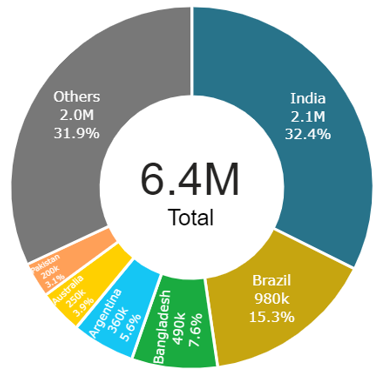
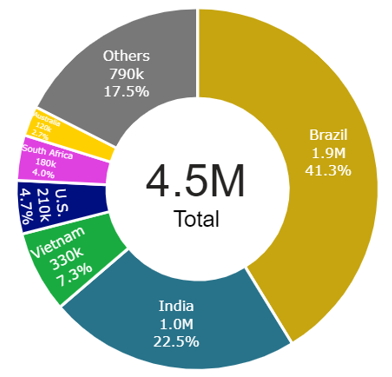
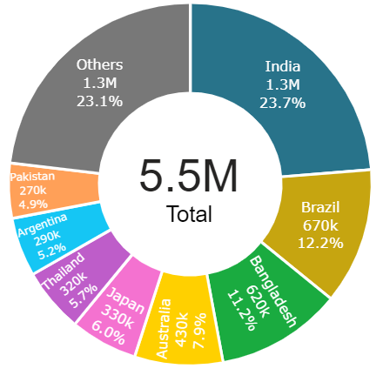
India continues to import ahead of normal / Brazil on pace
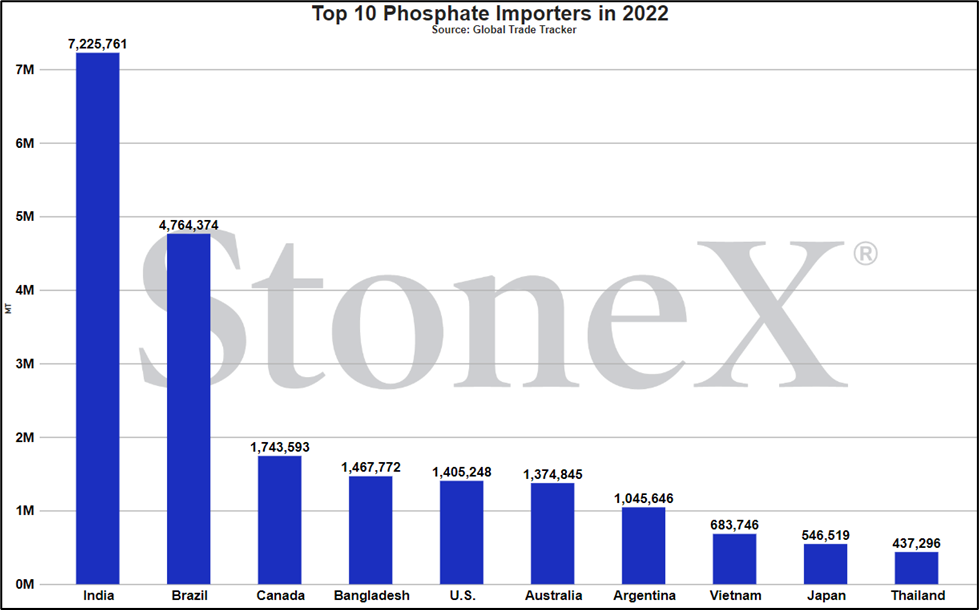
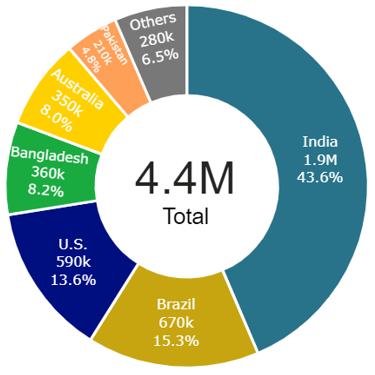
If we care so much about how well one of the world's largest exporters are doing, it makes sense to pay attention to the world's largest buyer...right?!
India sits alone as the world's biggest importer and number 2, Brazil, isn't close.  However, Brazil is extremely far ahead of the number 3 spot so a lot of world phosphate import can be tracked by these two countries.
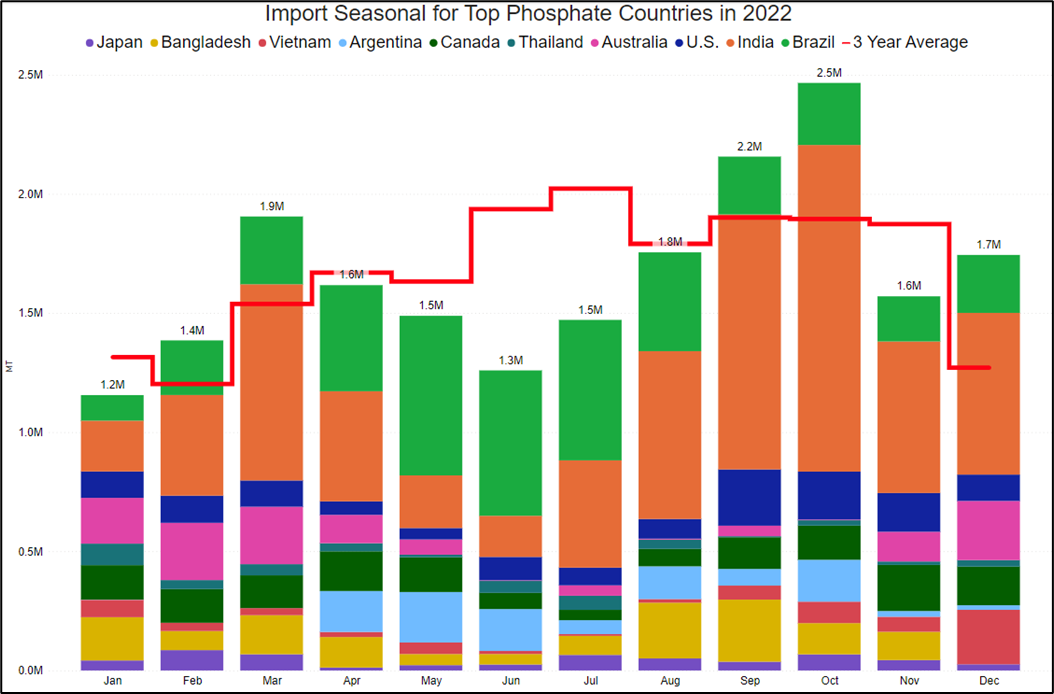
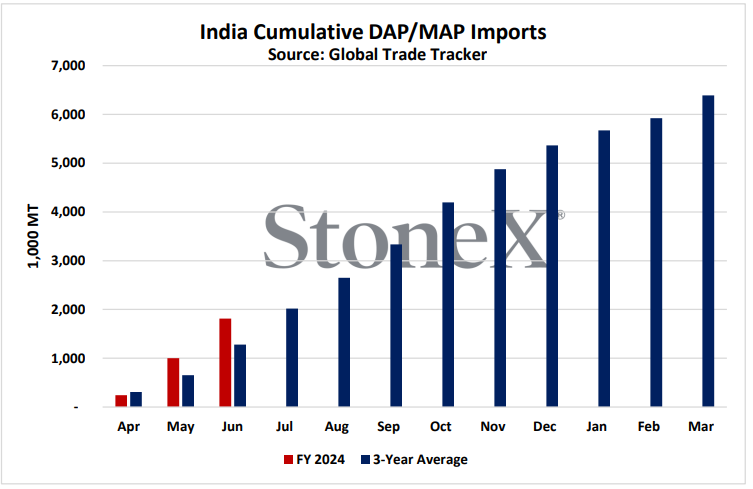
Starting with India, they continue the hot import pace that was set in their last fertilizer year.  Although they are only 3 months into this new fertilizer year, they are already a few hundred thousand tons ahead of schedule.  Combined with the aggressive pace from last year, it could mean a situation is brewing where India demand dries up earlier than normal, leaving the global phosphate market to sit and ponder when the next demand will step forward...never a good situation for those wanting higher prices.  
However, I have to admit that some more intelligent than I are saying that Indian phosphate stockpiles are actually low with solid domestic demand.  If that is the case or even the governments perceived view, the buying slow down may not occur.
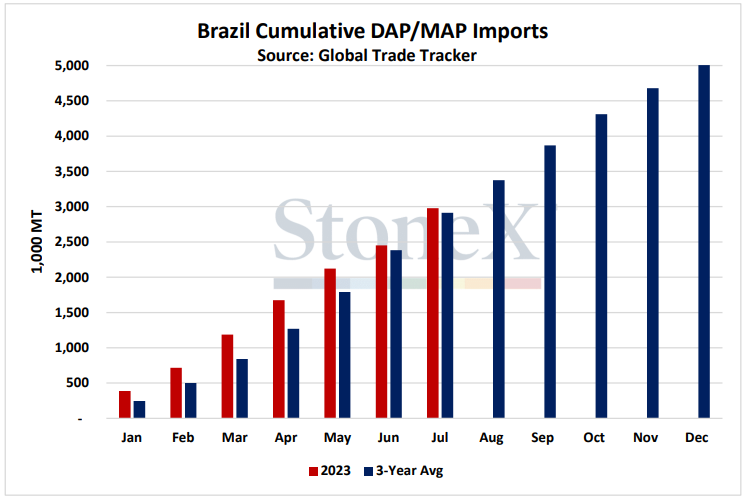
For Brazil, they are nearly even to their 3-year average import pace thru July.  There really isn't a reason to look at them and think that their demand will spike or wane in the near future.
While I do not know for sure, the ahead of average import pace for India does have me conservative on my outlook.  If they start scaling back their purchases, long positions can start to get very nervous very quickly.  Remaining demand points around the world will see a lot more attention.
image 78740
image 78741
Global trade flows still in flux as U.S. duties against Russia/China/Morocco remain
Chalk this one up to the U.S. 
There was one event that really kicked off the last 3 years of these insane markets on the fertilizer side:  U.S. imposing counter vailing duties against Morocco and Russia, joining China which already had duties in place.
The case was filed with reasons given that Morocco was not having to adhere to the same environmental standards as U.S. producers and Russia was getting inputs at a significantly lower value that free market pricing.  While this might anger some, the case WAS valid.  Florida producers are required to keep their gypsum stacks (by product of phosphate production) contained to keep it from contaminating surrounding areas.  They also must reclaim the land that they mine.  A great example of this is the Streamsong golf course in Florida.  Mosaic reclaimed the land and built a beautiful golf course in its place.  While a phenomenal course, this requires a lot of capital.  They are also subjected to free market input values.  If others are not required to the same standard, it puts domestic producers at a significant disadvantage which is why I make that comment.
However, that doesn't mean the impact isn't felt.
The result of the counter vailing duty rates has been that the top three exporters of DAP/MAP in the world are largely unable to come to the U.S.  While much of the past two year near record high values are attributed to global events (it wasn't just N.A. values high), N.A. is operating at a higher value vs the world.  That has been especially true recently with low ending spring inventories.
For many other buyers around the world, this has been a blessing of sorts.  With the U.S. cutting off these imports, it means those three exporters need to get more aggressive in the remaining markets which lowers price ideas.
There are still 2 years left on the current U.S. counter vailing duty with no signs of it being disrupted which means this situation will continue for the foreseeable future.  What happens at the end of the 5 year life is anyone's guess.  Some theorize the duties will be allowed to end and a return to normal happens.  Others theorize the duties will be refreshed and continued for years to come.  In the end, it is all just that:  theorizing.  No one knows.  It just makes for interesting coffee shop talk.
But as long as they continue, it will continue to disrupt normal and efficient trade flows around the world.
N.A. inventories still tight and high prices nearby
As was also the case with potash and urea, phosphate ended the spring season about as low on ending inventory than any year I can remember in my 20+ year history.  Typically, near the end of spring, values start to slide as remaining long positions puke to make sales and stay ahead of competition.  Better to give up some money on the nearby than to hold onto it for several months out of fear of what could happen in the summer.
This last spring was not typical.  Not only did prices not slide, values rose decently toward the end of spring and multiple regions across N.A. reported difficulty in getting product in a decent timeframe at a decent price.  Effectively, it turned into an auction for those with product with the question "who is willing to pay the most" being asked.  Not hard to see why values jumped.
That situation continues to affect phosphate today.  This is even more prevalent for nearby demand like wheat country and those reliant on the Upper Mississippi River for logistics.  Time is against these markets and the distribution side of the market knows it.  Want product sooner than later?  It's going to cost you...
I wish that wasn't the case.  That is the case.
A lot of question now is how long this tight supply situation will last.  The short answer is "it depends":
  • Will Morocco send product to the U.S.? - obviously, with their 15% duty on phosphate imports, it makes it difficult.  However, when you look at how much of a premium NOLA DAP is (MAP significantly higher still), it seems as though they could pay the 15% penalty and still have a better netback than most other global regions.  However, if they do that and start importing significant volumes, they lose a bit of footing on their argument against the CVD rate.  They have been vocal about it for the last 3 years and continue to fight today.  The problem is, if they start importing now, that 3 years worth of arguments goes out the window to a certain extent.  Without those imports acting as a supply boost and competition against domestic producers, it is a bit more of a free for all.
  • What does demand look like? - this depends on the area.  I am talking about replacement values...and there are still a lot of stories of retailers who are selling at the original fill price.  No, seriously.  Lot of folks like to beat up the retailer when prices hang but no one ever talks about when retailers keep the price cheap in a rising market.  This has been heard across N.A.  It isn't everywhere, but it is enough to point out.  If retailers have moved their price up, there is a solid case to be made that fall demand is going to scale back an help balance the S&D.  If retailers keep the price "low", demand will not change.  If corn prices rise, it helps build demand.  If corn prices fall, demand gets hurt.  There are a lot of factors which can fundamentally change the outlook.
  • How does the world continue in the coming weeks/months? - obviously by the price graphs on this newsletter, global phosphate values have turned a corner higher.  Will this continue, even with Chinese exports resuming?  Will the rising price cause more demand to step in or will it scare it away.  N.A. is a part of the global complex so while we can move to a premium/discount vs the world, we still ebb and flow with it.

All of this to say "don't sleep on phosphate".  Do not think that we can wait until November to walk in, check in hand, and demand our fields be fertilized.  There is decent price risk in the phosphate market today (see below for more info on that).  Last year stunk, for lack of a better description.  The forward futures market is indicating at last a $40 discount vs today's values.

I'm not saying we have to lock in our fall needs but if spring taught us anything, those further away from production points (west/north) need to have more conversations with their retailers about their wants/needs for the remainder of 2023.

Current phosphate values "high" vs many comparisons
I'm going to start his section by saying this: this does not mean that global/domestic phosphate values cannot move higher.  If the last few years have taught us anything, it is to expect the unexpected.
That out of the way...
image-20230824150208-1
Alright, let's get into the meat of why I think that.
Globally, phosphate values had fallen nearly constantly since April 2022.  In recent weeks, values have turned a corner and shown a little strength.  If we just look at price data since the start of 2022, this recent bump looks like nothing and shows phosphate still being decently well valued.
image 78749
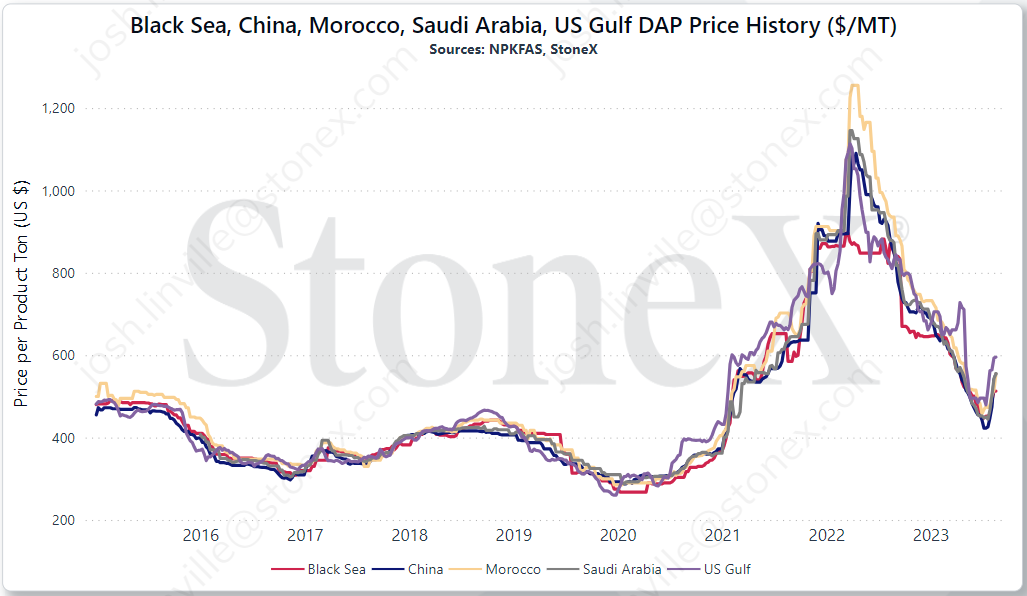
Now, if we step back a little further, the picture changes.  While values are significantly lower than the recent high's, they are certainly elevated when we expand the chart to 2015.  However, things change in the world.  Inflation is a very real thing so what was "normal" in the past may not be normal in the future.
image 78750
So let's get away from the flat price comparison of phosphate.  I preach that in my presentations, I should probably live it as well!
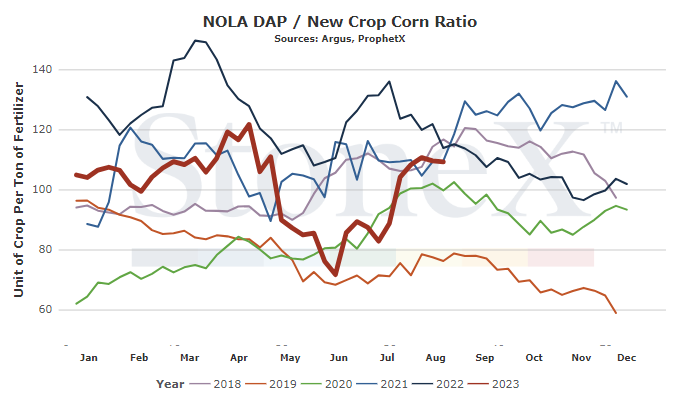
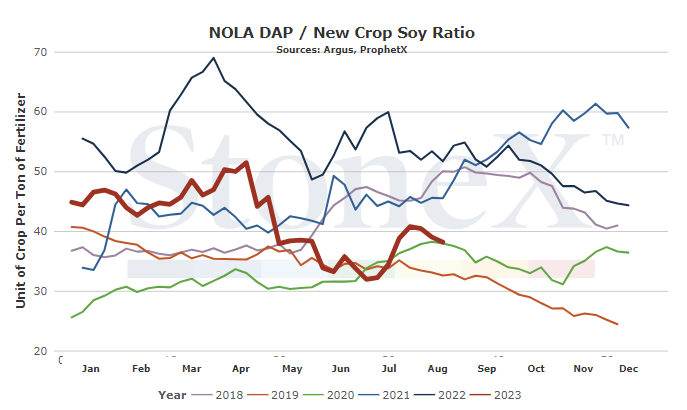
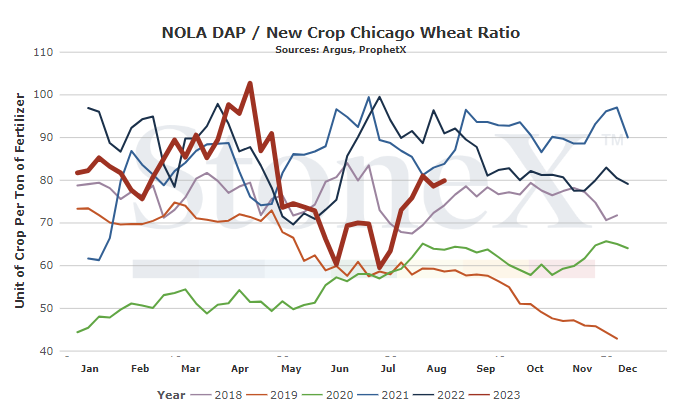
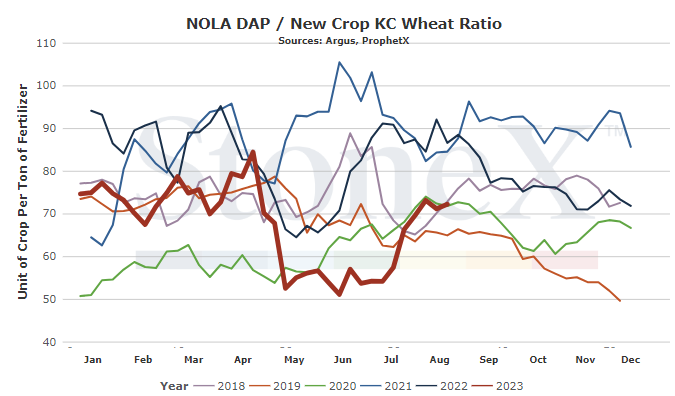
It is when I start comparing current values of DAP and MAP against grains like corn where it really captures my attention.  Take a look at the ratio charts below.  They have gotten back to the high side for DAP and are well into the high side of MAP.  If replacement values are flowing down to the farmgate, there is a very real possibility that fall demand could be lower than expected with farmers decided to either delay or reduce applications.
Again, I'm not saying values cannot go higher.  The last two years taught us that.  
I guess I'm just trying to justify my POV on the phosphate market being bearish longer term.
Where are current values in relation to the past
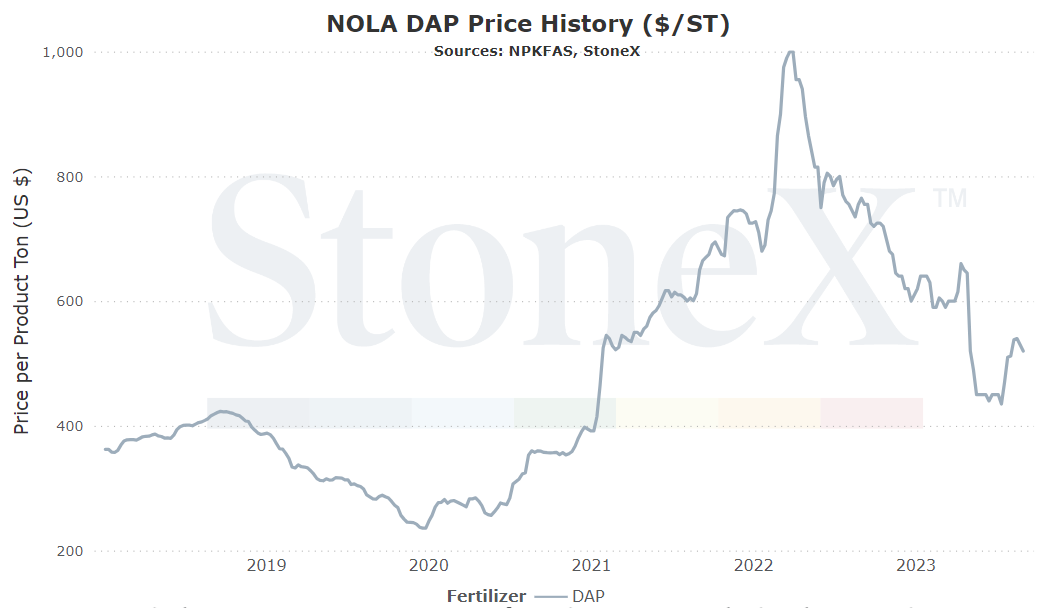
NOLA/New Orleans, Louisiana DAP price comparison
Number 5 global exporter in 2022
image 73041

Price comparisons

  • Vs 30 days ago - +2% or approximately $8 higher
  • Vs 90 days ago - +16% or approximately $70 higher
  • Vs 6 months ago - -13% or approximately $80 lower
  • Vs 1 year ago - -32% or approximately $245 lower

image 79291

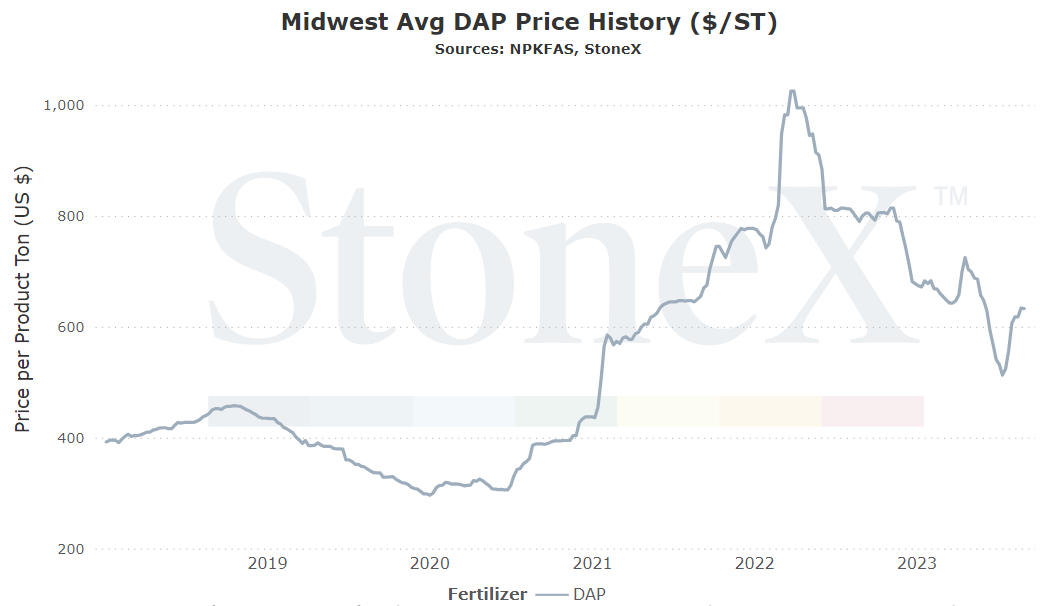
U.S. Midwest Average (using multiple points across Midwest) price comparison

  • Vs 30 days ago - +4% or approximately $26 higher
  • Vs 90 days ago - -2% or approximately $14 lower
  • Vs 6 months ago - -3% or approximately $21 lower
  • Vs 1 year ago - -21% or approximately $168 lower

image 79292

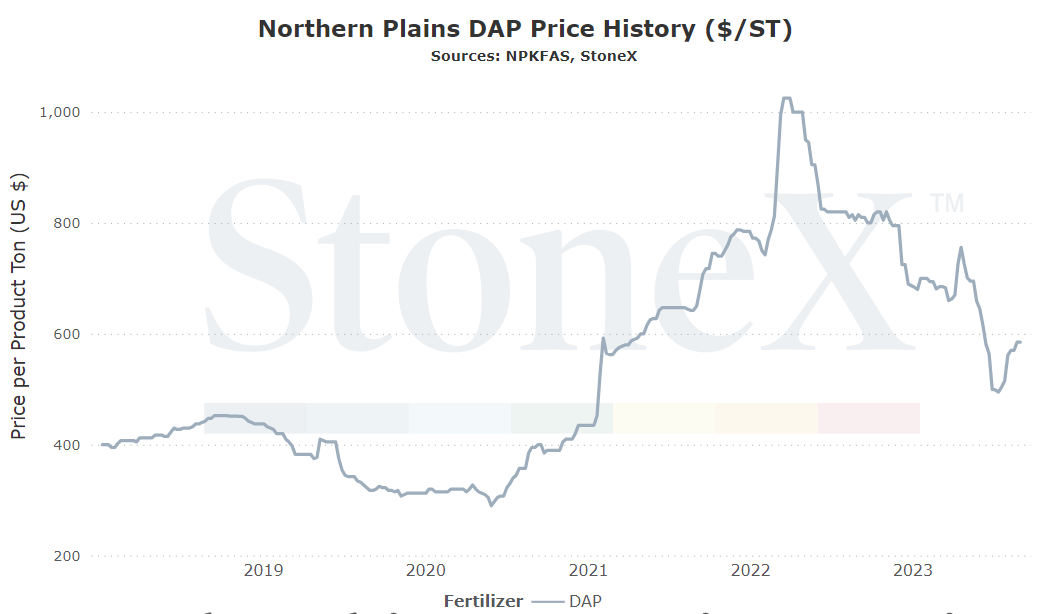
U.S. Northern Plains Average price comparison

  • Vs 30 days ago - +4% or approximately $24 higher
  • Vs 90 days ago - -9% or approximately $60 lower
  • Vs 6 months ago - -15% or approximately $100 lower
  • Vs 1 year ago - -28% or approximately $230 lower

image 79293

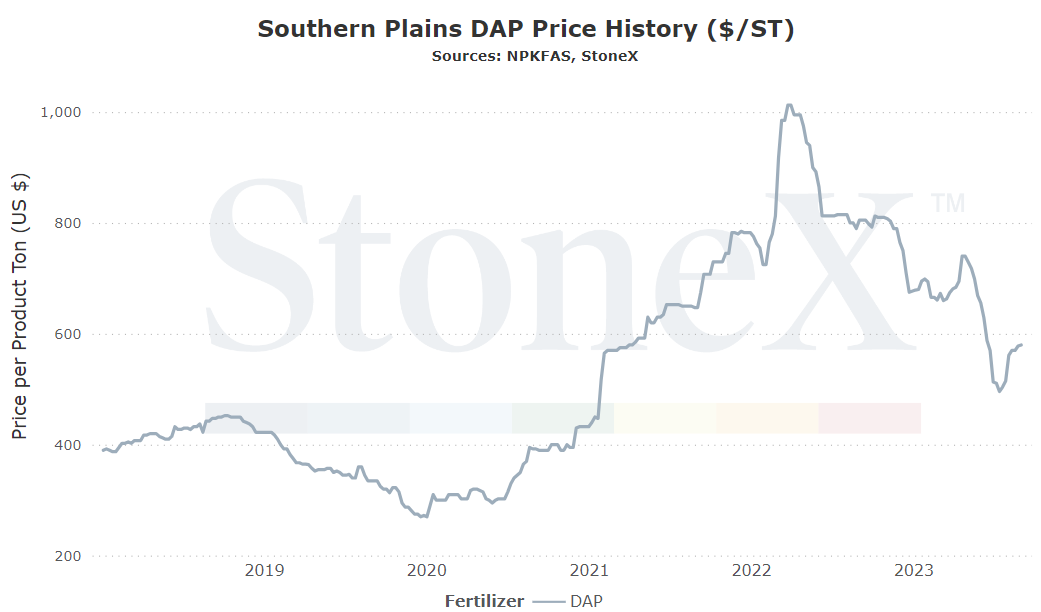
U.S. Southern Plains Average price comparison

  • Vs 30 days ago - +3% or approximately $19 higher
  • Vs 90 days ago - -12% or approximately $76 lower
  • Vs 6 months ago - -14% or approximately $93 lower
  • Vs 1 year ago - -28% or approximately $225 lower

image 79294

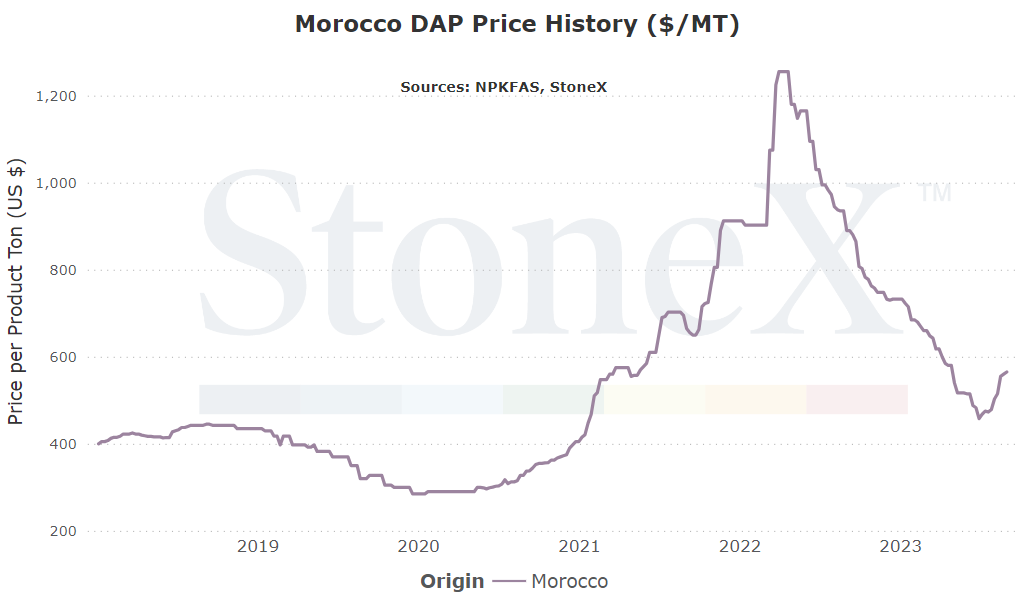
Morocco DAP price comparison

Number 1 global exporter in 2022

image 73042

Price comparisons:

  • Vs 30 days ago - +12% or approximately $63 higher
  • Vs 90 days ago - +10% or approximately $50 higher
  • Vs 6 months ago - -14% or approximately $95 lower
  • Vs 1 year ago - -37% or approximately $325 lower

image 79295

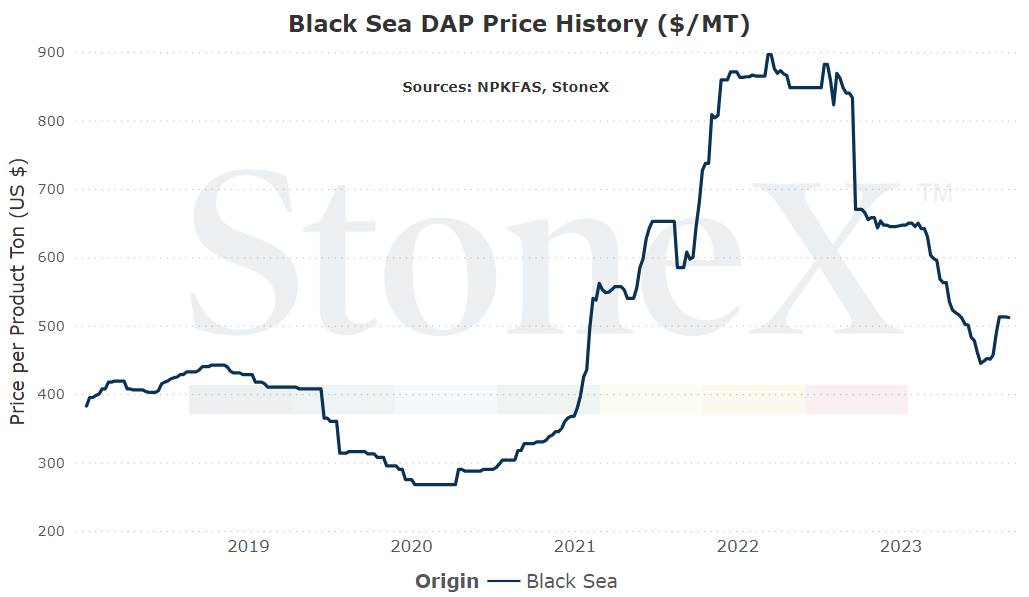
Black Sea DAP price comparison

Number 3 exporter of DAP/MAP in 2021

image 73043

Price comparisons:

  • Vs 30 days ago - +5% or approximately $24 higher
  • Vs 90 days ago - +2% or approximately $11 higher
  • Vs 6 months ago - -19% or approximately $118 lower
  • Vs 1 year ago - -39% or approximately $328 lower

image 79296

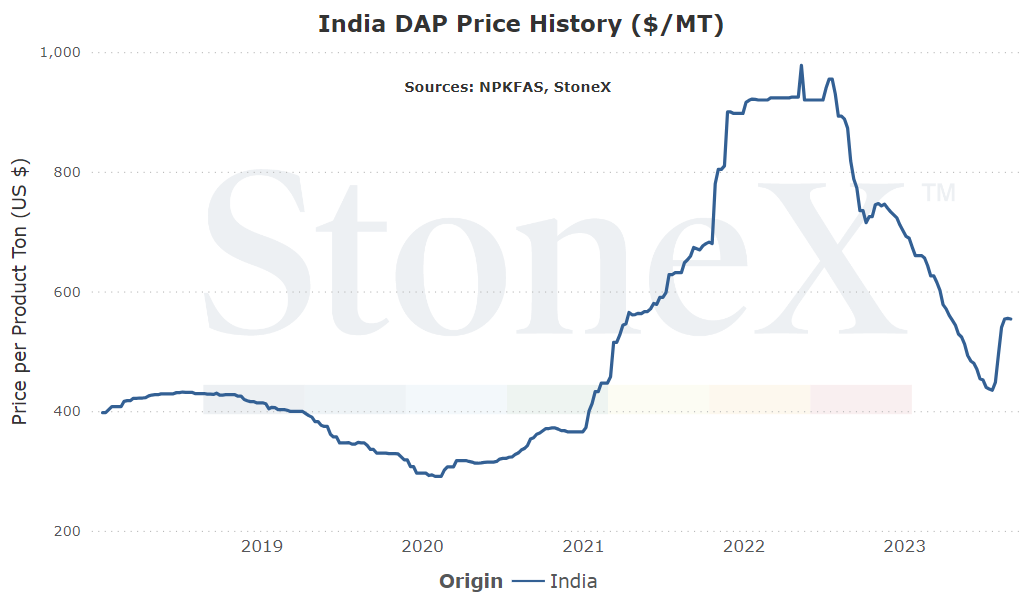
India DAP price comparison

Number 1 global importer in 2022

image 73044

Price comparisons:

  • Vs 30 days ago - +12% or approximately $59 higher
  • Vs 90 days ago - +15% or approximately $71 higher
  • Vs 6 months ago - -11% or approximately $72 lower
  • Vs 1 year ago - -32% or approximately $264 lower

image 79297

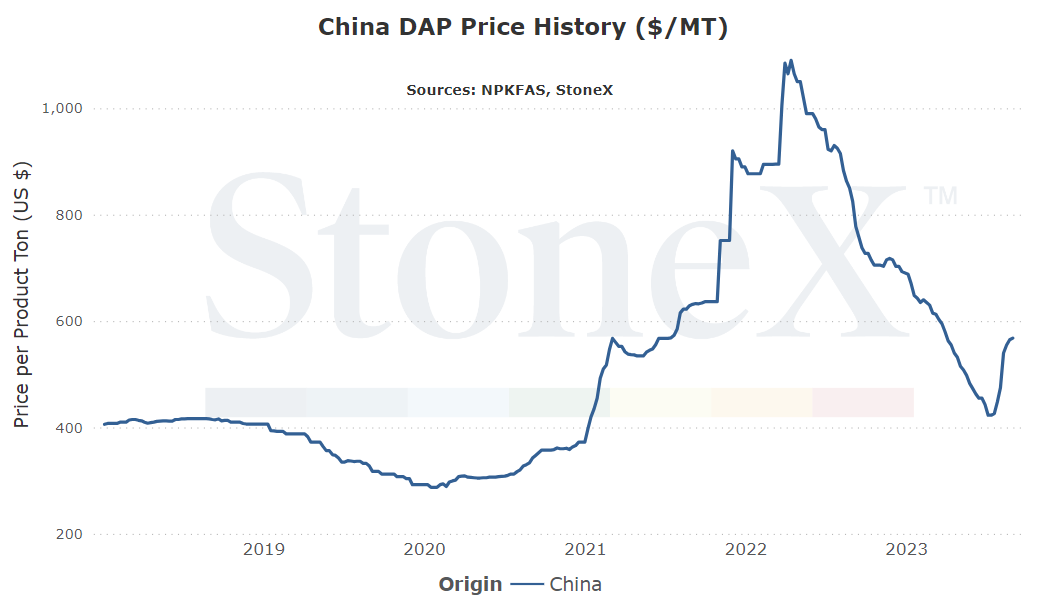
China DAP price comparison

Number 2 global exporter in 2021

image 73045

Price comparisons:

  • Vs 30 days ago - +19% or approximately $93 higher
  • Vs 90 days ago - +20% or approximately $95 higher
  • Vs 6 months ago - -8% or approximately $48 lower
  • Vs 1 year ago - -31% or approximately $258 lower

image 79298

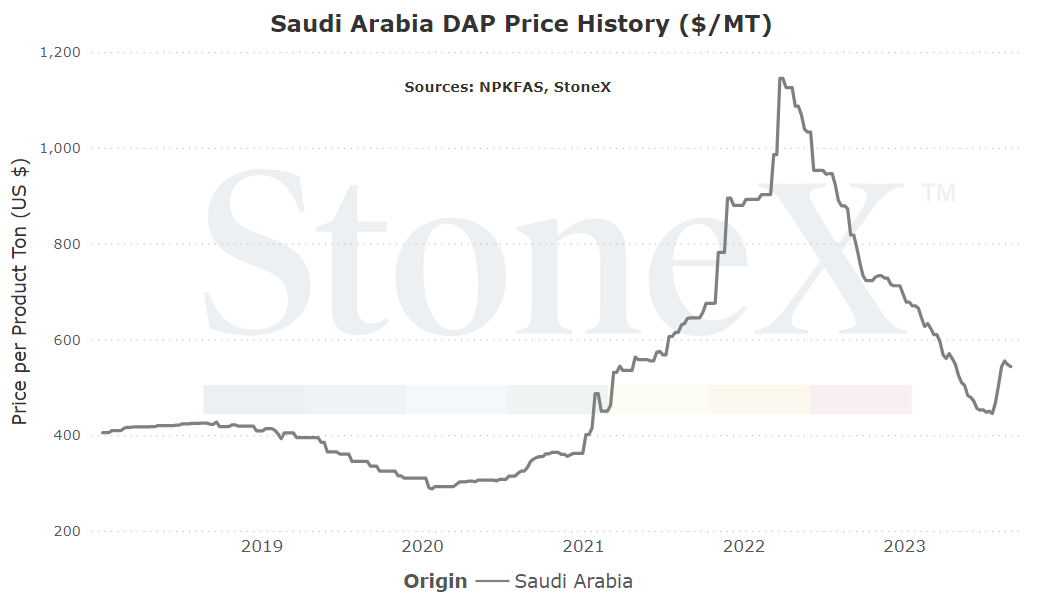
Saudi Arabia DAP price comparison

Number 4 global exporter in 2021

image 73046

Price comparisons:

  • Vs 30 days ago - +8% or approximately $40 higher
  • Vs 90 days ago - +13% or approximately $64 higher
  • Vs 6 months ago - -13% or approximately $80 lower
  • Vs 1 year ago - -34% or approximately $275 lower

image 79299

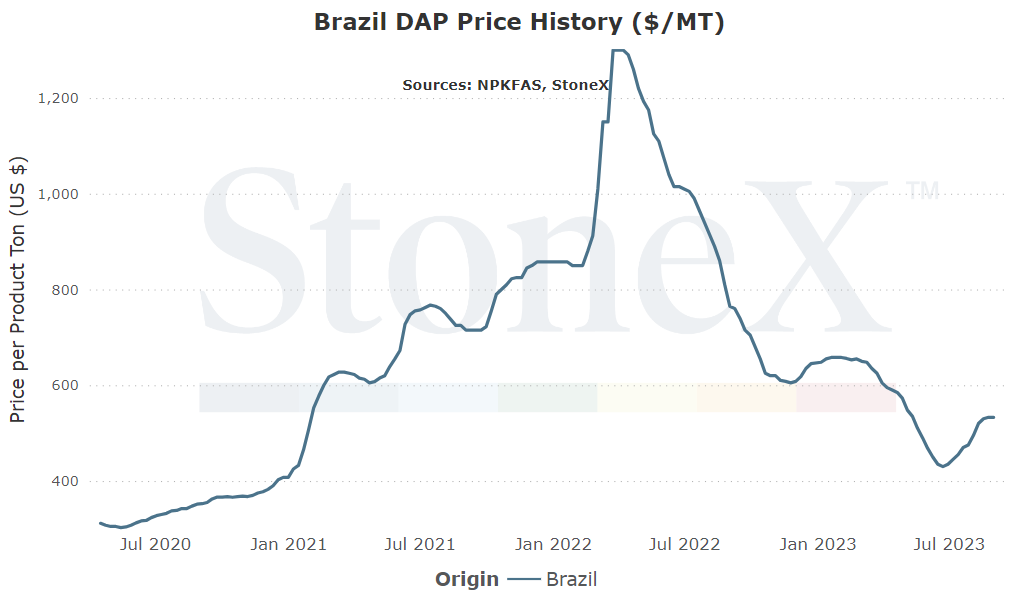
Brazil DAP price comparison

Number 2 global importer in 2021

image 73048

Price comparisons

  • Vs 30 days ago - +8% or approximately $38 higher
  • Vs 90 days ago - +14% or approximately $65 higher
  • Vs 6 months ago - -18% or approximately $118 lower
  • Vs 1 year ago - -30% or approximately $233 lower

image 79300

Bull/Bear Factors
Because no market is ever guaranteed to go higher/lower, we try to consider the factors that can sway values so that we are able to act when they occur rather than react.
Bullish Factors
  • Solid potash values may boost phosphate demand – as mentioned in the potash section, potash is currently very well priced and should drive solid demand in the coming months.  Most farmers I know will not pay to apply potash and phosphate separately.  They are a package deal.  With potash so well priced, farmers may capitulate and go ahead with phosphate...even if it is viewed as too high.
  • Chinese government can always restrict exports again – while we do not see this as a situation that will happen, it is certainly on the radar given political tension.  If their government pulls that trigger and stops exports again, the global S&D get very tight, very quickly.
  • U.S. blocking 3 biggest global exporters still – it is hard to really rebuilt inventories when you are blocking so much of global trade.  The U.S. is still imposing duties on China/Russia/Morocco in terms of phosphate.  As long as those restrictions are in place, there will be less competition across the N.A. region.  Less competition = higher pricing.
Bearish Factors
  • High price of phosphate may hurt fall demand – just because potash values are solid does not mean all farmers will use that to offset the price of phosphate.  Some will be the opposite and decide to delay out of spite of the current high value.
  • Global S&D appears to be normal...yet values are historically high – with Chinese exports returning, the world of phosphate is back to normal.  Yet, it seems as though no one has told phosphate prices.  If the S&D is back to normal and stays there, yet today values are high vs historical values, something has to break and from my perspective, it should be the phosphate price to break. 
  • Futures market continues to indicate a sliding price – obviously markets change and can change the futures market outlook but today, it is indicating a solid price decrease in the coming months.
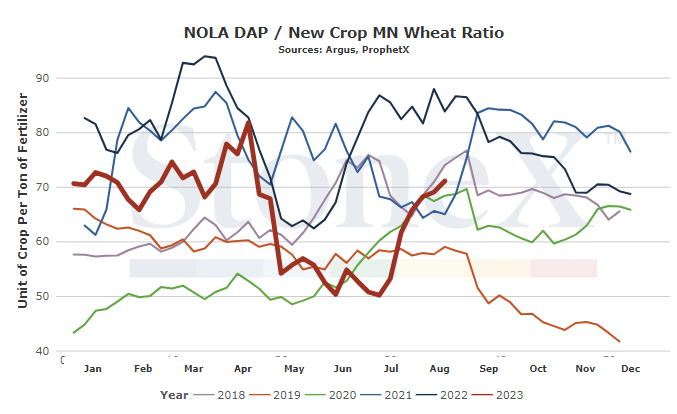
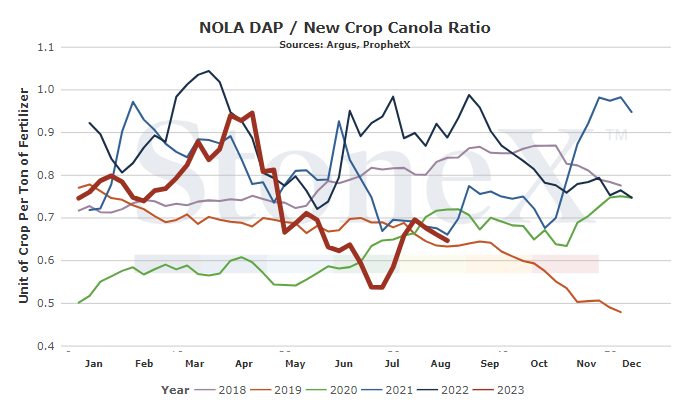
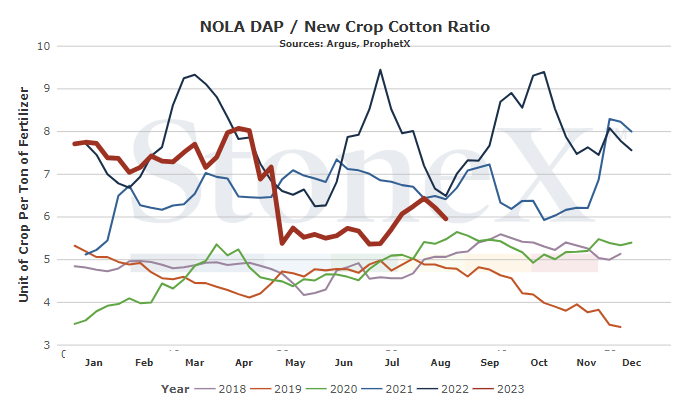
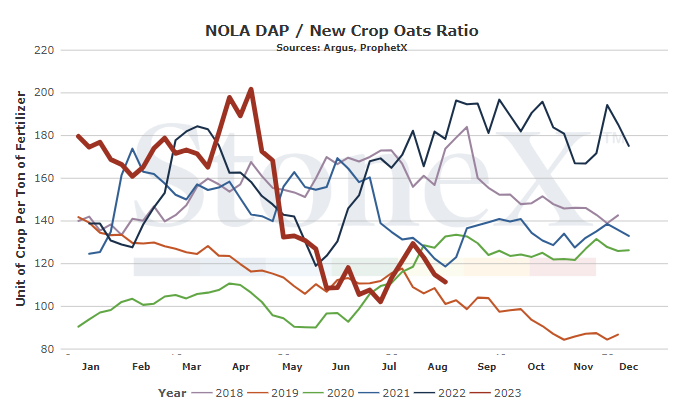
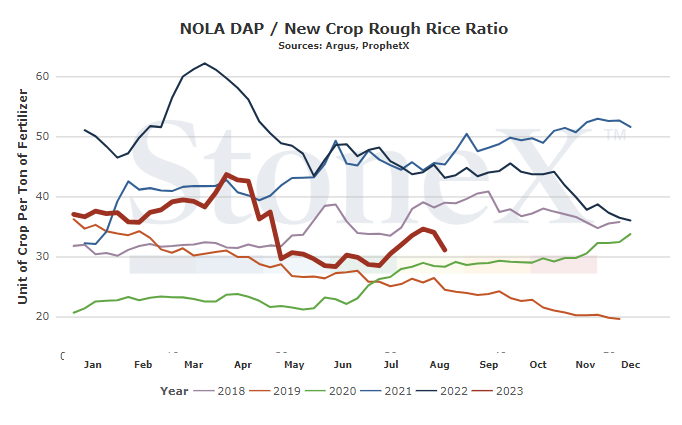
Where are the current phosphate/grain ratio values today?

We believe that only looking at the flat price of either grains or fertilizer can be misleading:

  • Only selling grain can hurt you if fertilizer prices rise substantially
  • Only buying fertilizer can hurt you if grain prices fall

We look at the ratio "value" to get a better indication of where we are or how many bushels of X does it take to pay for 1 ton of fertilizer.

Would you rather:

  • Spend 150 bushels to pay for 1 ton of DAP
  • Spend 80 bushels to pay for 1 ton of DAP

When we compare the current ratio value against recent years, we start to see if we are high or low.

YOUR VALUES WILL LOOK DIFFERENT

This graph looks at the NOLA DAP price vs the flat grain price. There are no logistics on either product. Your location will look different due to fertilizer logistical costs, grain basis, etc.

image 79301
image 79302
image 79303
image 79304
image 79305image 79306
image 79307
image 79308
image 79309
Josh Linville’s focal points
  • Demands reaction to the high price - this is my biggest worry today.  I think phosphate is overvalued for the current situation and ultimately, demand always gets the last say.  If we get to fall season and farmers collectively tell high phosphate values to go pound sand, this thing can turn even lower even quicker than the forward markets are indicating.  
  • Chinese export programs - chalk this one to a "no kidding" category but it is worth saying.  The world sure feels like it is picking sides for the next conflict.  The Chinese government could start restricting phosphate exports in an effort to hurt the world.  If we start hearing anything of that sort, we need to be aware of the possible outcomes...
  • Grain values over the next 3 months - if grain prices hold, we should be worried about fall phosphate demand.  If grain prices rise, it will help boost fall phosphate demand.  If grain prices fall, get away....

All data was sourced from StoneX unless otherwise noted.

This material should be construed as market commentary, merely observing economic, political and/or market conditions, and not intended to refer to any particular trading strategy, promotional element or quality of service provided by the FCM Division of StoneX Financial Inc. (“SFI”), StoneX Financial (Canada) Inc. (“SFFC”) or StoneX Markets LLC (“SXM”). SFI, SFFC and SXM are not responsible for any redistribution of this material by third parties, or any trading decisions taken by persons not intended to view this material. Information contained herein was obtained from sources believed to be reliable, but is not guaranteed as to its accuracy. Contact designated personnel from SFI, SFFC or SXM for specific trading advice to meet your trading preferences. These materials represent the opinions and viewpoints of the author, and do not necessarily reflect the viewpoints and trading strategies employed by SFI, SFFC or SXM. The FCM Division of StoneX Financial Inc., a subsidiary of StoneX Group Inc., is a member of the National Futures Association (“NFA”) and registered with the U.S. Commodity Futures Trading Commission (“CFTC”) as a futures commission merchant and commodity trading advisor. StoneX Financial (Canada) Inc. is currently registered as a Futures Commission Merchant or equivalent in all provinces of Canada and is a member of the Investment Industry Regulatory Organization of Canada.


  • Fertilizers

This material should be construed as the solicitation of an account, order, and/or services and represents the opinions and viewpoints of the individual authors or presenters. It does not constitute an individualized recommendation or take into account the particular trading objectives, financial situations, or needs of individual customers.


The views are current only through the date stated and are subject to change at any time based upon market or other conditions, and StoneX Group Inc. (“SGI”) disclaims any responsibility to update such views. Actual results, performance, or achievements may differ materially from those expressed or implied. Information is based on data gathered from what we believe are reliable sources. Past performance does not guarantee future results.


The StoneX Group Inc. group of companies provides financial services worldwide through its subsidiaries, including physical commodities, securities, exchange-traded and over-the-counter derivatives, risk management, global payments and foreign exchange products in accordance with applicable law in the jurisdictions where services are provided.


References to certain OTC products or swaps are made on behalf of StoneX Markets, LLC (SXM), a member of the National Futures Association (NFA) and provisionally registered with the U.S. Commodity Futures Trading Commission (CFTC) as a swap dealer. SXM’s products are designed only for individuals or firms who qualify under CFTC rules as an ‘Eligible Contract Participant’ and who have been accepted as customers of SXM.


StoneX Financial Inc. (SFI) is a member of FINRA/NFA/SIPC and registered with the MSRB. SFI is registered with the U.S. Securities and Exchange Commission (SEC) as a Broker-Dealer and with the CFTC as a Futures Commission Merchant and Commodity Trading Advisor. StoneX Financial (Canada) Inc. (SFCI) is registered in Canada and is a member of CIRO and CIPF. References to certain securities trading are made on behalf of the BD Division of SFI and are intended only for an audience of institutional clients as defined by FINRA Rule 4512(c). References to certain exchange-traded futures and options are made on behalf of the FCM Division of SFI. Wealth Management is offered through SA Stone Wealth Management Inc., member FINRA/SIPC, and SA Stone Investment Advisors Inc., an SEC-registered investment advisor, both wholly owned subsidiaries of SGI.

R.J. O’Brien & Associates, LLC (RJO) is registered with the CFTC as a Futures Commission Merchant and is a member of NFA.


StoneX Financial Ltd (SFL) is registered in England and Wales, company no. 5616586. SFL is authorized and regulated by the Financial Conduct Authority (FCA) (registration number FRN:446717) to provide services to professional and eligible customers including: arrangement, execution and, where required, clearing derivative transactions in exchange traded futures and options. SFL is also authorized to engage in the arrangement and execution of transactions in certain OTC products, certain securities trading, precious metals trading and payment services to eligible customers. SFL is authorized and regulated by the FCA under the Payment Services Regulations 2017 for the provision of payment services. SFL is a category 1 ring-dealing member of the London Metal Exchange. In addition SFL also engages in other physically delivered commodities business and other general business activities which are unregulated and not required to be authorized by the FCA.


This communication is issued in the European Economic Area by StoneX Financial Europe GmbH (SFEG). StoneX is the trade name used by STONEX GROUP INC. and all its associated entities and subsidiaries. StoneX Financial Europe GmbH (“SFEG”) is a securities trading firm registered in Germany under Company No. HRB 80844.


StoneX Financial Pte Ltd (Co. Reg. No 201130598R) (“SFP”) is regulated by the Monetary Authority of Singapore and is a Capital Markets Service Licence holder (for dealing in capital market products), an Exempt Financial Adviser (for advising on investment products and issuing or promulgating analyses/ reports on investment products) and a Major Payment Institution (for domestic and cross-border money transfer services).


SFP may distribute analysis/report produced by its respective foreign affiliates within the StoneX Group of companies pursuant to an arrangement under Regulation 32C of the Financial Advisers Regulations Recipients should contact SFP at (65) 6309 1000 for any matters arising from, or in connection with, this webinar.


StoneX APAC Pte. Ltd. (“SAP”) (Co. Reg. No 200616676W) is regulated as a Dealer (PS20190001002) under the Precious Stones and Precious Metals (Prevention of Money Laundering and Terrorism Financing) Act 2019 for purposes of anti-money laundering and countering the financing of terrorism.

StoneX Financial (HK) Limited (CE No.: BCQ152) (“SHK”) is regulated by the Hong Kong Securities and Futures Commission for Dealing in Securities and Dealing in Futures Contracts.

StoneX Financial Pty Ltd (ACN 141 774 727) holds an Australian Financial Service License (AFSL: 345646) for Dealing in Securities, Exchange-Traded Derivatives Contracts, OTC Derivatives Contracts and Foreign Exchange Contracts, and is regulated by the Australian Securities and Investments Commission.


StoneX Securities Co., Ltd. (“SSJ”) (Co. Reg. No 010401047199) is regulated by the Japanese Financial Services Agency as a Type-I Financial Instruments Business Operator (Kanto Local Finance Bureau (FIBO)No.291’), is a member of the Financial Futures Association of Japan for dealing and broking FX and FX Option transactions, and is a member of the Japan Securities Dealers Association for dealing and broking stock indices and option transactions.


Trading swaps and over-the-counter derivatives, exchange-traded derivatives and options and securities involves substantial risk and is not suitable for all investors. Past performance of any futures or option is not indicative of future success. Indicators are not a trading system and are not published as a specific trade recommendation. The information herein is not a recommendation to trade nor investment research or an offer to buy or sell any derivative or security. It does not take into account your particular investment objectives, financial situation or needs and does not create a binding obligation on any of the StoneX group of companies to enter into any transaction with you. You are advised to perform an independent investigation of any transaction to determine whether any transaction is suitable for you. No part of this material may be copied, photocopied or duplicated in any form by any means or redistributed without the prior written consent of StoneX Group Inc.


The report/analysis herein is not directed to, or intended for distribution to or use by, any person or entity who is a citizen or resident of or located in any locality, state, country or other jurisdiction where such distribution, publication, availability or use would be contrary to law or regulation.


© 2026 StoneX Group Inc. All Rights Reserved.

Satellite view of Earth at night showing illuminated cities across Asia and the Middle East

Discover more insights

Our subscribers have access to comprehensive market analysis from StoneX spanning commodities, equities, currencies and more.

StoneX: Your access to global markets

Our market expertise, advanced platforms, global reach, culture of full transparency and commitment to our clients’ success all set us apart in the financial marketplace.

Reach

With access to 40+ derivatives exchanges, 180+ foreign exchange markets, nearly every global securities marketplace and numerous bi-lateral liquidity venues, StoneX’s digital network and deep relationships can take clients anywhere they want to go.

Transparency

As a publicly traded company meeting the highest standards of regulatory compliance in the markets we serve; our financials and record of accomplishment are matters of public record. StoneX’s commitment to “doing the right thing over the easy thing” sets us apart in the industry and helps us build respect, client trust and new partnerships.

Expertise

From our proprietary Market Intelligence platform, to “boots on the ground” expertise from award-winning traders and professionals, we connect our clients directly to actionable insights they can use to make more informed decisions and achieve their goals in the global markets.