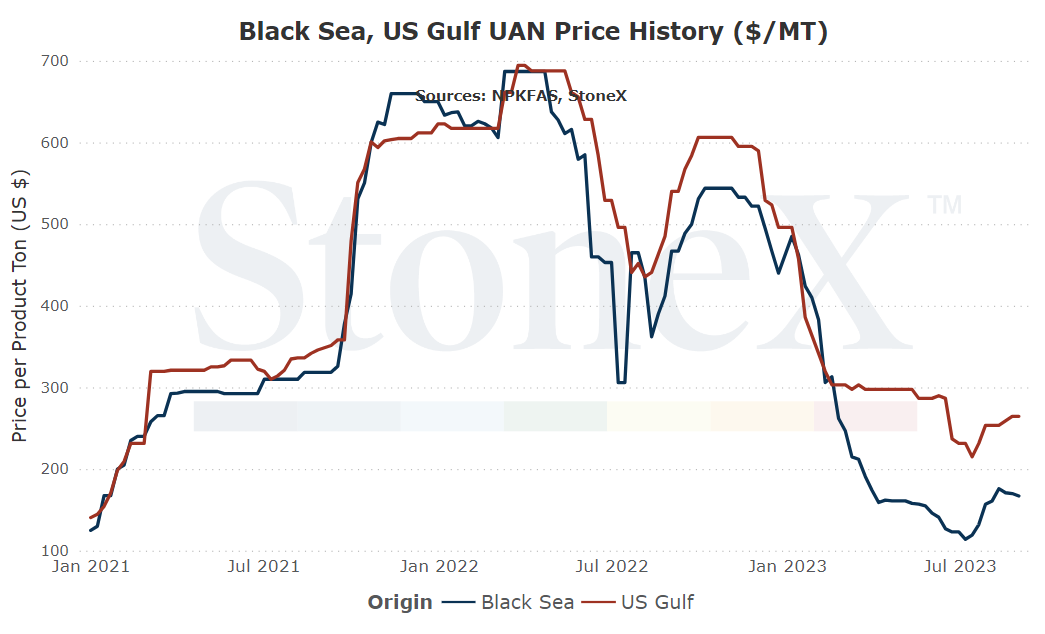
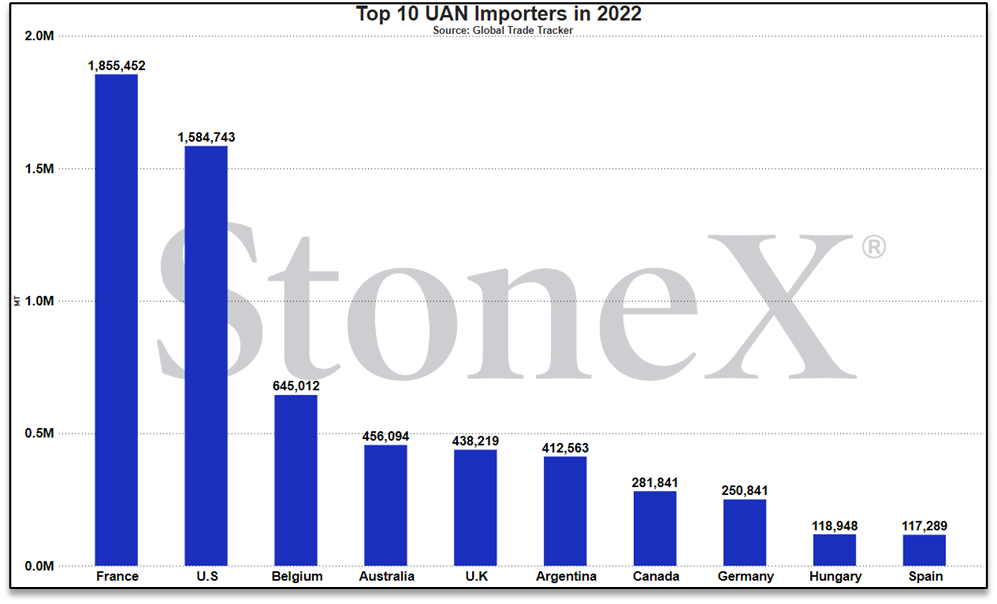
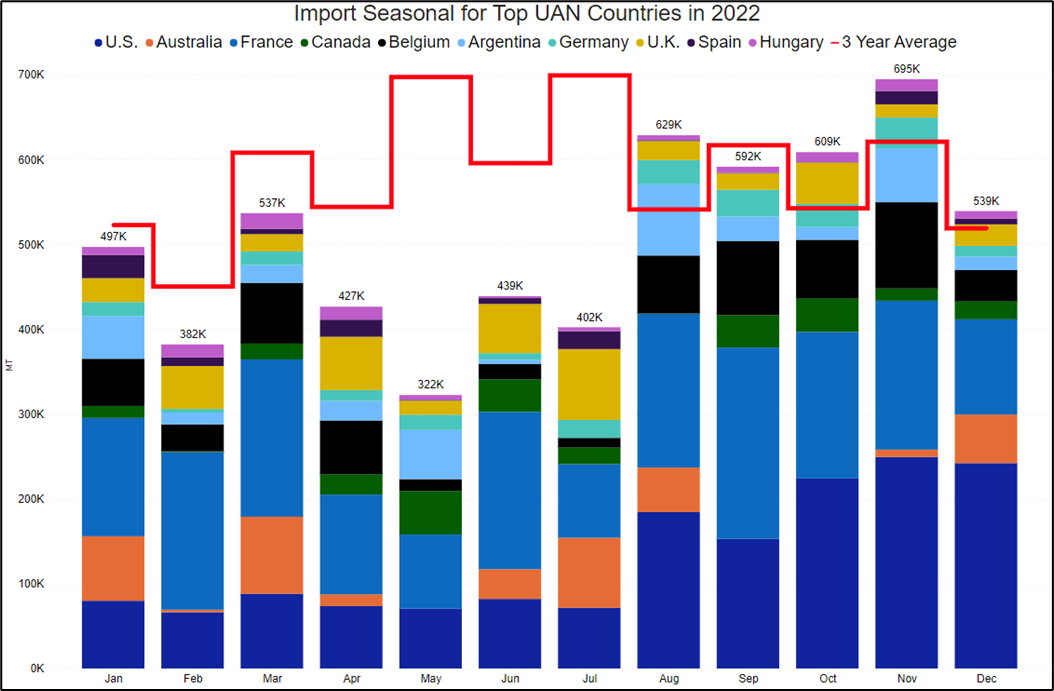
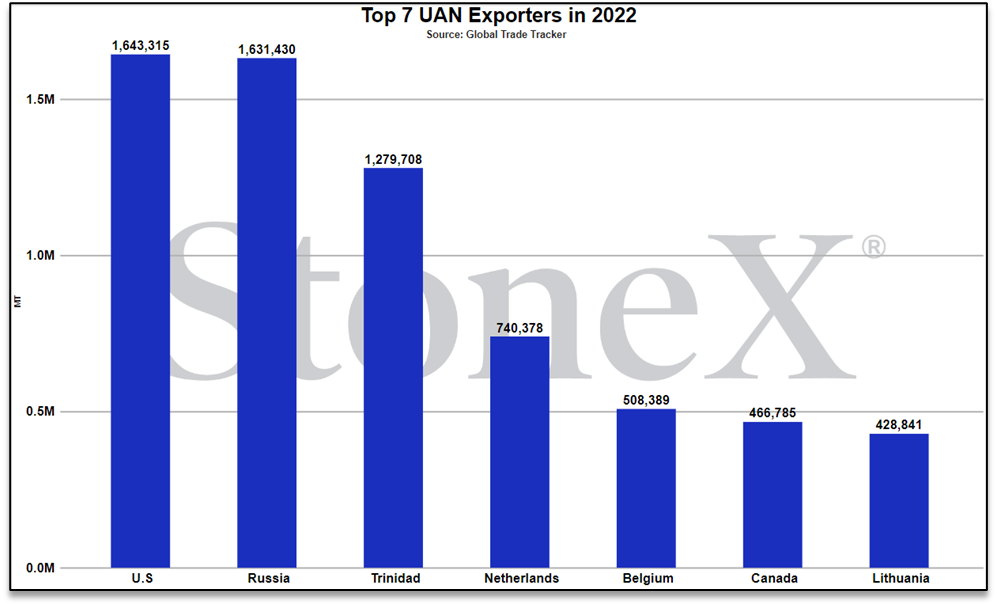
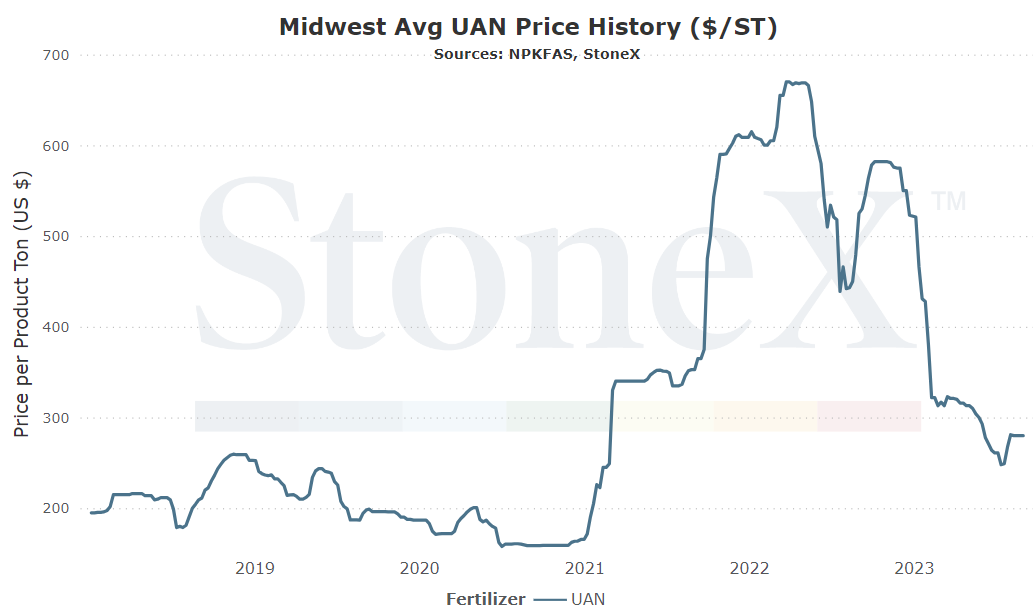
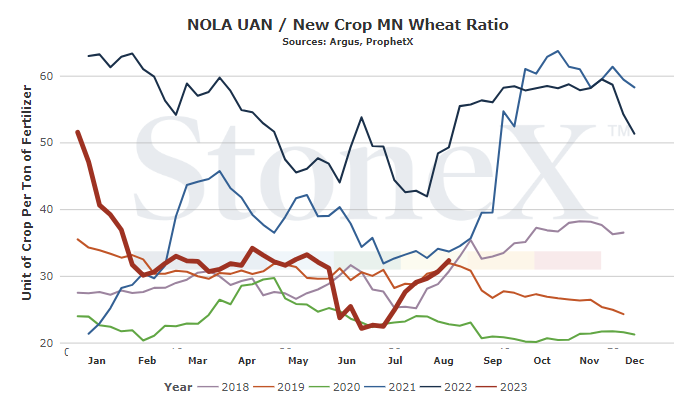
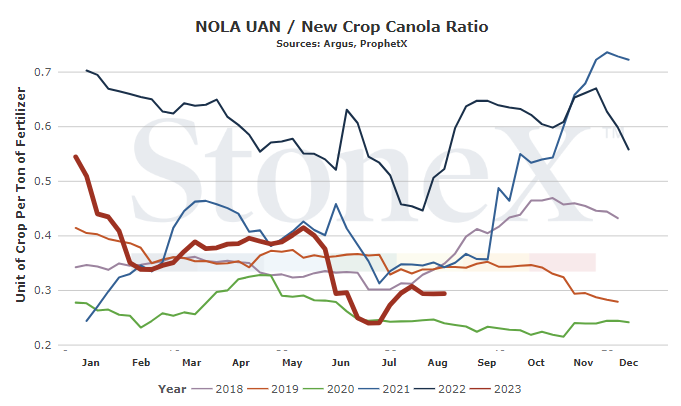
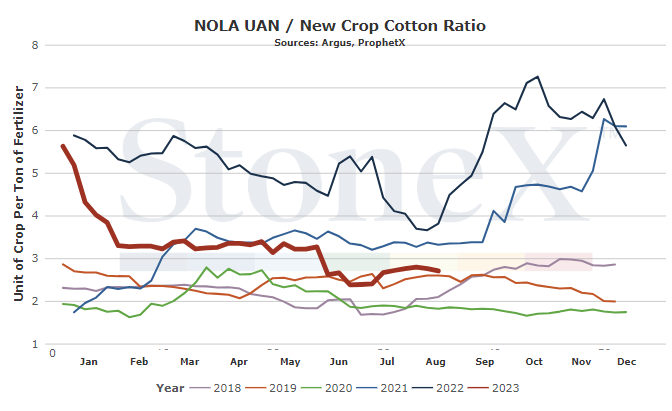
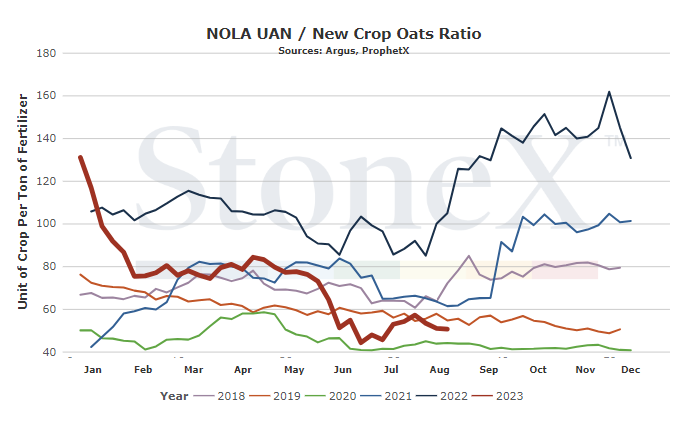
The intention of the below graphs are not to use to say "my price should be X based on this graph". These prices are derived from an FOB price point average. The intent is to show major global price movement trends. Your values will likely have significant basis difference (similar to your local grain price being different than the traded market price).
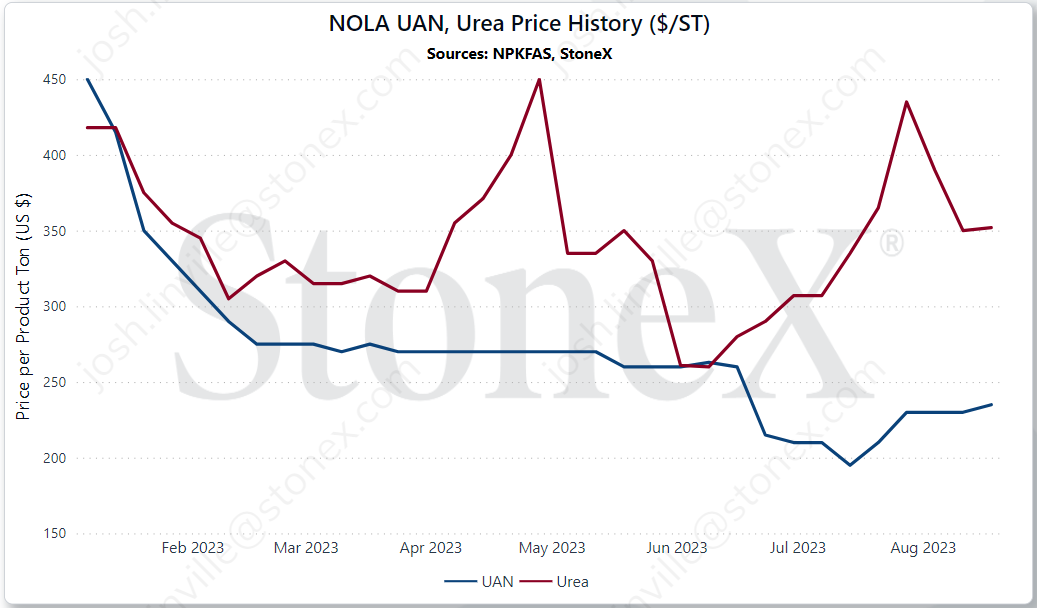
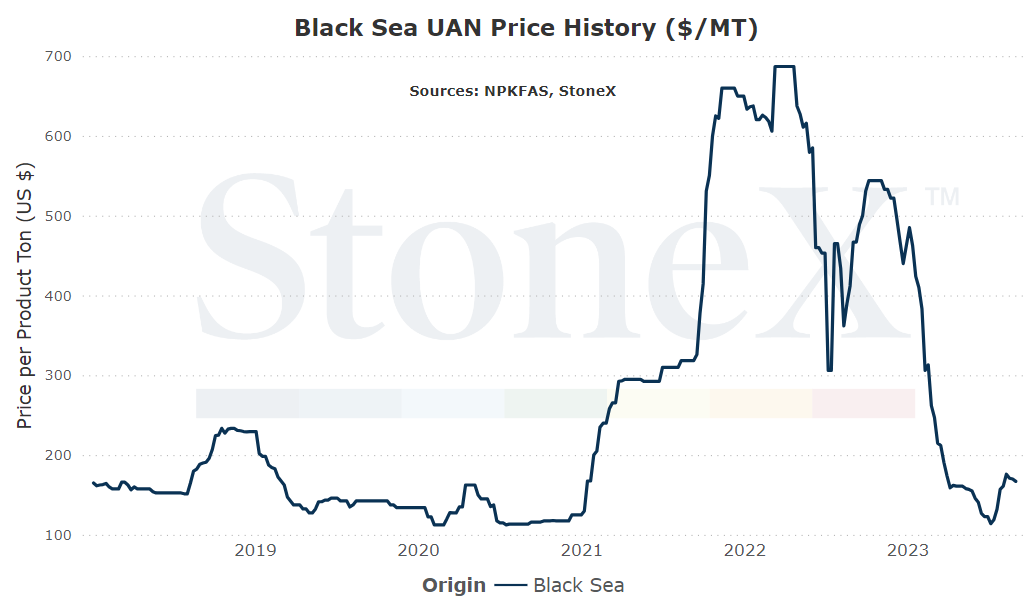
This graph is labeled as MT in USD currency.
What everyone wants to know first, what do we think will happen going forward
Global
This is a really tough call. Current values are still solid and with Russia continuing their thing in Ukraine, the possibility that the world shuts off Russian UAN is very real. On the flip side, demand still looks good going forward.
I know this isn't what you want but it is a coin flip with a tendency to be slightly bullish near term.
There are a lot of factors up in the air today that need to be figured out. As I said, if I have to make a choice, I'm going to say slightly bullish based on coming demand and the current decent price.
North America
N.A. buyers continue to enjoy having Russian imports keep a lid on price ideas. Also continue to hear manufacturers saying they will not repeat the sins of last year when they let prices get to high and they destroyed demand.
The tendency is going to be slightly bullish but shouldn't be crazy price moves.
Like the world, there are plenty of things that can disrupt this but today, the outlook is calm...and I like that!!!
should you buy your Spring '24 uan needs today?
If the current values work for your operation/region/etc., then that is your answer. Your local market needs to be considered as things like supply availability, demand timing and logistical issues can change the view. Just because we see the market strong or weak going forward does not mean it will translate to where you live. We are all a part of the world, but we live at home.
Global
If it makes sense, then yes.
I'm struggling to see a situation that completely breaks the market out of its current situation. However, that could very much be a situation. If the numbers work for your operation, then I wouldn't wait.
North America
So we will break this into two parts:
Preplant - I think it is worth at least a layer to be secured. Grain prices continue to hold. The N demand outlook remains solid. If the price works, lock in the value.
Sidedress - I'm less confident here. Not only is it a long time between today and that application period, I think we could see prices slide going into summer of next year. That would be much more "normal" and today, it seems things are getting back to normal.
...knock on wood...
general global import/export uan information
What has happened in the last 30 days?
UAN values flat as urea values fall
In recent weeks since the conclusion of the India urea purchase tender, a common topic has been coming up in conversation: "if urea is falling hard like it is, why isn't UAN?".
Now, this is a solid question. Typically, if urea values fall $100+ over the course of a couple weeks, it makes sense that we need to be on high alert for other N products to do the same. However, that only holds true if the alternative N products saw their prices rally with urea. That didn't happen this time.
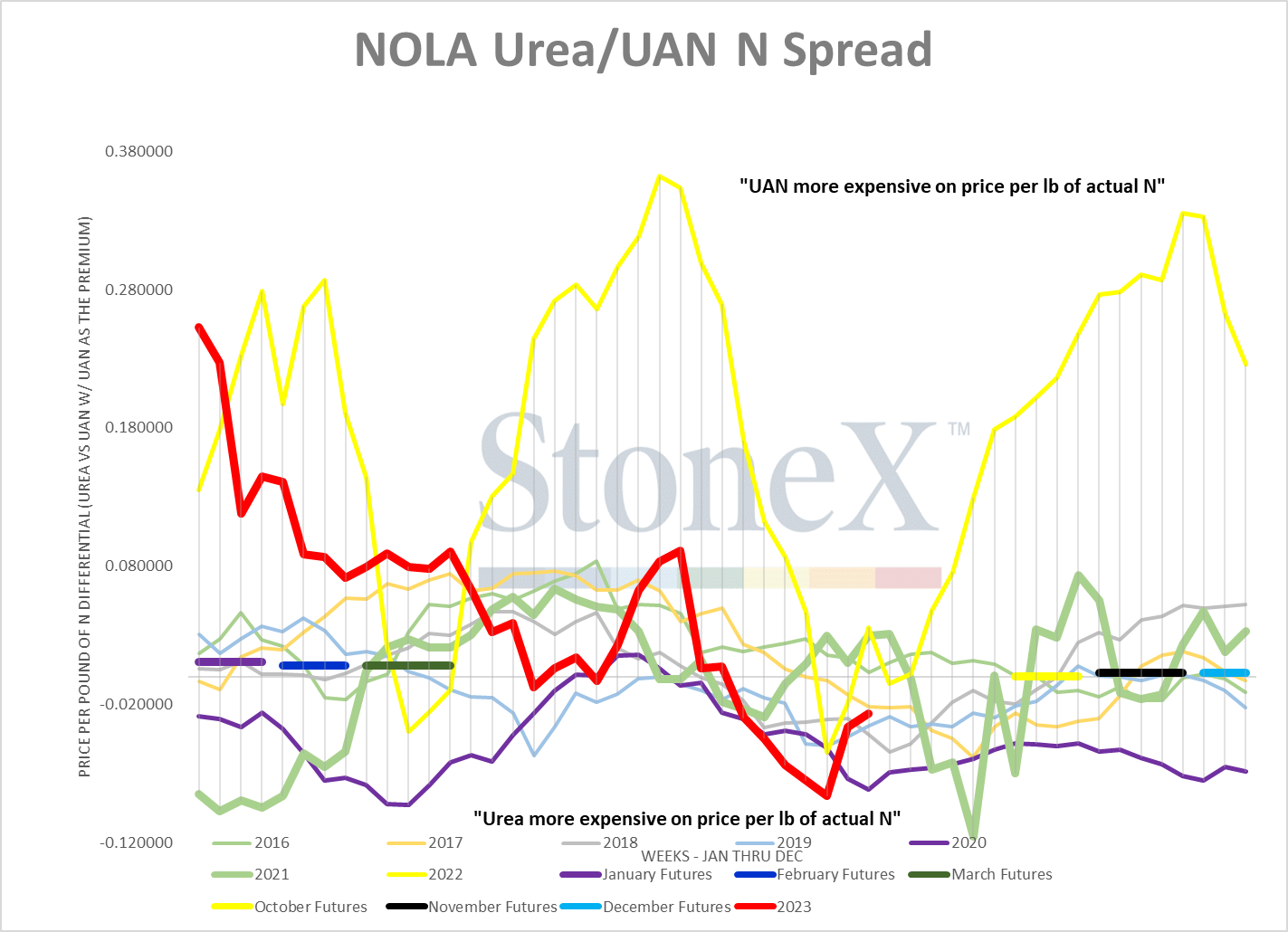
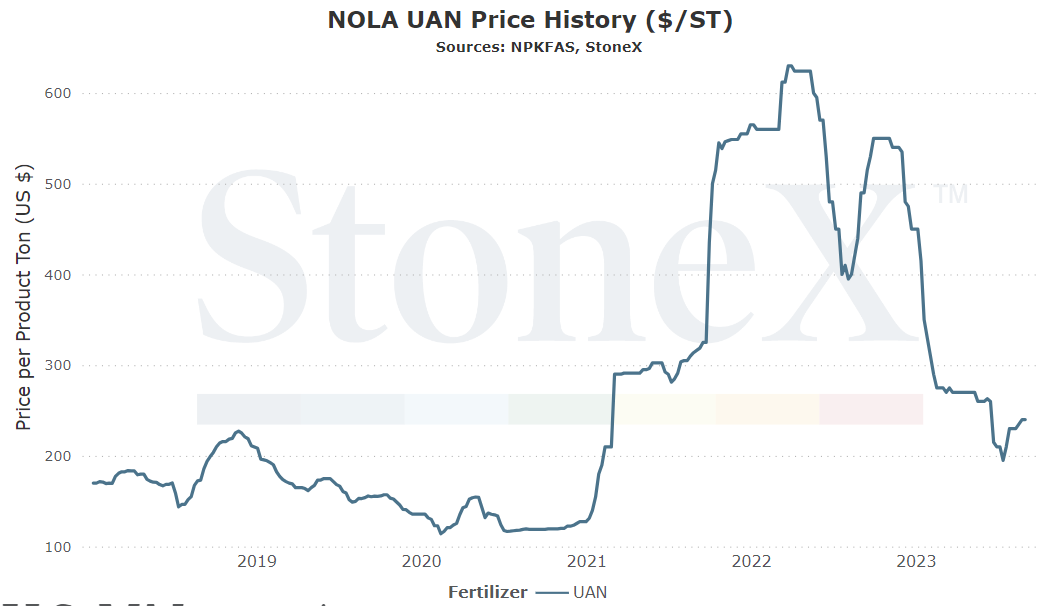
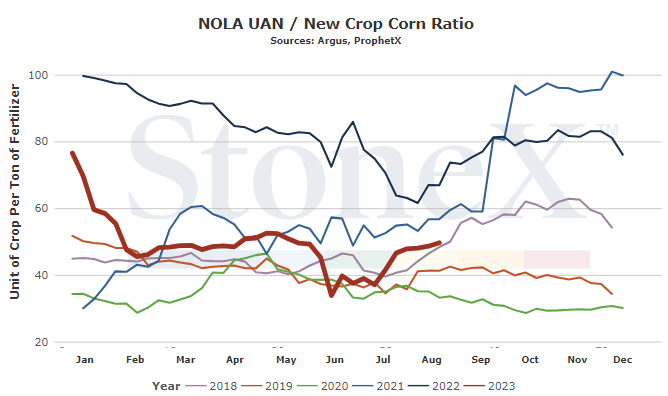
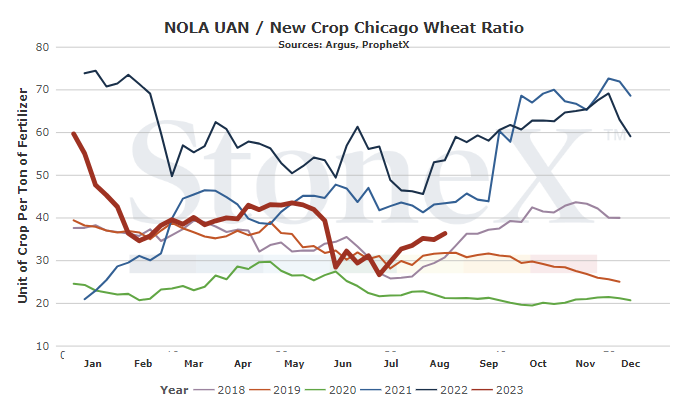
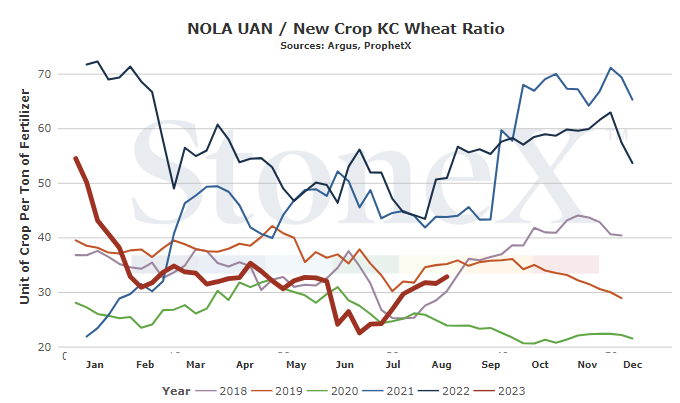
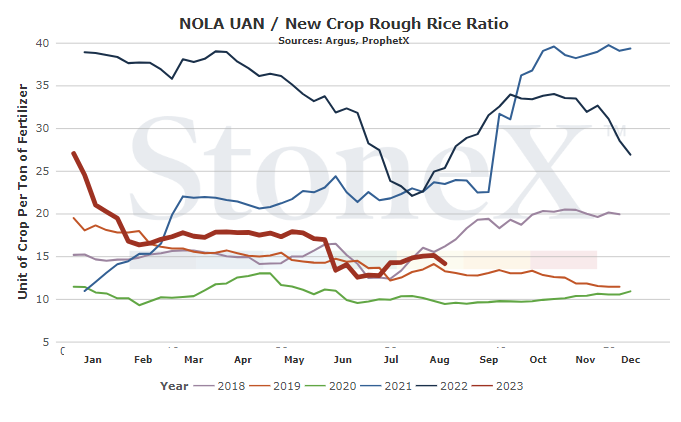
I'll focus in on the NOLA price differential on the graph below, though other world points reflect the same.
When India failed to secure enough urea on their previous urea purchase tender, the urea market got HOT. European buyers were locking up tons from North Africa almost daily. The near constant demand at higher and higher values helped to boost global price ideas. But at the same time, we saw UAN values dip as manufacturers rolled out summer fill programs and then values climb only slightly (in comparison to urea price movements) as solid sales were made.
Since the peak of the urea market and the eventual fall from high's, UAN has remained steady. This created a situation where UAN went from "cheap" on a price per pound of N basis vs urea to back in line today.
Simply put, there is no need for UAN to react to falling urea values as it largely didn't react to the higher values. N.A. manufacturers have been heard telling the market that they intend to not repeat the mistakes of last year and instead remain engaged with the market. What that means is not getting too proud of UAN values. This doesn't mean that values cannot go higher, it just means you see more situations like we have just gone thru.
Global (Russian) trade flows questioned going forward
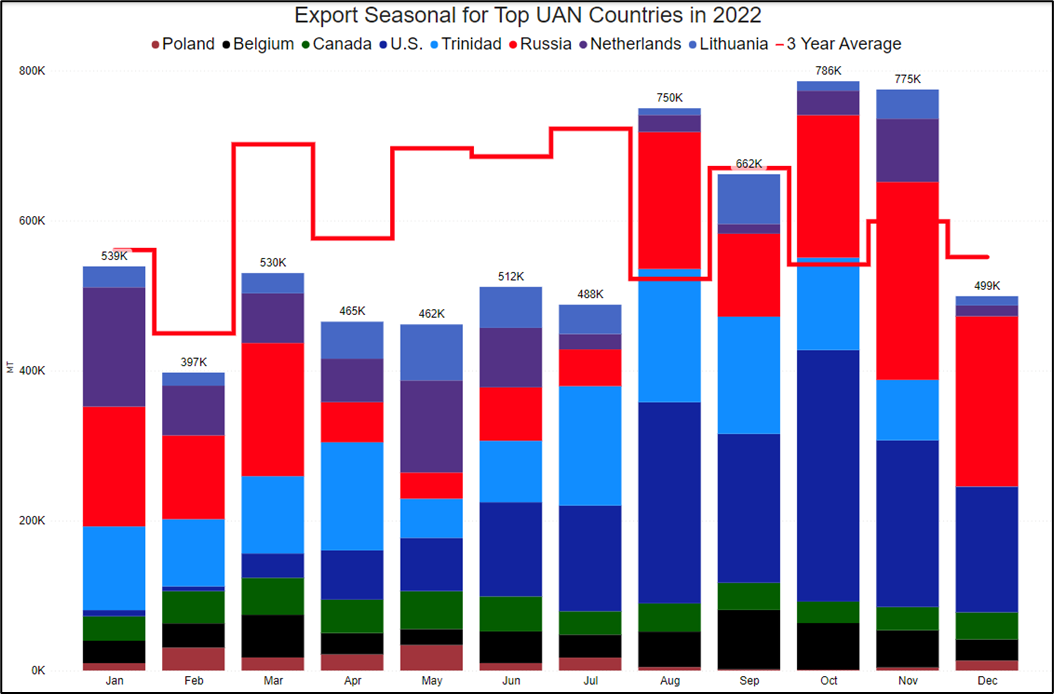
The questions of "where will Russian produced UAN ship to going forward" has been popping up in conversations of late. Today, we are not seeing any signs that they will be targeting anything different short term, but it is worth discussing what happens if they do.
From a global S&D, where Russia ships their product means very little, assuming their export volumes remain unchanged. Whether those tons arrive at the U.S., Australia, Europe, Canada, etc., if their volume is unchanged the S&D is unchanged and therefore, prices should remain unchanged.
However, if efficient trade flows are disrupted, it CAN have an affect. That is where we are today.
Following the Russian invasion of Ukraine, the world largely stepped up together and said no. While the world was weary of a direct military conflict, the business and political world ramped into high gear. Businesses quickly started to pull from Russia. Banks started telling businesses if they did business with Russian companies, they would lose their cash flow. Governments started to get on board...which is where it got tricky.
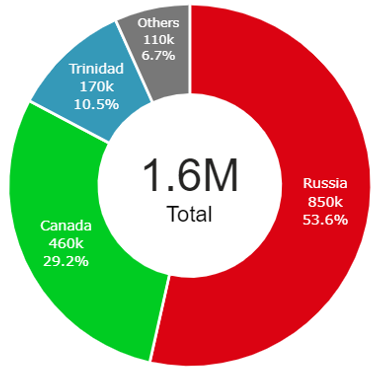
Many governments around the world condemned the invasion and made grand speeches about coming sanctions which many believed would include fertilizer exports, given Russian dependence on those income flows. Some countries like Canada and Australia, both typical receivers of Russian UAN, placed duties which effectively blocked the flow. Many European countries struggled to get funding approvals to purchase tonnages. The U.S., for all the talk, fell short of imposing duties on fertilizer and so it became the popular destination.
In a nutshell, Australia/Europe is seeing elevated pricing while North America is reaping the benefit of increased imports.
So what would happen if their tons could start arriving to Europe or Australia?
Likely both countries/regions would see prices dip as a more "normal" supplier started filling their needs.
Today, they have to compete against North American buyers to "take" tons and have them imported which means elevated values. If Russia were allowed to come directly, Europe likely sees values fall while Russian netbacks improve. For North America, with Russian tons no longer flooding the marketplace, that lack of competition would allow domestic manufacturers to be more proud of their product.
For those of you in Canada, it is worth noting that while Russian tons are not able to come directly, we still operate as a region. Russian tons are arriving in a big way to the U.S. This works to "force out" U.S. produced tons to help balanced the S&D. While some of these tons are flowing to Europe, many of them are getting pushed to Canada. Russia shoves its way to the U.S. which shoves U.S. tons to Canada. The overall N.A. S&D remains relatively unchanged.
As far as what will happen, I have no idea. Most of this is politically driven and I'm not going to even try and say what will happen from that POV. This is merely trying to shed light on what could happen if changes start being made.
European restart hopes dashed as Dutch TTF values rise/global nitrogen values fall
When we look at global urea and NH3 production, the European region drops on the list. They simply are not big power players in those markets. However, on the UAN front, they typically account for 1 out of every 5 tons produced around the world. So while the world market can somewhat "ignore" production rates in Europe from the urea/NH3 perspective, it needs to take note on the UAN side.
A quick background:
Last year, Russia began to punish Europe for its backing of Ukraine. How dare they support a country that had done nothing to justify Russian invasion...anyways. Russia had always been a major supplier of natural gas thru the Nordstream pipelines. In order to impose pressure on government heads, those flows were slowed and eventually stopped, likely with the idea that crazy high gas prices would cause populations to revolt again the governments. The market did exactly what they expected. The Dutch TTF, the main natural gas market there which is normally in single digits on an MMbtu unit, moved to a high of $103 in August 2022. As a result, all but 25 - 35% of European nitrogen production went offline. It was simply too expensive to produce anything...and the outlook was bleak.
However, as markets always do, a semblance of normal was found. Demand fell back. Imports started to make up a large difference of what was lost from Russia. The S&D started to find normalcy and with it, nitrogen production improved. Today, with values back in the $10's, nitrogen production is approximated around 75% or normal. Still not 100% but it was working that direction.
Today, we have seen natural gas values relatively stagnant to slightly bullish which is causing some concern. If those values start to rise, it could cause more producers to take their plants down once again. While we are not seeing signs of that today, it is certainly on the radar and given Europe's importance from a production POV, it could/should have ramifications on global S&D's as well as prices.
Again, this isn't meant to alarm anyone into doing something. It is just trying to shed light on a situation that needs to be tracked. If we start seeing that Dutch TTF value move higher and/or we hear reports that plants will start being slowed/stopped, we need to be aware because it will affect UAN markets around the world.
Where are current values in relation to the past