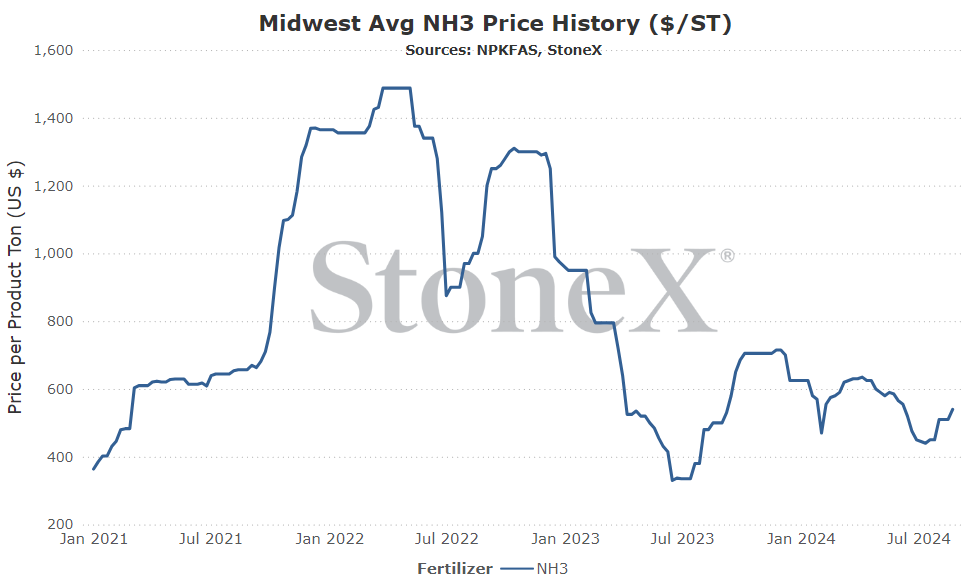
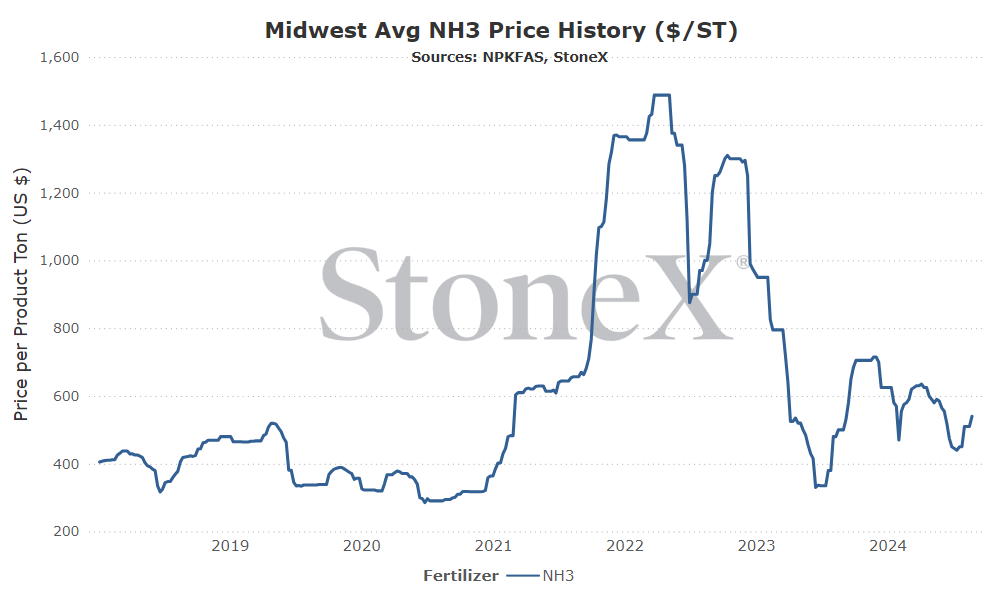
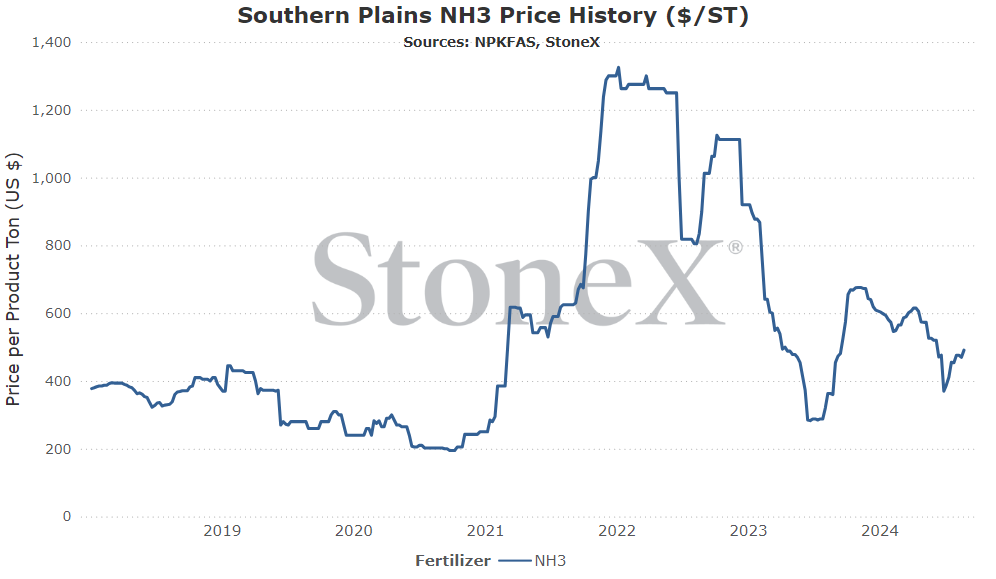
The first graph is the AVERAGE of the entire Midwest U.S. region. That means your local value WILL be different than what the graph reflects. Please do not take this into your retailer and say "why isn't my price the same as here". That is comparing apples to oranges. You might be on the cheaper or more expensive side of this graph. This doesn't take into account logistics/storage/interest/insurance/shrink/etc.
This graph looks at the price from a short ton and USD currency POV.
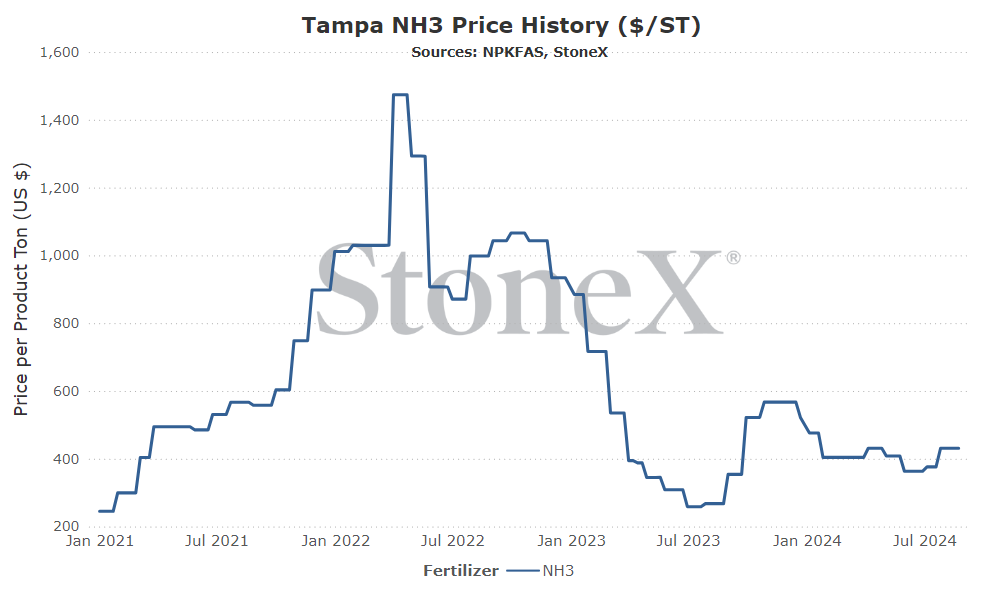
This second graph looks at the price set for Tampa NH3. This value does not have a high correlation to Midwest values. It is a talking point used when prices are rallying...yet somehow gets skipped on the way down. This price is more an indication of the global price. This price is set by two parties (purchaser - phosphate producer in Florida / seller - international producer providing NH3 to FL phosphate production).
This graph CAN be used as an indication of global market price direction/trends. This graph SHOULD NOT be used to determine a Midwest value. Tonnage is listed in short ton and currency in USD.
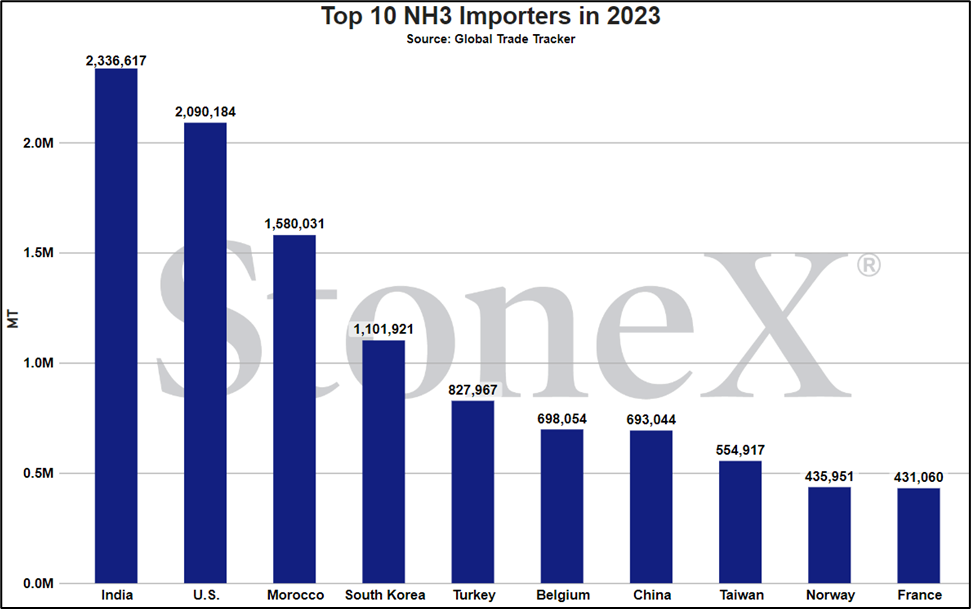
It is hard to see all the production/export/supply issues around the world and think that values cannot go higher. Russia, historically the world's largest exporter, didn't even break the top 10 in 2023. The EU, while expected, continues to suffer from high natural gas prices and so production rates have suffered and they continue to be an unnatural buyer. Trinidad production has suffered due to poor gas supplies. Demand remains firm.
I will be upfront and admit that I am writing this AFTER the September Tampa NH3 price got set at $55 higher than August. With that statement, I am still bullish going forward...but maybe not as much as has been seen the last couple months. Unfortunately, supplies are still tight and demand still solid. That is a recipe for supported markets.
North America
When we look at 2025, we continue to see solid nitrogen demand. Our forecast for U.S. corn continues to sit at 91.5M acres. For the most part, that crop requires nitrogen and NH3 continues to play a part. I would be lying if I didn't say that I do have some reservations about the fall/spring split. I am a little worried that typical fall appliers will drag their feet because current conditions suck. Rather than locking in a poor situation today, they can wait until spring and hope for something better...but that runs risks as well.
For the most part, fall appliers stick with a fall program. Some think the agronomy perspective of doing it this way is superior. Some fear trying to do everything in the spring. Regardless the reason, it is not typical for fall folks to switch to spring and vice versa. So if the acreage is appearing relatively unchanged and that means nitrogen demand remains unchanged, it is hard to see a huge fall impact.
With that, I think inland values will continue to be supported. Manufacturers have built a very healthy sales book so appear to have little need to approach the market near term. Demand continues to look good this fall. Harvest should be on time so as long as Mother Nature plays nice, we should have a solid period to apply. All of this coupled with a supported global outlook...it is just hard to see prices down unless weather is horrible in November/December but ever that would cause huge issues in the spring.
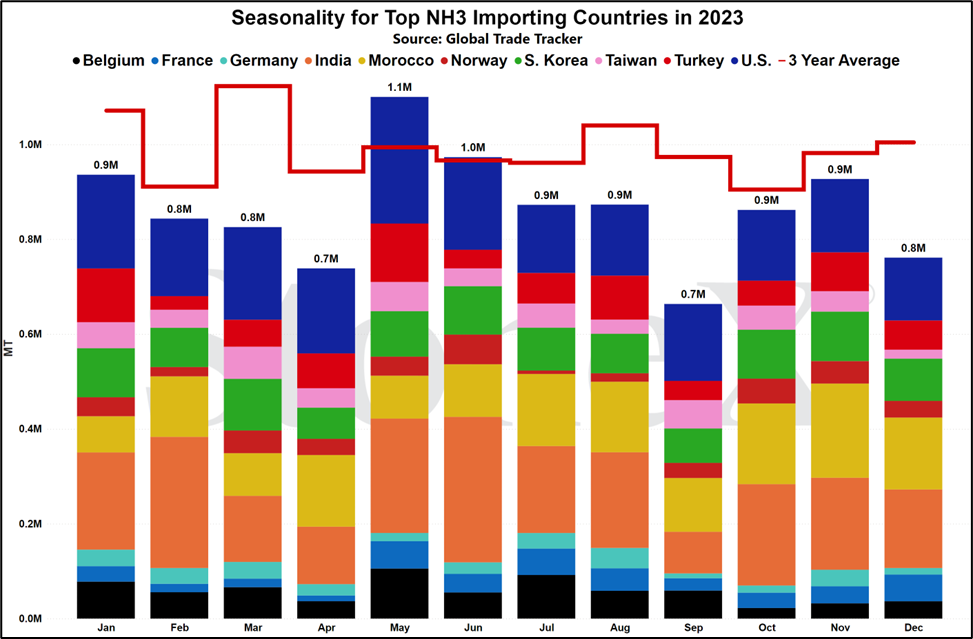
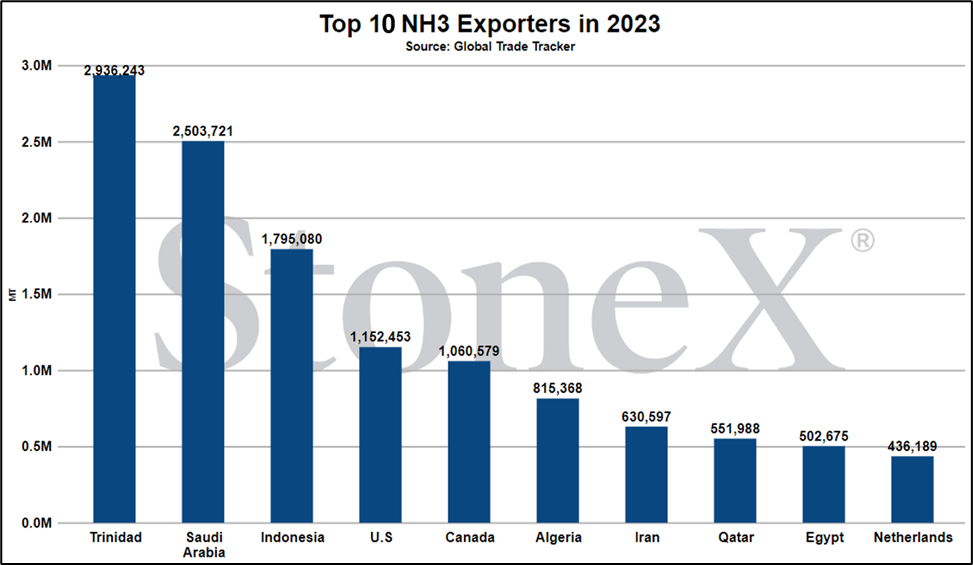
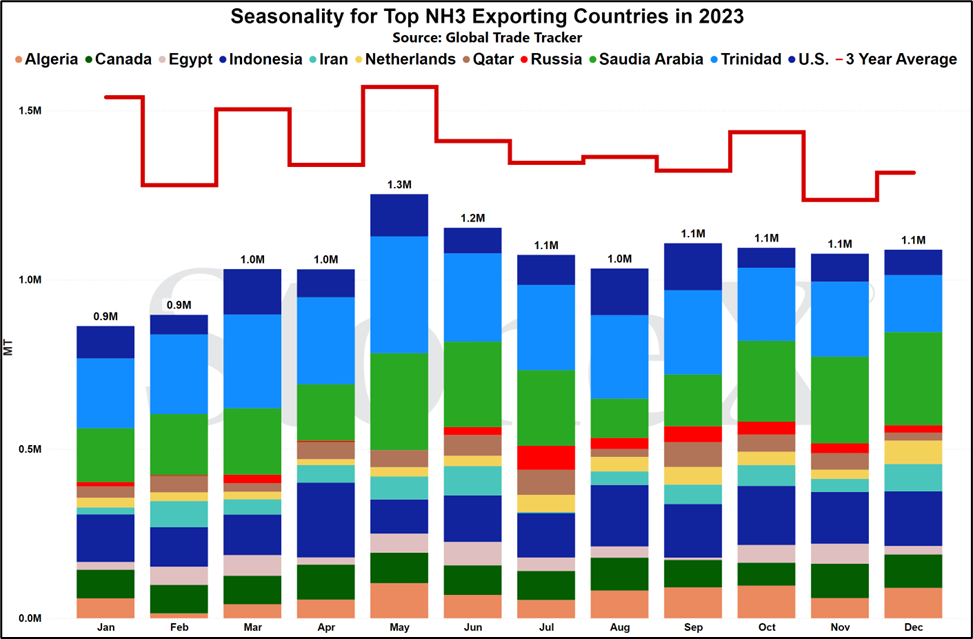
Global market supply update
Unfortunately, production and supply issues continue to pop up or continue for NH3. That is a big reason why Tampa NH3 has rallied $115 since July (more on that below). Let's go thru the list:
Russia (bad for farmers) - in 2021, Russia was the world's largest exporter of NH3 with 4.4M tons departing their shores. In 2022, they dropped to 7th largest and only exported 907K tons. In 2023, they did not make the top 10 list. Guess that is what happens when you invade the country that your export pipeline runs thru. Unfortunately for the world of NH3, that means that the largest exporter continues to be gone (we expect that Russia will not make the top 10 list for 2024). However, there is hope in sight. We understand that work on their new Teman facility continues and expectations are that they will be exporting product...sometime. Go thru all the newsletters since the beginning of the year and you will see repeated examples of us saying "eventually". We do not know the timing but if/when they return, it should help prices drop.
Trinidad (bad for farmers) - in recent years, Trinidad has struggled with unreliable natural gas supplies vs its demand. The result is that we can see nitrogen production slow or stop from time to time. Unfortunately, that has been happening in recent weeks. For the longer term, things should improve. Trinidad approved the exploration and development of new territorial waters. When these areas get developed, it should provide adequate supplies and these hiccups should fade away (we hope). However, in the meantime, we are seeing hiccups. That means that their export capacity struggles and presents opportunities for other local exporters...like the U.S.
EU region (bad for farmers) - this story has been in place since late 2021 when Russian natural gas flows were stopped. The world quickly understood how import Russia was as Dutch TTF (Europe natural gas) values went from single digits to a high of $103MMbtu. Since then, we have seen values plummet. They reached a low of $7MMbtu this last winter after warmer than normal conditions destroyed demand but have since rallied back to the $12 - $13 range. As a result, nitrogen production rates remain around 75% of normal and Europe has become an unnatural buyer to help subsidize what is not being produced. That is just another mouth to feed when food is scarce.
Verdigris, OK (bad for farmers) - storms blew thru Oklahoma and put the nitrogen production plant in Verdigris, OK square in the crosshairs. While details of damage are hard to find (this is by design as the plant owner usually likes to stay quiet on these sorts of things), we have not heard that loading has resumed and that usually isn't a great sign. Hopefully any damages can be repaired quickly and any impact to supply continue to stay minimal...but if not, it could hurt for the surrounding area.
Global demand remains firm (bad for farmers) - this is from an agronomic and industrial POV. From the industrial side, we are always watching for the next recession. If there is one, economies and manufacturing slow down and as a result, industrial demand for NH3 should fall. That pushes more supply toward the ag side of the business (i.e. hopeful lower prices). While we have been watching for it, there are still no indications of it happening today. On the ag side, nitrogen production continues and direct application (N.A.) looks solid for the coming fall/spring cycle with crop acreages similar to last year.
Unfortunately, supplies are tight right now. They can improve. Russia returning would be a big help but we have not seen that.
What this means for farmers
If demand continues to look steady (it does from my vantage point) and supplies are lower, Econ 101 tells us that prices should rise (which they have been).
For the North American direct application, this situation further emboldens manufacturers on their price ideas. They know as much as we do that next years crop mix requires solid nitrogen application. They also know that fall NH3 appliers typically stay fall NH3 appliers.
This is a boost for the sell side.
Tampa September price set $55 higher (August was $60 higher than June)
Earlier this week (last days of August), the September Tampa NH3 price was set and it was another doozy. The price jumped another $55 vs August which had jumped $60 from July. $115 over 2 months is not a small move.
The move higher was expected, but the size of the jump still caught us off guard. However, it should not have. As the list above shows, there are some decent sized holes in the world of NH3 and it is no secret. The biggest driver from my POV was Trinidad production hiccups. The loss of that production means that U.S. based NH3 suddenly had more destination options to backfill the loss. While I would love to tell you that all N.A. produced NH3 stays in N.A. I would rather not lie. Tons flow to the best netback.
Going forward, if Trinidad can get back to normal, that should help to keep from big increases but our tendency is still toward the higher side today.
What this means for farmers
The Tampa price is a funny thing. When it rallies, it can be used as a sales discussion on why prices need to go higher. When it falls, suddenly it is nowhere near as important. In a past life...I've had these exact conversations.
Still, Tampa does continue to point to a tightly supplied global market where prices "should" be trending higher until it is fixed. I am not worried that this will result in less tons being available inland this fall/next spring, but it makes sense that prices are rising.
Trinidad production hiccups gives U.S. export opportunities
As mentioned above, Trinidad NH3 production has taken some hits as rates have had to slow due to less natural gas being available. In the longer term, these issues should die out as new production in untouched territorial waters get developed but that is talking in months/years, not days/weeks.
What this means for N.A. is that new export sales options have popped up in the last month. If Trinidad is unable to produce the tons, they U.S. manufacturers are well suited to fill the role.
What this means for farmers
This is just another reason why values can go higher. The loss of some Trinidad production means the loss of some supply which leans on the S&D. Trinidad having less product means the U.S. can export more with less competition. It does not guarantee prices will go higher, but it certainly doesn't hurt.
Midwest demand outlook solid, values rising
Today, the emotional side of the market is saying "I am not going to apply a single pound at these grain prices". However, the fundamentals tell a different story.
For North American farmers who direct apply NH3, it is hard to move away from "normal". Farmers that typically apply in the fall stick with that approach. It may have to do in a belief that it is superior from an agronomic POV. It may have to do out of fear of not getting everything done in the spring. Regardless, fall folks stay with the fall. Then the outlook further presses the issue. We continue to forecast 91.5M acres of corn for 2025. I know the farm economics suck, but so does everything else. That number will likely change and change multiple times between now and spring '25 but for now, that is what we are using...and that means big N demand.
Not only this, but we continue to see plenty of feedback/data/etc. pointing to solid purchases on manufacturer fall prepay programs. If a manufacturer has a solid book of sales on, there is much less reason to drop the price because there is no discomfort.
As we look to fall, we continue to think it will be around 2 - 2.1M tons applied with spring being around 1.8M. As always, we have to remember that Mother Nature has the last word. Last fall was PHENOMINAL from a weather standpoint. Harvest wrapped up on time and weather allowed farmers a wide open window until nearly Christmas. That created one of the best fall's we have on record. We could have the same...or it could turn cold/wet and nothing gets done. As far as what happens going into Q1 will depend a lot on weather but for the fundamentals we have to go on today, fall should be good.
What this means for farmers
This means I do not see a lot of hope that prices can fall before spring. I wish I could tell you otherwise but:
- Demand looks good
- Solid sales book for the manufacturer
- Global S&D remains tight and continues to rally
- Weather is the only possible roadblock I can think of
I've been wrong before and I will be wrong again but looking at the cards as they lie, it is hard to see values doing much different than flat to higher.
U.S. Midwest Wholesale price average
Vs 30 days ago - 20% or approximately $90 higher
Vs 90 days ago - -8% or approximately $45 lower
Vs 6 months ago - -8% or approximately $50 lower
Vs 1 year ago - 8% or approximately $40 higher
U.S. Southern Plains price average
Vs 30 days ago - 8% or approximately $38 higher
Vs 90 days ago - -7% or approximately $35 lower
Vs 6 months ago - -13% or approximately $74 lower
Vs 1 year ago - 36% or approximately $131 higher
- Russian exports (historically worlds largest) still largely non-existent - while work toward a new export facility based in Taman continues to be discussed/expected, so far it doesn't look like it has made substantial strides in actual exports. That means the world's largest exporter is still largely absent...and millions of tons of supply are missing.
- Trinidad hiccups point to shaky supplies - global S&D was already snug and leaning to the higher side. Having a manufacturing/exporting country like Trinidad have production issues due to gas supply problems only worsened the outlook. It reminds the market of how quickly production can be lost as well as lowering available supplies.
- EU remains unnatural buyer due to high nat gas costs - this story doesn't look to change anytime soon as Dutch TTF value continue in the low $10 range. EU production rates continue to hold in the 75% range of normal and the high price of gas means some plants are reliant on cheaper import product. That creates an unnatural buyer in the world which in turns help keep prices supported.
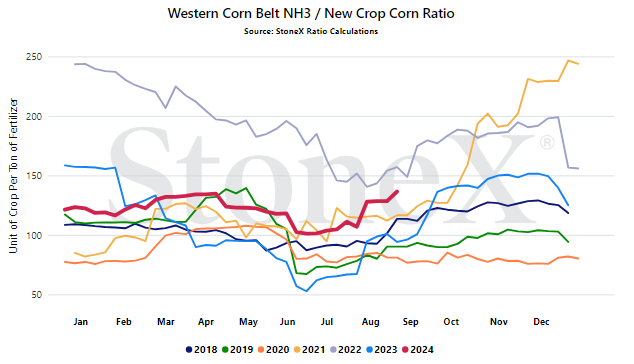
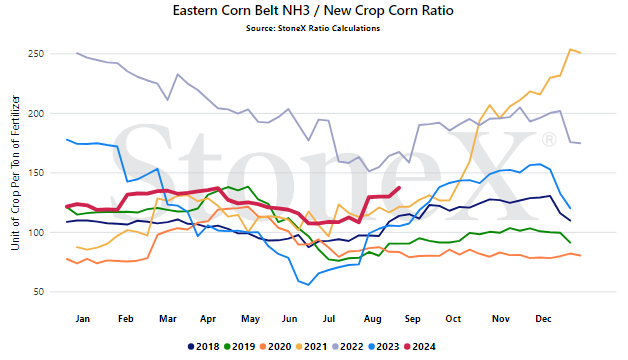
- NH3 values vs grain prices could have fall applicators thinking twice - the NH3 price has been creeping higher while grain prices have been dropping almost daily. The result is that we are suddenly looking at ratios that are on the higher side. Now, whether they are high enough to stop typical fall appliers from going forward remains to be seen. I have my doubts, but it is getting bad enough that the possibility needs to enter the chat.
- Russian exports are expected back...at some point - I hate this point because I have been wrong on it for so long. First we thought very early 2024. Then Q1. Then sometime Q2/Q3. Now maybe Q4 but more likely 2025. Still, at some point the world's largest exporter has to return to the market (in theory) and when they do, a lot of supply returns.
- Poor fall weather outlook - yes...I am stretching for this one and even if it happens, we wouldn't see values impacted until late November/December. Still, mother nature ALWAYS has the last say of how good/bad a season will be for NH3. If it gets cold early or stays wet all the way thru, no price in the world will help get it in the soil.
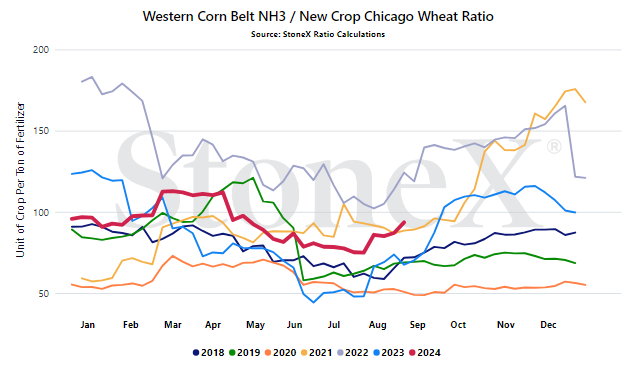
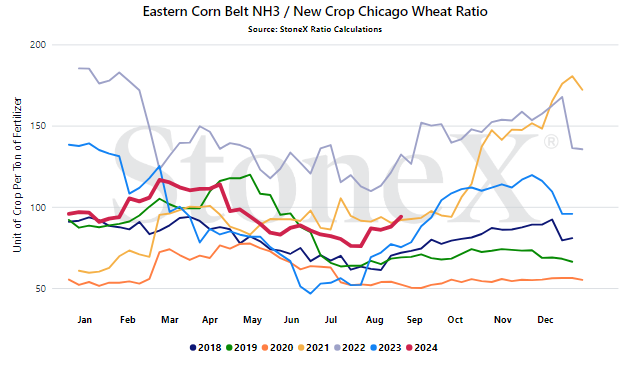
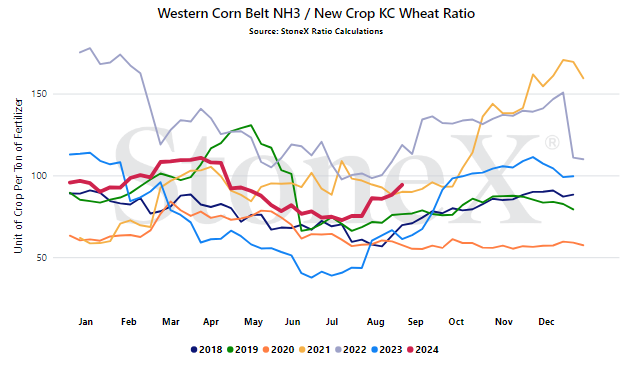
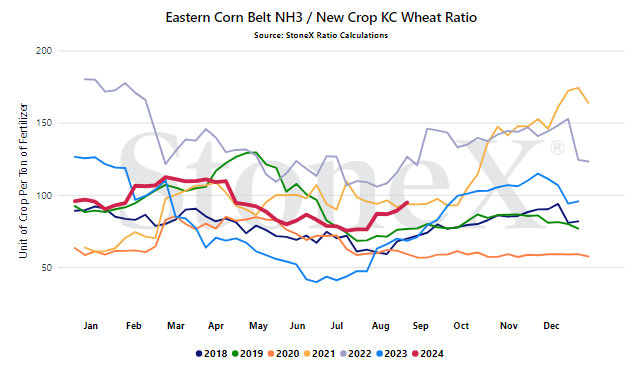
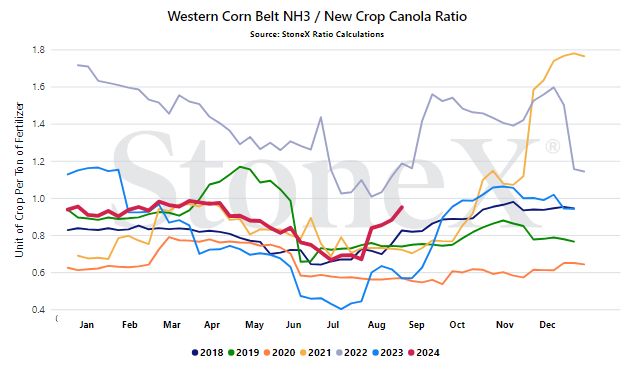
Where are the current NH3/grain ratio values today
We believe that only looking at the flat price of either grains or fertilizer can be misleading:
-
Only selling grain can hurt you if fertilizer prices rise substantially
-
Only buying fertilizer can hurt you if grain prices fall
We look at the ratio "value" to get a better indication of where we are or how many bushels of X does it take to pay for 1 ton of fertilizer.
Would you rather:
-
Spend 150 bushels to pay for 1 ton of potash
-
Spend 100 bushels to pay for 1 ton of NH3
When we compare the current ratio value against recent years, we start to see if we are high or low.
YOUR VALUES MAY LOOK DIFFERENT
This graph looks at the NOLA NH3 price vs the flat grain price. There are no logistics on either product. Your location will look different due to fertilizer logistical costs, grain basis, etc.
- Make smart/unemotional decisions - your grain price stinks. Your inputs costs are still high. You are not expecting to make much/any money this year and next year isn't much better. Blood pressure up yet? Has it ever come down? Listen, it is easy to be frustrating/pissed off/angry/etc. today and there is nothing wrong. I do not even farm and it gets under my skin. All I am saying is that when it comes time to make marketing decisions on either buying inputs or selling grains, set the emotion aside as best you can. I've made a lot of emotionally charged decisions in my life and my wife will be first in line to tell you none have worked out well. This is your livelihood. Your farm/family/etc. are counting on you to see it thru tough times. Treat it as such.
- Remember that even though things are calm now, they can get out of hand still - how the hell can it get worse?! I'm guessing that is the thought going thru your mind right now!!! There are still plenty of avenues to worse conditions for urea. Iran attacks Israel. Russia escalates against Ukraine. China invades Taiwan. Any/all of these possibilities have the ability to really mess up the market. It can get worse.
- Russian exports, if/when they return - eventually Russia is going to return...just a matter of when. When they do and they return to historically normal volumes, that will provide a lot of relief to a market that needs it. Now, it isn't as though Russia will export their 5M tons per year in the first day. It takes times to ramp up and we will still need to watch for Ukrainian drone attacks on the facility. However, we do expect them to return one day...hopefully soon.
- Fall applicators, start making your plans - I wish I could tell you that if you wait a little longer, the market is going to reward you with lower prices. I really wish I could...but you do not come here for sunshine and rainbows. You come here for the reality of the world. It does not look like it is getting much better before fall and it is around the corner. Globally, inventories are snug. Domestically, demand continues to look high (most fall guys stay fall guys). Barring a weather event that stops most application this fall (which would cause horrible spring demand issues), fall demand should be solid. I told my dad he shouldn't wait. If I can risk telling him that, then there you go...
StoneX Ratio Calculation
The ratio calculation is derived from Bloomberg historical grains values as well as fertilizer values from StoneX, NPKFAS, and Argus.
The calculation is simply dividing the fertilizer price by each grain price.
All data was sourced from StoneX unless otherwise noted.