- World production estimated above consumption in 2023/24, according to the USDA;
- Improvement in productivity with the harvest progress in Brazil;
- USDA cuts Brazil's crop by just 1 million tonnes;
- Crop should be favorable in Argentina;
- Concerns about the pace of global demand;
- Growth prospects for area in the USA.
- More pronounced production cut by CONAB;
- USDA revises Chinese exports upwards;
- NOPA brings sharper crushing in the US in February;
- High net short position of spec funds;
- The Argentine situation still favors holding soybeans as insurance.
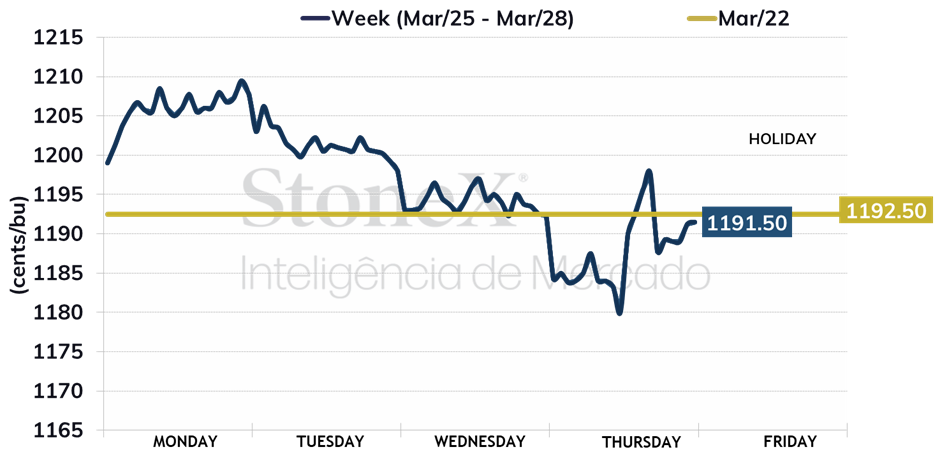
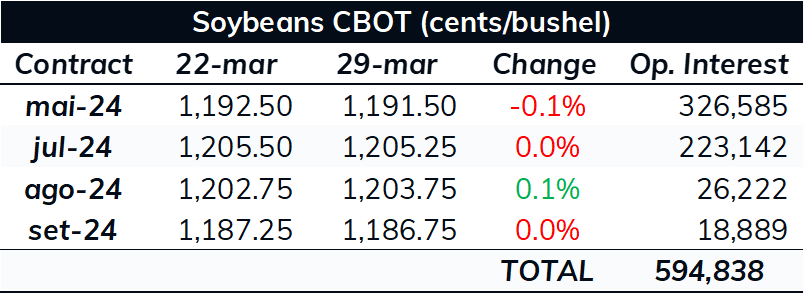
Soybean quotes in Chicago ended the previous week, which was shorter due to the holiday on Friday (29) and virtually unchanged, despite exceeding the 1200 cents per bushel level again during the period. The May contract ended Thursday's session (28) at 1191.5 cents per bushel, a weekly variation of -0.1%.
The market continued to monitor the crop progress in South America, in addition to demand, at a time when Brazilian soybeans are more competitive than American ones. The week's highlight was the release of the planting intention data for the 24/25 crop season in the US.
The result of 35 million hectares for soybean, came in sympathy with the market's expectations, confirming the outlook that the area of the oilseed should increase from the 33.8 million hectares planted last year. This result was slightly below that brought by the Agricultural Forum in February.
As the area came in tandem with expectations, there were no significant impacts on the oilseed quotes. With productivity at normal levels, the supply and demand balance in the US could trend towards a larger gap between supply and demand, leading to an increase in ending stocks.
Anyway, with planting starting this month, the progress of the American crop will start to dominate expectations regarding supply with the weather market during crop development, which has great potential to bring volatility to quotes, as seen last year.
Also noteworthy is the release of the quarterly stock numbers in the US on 03/29/2024, which came in line with the market's average expectations, standing at 86.5 million tonnes, signaling that the consumption of American soybeans is progressing as expected. Even so, as there are still six months left until the end of the 23/24 crop year in the country, the size of the stocks will become more relevant in the final months of the cycle.
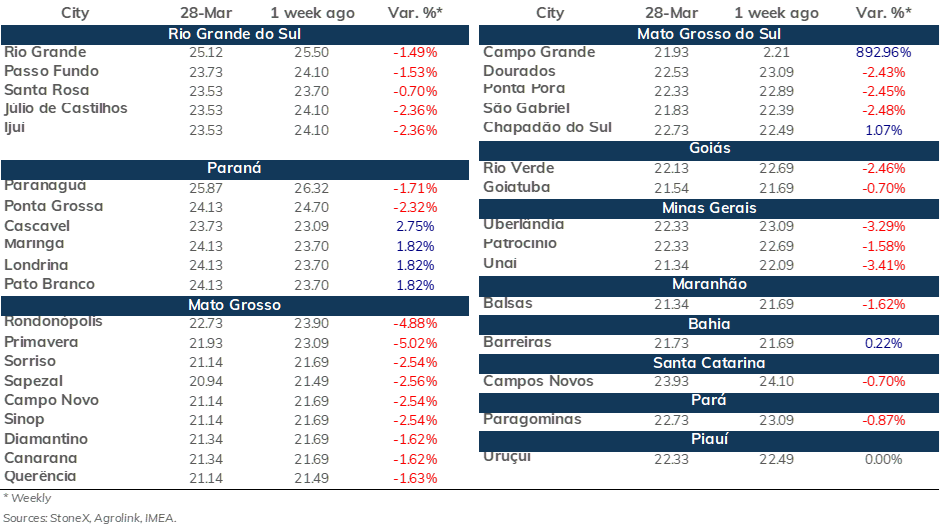
The Brazilian soybean harvest reached 74.7% of the total last week, according to StoneX, but doubts about the size of the crop still remain, with discrepancies among the various reports. While CONAB is betting on a lower level, at 146.9 million tonnes, there are figures even higher than those of the USDA, which currently reaches 155 million tonnes.
StoneX released its crop update for Brazil on Monday (01) with a 0.5% cut in its estimate for the 23/24 soybean production, which stood at 150.8 million tonnes. This small monthly negative adjustment was the result of productivity cuts in the states of Mato Grosso do Sul, São Paulo, and Paraná. On the other hand, states in the North and Northeast, where planting occurs later, are showing more positive results, benefiting from the recent rains.
Regardless of the size of the losses in Brazil, the Argentine crop maintains positive prospects, with the Buenos Aires Exchange estimate at 52.5 million tonnes. The harvest began in the country last week, as signaled by the institution. The crop conditions showed a slight worsening in the weekly comparison, with the percentage of G/E dropping 2 p.p. Anyway, mainly what was sown later is in very good conditions.
On the demand side, as mentioned, Brazilian exports are booming, which is usual for the first half of the year, and they are remaining competitive versus the USA.
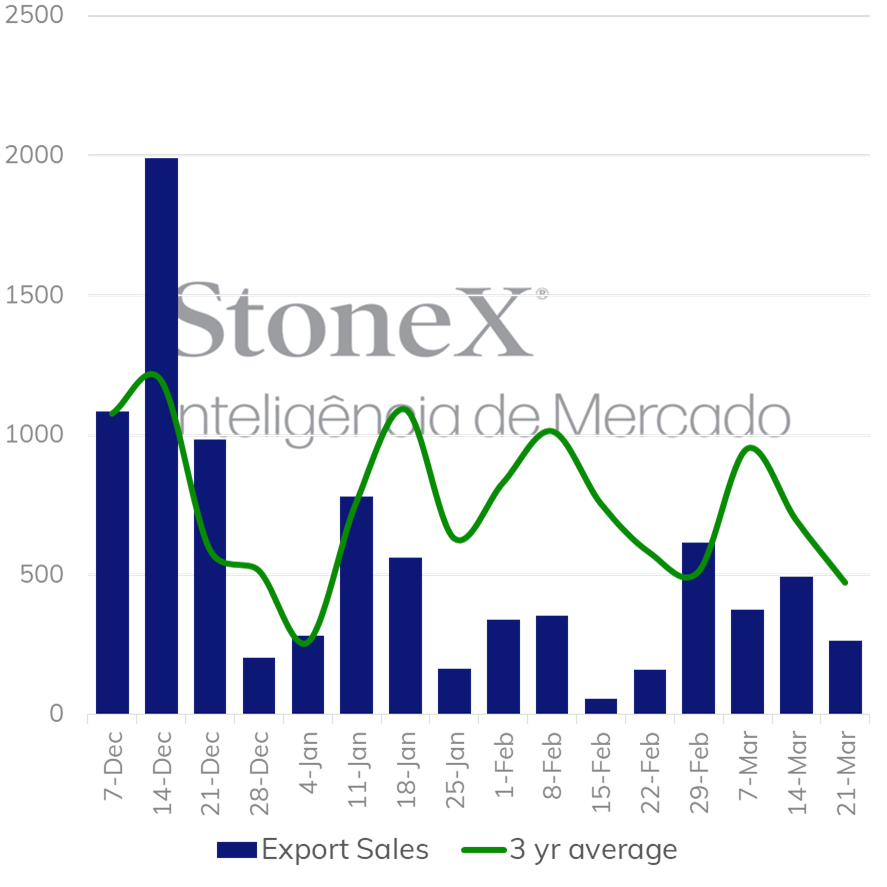
The pace of North American exports remains on the radar, with net sales for the week ending on 03/21 reaching 263.9 tmt for the 23/24 crop, below the market estimate range between 300 and 700 tmt. In the accumulated, sales are at 40.35 million tonnes, against 49.76 million in the same period last year, with USDA projecting an annual decrease in exports of 7.4 million tonnes. Therefore, sales need to gain strength to reach the estimate of 46.81 million tonnes expected for the country's exports in the 23/24 cycle.
The export market for soybean derivatives is also being closely monitored. The rebound of the Argentine crop should ensure a return of grinding to usual levels, increasing competition in the meal and oil export market. In the case of soybean oil, the prospects point to a rise in use in Brazil and the USA, which should naturally lead to a reduction in vegetable oil shipments.
In addition to crop updates in South America and the pace of demand for American soybeans, this week that begins should continue to focus on macroeconomic data, such as employment figures in the US, which are crucial for guiding monetary policy in the country.