- World production estimated above consumption in 2023/24, according to the USDA;
- Improvement in productivity with the harvest progress in Brazil;
- USDA cuts Brazilian crop by 155 million tonnes;
- Crop should still be favorable in Argentina;
- Concerns about the pace of global demand;
- Prospects of area increase in the USA.
- Lower production figure by CONAB;
- USDA revises Chinese exports upwards;
- High net short position of spec funds;
- Buenos Aires Exchange cuts Argentine crop 23/24;
- The Argentine situation still favors holding soybeans as insurance.
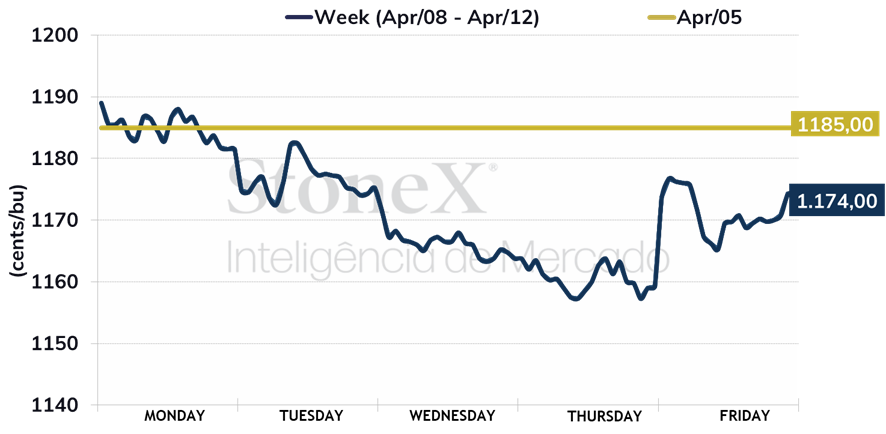
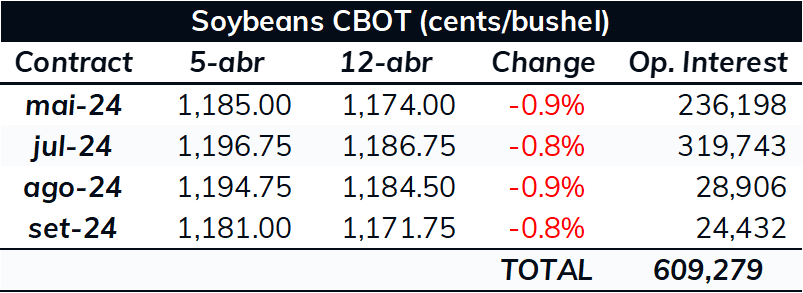
Soybean quotes trended lower for another week, with the May contract ending Friday (12) at 1174 cents per bushel, down 0.9%.
The market continued to monitor the progress of the South American crop, the demand side, mainly from China, and the release of the monthly reports from CONAB and USDA.
Despite being eagerly awaited, the April updates from CONAB and USDA did not change the divergences among the various market estimates. CONAB's survey brought a small cut to Brazilian production, which decreased from 146.9 to 146.5 million tonnes due to a slight decrease in the expected average productivity. There was also no major news on the demand side for Brazilian soybeans, with domestic consumption and exports remaining practically stable compared to the report from the previous month.
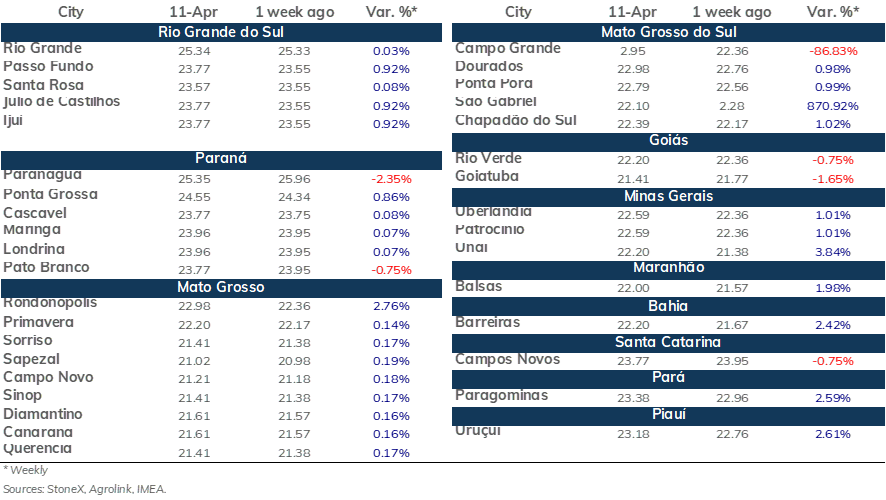
Anyway, the focus was on the production figure after the 23/24 crop was impacted by weather adversities, resulting in diverse estimates among the various institutions. The USDA did not contribute to "improving" this scenario, maintaining Brazilian production at 155 million tonnes, one of the highest figures in the market, with a difference of 8.5 million tonnes compared to CONAB, considered Brazil's official production. It is worth mentioning that StoneX estimates this year's Brazilian soybean production to be 150.8 million tonnes.
Thus, there are still doubts about the final size of the 23/24 soybean crop. Still, soybean prices continue under pressure amid Argentina's rebound, initial prospects of growth in the 24/25 soybean area in the US, and demand, with uncertainties about the size of Chinese imports.
Despite estimates pointing to a crop of around 50 million tonnes in Argentina, the Grain Exchange reduced the country's expected production for 23/24 from 52.5 to 51 million tonnes. The country's harvest reached 10.6% of the total last Wednesday, and even though better yields are expected from the portion sown later, the institution assumes that regions in the North of the country, including some areas in the provinces of Córdoba, La Pampa, and Buenos Aires, may not be able to recover fully.
This result would still be strong, indicating a sharp rebound for the country compared to the 22/23 crop, heavily affected by La Niña and more than compensating for Brazilian losses. Nonetheless, the conditions of the crops continue to be monitored, with the G/E percentage increasing by 1 p.p. to 31% in the latest survey, despite the proportion of crops in regular/poor conditions also advancing by 1 p.p., reaching 22%.
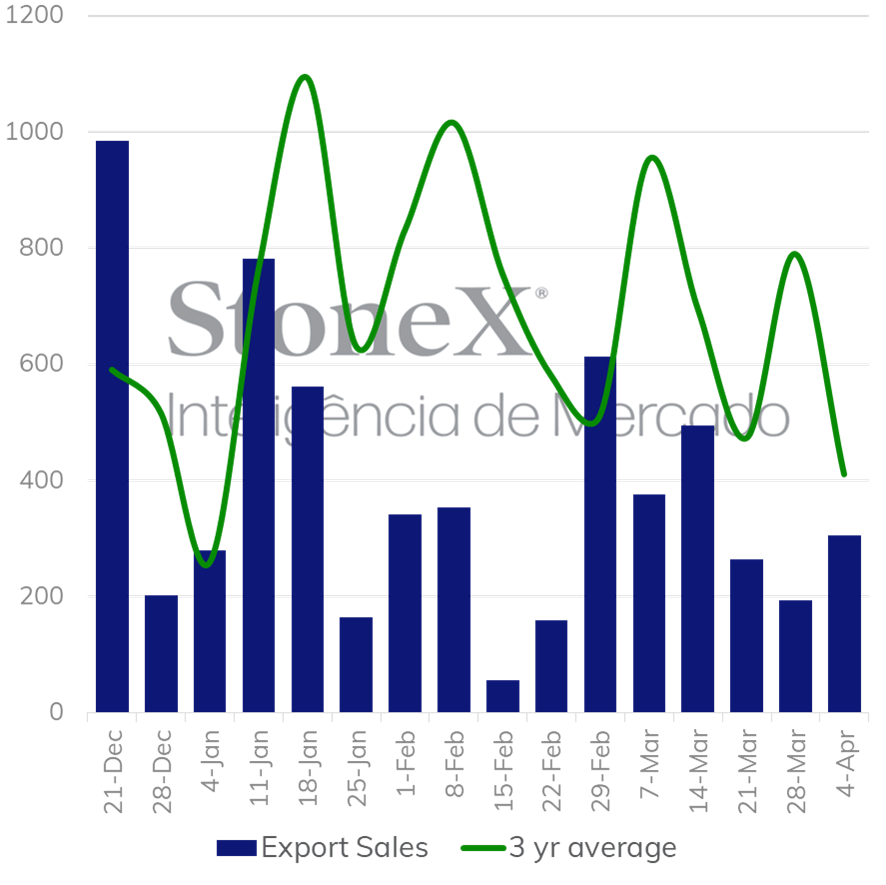
On the demand side, US export sales in the week ended on 04/04 reached 305.3 thousand tonnes, within the market estimates, which ranged from 200 to 600 thousand tonnes. In the accumulated period, 40.9 million tonnes of soybeans from the 23/24 crop were traded, compared to 50.1 million, with China accounting for 7.5 million tonnes of this delay.
Even with USDA cutting the US exports estimate for the 23/24 cycle from 46.8 to 46.27 million tonnes, 7.9 million less than the previous cycle, the slower sales pace would still be 1.3 million tonnes below the necessary to reach this adjusted estimate.
Chinese customs reported that the country imported 5.54 million tonnes in March, 1.3 million less than in 2023. Considering the imports so far, the annual volume would tend to be lower, less than 100 million tonnes, not reaching 105 million, as the USDA is projecting for the 23/24 cycle. It is worth mentioning that the USDA revised past Chinese crops, placing the country's import figures above the official ones.
Despite disagreements in the estimates, Chinese purchases remain on the radar. The margin of pigs has improved in the last few weeks, a beneficial situation that still does not allow us to affirm that there will be a greater incentive for grinding.
This week, in addition to macroeconomic data and the progress of the conflict in the Middle East, the soybean market should continue to pay attention to demand, with US export sales and preliminary shipment data in Brazil, as well as grinding in the US, released by the National Oilseed Processors Association (NOPA).