- Bearish Factors
- Global production in 2024/25 is expected to outpace consumption, according to the USDA.
- StoneX estimates record productivity for the US.
- Concerns persist about the pace of global demand.
- StoneX projects record production for the Brazilian 2024/25 crop.
- Favorable crop conditions in the US.
- USDA estimates record productivity and production levels in the US.
- Bullish Factors
- Incentive measures adopted by the Chinese government.
- Investment funds hold significant short positions.
- Strong soybean crushing activity in the US.
- Conversion of plants to renewable diesel in California.
- Investigation into fraud in UCO (used cooking oil) imports by the US from China.
- Forecast of a drier weather pattern for the US Midwest over the next ten days.
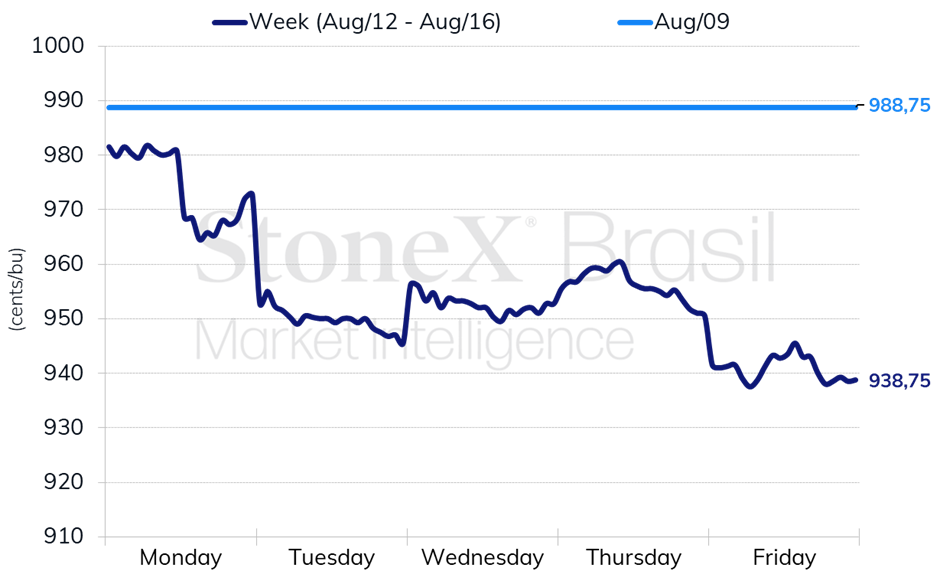
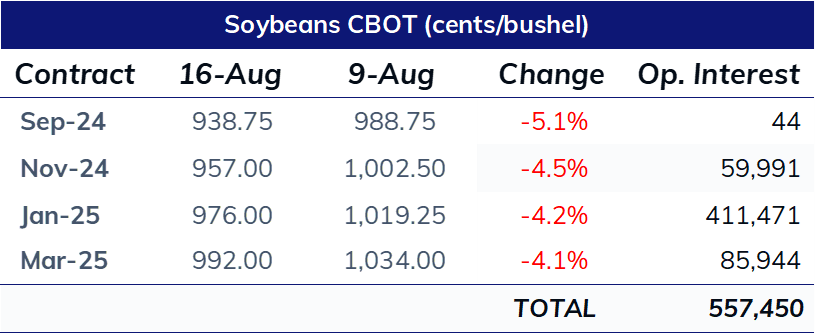
Last week, soybean quotes in Chicago continued to face pressure, following a downward trend amid the positive outlook for the North American 2024/25 crop. There were brief moments of profit-taking, with short covering by speculative funds, but these did not withstand the fundamentals indicating a significant surplus in supply over demand. The September contract ended Friday's session (16) at 938.75 cents per bushel, a decrease of 5.1% over the week.
As has been noted for some time, the conditions for the North American 2024/25 crop have remained very positive, with the percentage rated as good to excellent at 68% as of the week ending August 11th—a level significantly above the five-year average of 60% for this period. The maintenance of this high percentage during the key grain filling phase for soybeans tends to correlate with above-trend yields, which current estimates already reflect.
At the beginning of the month, StoneX released its survey for the US, indicating a national average productivity of 3.54 tonnes per hectare—a potential record. However, the USDA's August WASDE report provided an even higher estimate, reaching 3.58 tonnes per hectare.
Additionally, there were adjustments to the acreage, which are uncommon in the August report. The soybean area increased by just over 400 thousand hectares, reaching 35.25 million hectares. Combined with the expected record yield, production could reach 124.9 million tonnes—a record level.
This report further reinforces the bearish scenario for soybeans, with global production projected to exceed consumption by more than 25 million tonnes. However, it is essential to remember that the 2024/25 soybean crops in Brazil and Argentina will only begin next month, with weather conditions becoming the central focus, particularly with the potential influence of La Niña.
This week, the Pro Farmer Crop Tour is being conducted in the main producing states of the North American Midwest, with daily partial results being released. The final figures, which will be available on Friday (23rd), will take into account other factors besides the data collected during the Crop Tour, such as crop stage, area adjustments, historical differences in tour data compared to USDA final yields, and more.
Regarding the weather, this past weekend, rains were more concentrated in the eastern production region of the US. Forecasts for the next ten days indicate below-normal rainfall across much of the Midwest, which could lead to decreased moisture levels, with the market closely monitoring potential impacts on crops. Even so, it is still too early to suggest any major issues that could alter the current scenario of abundant supply.
Chinese market behavior remains a key focus, though there haven't been any major developments recently. Despite the country recording strong imports in recent months, there are no clear signs of significant growth in domestic demand. It is likely that a portion of these imports will be added to existing stockpiles. Notably, China has been less active in US export sales compared to previous years.
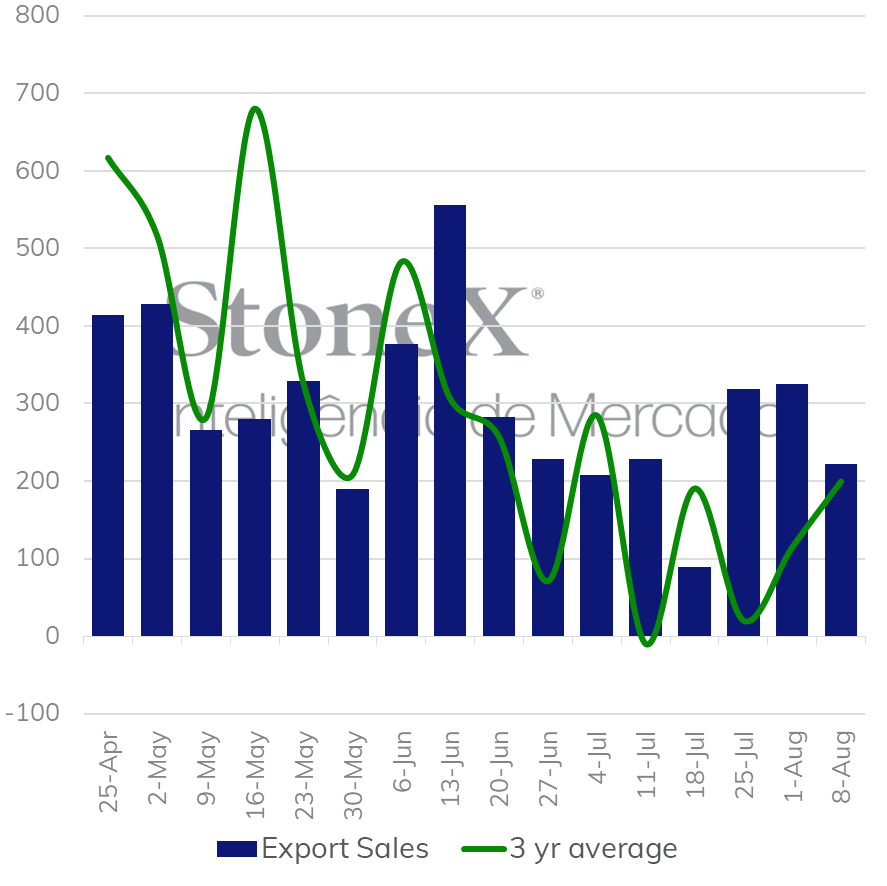
In the week ending August 8th, 221.7 thousand tonnes of soybeans from the North American 2023/24 crop were traded—a volume within the expected range. However, sales from the 2024/25 crop exceeded market expectations, reaching 1.34 million tonnes. Despite this, and the fact that China accounted for the purchase of 540 thousand tonnes of American soybeans from the new crop, the overall pace of negotiations is much slower than in previous years at this time. This slower pace is raising concerns about the potential for US exports, particularly to China.
The National Oilseed Processors Association (NOPA) released the soybean crushing data for July in the US, reporting a total of 4.98 million tonnes. This figure aligns closely with the market's average expectation of 4.96 million tonnes. Notably, soybean oil stocks fell to 692.6 thousand tonnes, which is below market expectations and suggests that consumption is stronger than anticipated. This trend indicates that the USDA's estimate of 62.3 million tonnes for the 2023/24 cycle is likely to be met.
This week, market attention is expected to remain heavily focused on the US crop, particularly with the ongoing Pro Farmer Crop Tour and weather forecasts that suggest a drier pattern across key growing regions.