- Bearish drivers
- 24/25 world production widens gap with consumption, according to USDA;
- StoneX estimates record productivity for the US;
- Concerns about the pace of global demand;
- StoneX estimates record production for Brazil's 24/25 crop;
- Favorable crop conditions in the US;
- Pro Farmer estimates record for the US, surpassing USDA figures.
- Bullish drivers
- Incentive measures adopted by the Chinese government;
- Funds with a large short position
Strong crushing in Argentina; - Conversion of plants to renewable diesel in California;
- Investigation into fraud in UCO imported by the US from China;
- Weather could become drier in the Midwest from next weekend.
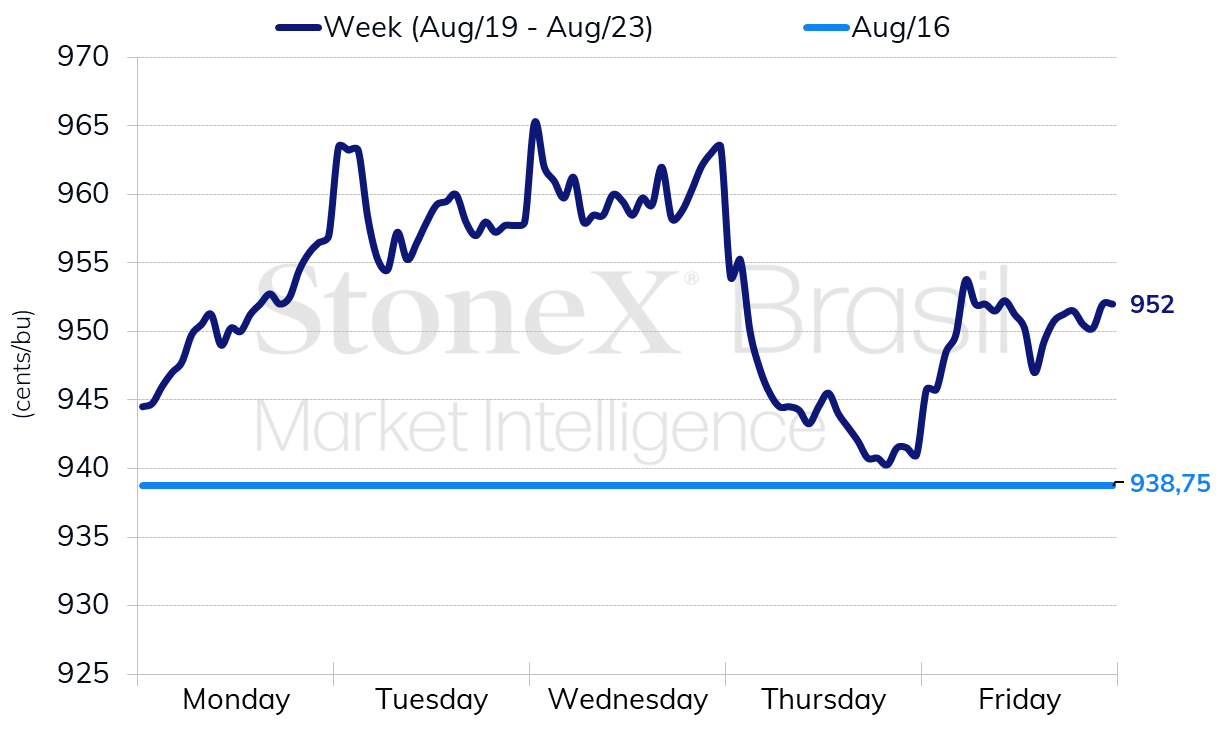
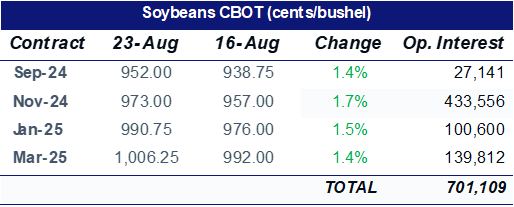
Last week, soybean prices alternated between highs and lows and ended the week in the positive, with the September contract ending Friday (23) at 952 cents per bushel, up 1.4% over the period.
There was some hedging of short positions by speculative funds, but the scenario suggesting a loose supply of soybeans in relation to demand has not changed. On the contrary, Pro Farmer's famous Crop Tour took place between August 19 and 22, with the information gathered corroborating the prospects of record soybean yields in the 24/25 cycle, with production also likely to be the highest in history.
The Crop Tour visited crops in seven Midwestern states and, together with other information, such as the stage of the crops, area adjustments, historical differences in the tour data in relation to the USDA's final yields, among others, indicated soybean productivity at 3.69 tonnes per hectare, with the crop reaching 129 million tonnes. Average yields were record-breaking in several states.
This result surpasses the last USDA report, which showed soybean productivity at an already record level of 3.58 tonnes per hectare, which, together with the positive revision of planted area, would take the country's production to an also record volume of 124.9 million tonnes.
As a result, if this figure assessed by the Crop Tour is confirmed, the US supply and demand balance for the 24/25 cycle would be even more relaxed, helping to further widen the gap between world production and consumption.
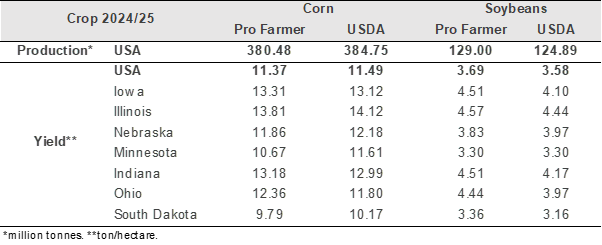
Sources: Pro Farmer & USDA. Design: StoneX.
As has been observed, the condition of the country's crops has pointed to a favorable season since the beginning of the reports, with the good/excellent percentage of the crops remaining considerably above the five-year average for the period, even in August, when the grain filling phase is in progress. In the week ending August 18, the good/excellent percentage for the US 24/25 crop stood at 68%, compared to the five-year average of 59% for the period.
In this context, despite the good prospects, with a high chance of record yields, the weather continues to be on the radar. Forecasts for this week indicate below-normal rainfall in the south of the belt, but good precipitation in most of the Midwest. From next weekend onwards, forecasts suggest a slightly drier pattern for most of the producing region.
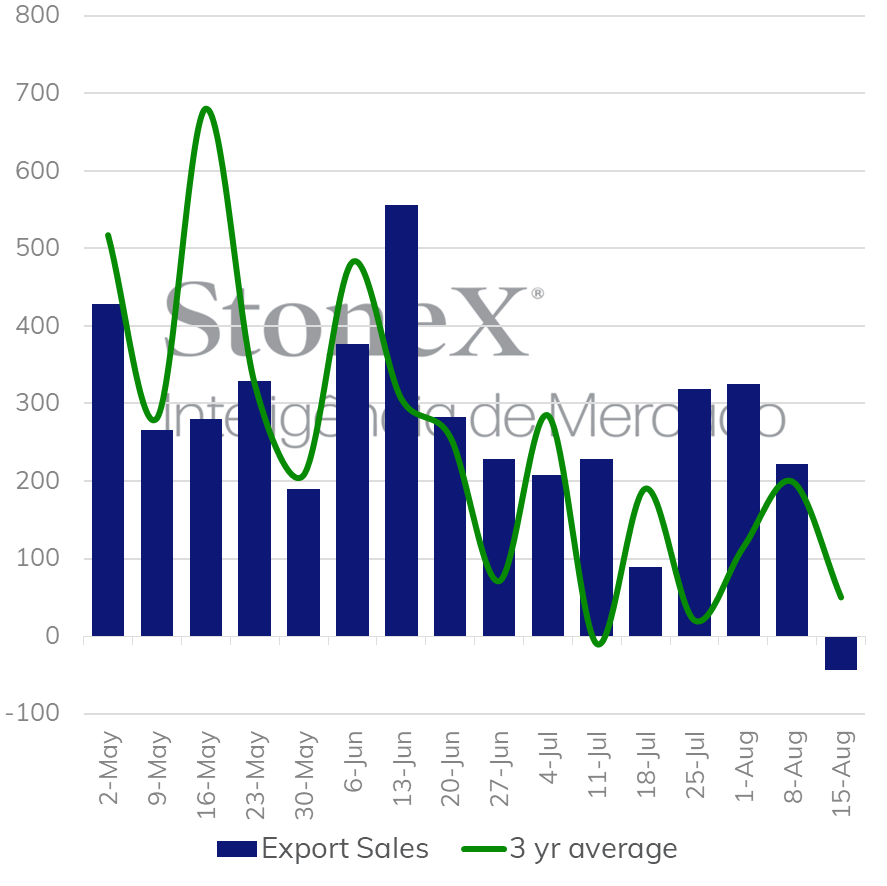
On the demand side, US exports remain on the radar. Export sales for the 23/24 crop in the week ended August 15 registered net cancellations of 43,700 tonnes, a common situation at the end of the cycle. Even so, the country is on track to reach the USDA's export estimate of 46.3 million tonnes by the end of August. Negotiations for the 24/25 crop reached 1.7 million tonnes, exceeding the ceiling of market expectations, which ranged from 800,000 to 1.35 million. In any case, accumulated sales for the 24/25 crop are below those recorded in previous years for the same period.
In Brazil, soybean exports are still relatively strong, but are starting to lose momentum. As of August 16, 4.3 million tonnes had been shipped, bringing the total since the beginning of 2024 to 79.8 million tonnes.
In Argentina, soybean processing is running strong, having reached a volume of 4.38 million tonnes in July, representing an increase of 10.4% compared to the previous month and 71.7% compared to July/2023, when it was 2.55 million tonnes. This result can be explained by better crushing margins, a greater number of working days in July and some delays in the harvest due to adverse weather, limiting the availability of oilseeds for crushing at the start of the crop.
In any case, it should be noted that the size of the supply should continue to be the main factor with the potential to significantly affect the balance of world soybean supply and demand, since potential changes in demand tend to be less sudden. With September approaching, planting of the Brazilian soybean crop could begin, with the closure of the fallow season in some regions of Mato Grosso taking place as early as September 1st. However, the weather is very dry in most of the country, with no significant rain forecast for the first half of the month, which should delay the start of sowing.