- Bearish factors
- Global production for 24/25 exceeds consumption, according to the USDA;
- US supply-demand balance remains unstrained;
- Concerns over the pace of global demand;
- Record production estimate for the Brazilian 24/25 crop;
- Rainfall in Argentina;
- Crushing (processing) below expectations in the US.
- Bullish factors
- New incentive measures adopted by the Chinese government;
- Short covering by funds;
- Reduction in US production for 24/25;
- Loss of potential in the Argentine crop;
- Expectations of a reduction in planted area for the US 25/26 crop.
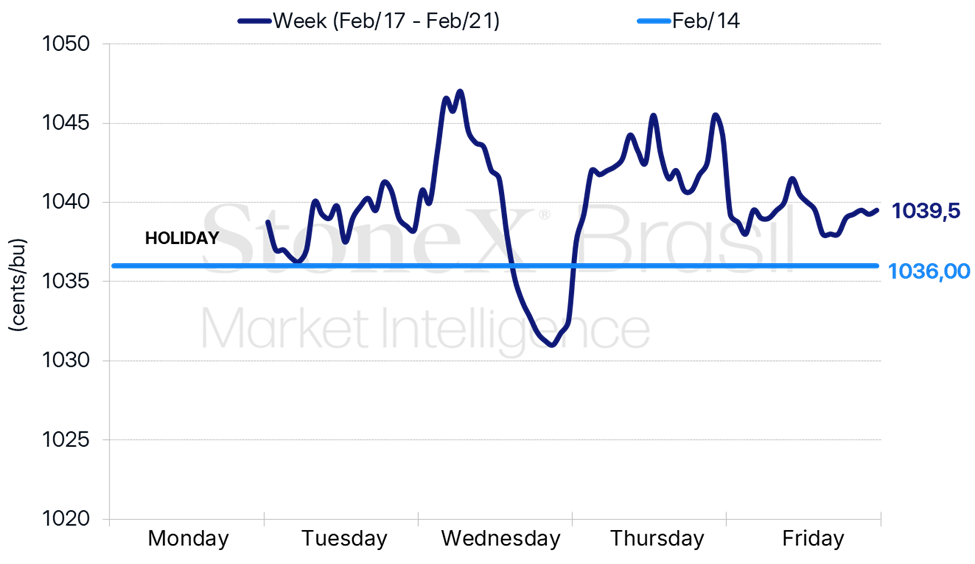
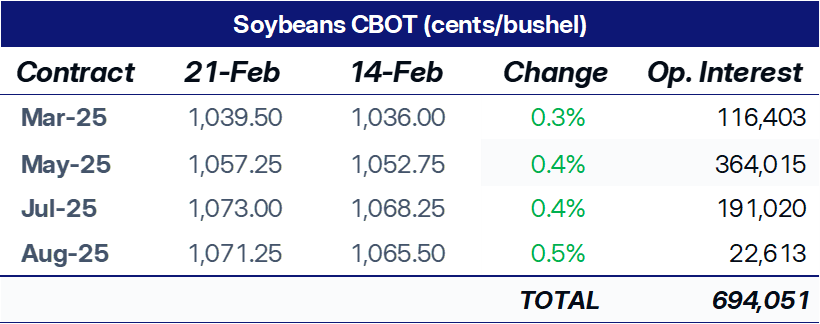
Last week, soybean prices in Chicago fluctuated around stability and ended the period slightly higher, with the March contract closing on Friday (the 21st) at 1039.5 cents per bushel.
The oilseed market continues to monitor the progress of the South American crop, while speculation about the planted area for the next US cycle, 2025/26, is also increasing. This week, the USDA held its annual Agricultural Forum, where data for the country’s new crop will be released. Although the planted area reported at the forum is not based on surveys with producers, the number is considered a first indication of what to expect, taking into account fundamentals such as price behavior. Currently, expectations lean towards a smaller soybean area, while corn could gain market share, since corn prices are in a more significant uptrend, and although soybean prices remain above USD 10.00 per bushel, they have not sustained more expressive gains.
The main factor explaining the lack of sustained higher soybean prices is the favorable outlook for the South American crop, mainly the Brazilian one, even after some productivity losses due to the impacts of dry weather.
Most private estimates continue to indicate a record Brazilian crop, around 170 million tonnes. In the past two weeks, good rainfall volumes were recorded across almost the entire producing region, which alleviated the impacts of very high temperatures and, at the same time, did not cause major delays in the harvest. For the next two weeks, forecasts indicate a climatic pattern with less rain in the South and Southeast, while other major regions may record more significant precipitation.
In Argentina, the Buenos Aires Stock Exchange maintained its soybean production estimate at 49.6 million tonnes, highlighting the rains recorded around mid-February. Thus, although some regions still face a water deficit, the percentage of fields in adequate/excellent condition increased by 4.8 percentage points, reaching 67%. Overall crop conditions also improved, with the percentage in good/excellent condition rising from 15% to 17%, while the share in normal condition remained at 49%, and the percentage considered poor dropped to 34%. The next two weeks are expected to be rainier in much of Argentina’s producing region, which should favor crop development, especially for later-planted areas currently in the grain-filling stage.
On the demand side, Brazilian exports are gaining strength, as expected seasonally. In the first two weeks of February, 1.66 million tonnes were shipped, with lineup data indicating even higher volumes. Brazilian soy for China remains more competitive than US soy, as US export sales and shipments have been losing momentum.
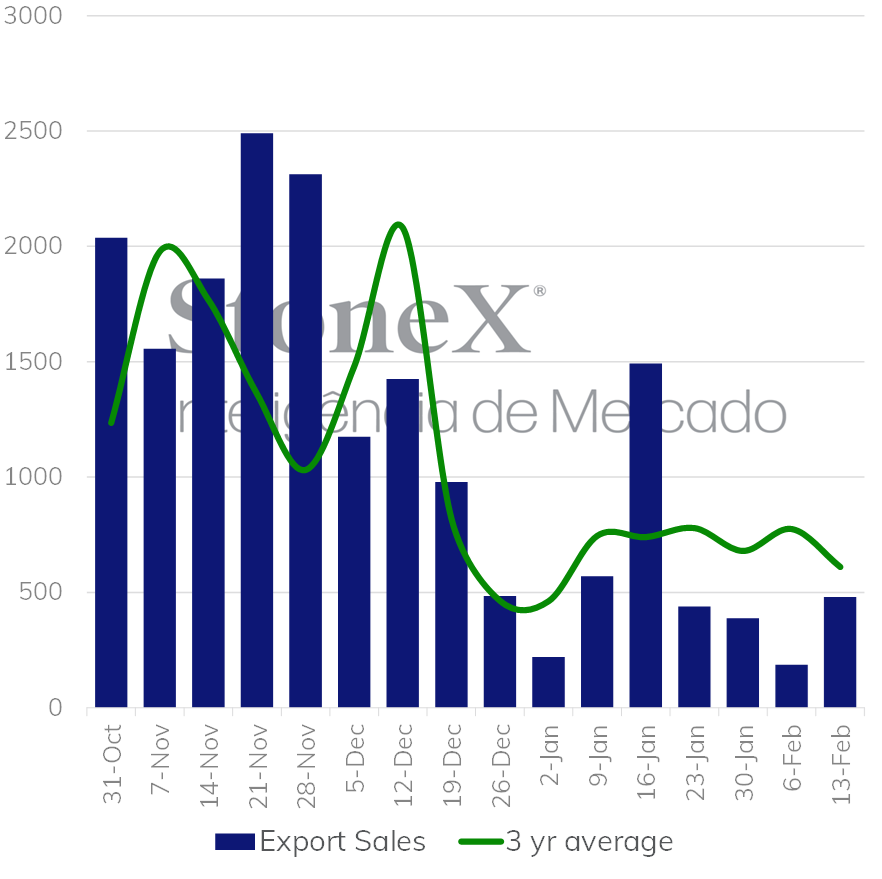
US export sales of the 24/25 soybean crop for the week ending February 13 reached 480.3 thousand tonnes, a volume near the upper limit of estimates, which ranged from 100 to 500 thousand tonnes. Cumulatively, 43.7 million tonnes have been traded, with exports to China trailing by 1.2 million tonnes compared to the same period last year, while sales to other destinations were 6.3 million tonnes above last year’s levels.
Also noteworthy is the US crushing figure, released by the National Oilseed Processors Association (NOPA), which represents 95% of the sector, indicating that 5.45 million tonnes of soybean were processed in January – a volume below the market expectation average of 5.57 million tonnes. With margins falling, crushing declined in some Midwestern regions, such as Illinois.
This week, in addition to expectations for USDA Agricultural Forum data, South American weather will remain under scrutiny, with a focus on the Argentine crop, which is going through key phases.