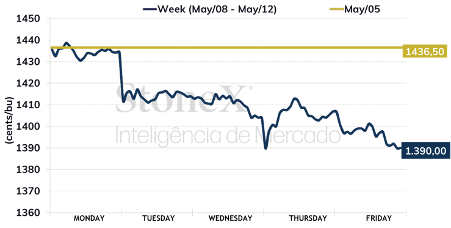
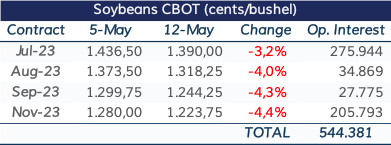
In any case, it was mainly the supply side that limited possible soybean gains and led prices to record a significant drop after the monthly supply and demand report on Friday.
In Brazil, Conab released its crop survey, showing an increase in Brazilian production for 2022/23 to 154.8 million tonnes, with positive adjustments in area and productivity. This number is still below that of StoneX, at 157.7 million tonnes, but, in any case, it sets an absolute record, “offsetting” the losses in Argentina.
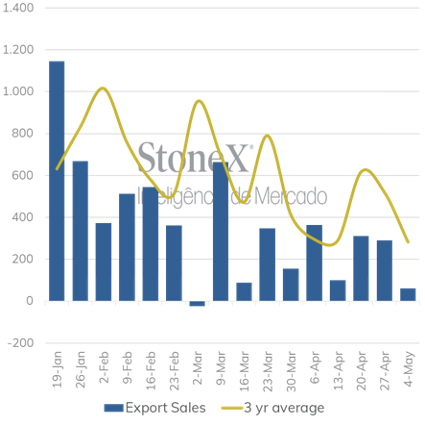
The Rosario exchange reduced Argentina's 2022/23 soybean production to 21.5 million tonnes, while the Buenos Aires exchange is at 22.5 million. Regardless of the number, the much lower volume offered by the country tends to affect domestic processing, even with the increase in grain imports. Last week, there were rumors of sales cancellations of Argentine meal, with buyers switching to the US product, but this bullish factor failed to offer greater support to soybeans, after the weak US export sales data.
The USDA's monthly report further reinforced this “lack of threats” scenario on the supply side, while demand concerns remain.
There was great expectation for the report, since it was the first one with numbers for the 2023/24 cycle. However, as already expected, the USDA maintained the intended planting area and productivity of the Agricultural Forum for the 2023/24 US crop, with production estimated at 122.7 million tonnes. On the demand side, the USDA brought a major growth to domestic consumption, which is set to reach 66.29 million tonnes, while exports were weaker in the new cycle. In any case, the US balance sheet would be more comfortable, with ending stocks rising to 9.1 million tonnes.
Furthermore, the Department did not report any changes in exports for the 2022/23 US crop, even with weaker sales data.
For the South American crop, the highlight was the increase in Brazilian 2022/23 production to 155 million tonnes, while Argentina was maintained at 27 million, even with the market betting on a cut. It should be noted, however, the reduction of 1.2 million tonnes in Paraguayan production, to 8.8 million.
While global stocks had minor changes in the 2022/23 cycle, these first figures for the 2023/24 crop indicate world production well above demand, leading to an increase of more than 20 million tonnes in estimated world stocks, reaching 122.5 million and reinforcing the current scenario of a supply without major problems.