- Global production for 2023/24 estimated much above consumption, according to USDA;
- Still weak economic indicators;
- Absolute production record in Brazil and lack of storage;
- Fast pace of US planting;
- Chances of El Niño increase from July.
- Relaxation of anti-Covid measures in China;
- Considerable crop losses in Argentina due to the weather;
- Chinese crush margins are more positive;
- Increase in mandatory biodiesel blending in Brazil;
- Drier US weather forecast in June.
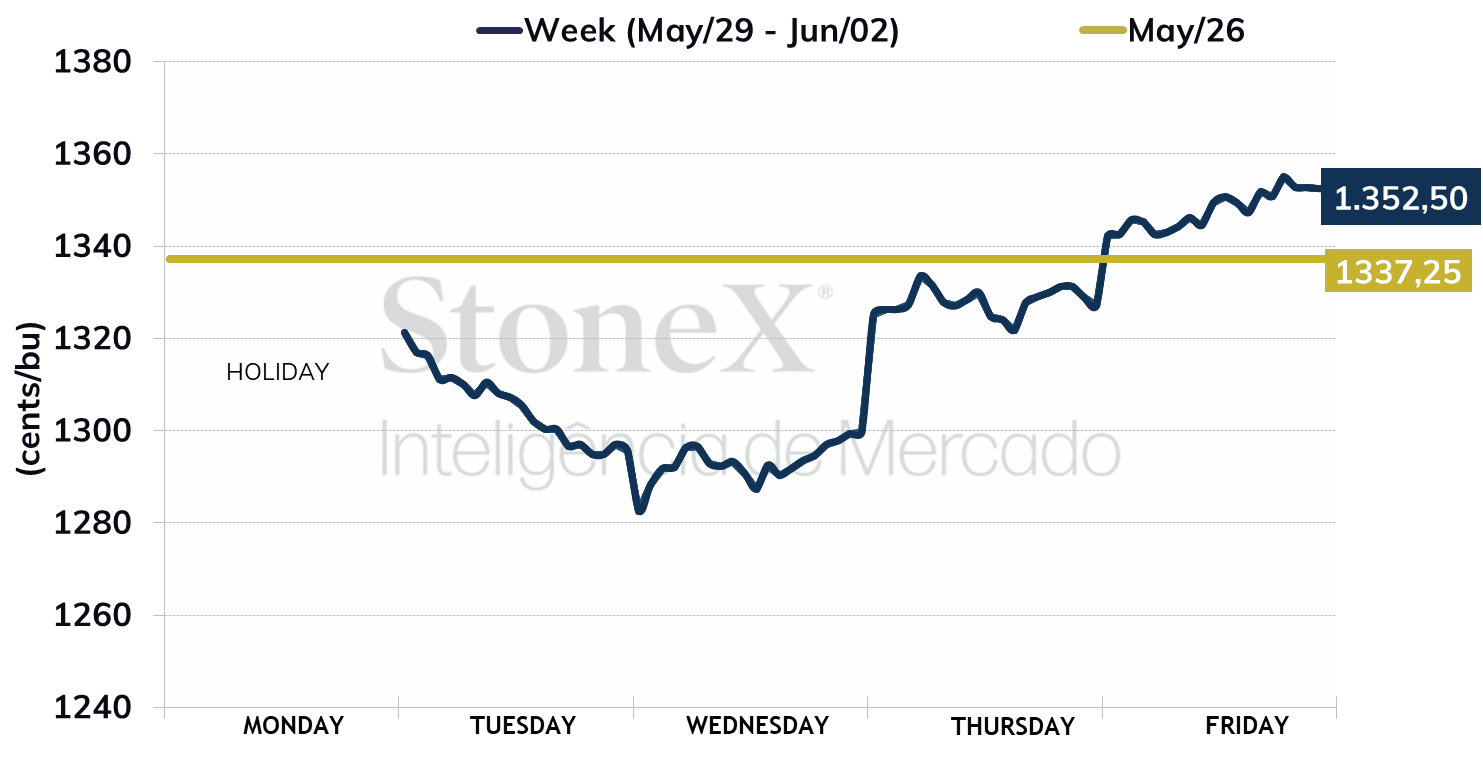
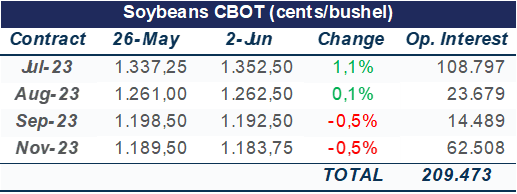
Last week was shorter in Chicago, due to the Memorial Day holiday on Monday (29). In any case, soybean prices alternated between highs and lows in the period, with the weather market in the US gaining strength. The contract for July accumulated a gain of 1.1% in the period, ending Friday (2) at 1352.5 cents per bushel.
The prospect of comfortable soybean supply is one of the main factors weighing on soybean prices, and the potential for a normal US crop is included in this scenario.
As such, any possible threat to the US crop ends up making room for price hikes, despite the fact that the production cycle is still at the beginning in the country. Forecasts of more scarce rain in early June had already been supporting prices, a situation that ended up being reinforced by longer forecasts. Although long-term forecasts may undergo changes, the prospects that the month of June as a whole will be drier in parts of the US, with emphasis on the states of Iowa and Illinois (the largest soybean producers) ended up being a major bullish factor last week.
The latest drought monitor released by the USDA, which shows current conditions, indicates that the situation is more critical mainly for the state of Missouri, whose relevance for soybean production is not so great. Even so, other areas of the belt also indicate less important drought conditions, which could be aggravated if the drier forecasts are confirmed.
In any case, as much as the lack of moisture can harm plants at any stage of development and forecasts may still change, June is not the most crucial period for soybeans in the US, with the filling phase of grain being concentrated in August. This year, as planting is advanced, part of the crops should already be filling grain in July.
Regarding US planting, the progress of work in the fields continued to accelerate, with the national average reaching 83% up to Sunday (28), considerably above the five-year average for the period, at 66%. Even North Dakota, which was significantly behind, posted a strong advance, reaching 53%, just below the average of 55%.
It should also be noted that these less positive weather forecasts ended up encouraging short covering, after prices dropped considerably.
Another factor that contributed to the recent soybean gains was the rise in soybean oil, given the advances in crude. With more expensive fossil fuels, biofuels end up improving their competitiveness.
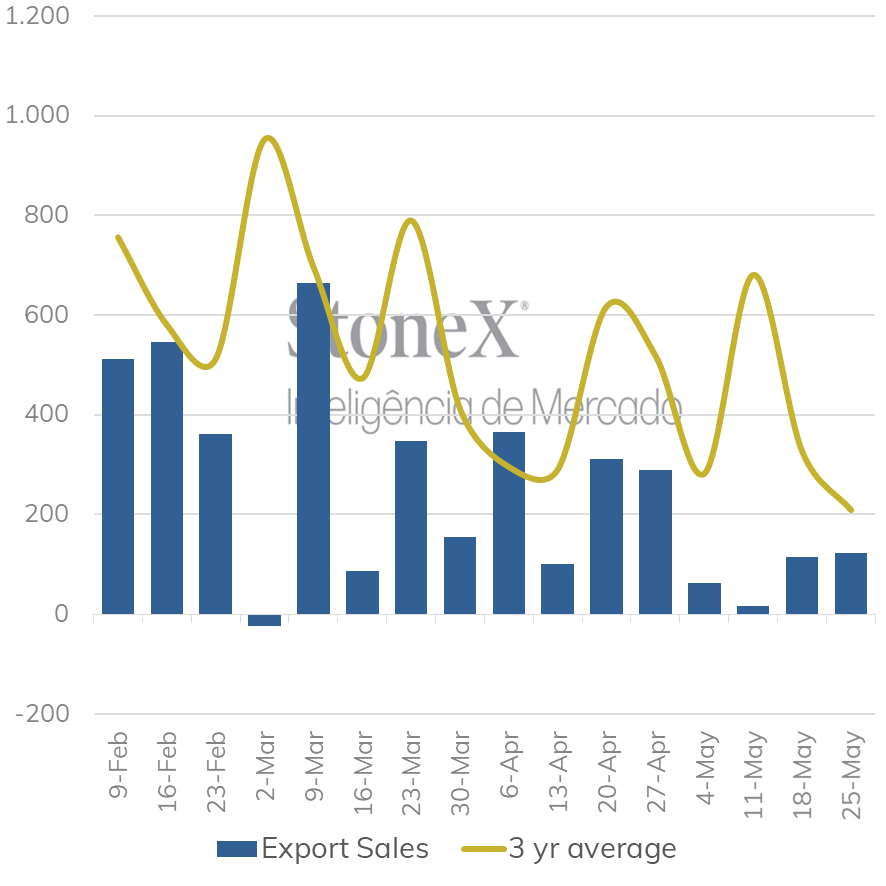
Also in the US, export sales in the week ended May 25 reached 133,400 tonnes for the 2022/23 crop and 301,000 for the 2023/24 cycle, volumes within market expectations in both cases. Even so, the important delay in the 2022/23 crop remains, with 50.96 million tonnes traded, against 59.5 million in the same period last year.
The current leading role in the export market is Brazilian soybeans, whose shipments reached 15.6 million tonnes in May, taking the accumulated since January to 49 million tonnes.
In addition to seasonality, this is the moment for Brazilian soybean exports, with the record harvest achieved this year, which is weighing on prices, the national product is very competitive, for example, arriving cheaper in China compared to US soybeans, which contributes to the recent movement of Chinese crush margins. The country's margins have been in positive territory, which is also a result of the rise of meal and oil prices.
However, China's economic situation is closely monitored, in addition to the country's pork protein sector, which continues to record negative margins, a situation that may affect future prospects for soybean demand.
Still on demand for Brazilian soybeans, even with high exports in May, prices remain under pressure, given the record harvest, coupled with the lack of sufficient warehouses and delayed sales. StoneX updated its sales numbers last Friday (2), with the percentage of the 2022/23 crop reaching 61%, remaining below that recorded at the same time in previous cycles.
This week, the weather in the US should continue to be the center of attention, without forgetting the USDA's monthly supply and demand report, which will be released on Friday (9). Despite being highly anticipated, no changes are expected for the 2023/24 US crop production, with planted area being updated at the end of June and productivity in August.