Long-term forecasts indicate that the summer could be drier in key areas of the Midwest
- Global production for 2023/24 estimated much above consumption, according to USDA;
- Still weak economic indicators;
- Absolute production record in Brazil and lack of storage;
- Fast pace of US planting;
- El Niño should be beneficial for US crop.
- Considerable crop losses in Argentina due to the weather;
- Record soybean imports by China in May;
- Chinese crush margins are more positive;
- Increase in mandatory biodiesel blending in Brazil;
- Forecast of drier weather for some of the US production region.
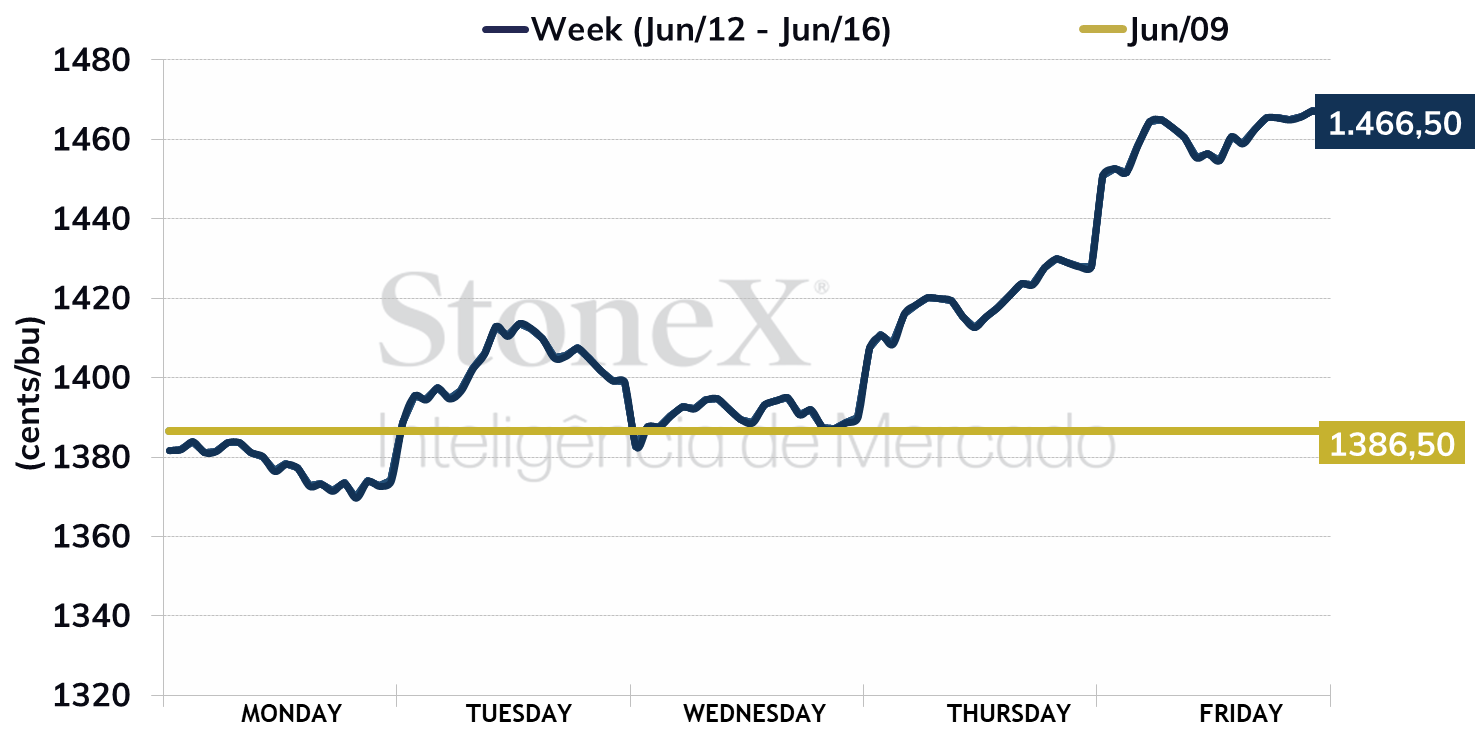
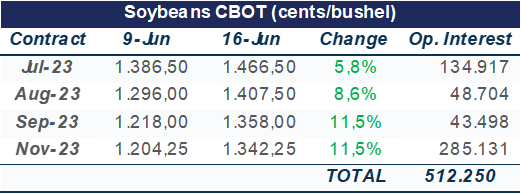
Soybean prices in Chicago had a week of significant highs, with the contract for July ending Friday (16) at 1466.5 cents per bushel, up 5.8% in the period. US new crop contracts had even more significant gains, with the contract for December accumulating an increase of 11.5% in the week.
The factor that continued to predominate was the weather in the US, with the market following forecasts that indicate a lack of rain in key parts of the Midwest and betting on negative impacts on the productivity of the country's 2023/24 crop.
Last weekend, the rains were concentrated in the Plains, while the most central and western area of the US grain belt remained drier. It is important to note that rainfall is below normal in major producing states, such as Iowa and Illinois, with forecasts indicating that this drier pattern tends to persist.
The forecasts until next Friday (23) indicate that this region further west and central, in addition to the north of the Midwest, will remain dry, with the rain forecast from next weekend expected to be more concentrated in eastern side of the belt.
As much as the most critical phase of soybean grain filling is concentrated in August (and should be a little earlier this year because of accelerated planting), the lack of moisture is also harmful in other periods of development. Furthermore, last week, NOAA's National Weather Service released seasonal drought forecasts, with the model valid for the period between June 15 and September 30 indicating that an important part of the US Midwest, with emphasis on the states around Lake Michigan, should keep a drier pattern in this period, which coincides with the development of the country's crop.
As such, weather conditions will continue to move the market in the coming weeks and months, which is normal for this period of the year, setting up what is known as the weather market. When rain forecasts for the Midwest are published, quotes tend to retreat and vice versa.
Given this scenario, the conditions of the US crop are also closely monitored. So far, the good/excellent percentage is lower than the five-year average and lower than last year. On Sunday (11), 59% of soybean crops in the country were in good/excellent condition. Some states, such as Illinois, Michigan, and Missouri report a good/excellent percentage below 50%. Since today (19) is a US holiday, the USDA's weekly crop progress update will only be released tomorrow (20).
Another highlight in relation to supply, but for the 2022/23 crop, was the new cut in the Argentine crop made by the Rosário exchange, with production remaining at 20.5 million tonnes. The Buenos Aires exchange maintained its projection at 21 million tonnes, with the country's crop reaching 98.1% last Wednesday (14).
On the demand side, the National Oilseed Processors Association (NOPA) reported that US soybean crushing in May reached 4.84 million tonnes, surpassing the level recorded in April and May 2022, when it stood at 4.7 million.
If the pace is maintained, annual US soybean processing could be between 59.5 and 60.4 million tonnes, with the USDA estimate for the 2022/23 crop being at the top of that range.
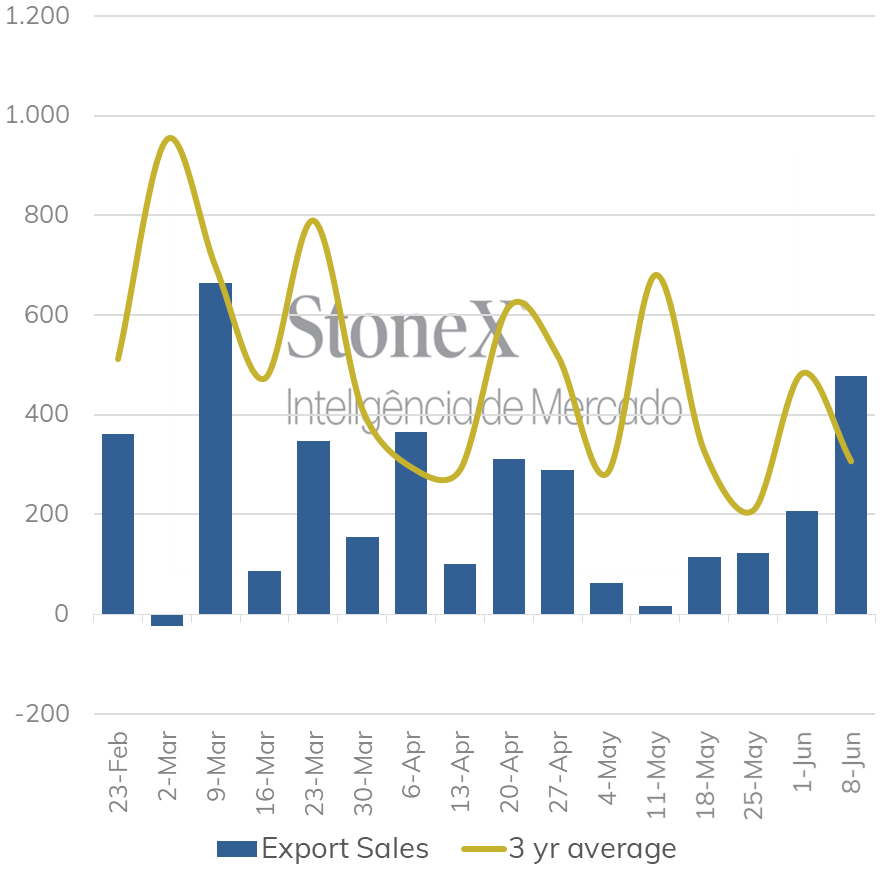
US export sales in the week ended June 08 reached 478,400 tonnes for the 2022/23 crop, closer to the top of estimates, which ranged from 250 to 550,000 tonnes. In accumulated terms, US sales are at 51.6 million tonnes, against 60.1 million in the same week last year. It should be noted that negotiations with China are stronger and 590,000 tonnes ahead of a year ago, while there is a negative difference of 9.1 million tonnes for shipments to other destinations.
For the 2023/24 crop year, US export sales came in at just 48,500 tonnes, below the floor of estimates at between 100,000 and 350,000 tonnes, and much lower than the three-year average for the week at 598,700 tonnes.
This week, the focus should continue to be the US weather, with forecasts moving prices in Chicago.