- World production in 2023/24 is expected to be far above consumption, according to the USDA;
- Economic indicators still weak;
- StoneX estimates a new record crop for Brazil in 2023/24;
- Pressured margins of the hog sector in China;
- Weak US exports.
- China's heated soybean imports;
- Positive crush margins in China;
- US crop productivity and production cut;
- Positive prospects for the American crush;
- Drier weather, with high temperatures in the US and lower production estimates by Pro Farmer.
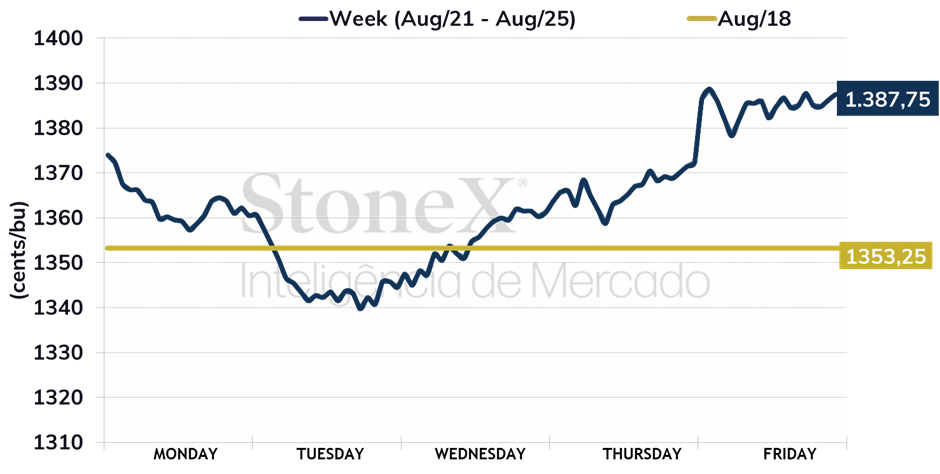
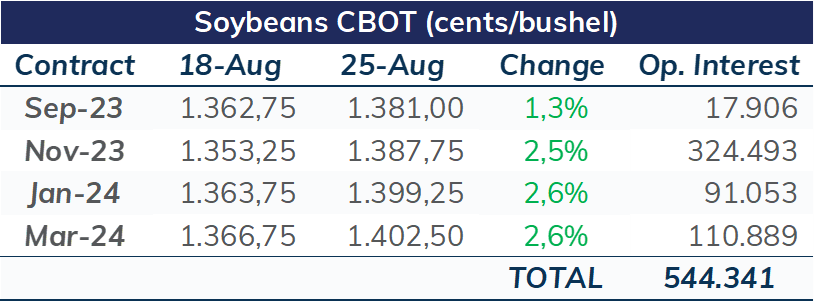
The bullish trend prevailed for another week in Chicago, under the main influence of the progress of the North American crop. The November 2023 contract ended Friday's session (25) at 1387.75 cents per bushel, an increase of 2.5%.
As the weather in August is very important for the final result of North American productivity due to the grain-filling stage, the drier and warmer weather that has prevailed since the middle of the month brings concerns.
Good rainfall was recorded this past weekend in the central US Plains and the southwest Midwest. The most significant volumes occurred in southeastern Nebraska, southern Illinois, far southwestern Indiana, and Kentucky. For this week, forecasts indicate that rainfall is expected to be lower than expected across the entire Midwest but with milder temperatures. Already from next weekend, in addition to the forecasts continuing to indicate drier weather, temperatures should return to rise above usual.
Also, the traditional Pro Farmer Crop Tour was held last week regarding the North American crop, touring the country's main corn and soybean producers. The field surveys highlighted a great variability of the samples collected, and the daily results of the pod count moved the market.
The final result of the crop tour, which considers, in addition to the crops evaluated, the stage of development, area adjustments, and differences from the official USDA data, among other factors, brought an average national productivity of 3.34 tonnes per hectare, with 2023/24 soybean production estimated at 111.86 million tonnes, against 114.44 million in the last USDA report. Only Indiana and Ohio recorded yields above the latest official USDA data, considering the seven states assessed. It is also noteworthy that in the final disclosure, it was emphasized that there is still a need for moisture in several regions to confirm these estimates. That is why the US weather continues to be closely monitored until the final productivity of the crops is defined.
US soybean crop conditions for the week ended 08/20 were stable, with the good percentage excellent at 59%, the level closest to the five-year average at 61%. The market awaits the next update in the late afternoon of Monday (28) after last week's hotter and drier weather. The Pro Farmer tour was held under a strong mass of warm air in some of the states visited, such as Iowa.
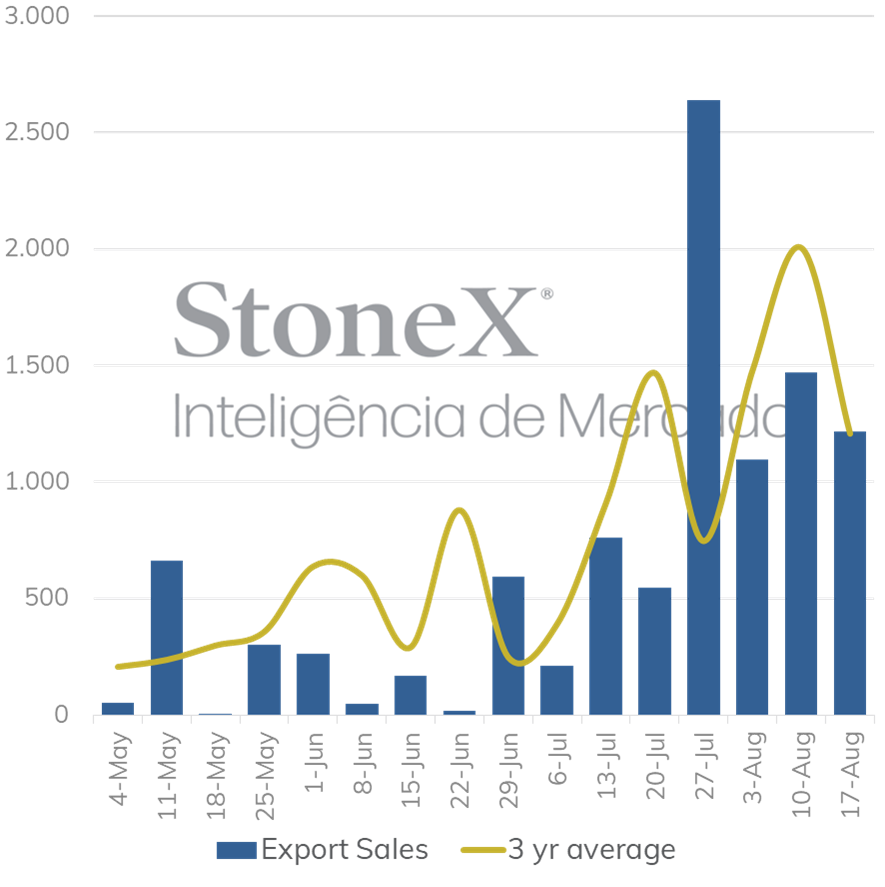
On the demand side, US export sales in the week ended 08/17 reached 364.95 thousand tonnes for the 2022/23 crop, volume above the top of estimates, which ranged from 0 to 200 thousand tonnes. For the 2023/24 crop, trading stood at 1.22 million tonnes, within the range of market expectations.
Either way, the chances of the estimate of exports to the US in the 2022/23 crop not being reached are increasing more and more, with only two weeks to go until the end of the crop year at the end of August. As of August 17, 51.5 million tonnes of the oilseed had been inspected, and the weekly volumes are lower than last year.
In China, crush margins remain positive, but concerns remain about the hog industry's margin. The country has recovered faster than expected from the large outbreak of African Swine Fever (ASF) between 20180 and 2019, which decimated almost half of its herd. Still, margins of activity remain under pressure, which could negatively impact the demand for soybean meal and, consequently, the crushing and import of the grain. It should be noted that the USDA estimates the country's soybean imports at 99 million tonnes in the 2023/24 cycle, below the potential result of the 2022/23 crop at 100 million.
In Brazil, the soybeans planting in 2023/24 is expected to begin in mid-September, after the end of the fallowing period in some states. The longer forecasts indicate rainfall within the normal range in southern Brazil, while in the central region, rainfall may be above normal in September.
This week, in addition to the usual data, the disclosure of Brazilian soybean exports in August to be released next Friday (01) stands out.