- World production in 2023/24 is estimated to be far above consumption, according to the USDA;
- Economic indicators are still weak;
- StoneX estimates a new record crop in 2023/24 for Brazil;
- US crush lower than expected in August;
Weak US exports.
- China's heated soybean imports;
- Positive crush margins in China;
- Cut productivity and production of the US crop;
- Positive outlook for US soybean oil demand;
- US productivity could still suffer further cuts as a result of the weather.
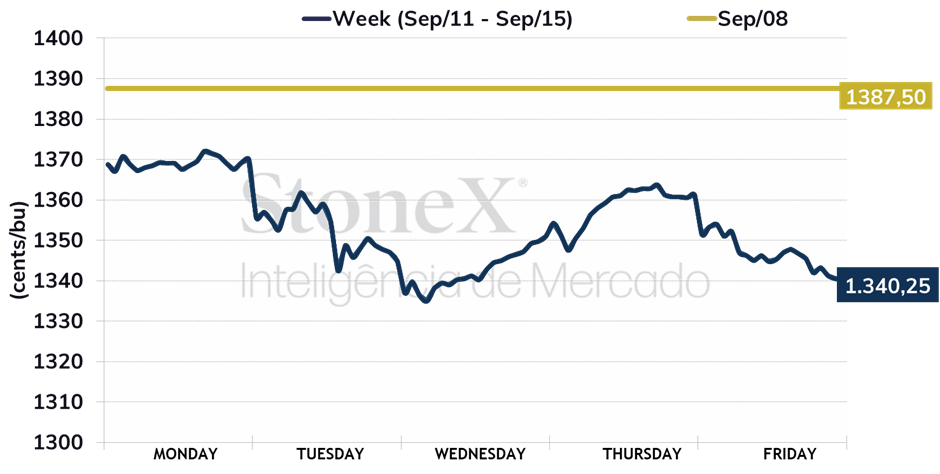
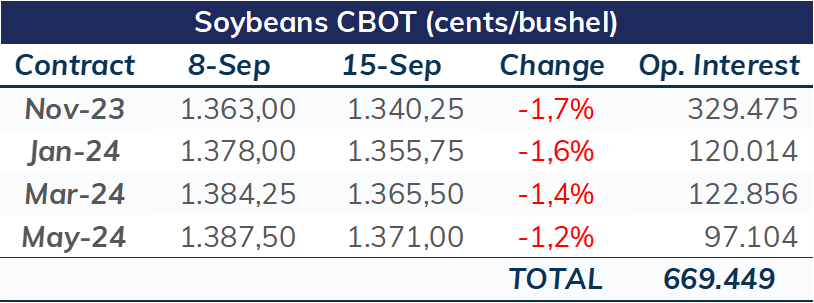
Last week, soybean prices in Chicago alternated between highs and lows throughout the sessions, ending the period lower. The November contract ended Friday (15) at 1340.25 cents per bushel, down 1.7% weekly.
The big anticipation at the beginning of the week was centered on the USDA supply and demand report, released on Tuesday (12), mainly related to the US numbers.
Estimated production for the US 2023/24 crop fell from 114.4 to 112.8 million tonnes, due to another expected productivity cut, to 3.37 ton/ha, highlighting that more than half of the country's producing areas recorded dry and hot weather in the second half of August.
As for the planted area, there was a marginal adjustment, going from 33.79 to 33.83 million hectares, an increase lower than expected, remembering that the number of areas of this cycle was lower than the market expected. Even so, it is worth noting that when adjustments are made to the planted area in the September report, this area tends to align with the final number for the cycle.
On the demand side, the USDA brought a small increase in 2022/23 exports to 54.16 million tonnes, with an equal impact on ending stocks. As for the new crop, there was another cut in estimated exports, which stood at 48.72 million tonnes, and there was also a small reduction in crushing, which caused some surprise, given the heated crushing amid the expected strong increase in renewable diesel production.
Thus, in addition to the fact that it is still too early to know what will happen to the demand for US soybeans, these adjustments reflect more the effort to close the balance sheet without stating that the country will face some rationing on the demand side.
However, future revisions in production, with possible further productivity cuts, are not ruled out since the potential climate impacts can be better evaluated with the harvest progress.
In the week ended 9/10, the USDA crop follow-up brought another worsening of North American crop conditions, with the good/excellent percentage dropping from 53% to 52% versus a 5-year average of 60%. However, it is noteworthy that the average of market expectations pointed to an even more significant retreat of crop conditions in the US.
Another highlight of the USDA's monthly report was the adjustment of imports from China. The 2022/23 crop estimate has risen to 102 million tonnes since the volumes recorded in recent months have been very warm, indicating that the accumulated between October 2022 and September 2023 should be higher than expected. For the 2023/24 cycle, Chinese imports are expected to reach 100 million tonnes, an increase from the figure released in August, representing an annual drop in the country's international purchases.
Even with these adjustments, it is noteworthy that the world balance of the 2023/24 soybean crop still indicates world production exceeding consumption by 18.71 million tonnes.
As pointed out, planting in South America is just beginning, with StoneX expected to bring its first follow-up to Brazil next Friday (22).
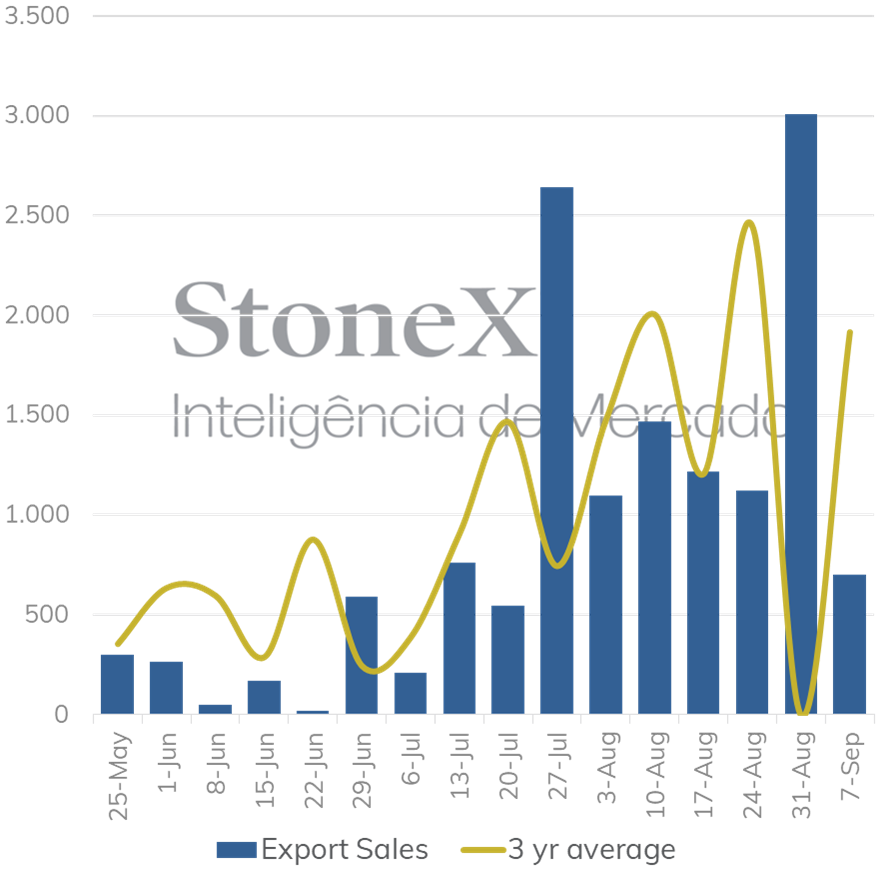
Regarding US export sales in the week ended 9/07, 703,900 tonnes were traded, a volume closer to the low end of estimates, between 600,000 and 1.45 million tonnes. Cumulatively, the delay compared to last year's period is 8.7 million tonnes, with China accounting for 6.5 million tonnes of this volume. As the country's 2023/24 export estimate points to a lower total in the annual comparison, this lower cumulative is not yet considered so worrying.
In the last session of the week (15), the monthly crushing data of the US, released by the National Association of Oilseed Processors (NOPA), surprised by indicating that 4.4 million tonnes of soybeans were crushed in August in the country, a volume on the low end of estimates and below the expected average, at 4.57 million. That result weighed on soybean prices in Chicago, though it was possibly related to maintenance shutdowns that hadn't been done in previous months.
On the other hand, soybean oil stocks in the country in August stood at 567,000 tonnes, considerably lower than the 672,700 tonnes expected by the market, which supported vegetable oil prices in the last session of the week.
In this week that begins, in addition to the crop follow-up in the US and also in Brazil, with the beginning of planting here, the oilseed export data stand out, as well as economic indicators and monetary policy decisions in both countries.