- World production estimated for 2023/24 well above consumption, according to USDA;
- Economic indicators still weak;
- StoneX estimates a new record crop for Brazil in 2023/24;
- 2023/24 crop harvest in the US;
Weak US exports.
- Heated soybean imports by China;
- Positive crushing margins in China;
- Productivity and production cuts in the US crop.
- Positive outlook for soybean oil demand in the US;
- Hot and dry weather in Brazil.
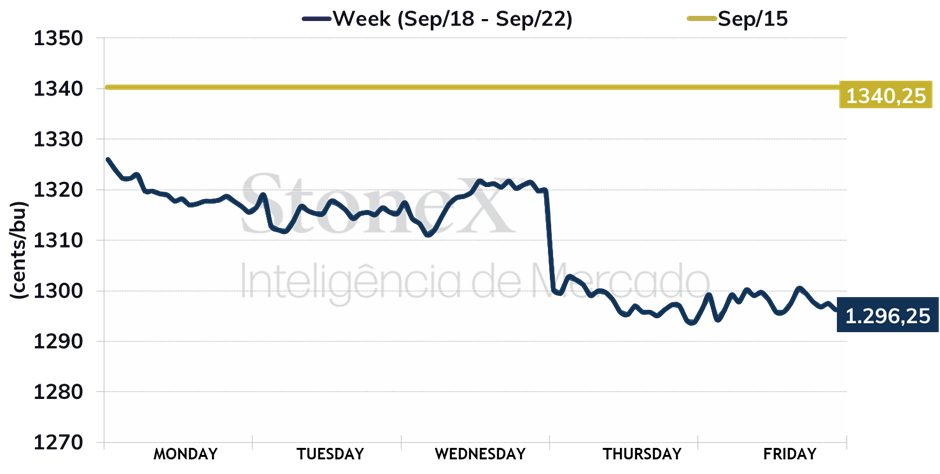
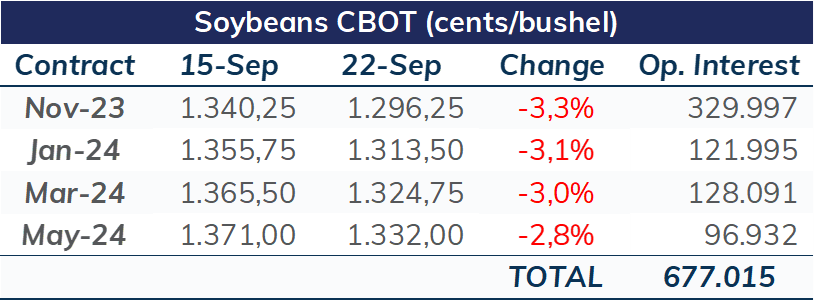
The soybean quotes in Chicago remained downward and recorded another negative week. The expiration for November ended on Friday (25) at 1296.25 cents per bushel, a decrease of 3.3% in the period.
The harvest of the North American crop is underway, which ends up weighing on prices, even with the prospects of a tighter balance and which may become even more complicated if there are new productivity cuts in future USDA revisions.
The first harvest monitoring of the 2023/24 US crop indicated a 5% national tally, above the recorded figure for the same period in the previous cycle and also above the five-year average at 4%. In the coming weeks, the pace is expected to accelerate, increasing the availability of soybeans in the country.
It is worth noting that USDA monitoring brought stability to the good/excellent percentage of crops, which stood at 52%, against market expectations of a drop to 51%. Improvements in Iowa, Minnesota, Michigan, Nebraska, Kentucky, and South Dakota offset the declines in other states. Even so, this level of 52% is the fifth lowest for the period in 24 years.
With the harvest progress in the US, regardless of whether there will be new crop adjustments in the future, the demand for the country's soybeans becomes increasingly relevant, remembering that the best period for American soybean exports is the last quarter of the year (between October and December). In addition to the volumes traded and shipped, the level of the Mississippi River is a concern again this year, as happened in 2022. This waterway route is essential for the country's grain exports. Still, with drier weather, some regions become unnavigable, impacting freight prices and even leading buyers to seek alternatives, which can ultimately benefit Brazil.
Brazilian exports are still warm after the record production in the 2022/23 cycle and, in many moments, managing to compete with the American grain, which seasonally tends to have an advantage at the end of the year.
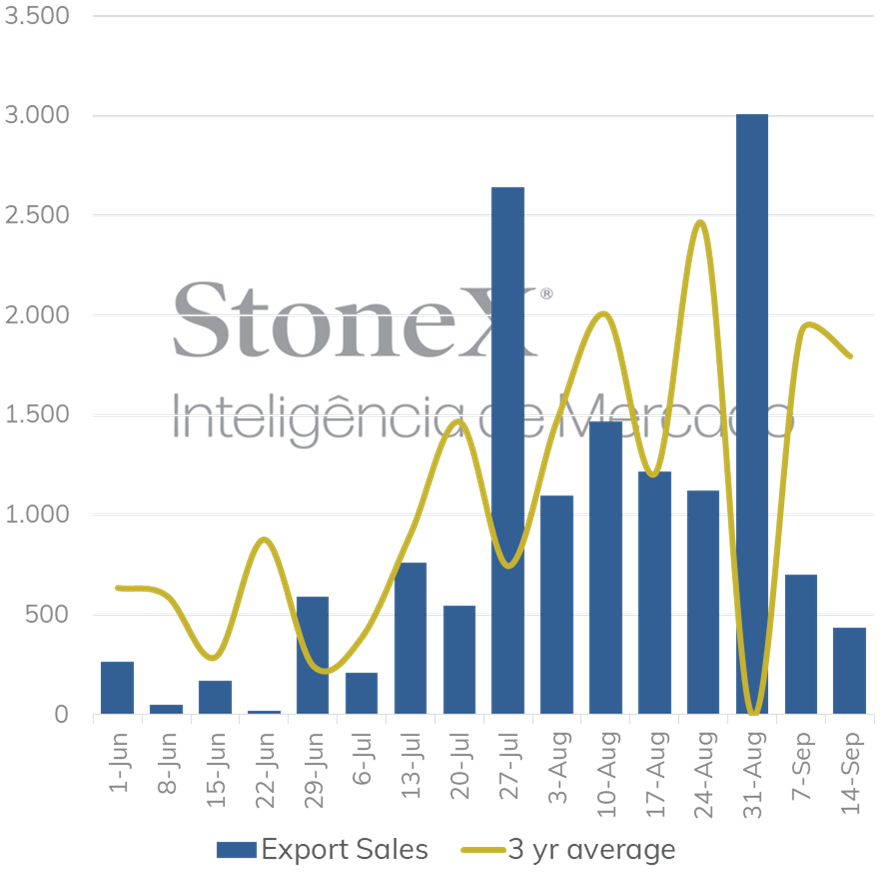
US export sales in the week ended on 09/14 totaled 434 thousand tonnes, below the market's estimated range of 600 thousand to 1.45 million tonnes. In the accumulated period, 17 million tonnes of soybeans from the 2023/24 crop were traded, compared to 25.7 million in the same period last year for the 2022/23 crop. It is important to remember that the USDA estimates an annual decline in American exports of 5.4 million tonnes.
On the other hand, prospects for domestic soy consumption in the US remain positive, driven by soybean oil, due to the increase in renewable diesel production. The imports of used cooking oil (UCO) from China are rising, reaching 384 thousand tonnes since January 2023. The UCO has increased its share in diesel and biodiesel production in the USA since last year, already accounting for more than 20% of the total. This advancement was greatly influenced by the Inflation Reduction Act (IRA) program and its tax credits for biofuels in the USA, while in China, the world's largest UCO producer, there is a lack of incentive policies that favor product demand.
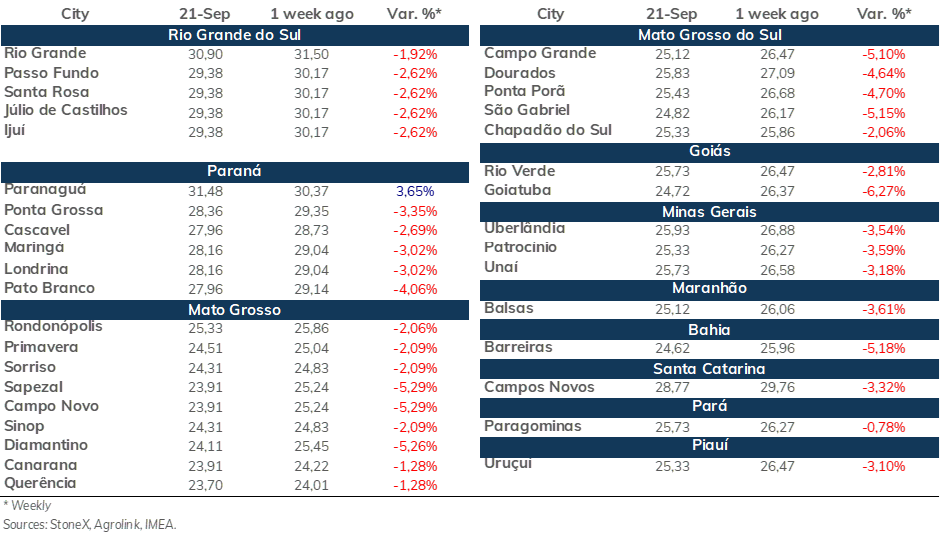
Shifting the focus to South America, the sanitary void has already ended in several Brazilian states, and planting is underway. StoneX has released its first planting update for the 2023/24 crop, with the national average at 2%, in line with the same week last year. It should be noted that, for now, planting has begun in Mato Grosso and Paraná, and the market is monitoring the weather conditions. Recently, a heatwave has resulted in temperatures well above average for this time of year, and there has also been very little rainfall in practically the entire soybean-producing region of the country. With this, speculation begins about possible delays in planting since this hotter and drier pattern is expected to continue in the coming days. However, in the case of soybeans, it is still early, and delays are not likely to result in production losses, with concerns falling on the corn planted in the same area as the oilseed in the second crop. A delay in the soybean cycle tends to reflect on the seasonality of demand for the oilseed in the first half of the year, as the harvest is also postponed, with impacts mainly on exports, whose peaks also tend to be delayed.
In the week that begins, the weather in South America is expected to remain on the radar, remembering that in Argentina, the planting only starts later, at the end of October. It is important to highlight that the estimates of a more comfortable global soybean balance, which have weighed on prices, depend on crops without major problems in Brazil and Argentina. Thus, the weather market here will gain increasing relevance.
In the US, on Friday (29), the quarterly stocks report as of 09/01 will be released, which, in the case of soybeans, corresponds to the ending stocks of the 2022/23 crop.