- World production estimated above consumption in 2023/24, according to USDA;
- US harvest progress;
- StoneX estimates a new record crop for Brazil in 2023/24;
- El Niño can favor crop production in South America;
- Weak accumulated export sales from the US.
- Heated soybean imports by China;
- Heated American domestic consumption;
- Productivity and production cuts in the US crop.
- Argentina may run out of soybeans for crushing in the coming weeks;
- Irregular rains in some Brazilian producing areas.
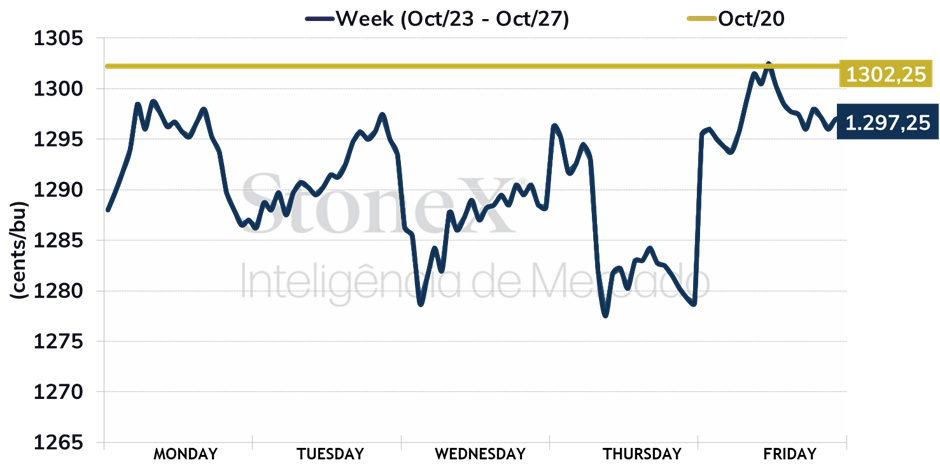
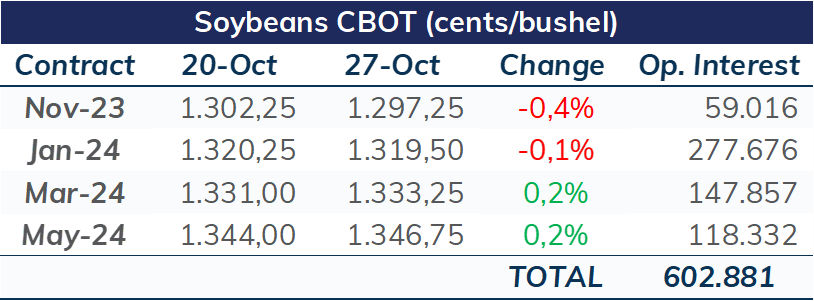
The soybean ended the previous week near unchanged, alternating between highs and lows, with the November expiration closing on Friday (27) at 1297.25 cents per bushel, a slight decrease of 0.4% in the period.
From the bearish side, it is worth noting that the harvest period in the US continued to weigh on prices, in addition to the rain forecasts in Brazil and Argentina. On the other hand, more positive data on US exports and concerns about the supply of Argentine soybean meal supported prices.
The USDA crop report for the week ending on 10/22 indicated that 76% of the soybean crops for the 2023/24 season in the US had been harvested, a percentage above the five-year average for the period at 67% but lower than the same week in 2022, at 78%.
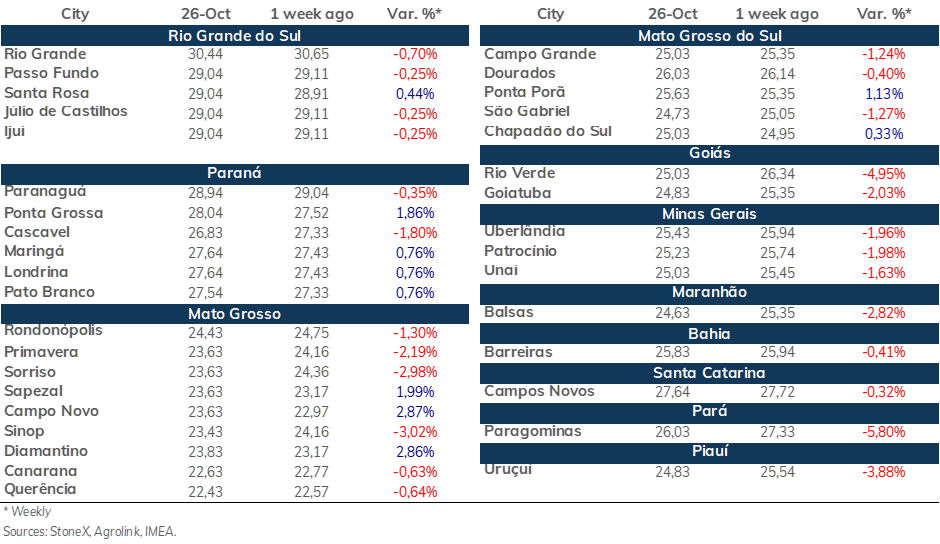
In Brazil, StoneX's weekly follow-up showed that 43.2% of the 2023/24 soybean crops were planted by October 27, remaining behind compared to the same period last year, when it reached 50.2%.
In this first month and a half of soybean planting in Brazil, the weather has remained very irregular in some producing areas, such as in regions of the Center-West. However, the weather forecasts indicate a more rainy climate in the upcoming weeks, improving soil moisture and creating room for faster planting progress around here.
Regarding the weather, Argentina has also recorded more significant rainfall volumes and more precipitation is forecasted for the country in the coming weeks. For soybeans, the Buenos Aires Grain Exchange has not yet started to release its planting follow-up, as the oilseed cycle in the country is later, with a similar window to that observed for Rio Grande do Sul.
Speaking of demand, American exports remain on the radar amid competition with Brazilian soybeans. The latest data from inspections and sales showed good volumes.
In the week ending on 10/19, 2.46 million tonnes of American soybeans were inspected, a volume higher than the previous week but lower than the amount reached in the same week last year. In the accumulated 2023/24 crop, inspections reached 7.9 million tonnes of soybeans, surpassing the recorded amount in 2022. Since the shipping cycle is still in its early stages, it's too early to say whether the USDA's estimate will be met or not, bearing in mind that the Department estimates US exports at 48.7 million tonnes, which is below the volume for the 2022/23 cycle, which stood at 54.2 million.
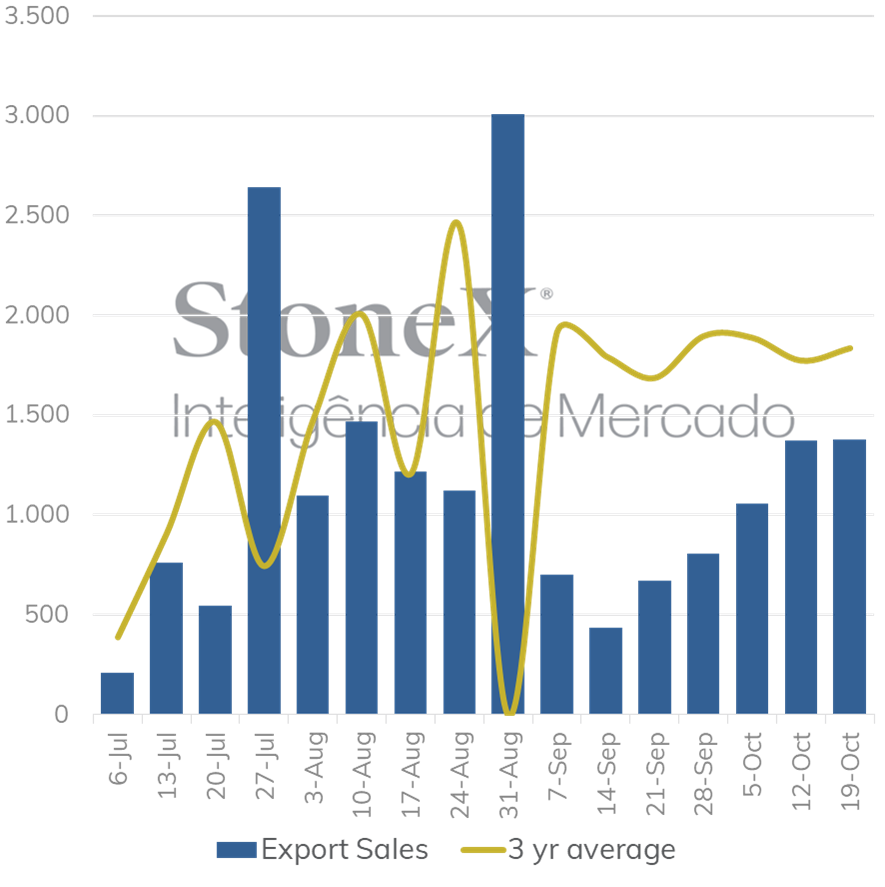
The export sales of the US 2023/24 crop reached 1.38 million tonnes in the same week, a volume closer to the upper end of the estimates, which ranged from 750,000 to 1.5 million tonnes, bringing the total to 22.26 million tonnes, still far from the previous year's record for the 2022/23 crop, which was at 31.47 million.
In Argentina, concerns about maintaining soybean crushing are significant, with prospects that the country may not have soybeans to process starting from the end of November. According to the Buenos Aires Stock Exchange, the 2022/23 crop suffered a 60% decrease due to the drought caused by La Niña, with production reaching only 21 million tonnes. The country is importing larger volumes of soybeans, but they will not be enough to maintain the usual crushed volume observed in production years close to 50 million tonnes.
In the last session of the week, on Friday (27), soybeans recorded a significant increase, driven by the soybean meal market. With Argentina crushing fewer soybeans and, consequently, exporting less, remembering that the country is the world's largest exporter of soybean byproducts, the search for meal from other suppliers, such as Brazil and the US, ends up being reinforced. Given this scenario, speculators were very present in the market.
In this upcoming week, crop monitoring in producing countries and American exports and Argentine crushing should remain in focus. It should be noted that StoneX will update its estimates for the crops in Brazil and the US on Wednesday (01). In addition, on the same day, Brazilian exports for October will be announced.