- World production estimated above consumption in 2023/24, according to the USDA;
- Record of the most abundant rainfall in Brazil's soybean areas;
- StoneX still estimates a record crop for Brazil in 2023/24;
- USDA increases production for the US in 2023/24;
- Weak accumulated export sales from the US.
- Sales of significant volumes of soybean from the US to China;
- Heated American domestic consumption;
- Argentina may run out of soybeans for crushing;
- Need for more rain in Brazilian producing regions.
- Losses of productive potential in the Brazilian crop.
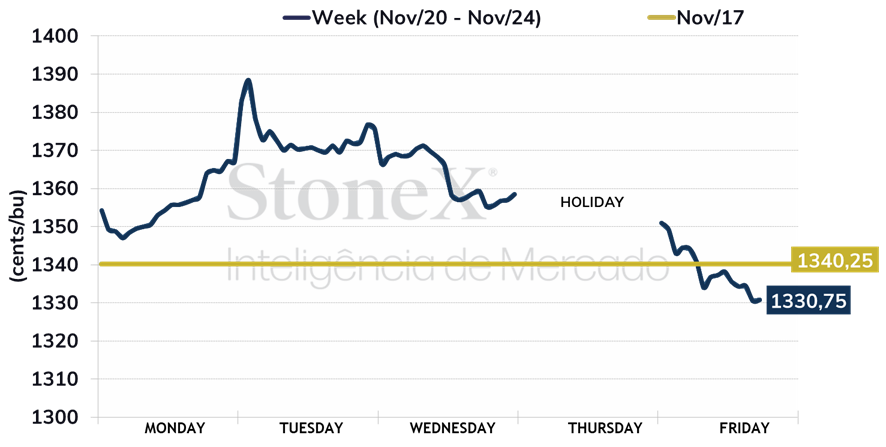
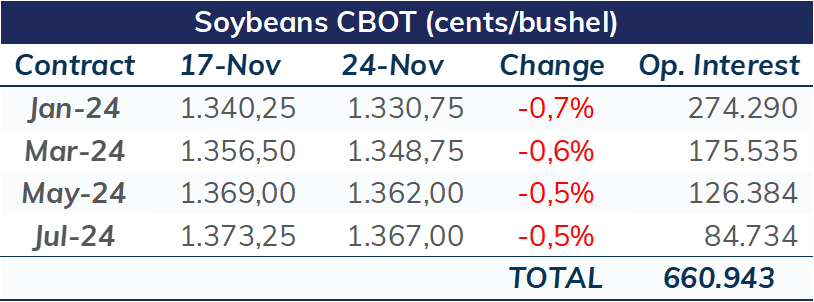
Soybean quotes in Chicago ended the week lower, with the January contract ending Friday's session (24) at 1330.75 cents per bushel, a 0.7% decrease in the period.
The week started with quite a lot of speculation after the result of the presidential election in Argentina. The victory of the ultraliberal candidate, Javier Milei, was quite well received by the country's agribusiness, which was quite disappointed with the retenciones on the exports of the world's largest supplier of soybean derivatives. Anyway, these gains came from the possibility that the new government will not adopt measures to encourage soybean sales by Argentine producers, such as the "soybean dollar," which could affect the availability of the oilseed around the world if the country's producers continue to hold onto the grains as a form of insurance against inflation.
There were also some rumors of Chinese purchases of American soybeans, but they were not confirmed by the USDA's daily reports, which are released when there are more significant export sales volumes.
Export inspections in the week ended on 11/16 reached 1.6 mmt, a volume below the average expected for the period. In the accumulated data, US soybean exports reached 15.9 million tonnes, below the number recorded in the same period last year, remembering that the country's best export window is the last three months of the year.
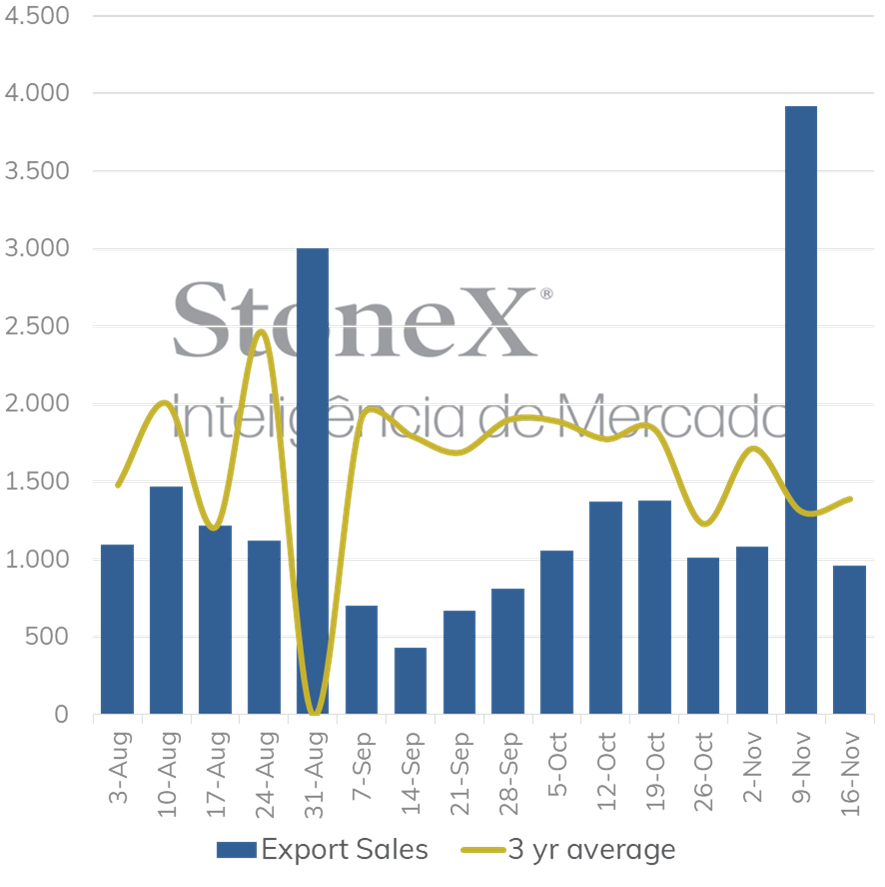
US export sales in the week ended 11/16 were 961.3 TMT, closer to the lower end of the estimates, which ranged from 800,000 to 1.8 MMT. In the accumulated, 29 million tonnes were traded, a delay of more than 6 million compared to the previous year, but remembering that USDA's estimates for the 2023/24 cycle are lower.
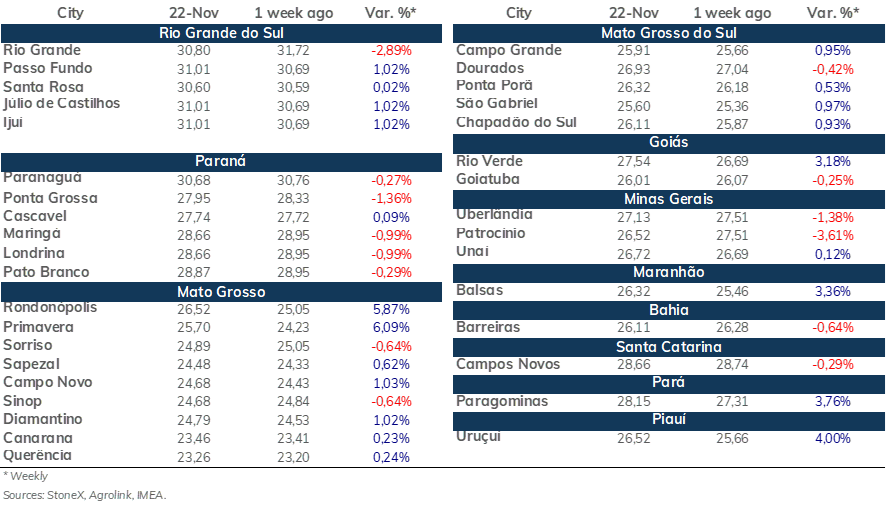
On the supply side, attention is very focused on the weather in South America. The rainfall volumes have been very high in Rio Grande do Sul, affecting the planting progress and creating doubts about the health of the plants. Already in other regions of the country, especially in the Center-West, the still irregular rainfall brought concerns, resulting in delays and the need for replanting in some areas.
Thus, some loss of productive potential for soybeans is already expected, although it is still not possible to speak of a very significant crop failure.
This last week of November, more abundant rains are expected in the soybean-producing regions of the Center-West, including more significant precipitation that has already occurred in recent days in various areas of the region. Thus, if there is greater regularity and good volumes of rain in the coming weeks, soybean production could still achieve a good result.
According to the Buenos Aires exchange, the 2023/24 soybean crop planting reached 34.8% of the estimated area of 17.3 million hectares in Argentina. The weekly progress was 17.4 p.p., with progress in the North and South regions. There were reports of replanting in some regions, but overall, the conditions are positive, with good crop emergence.
These higher levels of precipitation, which were also more widespread, conditioned the fall of soybean quotes in Chicago last week.
This week, the weather here in Brazil will continue to be central, emphasizing that the rains need to continue and that recent precipitation has been irregular in some areas. On Friday (01), StoneX will update its figures for the Brazilian 2023/24 crop.