- World production estimated above consumption in 2023/24, according to the USDA.
- Record of more abundant rains in Brazil's soybean areas and good expectations for the coming weeks;
- Although some damages are irreversible if good rainfall volumes are confirmed, later planted areas may show improvement;
- Full crop potential in Argentina;
- Concerns about the pace of global demand;
- Weak accumulated export sales from the US.
- Heated American domestic consumption;
- StoneX cuts 2023/24 soybean production, which is no longer a record;
- Cuts in estimated production by CONAB and USDA;
- The Argentine situation still favors holding soybeans as insurance;
- Brazilian exports above 100 million tonnes in 2023.
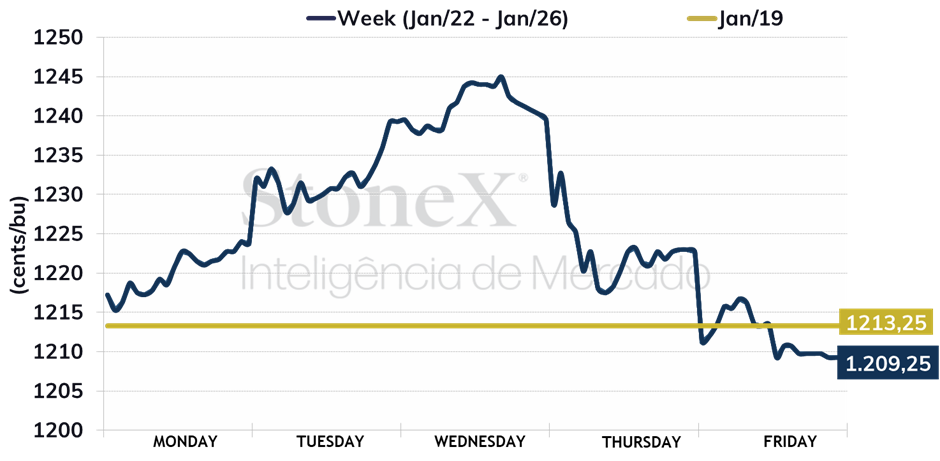
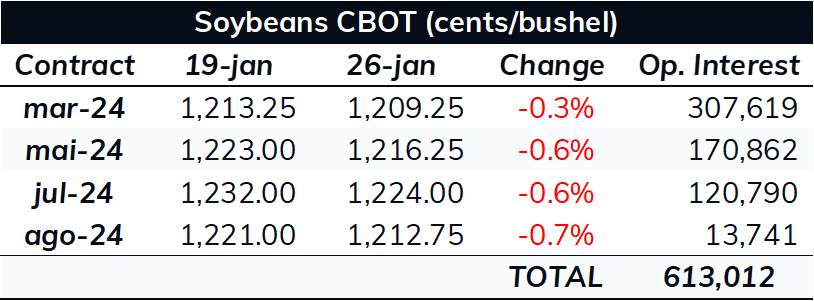
The soybean quotes in Chicago started the previous week higher but fell again, ending the period with slight losses. The March contract closed Friday (26) at 1209.25 cents per bushel, a weekly decrease of 0.3%.
Among the main factors influencing this movement are the progress and weather forecasts for the crop in South America, the prospects for the new crop in the US, and concerns on the demand side, which stand out.
The Brazilian crop harvest continues to advance, having reached 9.3% of the total on the last Friday (26), according to StoneX's monitoring, a percentage higher than last year, as the dry and hot weather accelerated the cycle of the oilseed in some regions. It should be noted that at the beginning of this crop, field results showed lower yields, which was expected since the crops planted shortly after the end of the sanitary void suffered from long periods of drought and high temperatures. Nonetheless, the yield is expected to increase as the harvest progresses.
In Argentina, the conditions of soybean crops are very favorable, according to the Buenos Aires Exchange, with 92% of the crops classified as normal/excellent and adequate/optimal water conditions in 90% of the country's area. Thus, the institution revised its soybean acreage for the 2023/24 cycle, reaching 17.3 million hectares, with production estimated at 52.5 million tonnes. The weather forecasts indicating a drier pattern in the next 15 days for the country were one of the support factors for the quotes of the oilseed at the beginning of the previous week. Nonetheless, the scenario is very positive for the Argentine crop.
Another factor that provided momentary support to prices was the discussion about the area of the next American crop, which will be planted starting in April. Given the tighter balance in the US and the price differential between soybeans and corn, the prospects have been for a hike in the soybean area. However, these prospects are currently less optimistic about the size of the area growth compared to what was speculated a few months ago. In February, the USDA holds the Agricultural Forum, eagerly awaiting the figures on the new US crop. At the end of March, the results of planting intentions are released, giving a better idea of how much the soybean area will grow.
On the demand side, it is noteworthy that Brazil basis continues to have significant discounts compared to the US Gulf soybeans to China. US export inspections for the week ended on 01/18 were at 1.16 mmt, a lower volume than last year. In the accumulated, inspections are at 26.8 million tonnes, compared to 34.3 million in the annual comparison.
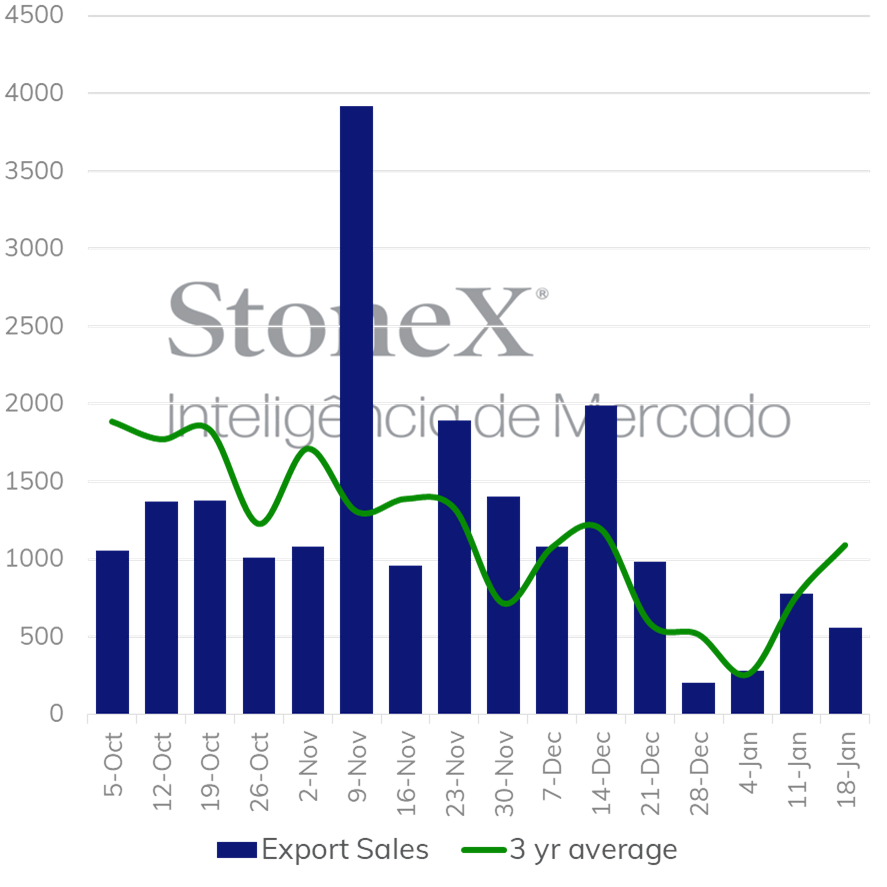
The country's export sales reached 560.9 thousand tonnes in the same week, below the estimated 700 thousand to 1.4 million tonnes. Nearly 38 million tonnes were traded, below last year's figure of 46.5 million. Despite USDA estimating lower American exports in the 2023/24 crop cycle, with the entry of the Brazilian crop, which is already quite competitive, concerns about the volumes the US will be able to ship increase.
Furthermore, the crushing margins and the Chinese pork industry are predominantly in the negative field, which raises doubts about the size of the country's imports, remembering that China took advantage of the Brazilian record crop 2022/23 to replenish its stocks. The country reported that its pig herd at the end of 2023 was 4.1% smaller than a year before. The number of sows fell by 5.7%. Furthermore, the outlook indicates slower economic growth for the country than in previous years.
Regarding the domestic demand for soybeans in the US, the prospects continue to be more favorable, with positive - but declining - crushing margins. It is worth noting that D4 RINs, including renewable diesel, a segment driving the domestic demand for soybeans in the United States, have shown a downward trend.
StoneX Brazil will update its figures for the 2023/24 crop this week on Thursday (02/01). Brazil and the US monetary policy meetings will be held in the macroeconomic field, with expectations of a new drop in the Selic rate. Also noteworthy are the US employment data, which are always followed due to their relevance for the Fed's decisions.