- Bearish factors
- Global production for 24/25 exceeds consumption, according to USDA;
- Concerns about the pace of global demand;
- Record production estimate for the Brazilian 24/25 crop;
- Improving crop conditions in Argentina;
- China raises retaliatory tariffs on the U.S.
- Bullish factors
- New incentive measures adopted by the Chinese government;
- Estimate of reduced U.S. planted area for the 25/26 crop;
- Loss of potential in the Argentine crop;
- Possible increase in U.S. biodiesel and renewable diesel mandate;
- Possible easing/delay of Chinese ship inspections at U.S. ports.
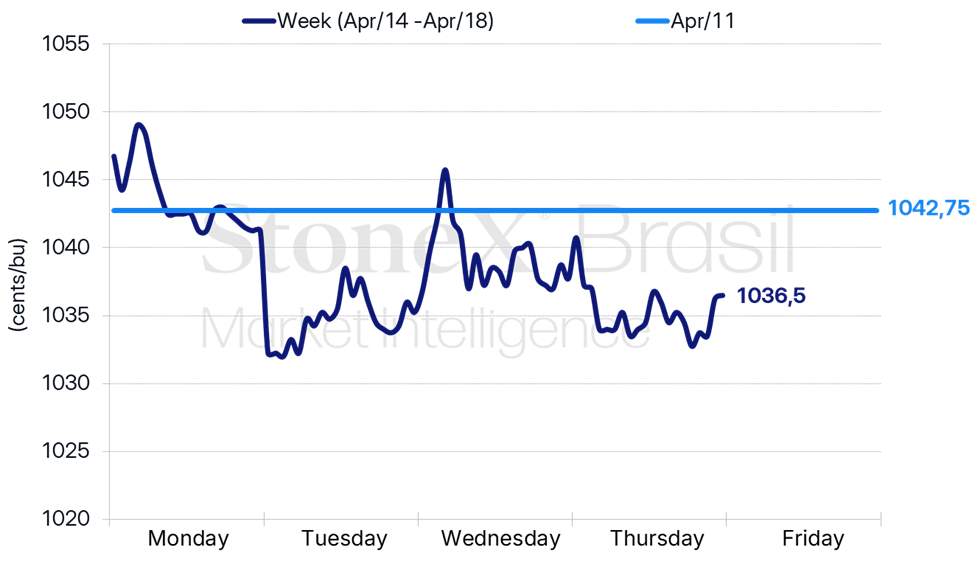
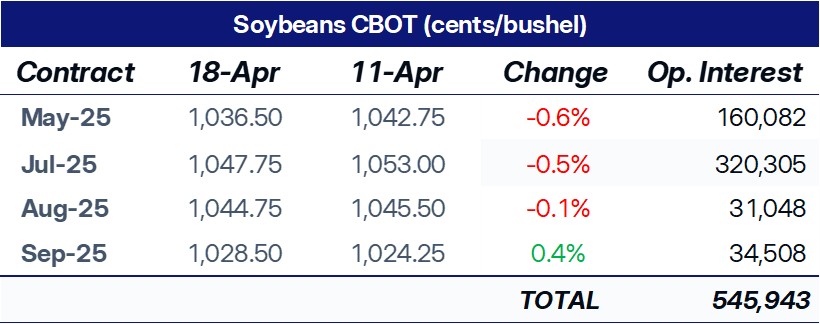
Chicago soybean futures traded around unchanged in this shorter week, with the front‐month contract finishing Thursday (the 17th) at 1,036.5 cents per bushel, down a modest 0.6% over the period.
The market remains focused on U.S. tariff developments and potential retaliations, but there were no major soybean‐specific updates beyond higher tariff percentages under consideration. Regardless of the exact level of China’s tariff on U.S. soybeans, U.S. supplies become largely uncompetitive. Brazil currently has abundant soybean availability, and the market is already seeing increased Chinese purchases. In addition, any U.S. soybean purchases by China could be executed through state‐owned Sino Grain, absorbing the higher tariff cost without passing it on to Chinese consumers.
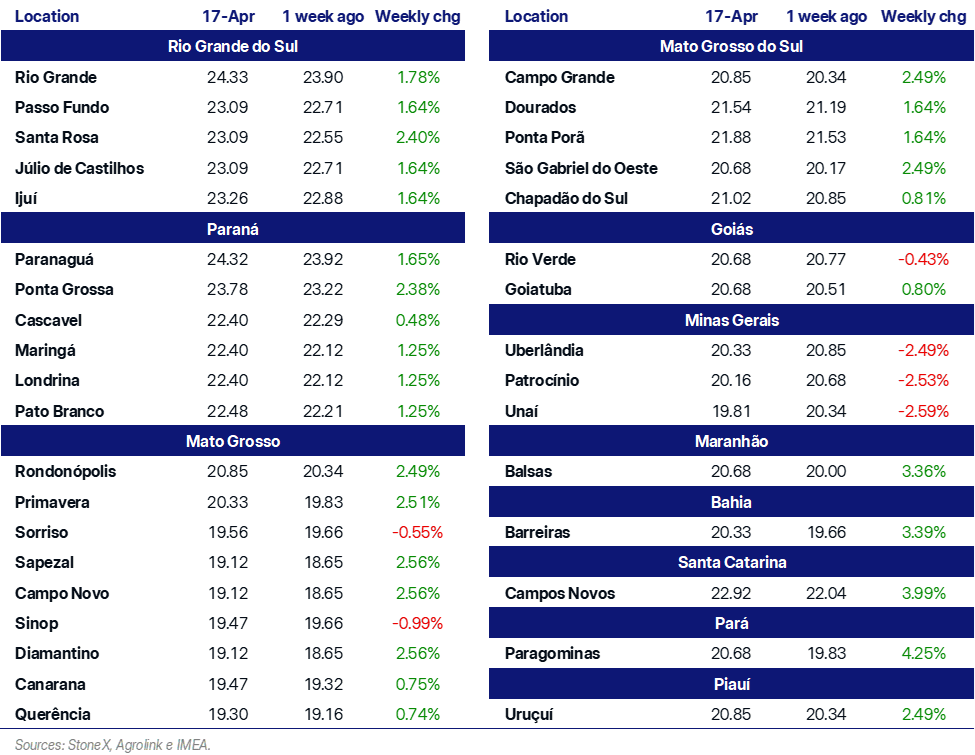
In Brazil, port premiums are stronger than a year ago, in part due to the U.S.–China tariff conflict. In early April, when Trump announced “reciprocal” tariffs and China retaliated, the nearest‐term premium briefly exceeded USD 1.00 per bushel.
Another key item is the U.S. biofuels policy, which has supported soybean (and especially soybean oil) prices following talks between fossil fuel and biofuel producers that could lead the EPA to significantly raise the biodiesel and renewable diesel mandates. No decision has been announced yet, though rumors suggest news as soon as next week. In this context, the National Oilseed Processors Association (NOPA) reported 5.29 million tonnes of soy crush in March—below the market’s 5.38 million tonne consensus—and weaker February crush as well. Coupled with mandate uncertainty, crush margins have softened, pushing more oil into export channels.
As for exports, U.S. soybean sales for the 24/25 season in the week ending 04/10 reached 554.8 thousand tonnes, taking the total to 46.8 million tonnes—well on track for the USDA’s 49.67 million tonne export forecast. While China’s tariffs are a concern, the U.S. isn’t selling strongly to China at this point; the biggest impact is likely in the year’s final quarter, when most U.S. shipments occur.
In the U.S., planting for the 25/26 soybean crop has begun: as of Sunday (the 13th), USDA reported 2% planted nationally, in line with the five‑year average.
In Brazil, harvest is wrapping up at 95.1% complete nationally, per StoneX. April exports through the 11th topped 7 million tonnes, maintaining very robust shipments after March’s record.
In Argentina, the Buenos Aires Grain Exchange reported 4.9% harvested—about nine percentage points behind last year. The country’s 48.6 million tonne soybean forecast remains unchanged.
Next week, tariff developments will remain in focus, along with Chinese demand for Brazilian soy and ongoing export trends.