
Daily Coffee Report 8/10/26
Daily coffee report
StoneX Coffee Team
- Coffee
Quarterly Commodities Outlook is available for free now. Download your report →
By: StoneX Intelligence Brazil, StoneX Intelligence Brazil


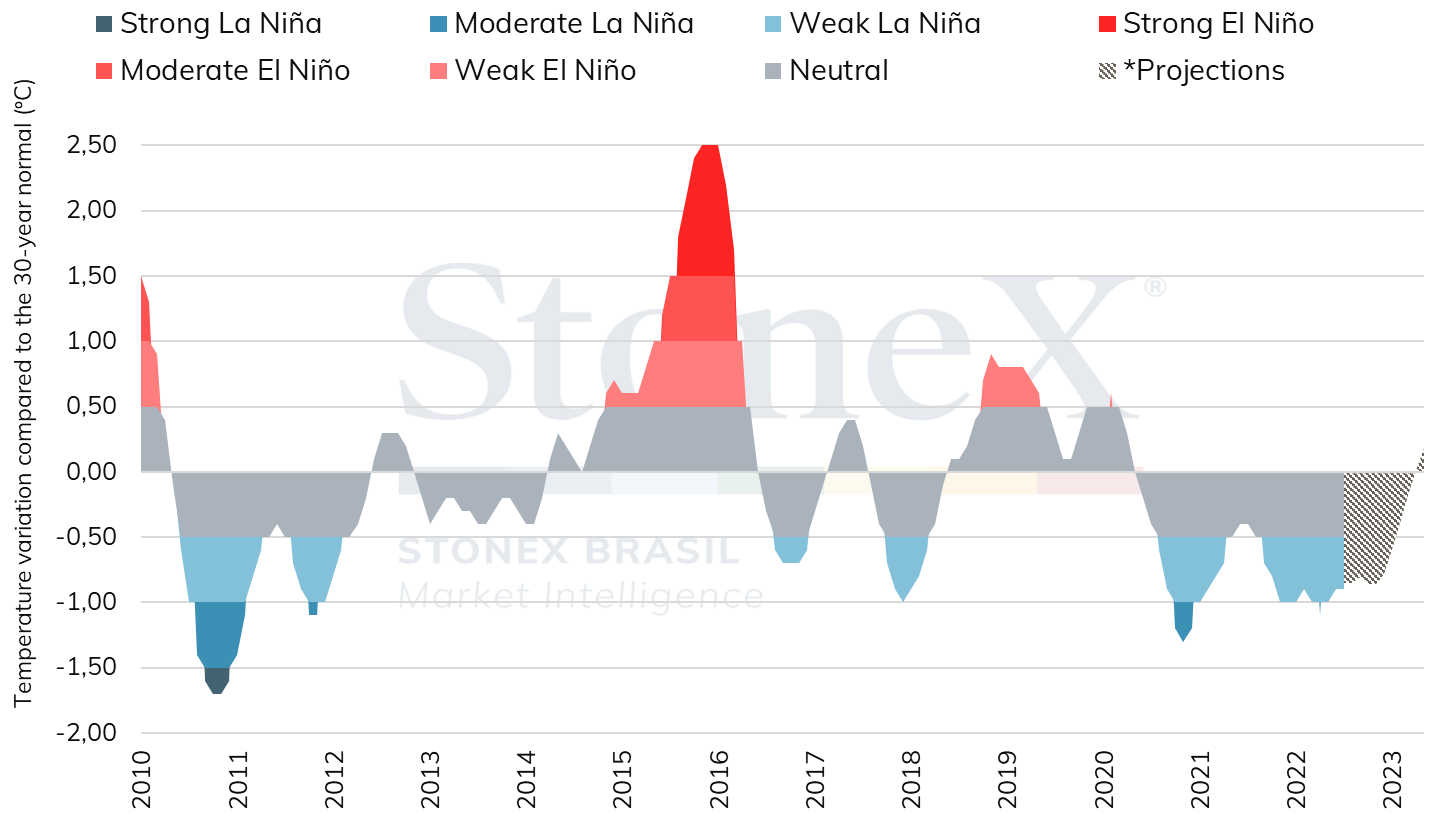
After the record crop in 2020, the Brazilian coffee industry faced a sequence of challenges, which resulted in major losses in production and contributed to prices reaching their highest levels in 10 years in 2022. In addition to frost, which caused major losses in 2021, the La Niña occurrence caused delayed rainfall during the coffee flowering stage in 2020 and 2021 and dry weather accentuating production losses in 2022. The weather phenomenon, basically the cooling of the waters of a region of the Pacific Ocean, is associated mainly with dry weather in the south of the country and delayed rainfall in the coffee belt in the second half of the year.
El Niño/La Niña occurrence history and projections for the coming months
With the 2022/23 crop almost finished, attention is turning to the 2023 crop development, which, under adequate weather conditions, should reflect the recovery of the crops that suffered from frost and adverse weather in 2021. Considering that part of the crops impacted by the weather phenomena was pruned or renewed, there is an expectation that the production in 2023 could be large or even exceed the volume harvested in 2020. Of course, it is still too early to estimate the 2023/24 crop, and making it clear that this is NOT a StoneX estimate, there have been rumors of participants projecting a crop of 70 million bags or higher.
But before these expectations become a reality, Brazilian coffee crops still need to go through flowering, a crucial stage that could define the potential for 2023. Whatever the problem is at this stage, Brazilian production would be compromised, as was seen in the previous two years.
Before analyzing the flowering scenario in Brazil, it is important to remember the process stages. For this report, we will focus only on the development and opening of flowers from the biennial cycle of the coffee plant. The growth of the floral bud intensifies from February to August, when the day length begins to decrease, reaching less than 13 hours of adequate sunlight. The flowering process can be separated into four distinct stages, with a certain degree of overlap between them: (stage 1) flower bud initiation; (stage 2) flower bud differentiation and development; (stage 3) flower bud dormancy; and (stage 4 and 5) flower opening.
Coffee floral bud development stages
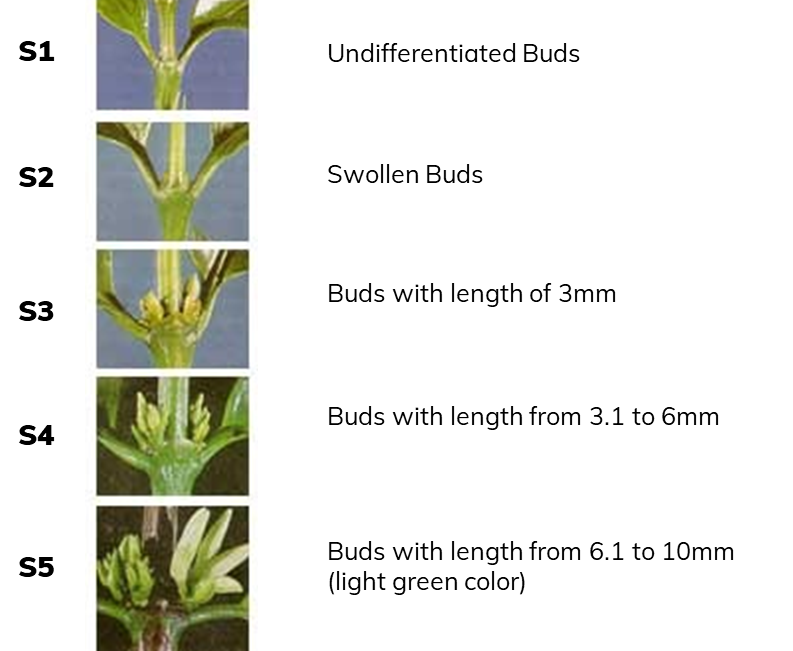
Coffee floral buds go from stage 1 to stage 3 between February and August when dormancy begins. While in dormancy, floral buds are less susceptible to damage from drought and high temperatures. The flower-opening stage begins when the plant faces an increase in soil water potential, which is basically the availability of water in the soil (it will occur after rainfall or irrigation). Still, the buds will remain dormant if the weather is dry. Once the flower buds begin their opening process, after an initial increase in soil moisture potential, it cannot be stopped, and the flower will open. Once open, coffee flowers become very susceptible to damage from drought and high temperatures.
First of all, we need to understand that we are dealing with the weather, one of the most unpredictable factors that can affect coffee. Even the weather forecast models have a high level of uncertainty. Weather forecasts that are longer than 48 hours are considered long-term forecasts and have a high degree of uncertainty.
In 2022, similarly to the last two years, the Pacific conditions favor the La Niña phenomenon and the probability forecasts projections of NOAA (US National Oceanic and Atmospheric Administration), the US weather agency, indicate that the phenomenon should persist throughout the second half of the year, with a probability above 90% for the SON quarter (September, October and November) and probability above 80% until the NDJ quarter (November, December and January).
El Niño/La Niña Probability Forecast
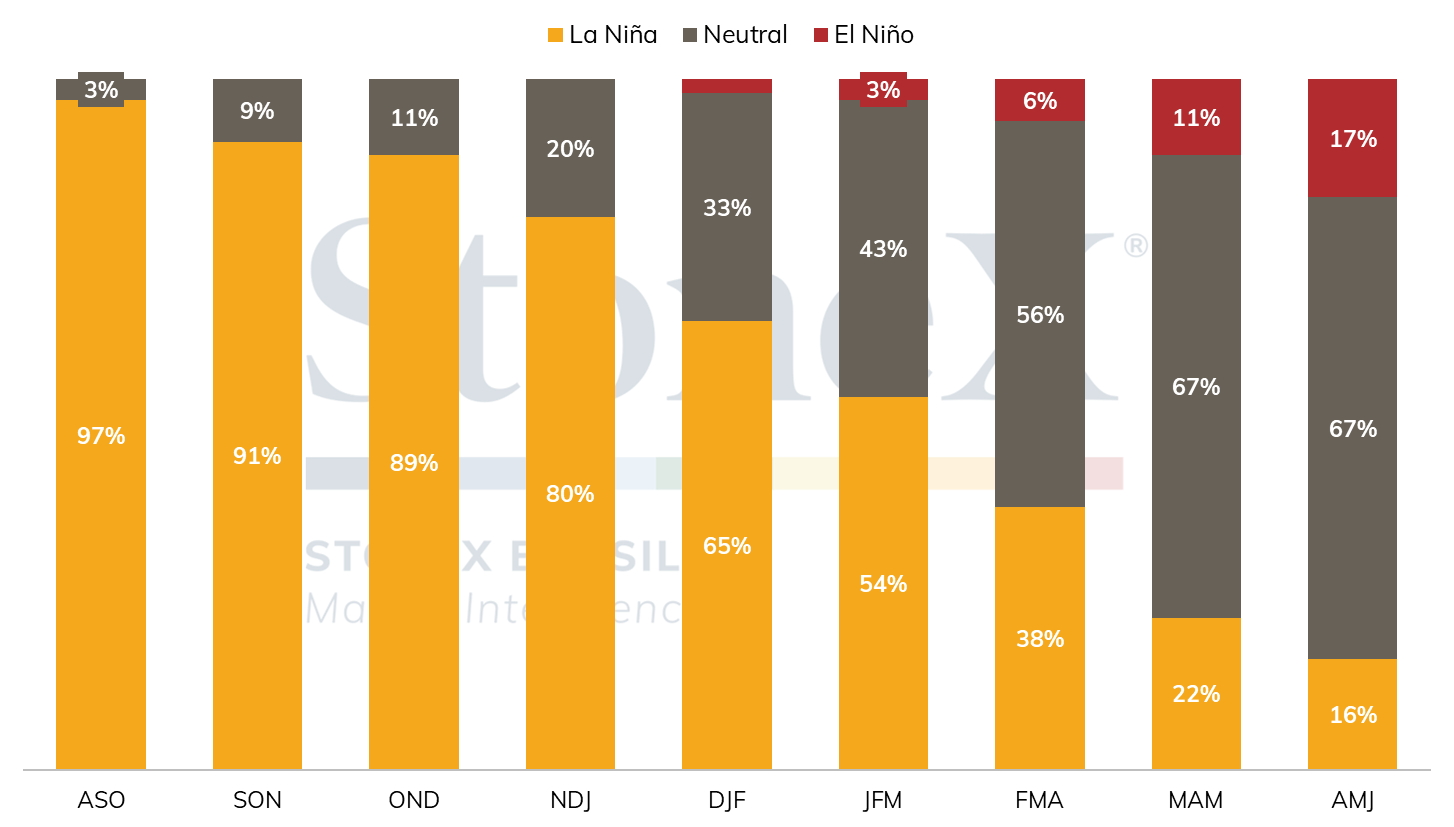
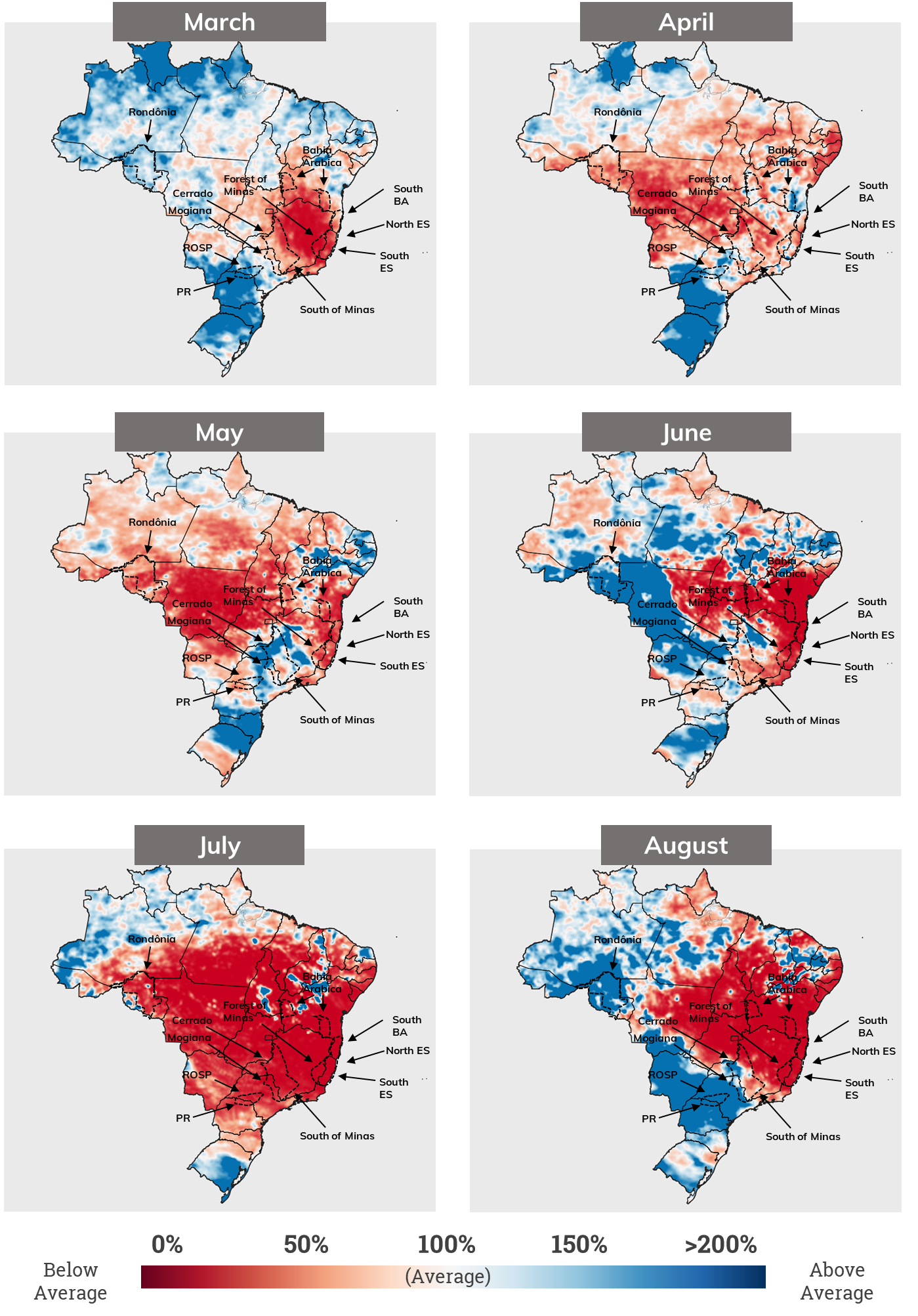
Although some coffee crops in 2022 are recovering from the 2021 weather, they faced some months of unfavorable weather in 2022. According to the rainfall anomaly maps, which compare the observed volume with the historical average for the region, February and May had above-average rainfall volumes in much of the belt. However, in the remaining months - March, April, June, July, and August - most of the coffee belt saw volumes well below the historical average. In mid-August, some municipalities in the southern region of Minas received up to 36 mm, which resulted in the start of a small flowering, but the main flowering is still to come.
Precipitation in 2022 compared to the average of the last 20 years in Brazil
Starting in September, the weather could impact coffee flowering in two ways: a prolonged rainfall delay or an uneven rainfall regime combined with hot and dry weather. The delay is already a problem, considering crops have been facing dry weather for months. On the other hand, an unstable rainfall regime, interspersed with dry and hot periods, jeopardizes the buds that may eventually open with the rainfall - as mentioned above, once dormancy is broken, the flowering process continues regardless of weather conditions.
The weather inconsistencies have already started and should continue to impact the market in the coming months. Look at what happened a few weeks ago: in mid-August, in the midst of dry weather forecasts for the producing regions, the StoneX weather report, which uses data from the NOAA's GFS forecast model - recognized worldwide and used by several climate agencies - began to indicate the possibility of the arrival of rainfall in part of the belt starting on September 7. However, as the date approached, the model changed its forecast and indicated insufficient rainfall volumes for the period in question.
Considering scenarios, in case of adequate rainfall return, the perception that the next crop would be great would grow, generating a bearish sentiment in the market. Otherwise, weather adversity, such as those caused by La Niña in the last two years' flowering, could bring new impacts and frustrate expectations for production in 2023. A confirmation of this scenario would help prices to remain close to the historically high levels recorded in 2022, with the potential, depending on the intensity of the impact, to move even higher. While it is not possible to be sure about rainfall and flowering, we can expect the weather market to dominate the movements and bring volatility to coffee prices.
The StoneX Group Inc. group of companies provides financial services worldwide through its subsidiaries, including physical commodities, securities, exchange-traded and over-the-counter derivatives, risk management, global payments and foreign exchange products in accordance with applicable law in the jurisdictions where services are provided. References to over-the-counter (“OTC”) products or swaps are made on behalf of StoneX Markets LLC (“SXM”), a member of the National Futures Association (“NFA”) and provisionally registered with the U.S. Commodity Futures Trading Commission (“CFTC”) as a swap dealer. SXM’s products are designed only for individuals or firms who qualify under CFTC rules as an ‘Eligible Contract Participant’ (“ECP”) and who have been accepted as customers of SXM. StoneX Financial Inc. (“SFI”) is a member of FINRA/NFA/SIPC and registered with the MSRB. SFI is registered with the U.S. Securities and Exchange Commission (“SEC”) as a Broker-Dealer and with the CFTC as a Futures Commission Merchant and Commodity Trading Adviser. References to securities trading are made on behalf of the BD Division of SFI and are intended only for an audience of institutional clients as defined by FINRA Rule 4512(c). References to exchange-traded futures and options are made on behalf of the FCM Division of SFI . StoneX is a trading name of StoneX Financial Ltd (“SFL”). SFL is registered in England and Wales, Company No. 5616586. SFL is authorized and regulated by the Financial Conduct Authority [FRN 446717] to provide to professional and eligible customers including: arrangement, execution and, where required, clearing derivative transactions in exchange traded futures and options. SFL is also authorised to engage in the arrangement and execution of transactions in certain OTC products, certain securities trading, precious metals trading and payment services to eligible customers. SFL is authorised & regulated by the Financial Conduct Authority under the Payment Services Regulations 2017 for the provision of payment services. SFL is a category 1 ring-dealing member of the London Metal Exchange. In addition SFL also engages in other physically delivered commodities business and other general business activities which are unregulated and not required to be authorised by the Financial Conduct Authority. StoneX Group Inc. acts as agent for SFL in New York with respect to its payments services business. StoneX APAC Pte. Ltd. acts as agent for SFL in Singapore with respect to its payments services business. ‘StoneX’ is the trade name used by StoneX Group Inc. and all its associated entities and subsidiaries.
Trading swaps and over-the-counter derivatives, exchange-traded derivatives and options and securities involves substantial risk and is not suitable for all investors. Past performance of any futures or option is not indicative of future success. Indicators are not a trading system and are not published as a specific trade recommendation. The information herein is not a recommendation to trade nor investment research or an offer to buy or sell any derivative or security. It does not take into account your particular investment objectives, financial situation or needs and does not create a binding obligation on any of the StoneX group of companies to enter into any transaction with you. You are advised to perform an independent investigation of any transaction to determine whether any transaction is suitable for you. No part of this material may be copied, photocopied or duplicated in any form by any means or redistributed without the prior written consent of StoneX Group Inc.
© 2026 StoneX Group Inc. All Rights Reserved.
Our subscribers have access to comprehensive market analysis from StoneX spanning commodities, equities, currencies and more.
Daily coffee report

August 10 – The world commodity markets and economy remains at risk amid two wars this morning. Tensions continue to escalate in both the Middle East and the Black Sea – risking pulling other countries into the conflicts. Stocks are down modestly this morning as we start a week of trade in which we’ll see key inflation and retail sales data following a weak jobs report this past Friday. Yet, stocks continue to trade just below record high levels, with the VIX trading near 2026 lows just above 15. The dollar index is trading near 99.7. Yields on 10-year Treasuries are trading near 4.68%, while yields on 2-year Treasuries are trading near 4.23%. The energy and food-based markets are firmer today amid the escalated risks. WTI crude oil is trading near $80, while Brent trades near $85 per barrel. Double-digit gains in the winter wheat markets lead the way for higher grain and oilseed prices.

August 7 – The U.S. economy unexpectedly lost 23k jobs in July, dramatically below market expectations of an 80k increase and marking the worst Non-Farm Payrolls print since February. Furthermore, May and June were both revised sharply downward, with combined revisions showing 103k fewer jobs than previously reported. Outside of the healthcare sector, which added 22k jobs in July, the losses were very broad-based. Government payrolls saw the largest decline, shedding 53k jobs in July, the largest seen since October 2025, while June was revised down to show a loss of 10k jobs as well. The private sector at least saw growth, adding 30k jobs in July, now matching the month prior after it was revised down from the 49k initially reported, and substantially missing forecasts of 78k jobs being added. This is a sharp reversal in course from the largely better than expected U.S. labor data seen earlier this week.

Our market expertise, advanced platforms, global reach, culture of full transparency and commitment to our clients’ success all set us apart in the financial marketplace.
Reach
With access to 40+ derivatives exchanges, 180+ foreign exchange markets, nearly every global securities marketplace and numerous bi-lateral liquidity venues, StoneX’s digital network and deep relationships can take clients anywhere they want to go.
Transparency
As a publicly traded company meeting the highest standards of regulatory compliance in the markets we serve; our financials and record of accomplishment are matters of public record. StoneX’s commitment to “doing the right thing over the easy thing” sets us apart in the industry and helps us build respect, client trust and new partnerships.
Expertise
From our proprietary Market Intelligence platform, to “boots on the ground” expertise from award-winning traders and professionals, we connect our clients directly to actionable insights they can use to make more informed decisions and achieve their goals in the global markets.