Quarterly Commodities Outlook is available for free now.  Download your report  →

StoneX logo

Special | Coffee Market Outlook [may-july]

By: StoneX Intelligence Brazil, StoneX Intelligence Brazil

Coffee Market Outlook [may-july]
 
Fernando Maximiliano
 
Leonardo Rossetti
 
After starting the year with a bullish bias and reaching a 10-year high, a sequence of unforeseen events has put coffee prices on an uncertain path 

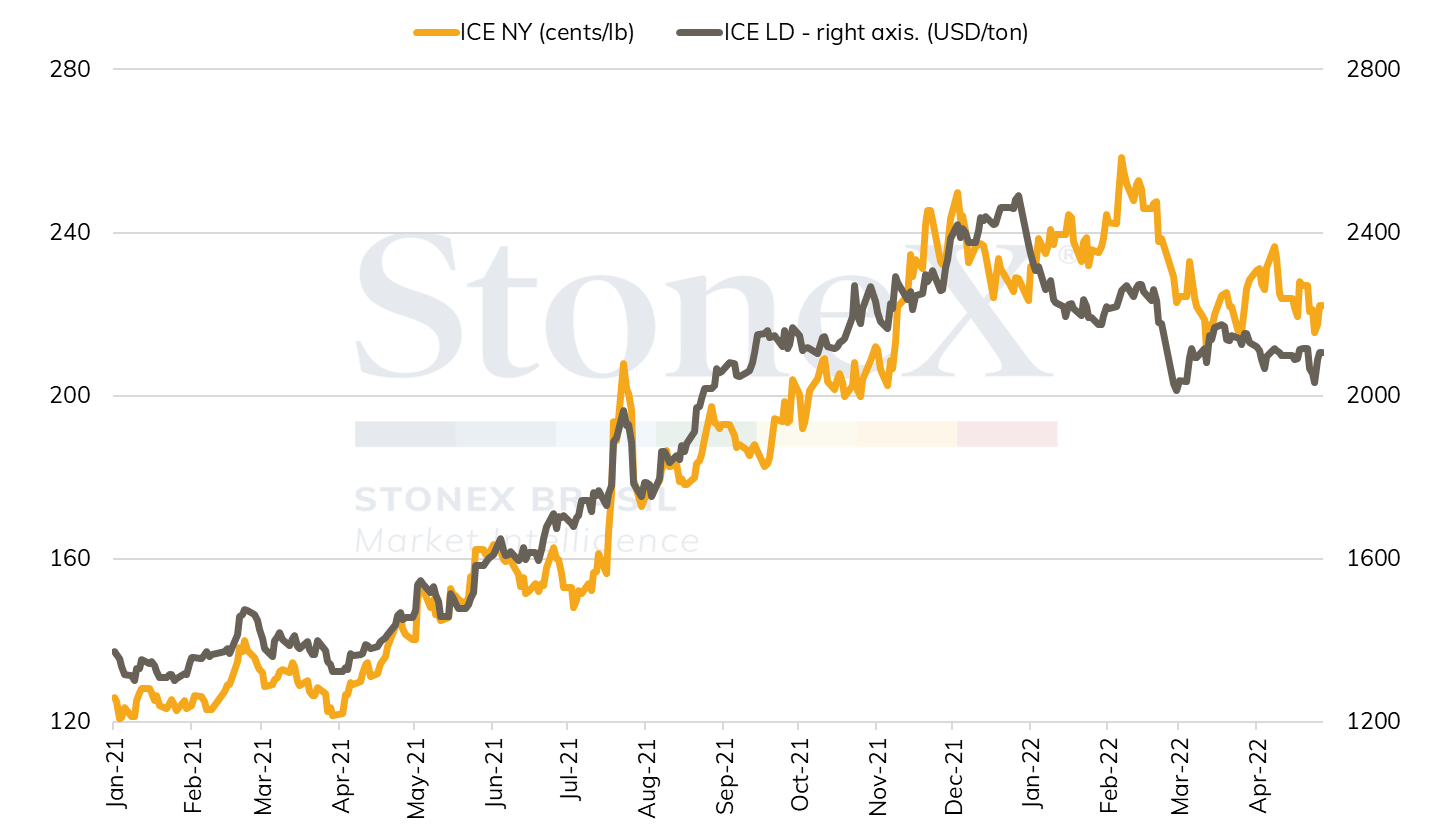
The beginning of 2022 was marked by great volatility in the coffee market. As the sentiment of a large deficit in the global S&D balance for the 2021/22 season, together with a likely tighter balance in 2022/23, was consolidated among market players, coffee prices began the year by extending the strong appreciation of 79.2% and 72.7% observed for Arabica and Robusta coffee, respectively, on their main exchanges in 2021. By mid-February, prices in New York (ICE) had advanced some 16% on the year to their 10-year highs, when the most active contract touched US₵ 258.45/lb on February 9. 

However, a market with mostly bullish factors at the time was once again subject to downward pressures during a period of heightened risk aversion following the outbreak of the Russian-Ukrainian war (February 24). Since the beginning of the armed conflict, coffee futures in NY showed a range of 3610 points, with the most active contract oscillating between a high of US₵ 247.55/lb and a low of US₵ 211.25/lb, to end the last month quoted at US₵ 222.1/lb, a devaluation of 10.3%. In London, prices showed a similar trend, with quotes retreating 5.7% from the beginning of the war until the end of April, going from USD 2234/t to USD 2107/t.

Arabica and Robusta coffee price trend

image 36528
Source: ICE, Traders Pro, StoneX. Design: StoneX.

The war between Russia and Ukraine has brought new elements of uncertainty to the coffee market, which already has a major problem with the wide discrepancy between available supply and demand (S&D) estimates. Russia and Ukraine together account for about 3.3% of global coffee consumption, or just over 5 million bags, with most of this coffee going to Russian territory (4.2 million). 

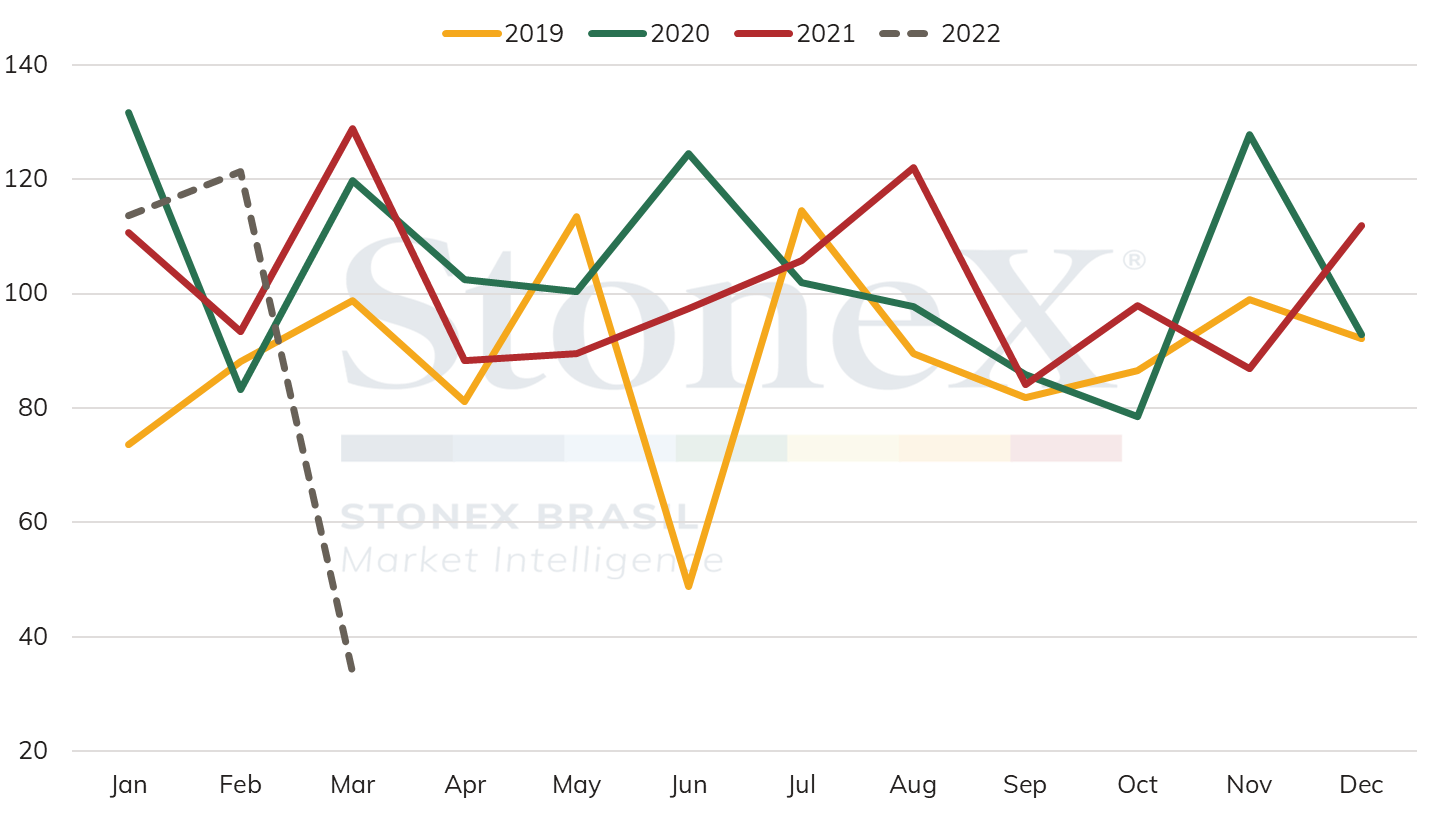
Brazil is the second-largest exporter of coffee to Russia, having shipped 1.2 million bags to the country, second only to Vietnam. Due to the sanctions imposed by the countries on the Kremlin, the risk of defaults on payments, and the reputational risk, the average volume of Brazilian coffee shipments to the country should be largely impacted in 2022. According to Cecafé's most recent data, exports to Russia in March, the first full month after the beginning of the conflict, totaled 33,855 bags, a 72% decrease compared to February and 74% compared to March 2021.

Coffee exports to Russia (thousand bags)

image 36529
Source: Cecafé. Design: StoneX.

Although the Vietnam General Statistics Office (GSO) does not break down destination countries in its monthly export data, Vietnamese shipments of Robusta coffee to Russia are also expected to be largely affected. In this context, despite the difficulties in estimating the size of the impact, a drop in global exports and consumption becomes likely, which would act to reduce a deficit or raise a surplus in the global balance sheet. Moreover, this trend should become increasingly stronger as long as the Russian-Ukrainian conflict persists, limiting the upward momentum in prices. As an additional factor, there is the risk that the economic consequences of the war, with the advance of inflation, loss of purchasing power among the population and a reduction in growth estimates in the main global coffee consuming countries, could damage consumption.

What to expect from the supply and demand balance in 2022/23

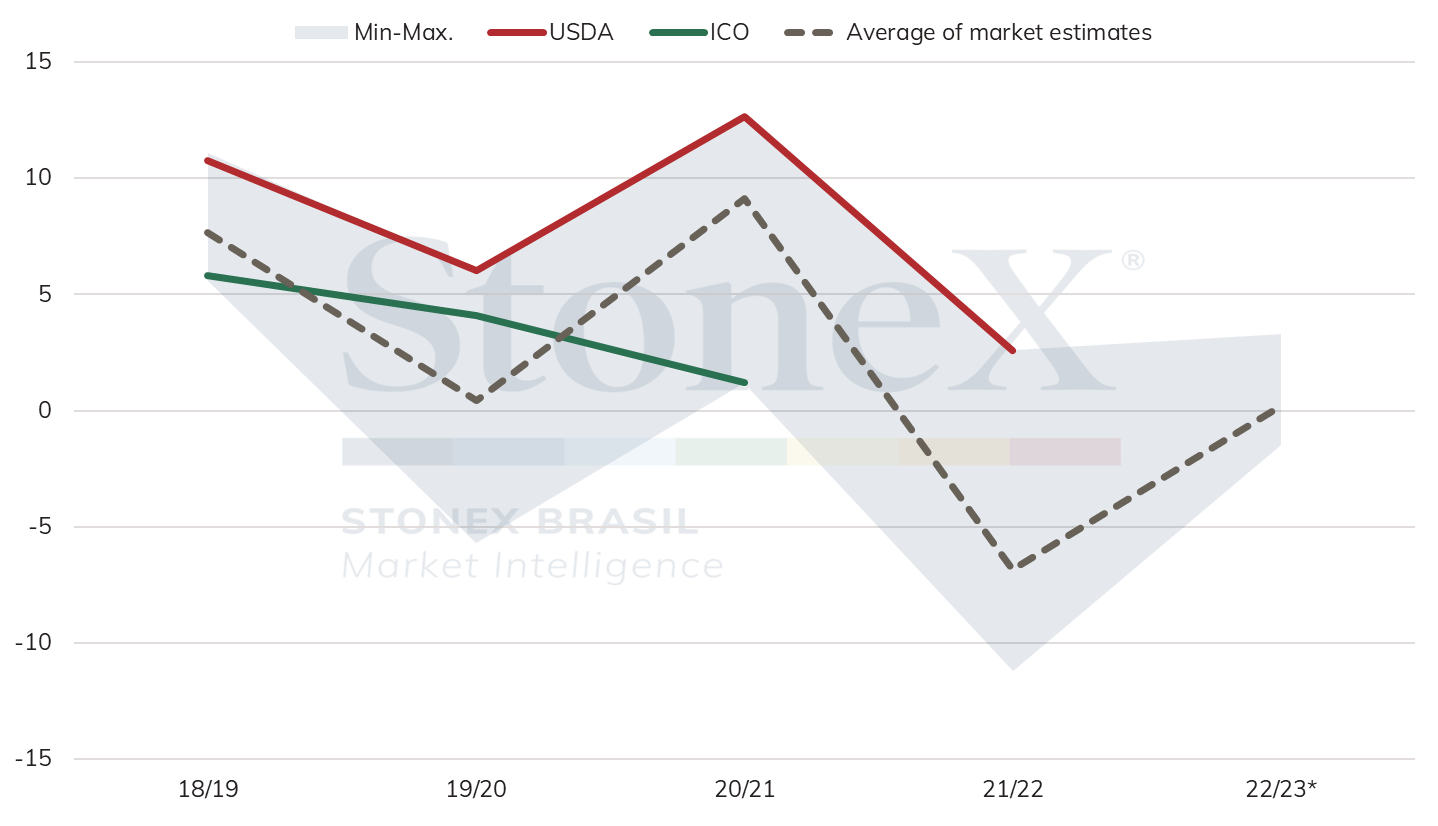
Before assessing the S&D balance, it is important to note that the discrepancy between estimates for Brazilian production and the global S&D balance is one of the biggest challenges in the coffee market and a major driver of volatility. For example, in 2021/22 alone, some estimates pointed to a deficit of 11 million bags and the USDA's a surplus of 2.6 million, resulting in a difference of almost 14 million bags between the highest and lowest estimate. Overall, the market sentiment is that the year 2021/22 does indeed have a very negative deficit, with the average of the estimates pointing to a deficit of 6.9 million bags, which has justified some of the price advances that have been observed in the second half of 2021 and early 2022. 

Range of estimates for the global coffee supply and demand balance (million bags)

image 36530
Source: StoneX, USDA, ICO. Design: StoneX.

There are still many uncertainties for 2022/23, as production in many countries is still in the early stages of crop development. The number of estimates released is still small, and estimates from major agencies such as the USDA and ICO have not yet been released.

 As already mentioned, the size of the impact of the war between Russia and Ukraine on world coffee consumption is still very uncertain. However, taking into account only the estimates available, it can be seen that the market outlook is for a more balanced S&D balance in 2022/23, with the average of the estimates available so far indicating a surplus of around 1 million bags. The expectation of a more comfortable balance or slight surplus cools market concerns following a year with a very negative balance. For the next quarter, the market will keep an eye on the release of USDA estimates for countries' production, which should be released in May, and estimates for the global balance sheet, with the publication of the full report scheduled for the first half of June. 

Despite recent progress, conditions are not favorable for coffee certification on the exchange

One of the factors contributing to the increase in prices is the drop in certified stocks of Arabica coffee, which have fallen sharply since the second half of 2021. In September, stocks have fallen from around 2.2 million bags to lows below 1 million bags in February. The drop in certified stocks, which has a bullish bias for the market, is closely linked to differentials in origins and sea freight costs. The lower the differentials and the cheaper the shipping costs, the greater the possibility that coffees will be certified on the exchange. The drop in stocks presented above was due to the strengthening of differentials at origin, reflecting the lower production mainly in Brazil and the significant increase in freight costs, which discouraged the certification process.

ICE Arabica Certified Stocks (thousand bags)

image 36531
Source: ICE – Intercontinental Exchange. Design: StoneX.

Since the end of February, stocks have increased slightly but have remained relatively stable at around 1.1 million bags, which has cooled agents' concerns around this issue. Moreover, some attention has been diverted to other issues, such as the war between Russia and Ukraine. However, monitoring certified stocks is essential since, despite the advances seen recently, conditions are not yet favorable for the certification of new coffees from origins. Even with the perspective of a larger production in Brazil in 2022/23, the scenario should not become favorable for certification in short/medium term, given the recent logistical problems and the high differentials at origins. 

With Robusta coffee worth more in Brazil, what can we expect in the coming months?

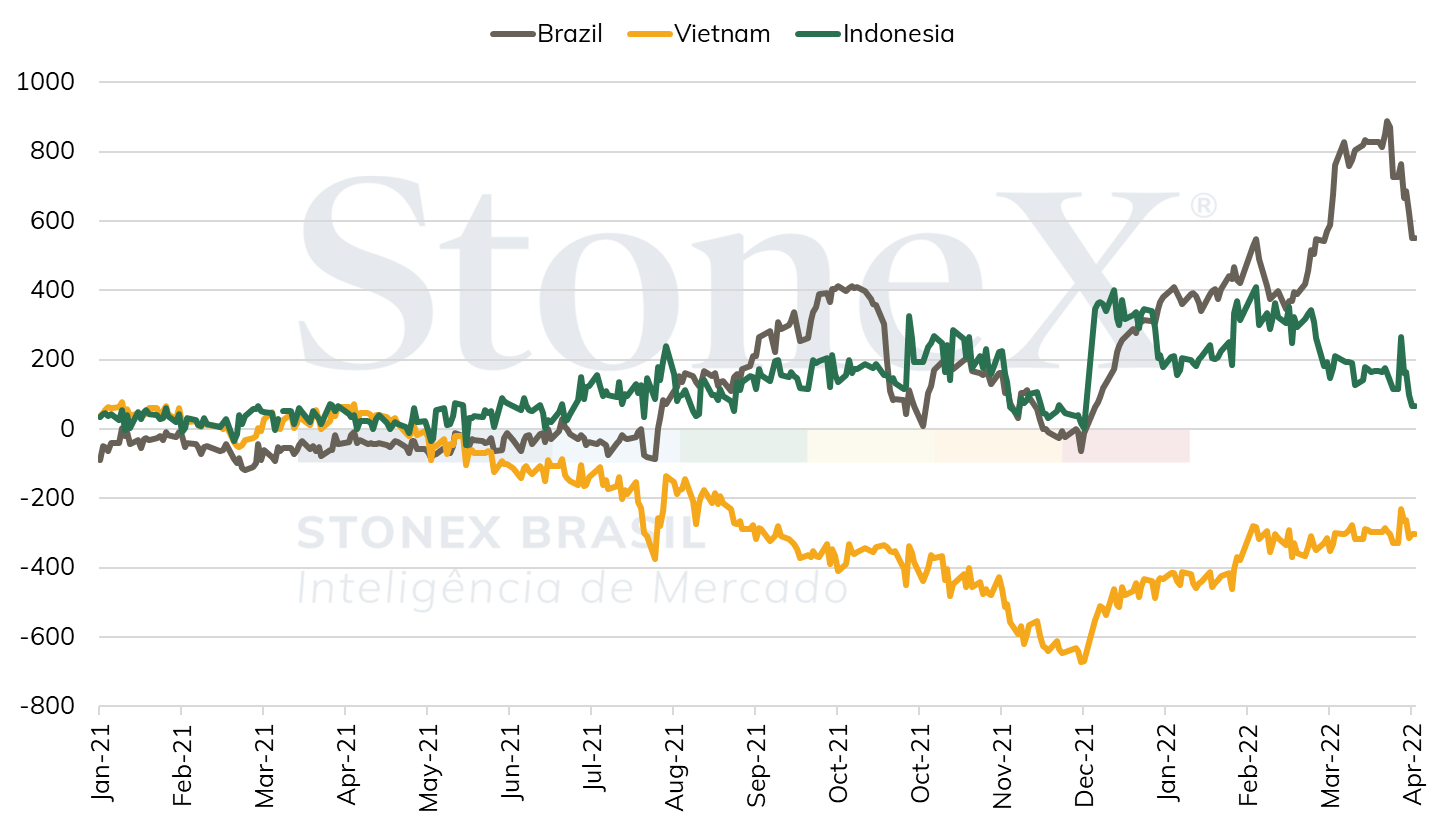
From the massive crop of 2020 until the first quarter of 2021, Brazilian Robusta coffee has achieved a prominent position in shipments abroad after becoming the most competitive origin for the type. This condition resulted from the large production that year and the devaluation of the Brazilian currency, which could be seen in the level of differentials – the difference between prices in the Brazilian domestic market and the London market – which was below the main origins, such as Vietnam and Indonesia.

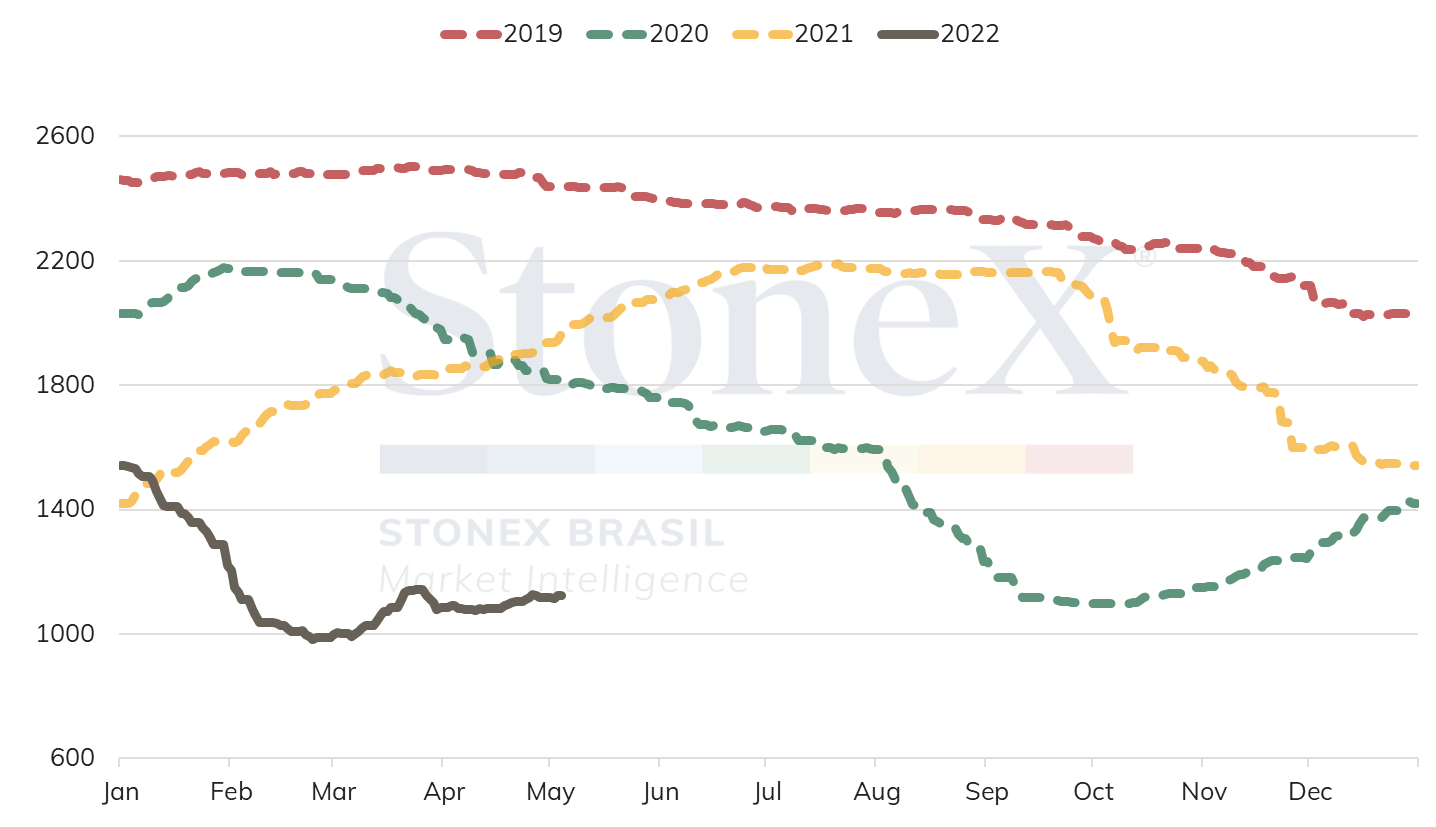
However, since the second half of 2021, this scenario has been reversed, with Robusta prices exceeding London prices from August onwards. The increase in prices in the domestic market reflected the strong increase in Arabica coffee prices in the Brazilian domestic market, which forced the industry to increase the use of Robusta in the blend. Since August of last year, the differentials advanced to USD 400/ton in September and October, fell back to close to 0 in January 2021, but increased again, reaching values above USD 800/ton in April. The main reflection of this scenario was the sharp reduction in Brazilian Robusta exports, while Vietnamese exports advanced, consolidating again as the most competitive origin in the current scenario.

Robusta coffee differentials by major origins (USD/ton)

image 36532
Source: ICE, Traders Pro, Cepea, Bappebti, Giacaphe, StoneX. Design: StoneX.

For the coming months, the prospect is that the differentials of Robusta in Brazil will not remain at these levels after the entry of the new crop, which, according to several sources, should reach record volumes. The average available estimates point to a production of 20.9 million bags for the type, and StoneX estimates production at 20.6 million. However, estimates for Robusta have a difference of 6.4 million bags, ranging from 17 million (Conab) to volumes above 23 million, estimated by private organizations.

Besides the factors mentioned above, the climate market should dominate the price oscillations in the coming months

As always, Brazil, as the main global producer and exporter, will have the greatest weight in the definition of the global balance in 2022/23 and the market oscillations. Despite the concerns with production, the beginning of the 2022/23 crop harvest, which will start in mid-May and peak between June and July, should ease the market's concern with supply in short/medium term.

However, in the coming months, the weather should take center stage over price fluctuations, with market participants looking increasingly to the approaching winter in Brazil. After the severe damage caused by last year's frost, the fear that the winter of 2022 may cause further damage to the Brazilian Arabica coffee production should generate a lot of volatility in the market.

The constant analysis of La Niña/El Niño probability models and indications of their intensity will also be fundamental. The chances of La Niña continuing for the third year in a row should continue to be a source of concern. Colombia has been suffering serious difficulties because of the climate phenomenon, which has caused excessive rainfall in the country's producing areas in recent months and damaged local production. According to the National Federation of Coffee Growers (FNC), the country's production is expected to decline by more than 10% in the first half of this year. On the other hand, an extension of La Niña projections for the second and third quarters would increase the risks of delays and reduction in rainfall before flowering in the Brazilian harvest of 2022/23, affecting its potential. 

For demand, the signs that the Russian-Ukrainian war is far from an end, along with the economic ramifications of the conflict, such as the advancement of inflation and loss of purchasing power of the population, should keep agents on the alert regarding its negative impacts on consumption. Furthermore, the lockdown measures in important industrial cities and ports in China deserve attention, as they may, if prolonged for longer than expected, generate negative impacts on out-of-home consumption in the region and cause a return to the reestablishment of global logistics chains.
 

  • Coffee

The StoneX Group Inc. group of companies provides financial services worldwide through its subsidiaries, including physical commodities, securities, exchange-traded and over-the-counter derivatives, risk management, global payments and foreign exchange products in accordance with applicable law in the jurisdictions where services are provided. References to over-the-counter (“OTC”) products or swaps are made on behalf of StoneX Markets LLC (“SXM”), a member of the National Futures Association (“NFA”) and provisionally registered with the U.S. Commodity Futures Trading Commission (“CFTC”) as a swap dealer. SXM’s products are designed only for individuals or firms who qualify under CFTC rules as an ‘Eligible Contract Participant’ (“ECP”) and who have been accepted as customers of SXM. StoneX Financial Inc. (“SFI”) is a member of FINRA/NFA/SIPC and registered with the MSRB. SFI is registered with the U.S. Securities and Exchange Commission (“SEC”) as a Broker-Dealer and with the CFTC as a Futures Commission Merchant and Commodity Trading Adviser. References to securities trading are made on behalf of the BD Division of SFI and are intended only for an audience of institutional clients as defined by FINRA Rule 4512(c). References to exchange-traded futures and options are made on behalf of the FCM Division of SFI . StoneX is a trading name of StoneX Financial Ltd (“SFL”). SFL is registered in England and Wales, Company No. 5616586. SFL is authorized and regulated by the Financial Conduct Authority [FRN 446717] to provide to professional and eligible customers including: arrangement, execution and, where required, clearing derivative transactions in exchange traded futures and options. SFL is also authorised to engage in the arrangement and execution of transactions in certain OTC products, certain securities trading, precious metals trading and payment services to eligible customers. SFL is authorised & regulated by the Financial Conduct Authority under the Payment Services Regulations 2017 for the provision of payment services. SFL is a category 1 ring-dealing member of the London Metal Exchange. In addition SFL also engages in other physically delivered commodities business and other general business activities which are unregulated and not required to be authorised by the Financial Conduct Authority. StoneX Group Inc. acts as agent for SFL in New York with respect to its payments services business. StoneX APAC Pte. Ltd. acts as agent for SFL in Singapore with respect to its payments services business. ‘StoneX’ is the trade name used by StoneX Group Inc. and all its associated entities and subsidiaries.
 
Trading swaps and over-the-counter derivatives, exchange-traded derivatives and options and securities involves substantial risk and is not suitable for all investors. Past performance of any futures or option is not indicative of future success. Indicators are not a trading system and are not published as a specific trade recommendation. The information herein is not a recommendation to trade nor investment research or an offer to buy or sell any derivative or security. It does not take into account your particular investment objectives, financial situation or needs and does not create a binding obligation on any of the StoneX group of companies to enter into any transaction with you. You are advised to perform an independent investigation of any transaction to determine whether any transaction is suitable for you. No part of this material may be copied, photocopied or duplicated in any form by any means or redistributed without the prior written consent of StoneX Group Inc.
 
© 2026 StoneX Group Inc. All Rights Reserved.

Satellite view of Earth at night showing illuminated cities across Asia and the Middle East

Discover more insights

Our subscribers have access to comprehensive market analysis from StoneX spanning commodities, equities, currencies and more.

Related articles for Coffee

Perspective: Morning Commentary for August 7

August 7 – The U.S. economy unexpectedly lost 23k jobs in July, dramatically below market expectations of an 80k increase and marking the worst Non-Farm Payrolls print since February. Furthermore, May and June were both revised sharply downward, with combined revisions showing 103k fewer jobs than previously reported. Outside of the healthcare sector, which added 22k jobs in July, the losses were very broad-based. Government payrolls saw the largest decline, shedding 53k jobs in July, the largest seen since October 2025, while June was revised down to show a loss of 10k jobs as well. The private sector at least saw growth, adding 30k jobs in July, now matching the month prior after it was revised down from the 49k initially reported, and substantially missing forecasts of 78k jobs being added. This is a sharp reversal in course from the largely better than expected U.S. labor data seen earlier this week.

Mike Castle
Mike Castle
  • Grains & Oilseeds
  • Energy
  • Dairy
  • Renewable Fuels
  • Cocoa
  • Coffee
  • Cotton
  • Sugar
  • Meats & Livestock
  • Forest Products

Daily Coffee Report 8/6/26

Daily coffee report

StoneX Coffee Team
StoneX Coffee Team
  • Coffee

Perspective: Morning Commentary for August 6

August 6 – This morning’s stronger-than-expected U.S. labor data offered markets some relief, reinforcing confidence in the economy while giving the Fed greater flexibility to raise rates should inflationary pressures reaccelerate in next week’s July data. Stock futures are pointing to a mixed open to start the day, with the tech-heavy Nasdaq showing the most weakness. The VIX has fallen notably from yesterday’s spike above 18.4 as it starts the day hovering just below the 16-mark. The dollar is quietly higher as it trades just above 99.8, holding in the tight range seen thus far this week as traders continue to digest data to shape expectations for the Fed’s next move, which we’ll dive into in more depth below. Long-term treasury yields have relaxed slightly from their recent spike, with 30-year yields starting the day trading just above 5.19%, while 10-year yields trade above 4.64%, and 2-year yields sit below 4.22%. Crude oil is modestly higher to start the session after sharp declines earlier in the week, with nearby WTI up 1.8% to trade at $76.40 and nearby Brent up 2.4% to trade at $81.40. Meanwhile, the ags are quietly mixed to start the day.

Mike Castle
Mike Castle
  • Grains & Oilseeds
  • Energy
  • Dairy
  • Renewable Fuels
  • Cocoa
  • Coffee
  • Cotton
  • Sugar
  • Meats & Livestock
  • Forest Products
StoneX: We open markets

Our market expertise, advanced platforms, global reach, culture of full transparency and commitment to our clients’ success all set us apart in the financial marketplace.

Reach

With access to 40+ derivatives exchanges, 180+ foreign exchange markets, nearly every global securities marketplace and numerous bi-lateral liquidity venues, StoneX’s digital network and deep relationships can take clients anywhere they want to go.

Transparency

As a publicly traded company meeting the highest standards of regulatory compliance in the markets we serve; our financials and record of accomplishment are matters of public record. StoneX’s commitment to “doing the right thing over the easy thing” sets us apart in the industry and helps us build respect, client trust and new partnerships.

Expertise

From our proprietary Market Intelligence platform, to “boots on the ground” expertise from award-winning traders and professionals, we connect our clients directly to actionable insights they can use to make more informed decisions and achieve their goals in the global markets.