
Halving It All: Bitcoin's Halving Cycle Begins

Executive Summary
- Market trading color: $BTC price action as a result of macroeconomic conditions, $BTC puts are trading at their highest premiums since January, $ETH option data continues to screen bearish leaving the potential for long term opportunity
- Theme of the week – Bitcoin halving cycles and its effects on the miners and price historically
- Sector commentary: Bitcoin volatility, Ethereum growth, Solana fees, DeFi innovations, and expanding infrastructure
Market Trading Color (Nolan Aibel)
It has been another tumultuous week with $BTC down 11% over the time span. This has led to more than $2.23B in longs liquidated. $BTC ETF flows have also reflected this negative price action. While there were modest positive inflows last Thursday and Friday, this week has been a different story with four straight days of outflows. $BTC has now tested the $60,000 a few times and briefly dipped below overnight. On the latest move, open interest was little affected, showcasing this was driven by spot sales. $60,000 remains the key level to hold as the bull and bear stalemate here builds. Funding rates remain negative with short positions continuing to build ahead of the halving as many believe this will be a sell the news event. If Bitcoin does rally, it will largely be driven by shorts being squeezed as over $3.5B worth of shorts will get liquidated if $BTC could reclaim the $71,000 level.
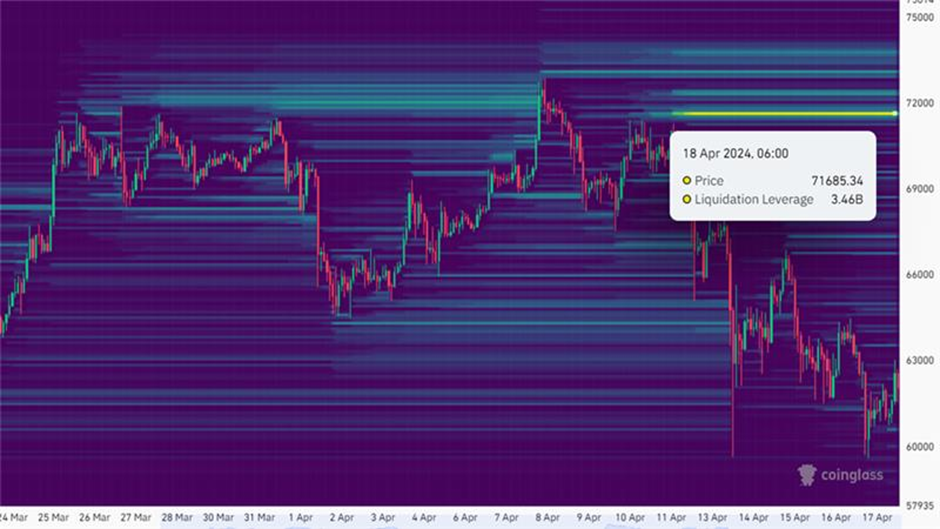
Source: Coinglass
As mentioned above, as shorts pile into the $60,000 strike, $BTC puts are trading at their highest premiums since January.
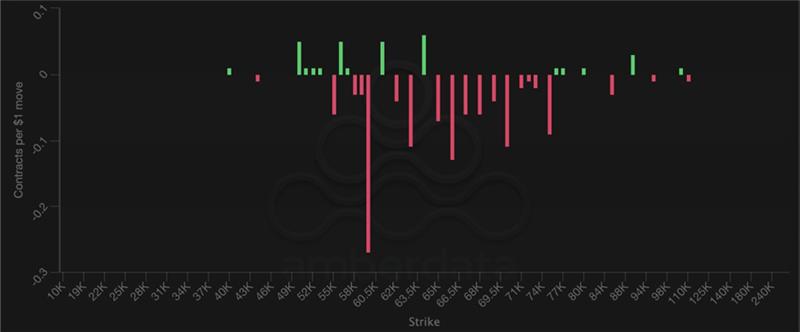
Source: Amberdata
On top of this and as mentioned yesterday, $ETHs 90d puts are more expensive than calls on Derebit, also the first time since January. $ETH’s 60d skew continues to rise with puts now 3 points above calls. While many continue to be pessimistic on $ETH given the expected near term ETF denial in May, the Ethereum blockchain quietly generated over $369M of profit in Q1 ’24. With US investors not having built up positions in the asset, long dated OTM calls could be interesting.
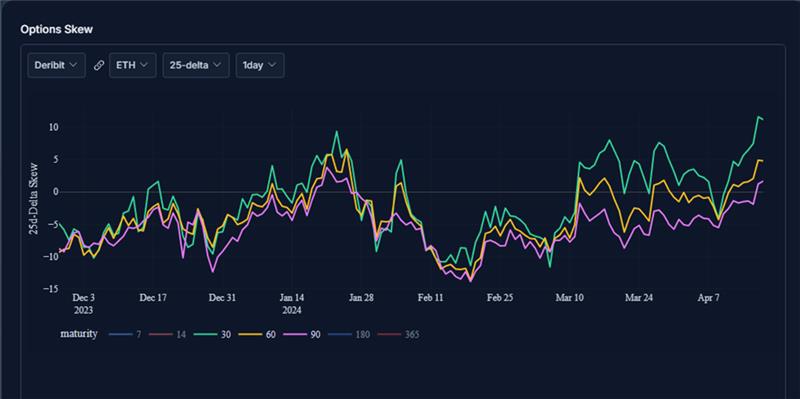
Source: TheTie
What is the Bitcoin Halving?
The Bitcoin halving shapes the network's monetary policy, occurring roughly every four years and reducing block rewards for miners. This leads to a substantial decrease in the inflation rate of newly minted Bitcoins. The most recent halving in May 2020 saw the block reward drop from 12.5 to 6.25 Bitcoins, and the next is anticipated to occur in April 2024, reducing the block reward to 3.125 BTC. This periodic reduction not only contributes to the scarcity of Bitcoin but also affects its supply dynamics. As new Bitcoin issuance decreases, miners, who secure the network, find themselves with less Bitcoin to sell. Historically, each halving has triggered price surges and prolonged bull markets, highlighting Bitcoin's unique scarcity with a fixed supply of 21 million Bitcoins. The halving events also emphasize the economic incentives in Bitcoin's design, as reliance on transaction fees increases with diminishing new supply, reemphasizing the potential importance of L2s and Ordinals on Bitcoin.
Bitcoin's halving cycles are fundamental events deeply embedded in the cryptocurrency's ecosystem, shaping its supply dynamics and market behavior. Historically, these halvings have led to significant shifts in market sentiment and price action. The anticipation and aftermath of halving events often witness heightened volatility, with Bitcoin's price experiencing both surges and corrections as supply dynamics adjust. These cycles have been extensively explored in a variety of articles and academic research papers, and they are frequently discussed in the news, leading to ongoing discussion and adoption over time.
The Role of Halving in the Formation of Super Cycles
The published academic paper by Gilles M’bakob, titled "Bubbles in Bitcoin and Ethereum: The role of halving in the formation of super cycles," delves into how halving events in Bitcoin trigger speculative bubbles, typically peaking about a year after each halving cycle. This delay is attributed to factors like gradual adoption and a cumulative impact. Progressive adoption implies that news about halving spreads slowly, influencing prices later as investors understand its implications. The cumulative effect suggests that the halving's impact builds up over time instead of being immediate.
The study also finds a contagion effect between Bitcoin and Ethereum market capitalization cycles, indicating that when Bitcoin's cycle expands by 1%, Ethereum's cycle expands by 0.2190%. The reasons behind this connection include the reduced supply of new Bitcoins due to halving, which encourages price rises and speculative bubbles. Additionally, investor expectations of post-halving price increases and growing confidence in Bitcoin's long-term value contribute to speculative cycles.
The paper notes that speculative bubbles in cryptocurrencies are influenced by factors like herding behavior among investors, particularly during bullish and high-volatility periods. The COVID-19 outbreak intensified this behavior. The network effect, where a cryptocurrency's value increases with user numbers, and the role of social media in disseminating information and opinions also contribute to speculative behaviors.
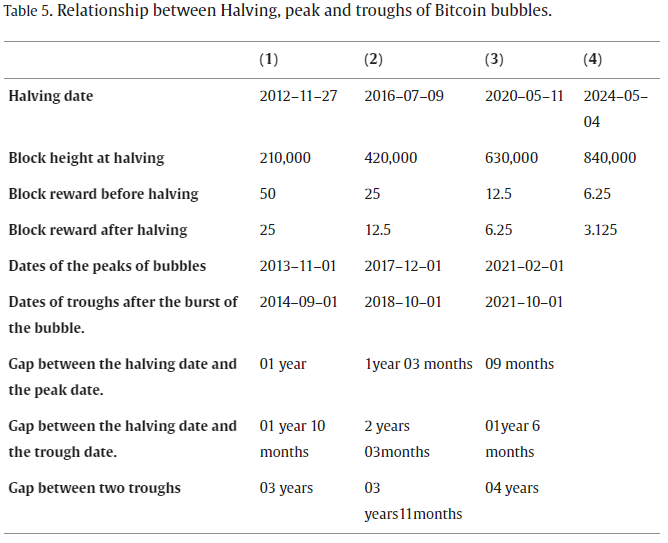
Source: M'bakob, G. B. (2024). Bubbles in Bitcoin and Ethereum: The role of halving in the formation of super cycles. Sustainable Futures, 7, 100178. https://doi.org/10.1016/j.sftr.2024.100178
In addition to examining news sentiment and network effects through metrics like modified Metcalf's law, analyzing historical market performance surrounding Bitcoin halvings reveals notable trends. After the first halving, Bitcoin surged to $1,135, marking a 9,204% increase before undergoing a 42.52% drawdown, followed by a rebound to $198, showcasing a 229.99% rise before the next halving. Subsequently, the second halving witnessed an ATH of $19,496, with a 2,888% uptrend, followed by a 55.27% drop to $3,230, then a recovery surge of 169.98% leading to the third halving. Presently, the third halving has peaked at $72,743, a 743% gain from the previous cycle's low, highlighting ongoing market dynamics awaiting the anticipated fourth halving and prompting keen observation of drawdown and recovery patterns.
Miner Economics and Breakeven Analysis
The Bitcoin network's resilience and economic shifts are evident in current statistics, particularly as the community awaits the halving event. Post-halving, the diminishing block rewards highlight the growing significance of transaction fees, now at 0.355 BTC per block, in miner revenue. This shift underscores the need for adaptation, especially considering the total mining revenue of approximately $66.57 million per day, which increasingly relies on market dynamics and transaction fee models. The upcoming halving, known to alter the incentive structure within the mining community historically, further emphasizes this adaptation.
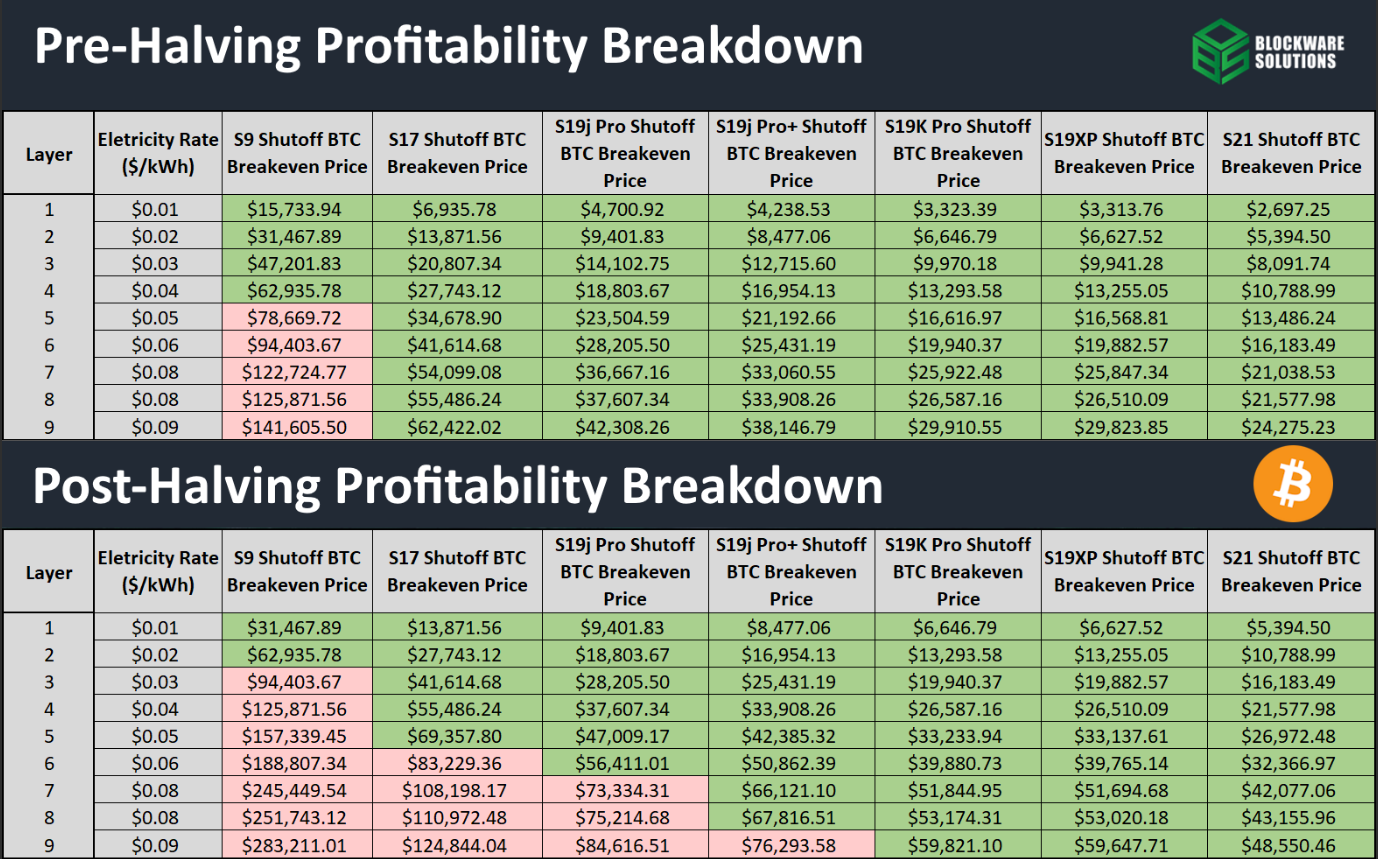
While miners retain an essential role in the Bitcoin ecosystem, their direct impact on price formation has notably decreased over time, despite total mining revenue surpassing daily trading volume significantly in previous years. The economics of mining gains importance as the halving event nears. Post-halving, the breakeven price for mining 1 BTC is expected to rise, a factor detailed in the table mapping various hardware models to their breakeven price post-halving based on electricity rates underscores this point.
Post-Halving Profitability (at $0.05/kWh) per BTC:
- For an S9 miner, the post-halving breakeven price is now $157,339.45
- The S17 model shows improved efficiency, with a breakeven of $69,357.80
- The S19j Pro, one of the most advanced models, reaches breakeven at $47,009.17
- The newer S19XP and S21 models demonstrate even greater efficiencies, with breakeven points at $33,137.61 and $26,972.48 respectively
- For comparison, the average electricity rate in the U.S. is $.15
Source: Blockware Solutions
The Effects of Hash Rate
The hash rate, indicative of the processing power per second used by the Bitcoin network to mine new blocks and process transactions, is crucial for assessing the network's health and security. A higher hash rate enhances the network’s security and its resistance to potential attacks. Specifically, a high hash rate means:
- Increased security against 51% attacks, preserving the integrity of the blockchain
- Greater resilience to external shocks, such as price volatility
- Sustained and consistent transaction verification, maintaining the network's efficiency and reliability
Mining difficulty is a dynamic metric maintaining a consistent average block confirmation time. It adjusts approximately every two weeks or every 2016 blocks, responding to changes in the network's total hash rate. This adjustment ensures a steady block time of about 10 minutes, vital for predictable Bitcoin issuance and network stability. Historically, the hash rate dips after a halving as unprofitable miners disconnect but recovers within a month. This is due to Bitcoin’s supply and demand forces at work, increasing the price of Bitcoin and profits for those who can keep mining.
The Bitcoin network's hash rate currently stands around 651.55 EH/s. To put this computational effort into perspective, imagine it as having the computational power equivalent to streaming HD video continuously for over 74,000 years, or storing a billion high-resolution pictures simultaneously. This level of computational power underpins the security of the Bitcoin network, with a higher hash rate signifying increased resilience against attacks and the overall robust health of the system.
The Impact of Halvings with Hash Ribbons Indicator
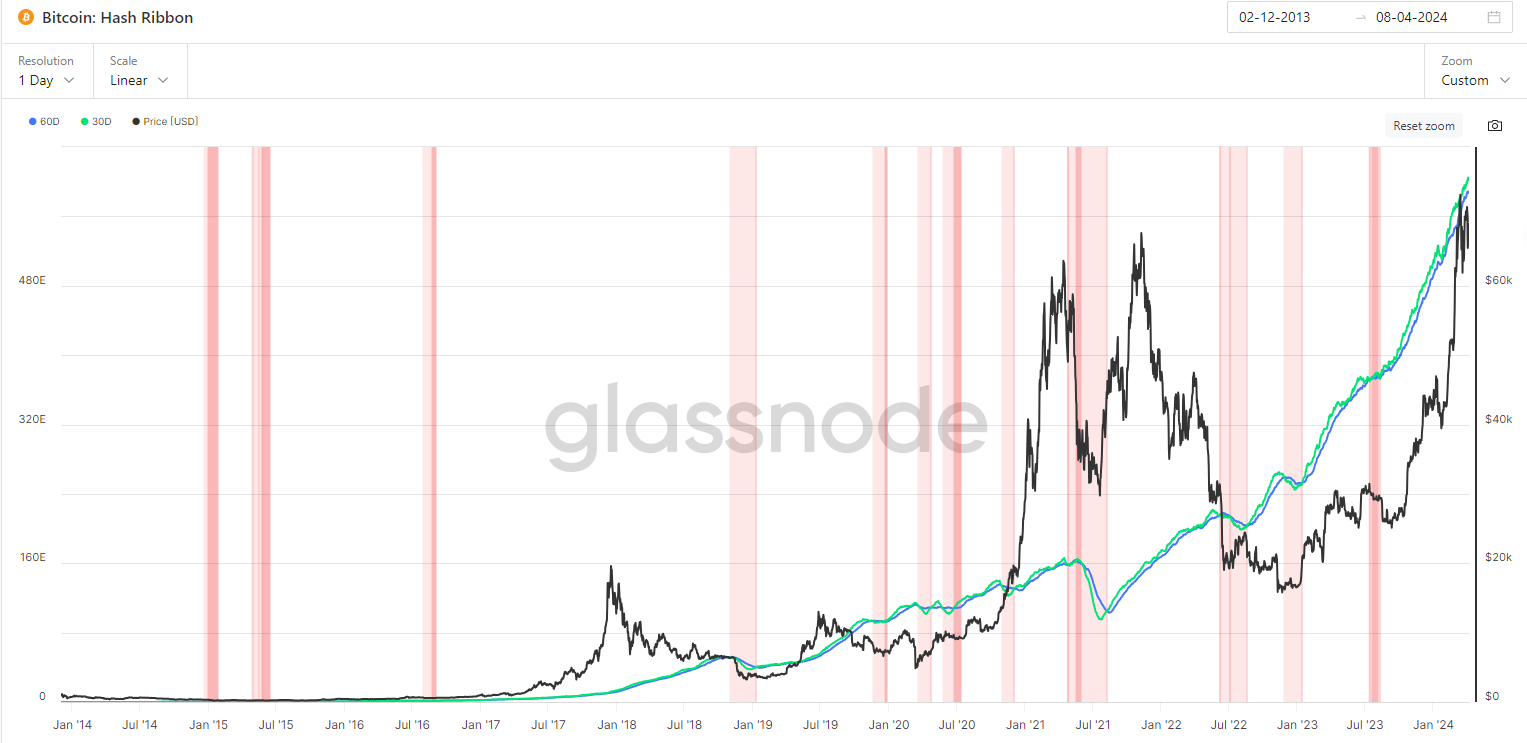
The Hash Ribbons Indicator serves as a tool for assessing miner sentiment and the overall market bottoms for Bitcoin. It combines the 30-day and 60-day moving averages of the Bitcoin hash rate to pinpoint potential periods of miner capitulation, which can signal buying opportunities. Here's how we can interpret the graph:
- Dark Pink Vertical Lines: These lines indicate periods where the 30-day MA of the hash rate drops below the 60-day MA, suggesting miners may be capitulating due to challenging market conditions, such as when the cost to mine Bitcoin exceeds the price of Bitcoin
- Light Pink Vertical Lines: When the 30-day MA crosses back above the 60-day MA, it signals an end to miner capitulation, hinting at potential recovery in the hash rate and miner activity
- Return to White: This transition coincides with both the hash rate's recovery and a positive momentum in Bitcoin's price, often suggesting a strong buying signal
Source: Glassnode
Bitcoin halvings, as the graph above shows, typically mark the beginning of phases where miners may face economic stress due to reduced rewards. This is often visualized by darker shades on hash rate indicators, where the darkening symbolizes the period of miner capitulation. Yet, the resilience of Bitcoin’s protocol ensures that these periods are temporary and are followed by recovery, which is represented by the transition back to lighter shades. Historically, such recoveries have aligned with robust periods for Bitcoin investment, highlighting the cyclical resilience of Bitcoin's network and its economy.
Geographical Distribution of Mining
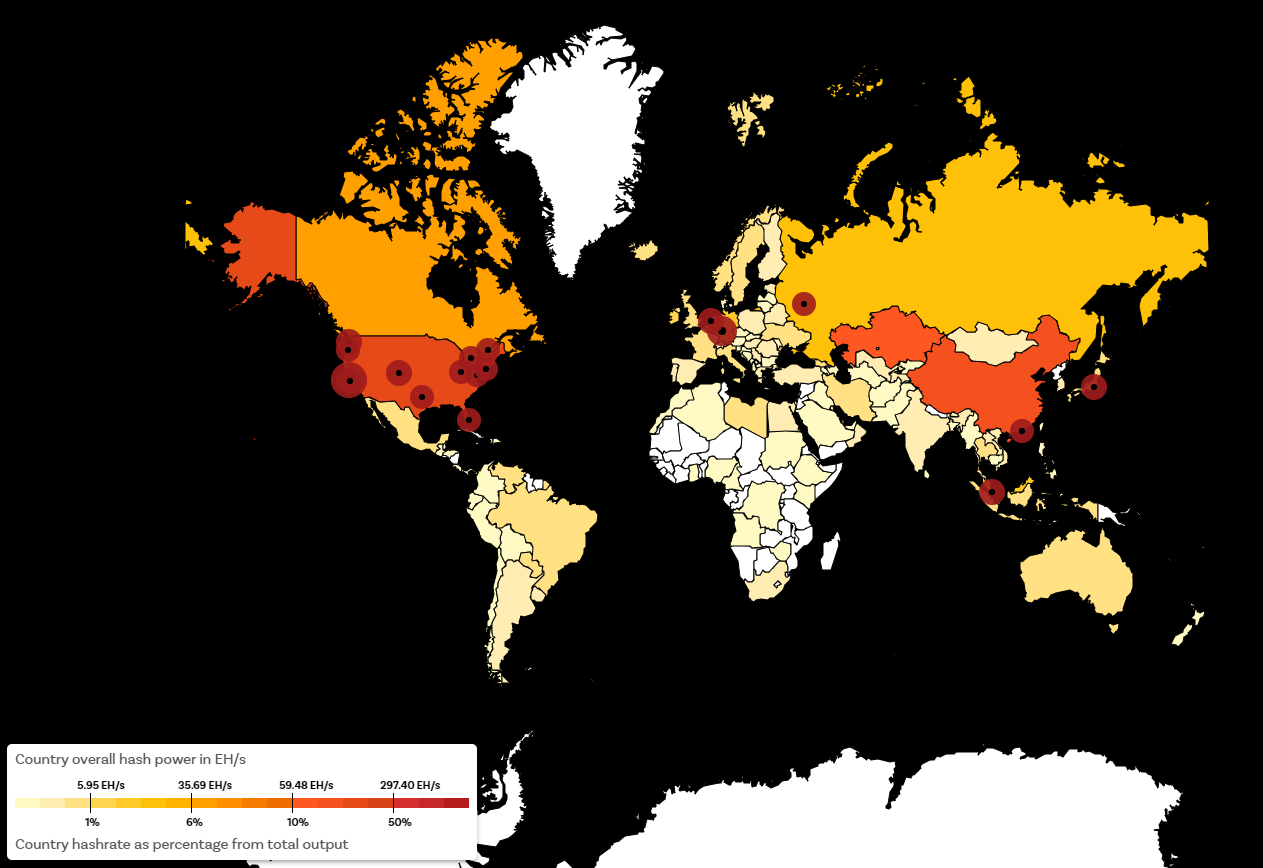
The United States has emerged as the preeminent hub of Bitcoin mining activity, commanding 37.8% of the global hash rate. This shift, particularly from China, which now holds 21.1% post-regulatory crackdowns from 2021, highlights the fluid nature of mining power dynamics. Other significant contributors to the network's hash rate include Kazakhstan (13.2%), Canada (6.5%), and a variety of other nations that together form a competitive and decentralized mining environment.
Source: chainbulletin.com
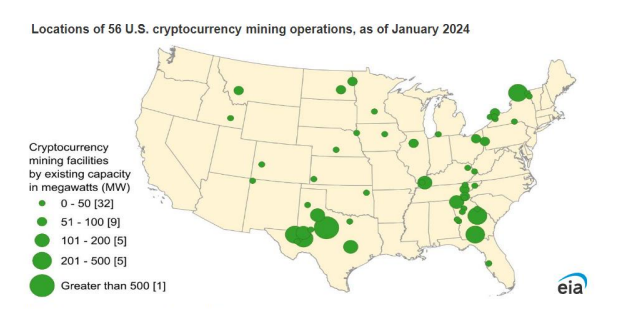
Following the global overview, we present a detailed map of U.S. cryptocurrency mining operations, offering an in-depth look at the country's specific capacity and distribution.
Source: eia.gov
This map, drawn from data as recent as January 2024, offers a closer look at mining operations across the United States. It presents a granular view of facilities by their existing megawatt capacities. It underscores the expansive reach of mining activities across the country, particularly in states like Texas, Georgia, and New York.
In conjunction with the geographical data, it's important to consider the industry's electricity demand. The EIA reports that mining efforts now represent between 0.6% to 2.3% of the entire nation's electricity consumption, emphasizing the need for a discussion on the sustainable management of energy resources in relation to the cryptocurrency sector. According to the Cambridge Centre for Alternative Finance, Canada leads with 69.7% of its Bitcoin mining powered by renewable energy, while the U.S. and China use renewable sources for 22.5% and 30.2% of their mining, respectively. Mining entities are shifting towards renewable sources in response to regulatory pressures and to mitigate risks associated with non-renewable energy. Something that our team is watching going into the election cycle.
Source: EIA.gov, Blockware Solutions, Glassnode, LookIntoBitcoin, M'bakob, G. B. (2024). Bubbles in Bitcoin and Ethereum: The role of halving in the formation of super cycles. Sustainable Futures, 7, 100178. https://doi.org/10.1016/j.sftr.2024.100178
Sector Commentary
- Layer One / Altcoins
- Bitcoin ($BTC): Bitcoin Could Surge to $120K on 'Doomsday Rally,' Trader Says (link)
- Bitcoin ($BTC): Bitcoin’s spot price action does little to spook BTC options traders (link)
- Bitcoin ($BTC): Exploding Gold Sales at Pawnshops Offers Lesson for Bitcoin Bulls (link)
- Bitcoin ($BTC): Bitcoin From Rare 'Satoshi Era' Moves After 14 Years of Dormancy (link)
- Bitcoin ($BTC): Empire Newsletter: Bitcoin wasn’t a hedge — this time (link)
- Bitcoin ($BTC): Op-Ed: OG Bitcoin L2 Stacks Is Getting a Major Overhaul (link)
- Ethereum ($ETH): Ether derivatives conditions could trigger sharp ETH price swing in the near future, analysts say (link)
- Ethereum ($ETH): Op-Ed: No, ETH isn’t suddenly a security now (link)
- Ethereum ($ETH): Ethereum validator queue hits highest level since September 2023 (link)
- Solana ($SOL): Solana Update Brings First Fixes for Congestion Issues (link)
- Altcoins: Memecoins have more potential upside than blue-chip governance tokens, according to VC (link)
- Altcoins: Bitcoin and Ethereum Show Relative Resilience Amid Widespread Losses: CoinDesk Indices Market Update (link)
- DeFi
- Runes Will Help Bitcoin DeFi ‘Close the Gap’ on Ethereum, Solana: Franklin Templeton (link)
- Solana DEX Drift to Airdrop 100M Tokens in Weeks (link)
- Tether, Circle Diverge on How to Tackle Global Patchwork of Stablecoin Rules (link)
- Max Boonen's PV01 Tokenizes $5M Treasury Bill, Plans to Look at Corporate Bonds (link)
- Avalanche home loan tokenization protocol raises $10M in Series A (link)
- AI / NFTs / Web3
- Protocol Village: Internet Computer Aims for 'Bitcoin Layer Zero' With New Threshold-Schnorr Integration (link)
- PayPal removes buyer and seller protections for NFTs (link)
- Op-Ed: What the History of Linux Says About the Long Road to Decentralized Storage Adoption (link)
- Liquid Restaking Protocol Puffer Raises $18M, Led by Brevan Howard, Electric Capital (link)
- RWA / Tokenization / Metaverse / Gaming
- Digital Infrastructure: Capital Markets / Exchanges / DAOs / Mining
- Despite bitcoin ETF approval, institutions are on the sidelines: BitGo CEO (link)
- Bitwise: “The Bitcoin Halving: A Programmatic Monetary Policy” (link)
- Bitcoin ETF snapshot: Outflows strike last week as BTC price uptrend stalls (link)
- BlackRock’s Bitcoin ETF is the only fund with inflows since Friday (link)
- Grayscale's GBTC reaches its own halving, down 50% in bitcoin holdings since spot ETFs launch (link)
- Financial trouble for bitcoin miners: A look back, and ahead as the halving looms (link)
- Op-Ed: Bitcoin Miners Must Optimize to Survive (link)
- Crypto Exchange OKX's Polygon-Powered Layer 2, 'X Layer,' Hits Public Mainnet (link)
- After crypto ETF movement in Hong Kong, other Asia regulators could act (link)
- Hong Kong’s Ether, Bitcoin ETFs will be ‘lucky to get $500m’ (link)
- Germany’s Largest Federal Bank to Offer Crypto Custody Services (link)
- Senators Warren, Grassley want details on CFTC’s communications with FTX (link)
- UK to propose clearer crypto regulations by July (link)
- Korean won becomes world’s most traded fiat for crypto traders: Report (link)
- What to expect at Changpeng Zhao’s sentencing on April 30 (link)
- Crypto Hiring: Chainalysis enlists high-level IRS veteran (link)
- Former NY Fed compliance chief joins Binance US board (link)