Mission Control: Jupiter (JUP) Tokenomics and Upgrades

Executive Summary
- Market trading color: BTC breaks $61K after Fed minutes, ETH struggles; Top altcoins rise, with BTC ETFs gaining inflow
-
Theme of the week – Jupiter explores fee distribution expansion, tokenomics shifts, and market impact
-
Sector commentary: Bitcoin and Ethereum draw institutional interest, while crypto infrastructure sees shifts in regulation and innovation
Market Trading Color (Nolan Aibel)
It has been a choppy week for digital assets. Earlier in the week, $BTC attempted numerous times to break the 4hr 200 EMA level that was sitting just below $61,000. It finally did so yesterday afternoon post a dovish Fed minutes. Alongside, BTC futures open interest rose $1.3B to $31.92B. It is key to stay in this range and not lose the $56,000 support. We anticipate the rest of August to reflect this choppy price action, with the potential to breakout of this range if the dovishness continues during Jackson Hole. Increase liquidity and participation from retail would likely be needed to sustain any breakout. On the topic of liquidity, Tether has minted $3B of USDT this week alone.
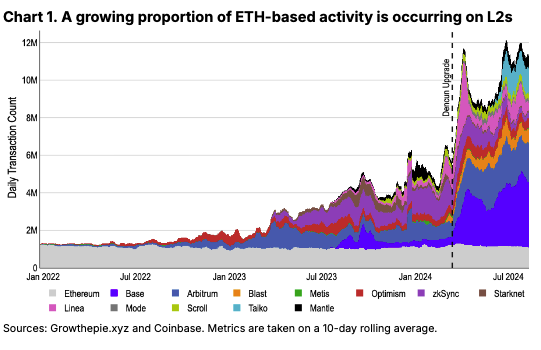
Albeit marginally, BTC ETFs have seen net inflows every day since last weekly publication totaling $237M. This showcases investors willingness to scoop up tokens at these levels. Bitwise noted that the total number of institutional investors holding bitcoin ETFs rose 14% in the second quarter. Chief Investment Officer Matt Hougan was quick to point out “if institutions will buy bitcoin when prices are volatile, imagine what could happen in a bull market.” ETH ETFs on the other hand have seen only net outflow days since last publication. These outflows are still being led by $ETHE and have totaled a small amount of $93M over the past 5 trading days. $ETH continues to struggle to gain price momentum and rally back above $3,000. However, evidence of its scaling efforts is in full effect as the number of transactions processed by the ecosystem shattered an all-time high above 350 TPS. This has been led by L2s as daily transactions jumped from 1M in early ’23 to 11M now. While these L2s take fee revenue away from mainnet, they will ultimately help Ethereum be able to build real world applications with this enhanced scaling ability and strength of network.
Options open interest surrounding the election continues to increase, now up to $444M of notional expressed on the 11-08 expiry on Deribit. September and year end still dominate in terms of notional expressed across expiries. A noticeable kink
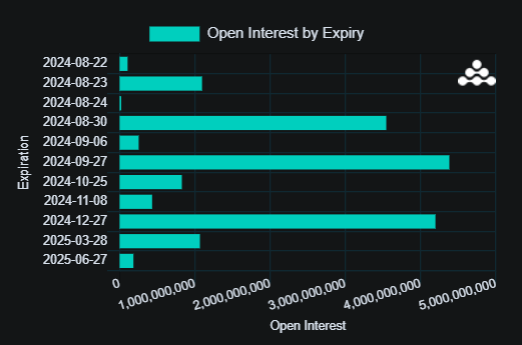
Source: Amberdata
Amongst the top performers from this past week were $AAVE +25%, $MATIC +24%, $TRON +21%, and $FTM +20%.
Mission Control: JUP Tokenomics and Upgrades
The Jupiter ecosystem is undergoing significant transformations aimed at enhancing community involvement, transparency, and long-term sustainability. Recent changes include an overhaul of the LFG Launchpad structure to be more community-centric, a refined approach to fee generation and distribution, and a JUP token supply reduction to address community concerns about high valuations and token distribution. As Jupiter continues to evolve, new strategic shifts could have large implications for token holders, liquidity providers, and the broader market. For a recap on what Jupiter is and why it is important please reach out for our previous write up covering the significance.
Tokenomics of the JUP Token
Jupiter (JUP) accrues fees through various trading and platform activities, which are important for sustaining and incentivizing participation in its ecosystem. These fee-generating activities include base trading fees, price impact fees, borrow fees, referral program fees, liquidity provider fees, and platform maintenance fees.
- Base Trading Fee: A flat fee of 0.06% applied to all trades, serving as the core revenue stream for the platform.
- Price Impact Fee: A dynamic fee that increases with trade size to protect liquidity providers and discourage large trades that could manipulate the market.
- Borrow Fee: An hourly fee on leveraged positions, compensating liquidity providers and managing leverage demand.
- Referral Program Fees: Fees from third-party integrations, with Jupiter taking 2.5% of the integrator's platform fee.
- Liquidity Provider (JLP) Fees: Rewards for liquidity providers from trading and borrow fees, incentivizing liquidity provision.
- Platform Maintenance Fees: Allocated portions of collected fees for platform upkeep, ensuring continuous development and operational efficiency.
Over time, Jupiter's fee structure has undergone significant evolution, particularly with the introduction of the Price Impact Fee in June 2024. This adjustment has fostered a more balanced trading environment by mitigating the risk of market manipulation, resulting in an 11% increase in overall trading fees and a marked shift towards medium-sized trades.
Jupiter is now considering an expansion of its fee distribution to token holders, with a recent proposal advocating for the allocation of 25% of all platform-generated fees to JUP token stakers. This initiative is designed to enhance decentralization, elevate token value, and strengthen community engagement. Historically, JUP fees were retained by the platform to fund development and operational needs; however, as the platform has matured, there has been a strategic shift towards integrating fee distribution as a fundamental component of the JUP token’s value proposition. Ongoing discussions aim to further increase the percentage of fees allocated to stakers and explore additional reward mechanisms.
Evolution of Fee Activities:
- Price Impact Fee (June 2024): Introduced to address market manipulation and protect liquidity providers, leading to an 11% increase in total trading fees.
- Shift in Trade Sizes: A 30% decrease in large trades and an increase in medium trades, indicating traders are adapting by splitting larger orders.
- Market-Specific Impacts:
- SOL Market: Increased activity in the $250K-$500K trade range with a 15% increase in fees.
- ETH Market: Overall decrease in volume and fees, particularly in larger trades.
- BTC Market: 30% increase in volume, especially in the $500K-$1M range, with a 6.55% increase in fees.
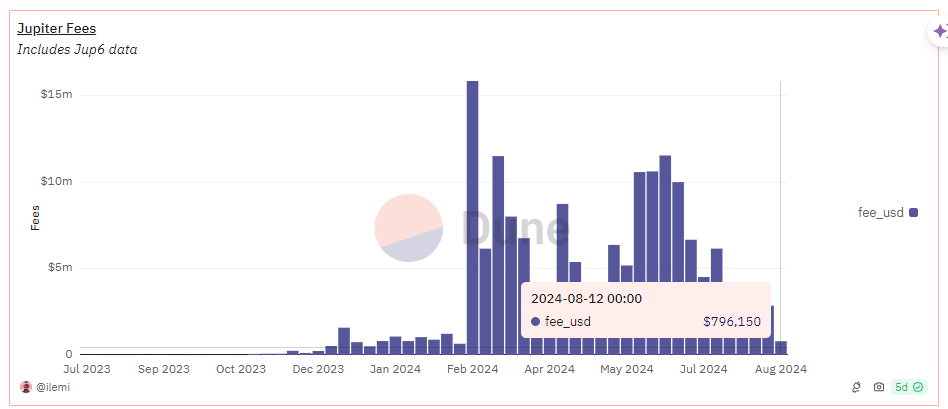
Source: Dune Analytics @ilemi
According to Dune Analytics (@ilemi), although trading fees have declined since their peak in February, Jupiter's total 24-hour trading volume currently stands at $169,385,445. Below is a table showcasing the top 10 coins on Jupiter along with their respective trading volumes.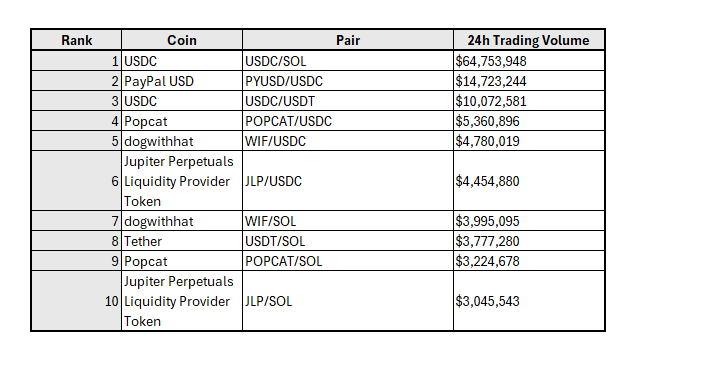
For institutions looking to get indirect exposure to memecoins, Jupiter becomes an interesting value proposition from the fees generated and the proximity to volume done by memecoin traders.
JUP Supply Reduction
The JUP Supply Reduction Proposal, which passed with overwhelming support with 95% in favor on August 4th, aims to increase certainty and transparency within the JUP community by reducing the total token supply by 30%. This initiative is part of a broader effort to address concerns about the high Fully Diluted Valuation (FDV) and clarify token distribution. The key actions include voluntary cuts from the team's allocation, reductions in Jupuary emissions, and cuts to previously assigned allocations such as liquidity pools and strategic reserves. A total of 3 billion JUP tokens will be burned gradually.
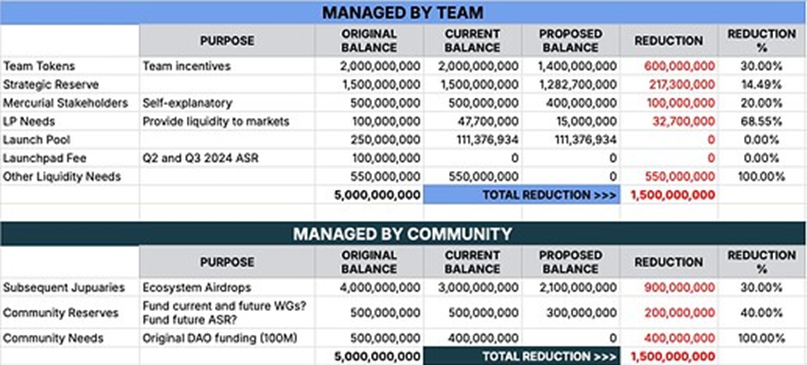
Source: BlueZenith on the Jupiter Forum
Detailed Breakdown of Reductions:
- Team's Contribution: 600 million tokens.
- Community's Contribution: 900 million tokens from future Jupuaries.
- Strategic Reserves: 217.3 million tokens cut by the team, 200 million by the community.
- Additional Reductions: 582.7 million tokens from liquidity buckets, 100 million from Mercurial Stakeholders.
Supporters believe this move will build trust, potentially lead to price appreciation through scarcity, and align the community and team for long-term success. However, critics argue that the real issue lies in the lack of demand for JUP, not its supply. They also express concerns about the impact on community reserves and whether the reduction will have the desired effect without addressing demand.
LFG Launchpad Rework
Jupiter is restructuring its LFG Launchpad to prioritize community involvement, transparency, and a more thoughtful approach to launching projects. The revamped process includes community voting on projects, incentivized voting rewards, and a transparent, data-driven evaluation process. Community members, known as "catdets," will have a direct say in which projects are launched, with votes weighted by the amount of JUP tokens held. To foster long-term commitment, 75% of launchpad fees will be distributed to voters over a 3-6 month vesting period. The Jupiter DAO will oversee these decisions, ensuring that only high-quality projects are selected. The platform will limit launches to two per month, with a minimum two-week gap between them, to ensure each project receives adequate attention.
Sector Commentary
- Layer One / Altcoins
- Bitcoin ($BTC): Attention Bitcoin Traders, the Japanese Yen Is Strengthening Again (link)
- Bitcoin ($BTC): U.S. Elections-Linked Bitcoin Options Draw Nearly $350M in Open Interest (link)
- Bitcoin ($BTC): Bitcoin Returns to $61K, Outperforms Broader Crypto Market (link)
- Bitcoin ($BTC): Trump's Election Odds Are Not The Dominant Driver of Bitcoin's Price, Data Show (link)
- Bitcoin ($BTC): Institutional investors holding steady on bitcoin despite market volatility, analysts say (link)
- Bitcoin ($BTC): Bitcoin whales now add just 1% to their BTC holdings per month (link)
- Ethereum ($ETH): Dark Pools Dominate Ethereum as Private Transactions Surge – at Least by One Measure (link)
- Ethereum ($ETH): ETH supply in profit hits 2024 low as recent buyers feel the pressure (link)
- Ethereum ($ETH): 11 critical moments in Ethereum’s history that made it the No.2 blockchain (link)
- Altcoins: CoinDesk 20 Performance Update: AVAX and NEAR Lead as Index Gains 2.2% (link)
- Altcoins: Solana sees record outflows as memecoin trading declines: CoinShares (link)
- DeFi
- Web3 / AI / NFTs
- RWA / Tokenization / Metaverse / Gaming
- Digital Infrastructure: Capital Markets / Exchanges / DAOs / Mining
- The Rise of Crypto’s Shadow Bankers (link)
- U.S.-Listed Bitcoin Miners Have the Upper Hand Over Unlisted Peers: Bernstein (link)
- Bitcoin Mining Profitability Fell to All Time Lows in August, JPMorgan Analyst Says (link)
- Bitcoin Miner Riot Platforms Is Getting Closer to Taking Over Bitfarms by Force (link)
- Bitwise Acquires London-Based ETP Provider ETC Group to Enter Europe (link)
- Japan’s Metaplanet buys $3.4 million more in bitcoin to total 360 BTC (link)
- US spot bitcoin ETFs see lowest daily trading volume since early February (link)
- Grayscale’s Share of Bitcoin ETF Market Falls Below 25% as Rivals Rise (link)
- The SEC rejected Cboe’s 19b-4 filings for Solana ETFs: Source (link)
- Solana's Former Top Decentralized Crypto Exchange Faces SEC Securities Violations (link)
- Nigeria Plans to Introduce Crypto Licensing Process: Bloomberg (link)
- Blockworks “On the Margin” Newsletter: The real driver of gold and bitcoin (link)