StoneX Natural Resource Summit 4.0 - Copper's Strategic Importance Q&A
LME 3M Copper Price
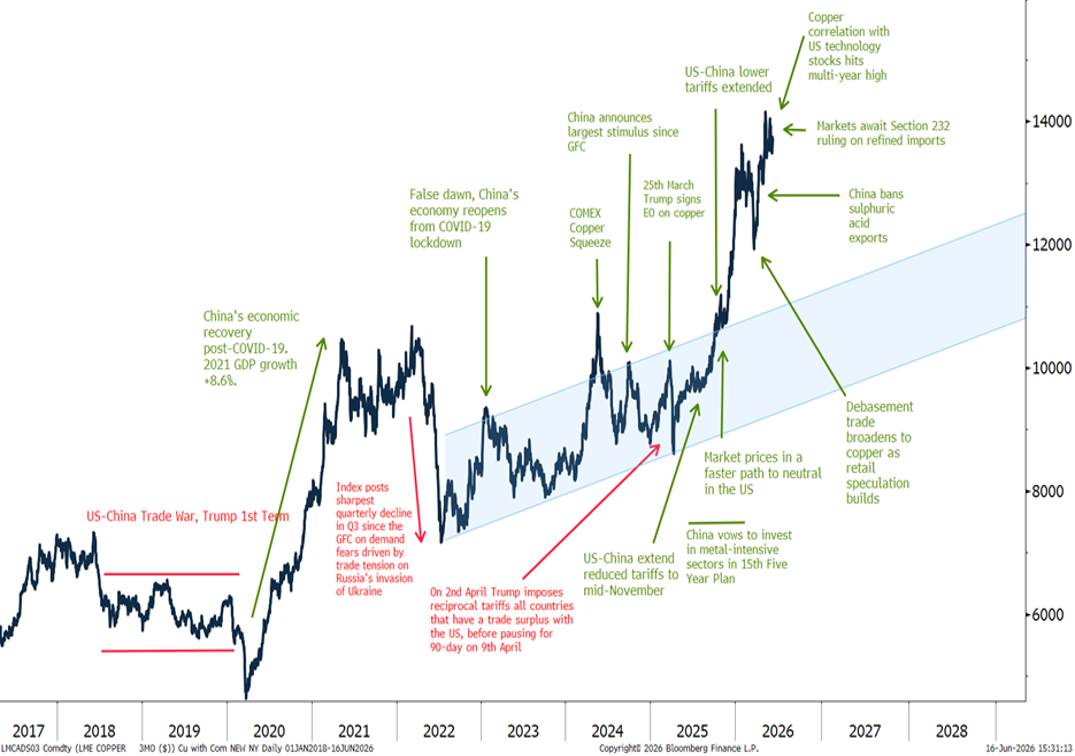
Source: Bloomberg
Before we dive in, I’d like to take a step back and look at how the copper market has evolved over the past decade.
There’s little doubt that copper has entered a bull run since the back end of 2022. Prices have moved in a clear upward trend, underpinned by a growing consensus that the market is heading toward a structural supply deficit later this decade.
At the same time, demand expectations remain robust, driven by power infrastructure, the energy transition, digitalization, and electrification, alongside the reality that there are limited viable substitutes for copper.
Against this backdrop, we’ve also seen increasing participation from speculative investors. Arguably, this has contributed to the volatility and price spikes of the past few years, with markets at times running ahead of macro and fundamental realities.
However, as we moved into the latter part of last year and the first half of this year, something changed.
Copper broke decisively out of that long-term trend channel and has held above it, reaching new all-time highs. This suggests that new, more durable bullish drivers may now be at play, potentially reshaping the copper landscape.
Copper is now widely recognized as a critical mineral. We’re seeing the rise of strategic stockpiling, the impact of US tariffs distorting global trade flows, and a renewed wave of macro-driven investor interest as copper becomes increasingly viewed as a tactical material for the future.
1. Are Copper Prices Justified at Record Highs?
Copper has broken above its long-term trend channel and reached record highs. Are prices justified by fundamentals, or are they increasingly being driven by strategic and speculative factors?
- Bullish
- Copper is increasingly being treated as a strategic asset rather than a traditional industrial commodity.
- Future supply deficits are becoming more important than current inventories.
- Strategic stockpiling ahead of anticipated shortages is rational behaviour.
- Electrification, AI, power infrastructure and energy transition demand continue to strengthen the long-term outlook.
- Current prices may simply reflect a higher equilibrium price needed to incentivise future mine development.
- Bearish
- Prices may be running ahead of near-term physical fundamentals.
- Speculative positioning and investor flows have amplified price moves.
- Some demand expectations may already be priced in.
- Historical commodity cycles suggest sharp corrections are still possible even within long-term bull markets.
Areas of Consensus
- Copper's pricing framework has changed.
- Strategic considerations now play a larger role than in previous cycles.
- Long-term fundamentals remain constructive.
Key Takeaway
The panel broadly agreed that copper's valuation is increasingly being driven by future scarcity rather than current availability. While short-term corrections remain possible, the structural bull case remains intact.
2. The New Copper Market: Why Has Behaviour Changed?
What has been the most surprising aspect about copper’s price behaviour over the last year?
- Bullish
- Copper's emergence as an investment-grade asset has expanded the investor base.
- Increased financial participation reflects growing recognition of copper's strategic importance.
- Strong investor interest may support higher pricing through the cycle.
- Bearish
- Markets have become increasingly headline-driven.
- Political events and policy announcements are creating extreme volatility.
- Traditional fundamental signals have become less reliable.
- Large price swings may discourage physical participation.
Areas of Consensus
- Volatility has increased materially.
- Geopolitical developments now influence copper more than at any point in recent memory.
Key Takeaway
Copper is no longer trading solely as an industrial metal. Financial and geopolitical influences are increasingly shaping market behaviour.
3. Impact of the Iran Conflict
Would a resolution of the Iran War materially change the copper outlook?
- Bullish
- A peaceful resolution would support global growth.
- Improved economic sentiment would benefit copper demand.
- Lower logistics costs and reduced supply chain disruption would support market efficiency.
- Bearish
- Continued conflict creates downside risks to growth.
- Higher energy costs could weaken industrial activity.
- Geopolitical uncertainty may suppress investment and manufacturing activity.
Areas of Consensus
- Copper remains fundamentally linked to global growth.
- Resolution would be supportive, though not transformative.
Key Takeaway
The panel viewed geopolitical risk primarily through the lens of economic growth rather than direct copper supply disruption.
4. US Section 232 Tariffs
What happens next with US refined copper tariffs under Section 232 ("requiring 25% of copper input materials (such as copper ores, concentrates, mattes, cathodes, and anodes) produced in the United States to be sold in the United States – starting at 25% in 2027, increasing to 30% in 2028 and 40% in 2029@).
Please note, there is no legal timeline for the decision. The 30th of June is when Howard Lutnick will outline his recommendation to the US President, but he does not have a 90-day deadline and/or then 15-days to enact it). President Trump may just absorb that information.
However, if we assume the most bullish scenario where we see 15% tariffs at the start of 2027, and then 30% in 2028, how would you expect the market to actually adjust in the period immediately after announcement?
- Bullish
- Continued delays would encourage ongoing copper inflows into the US.
- Strategic stockpiling could continue.
- Tightness outside the US may become more pronounced.
- Scrap export restrictions could tighten global markets further.
- Bearish
- Tariffs could distort trade flows and reduce market efficiency.
- Elevated regional premiums could create demand disruption.
- Policy uncertainty continues to weigh on investment decisions.
Areas of Consensus
- The outcome remains highly uncertain.
- Markets have partially priced in tariff risks.
Key Takeaway
The uncertainty itself has become a market driver, with many participants viewing future scrap policy as potentially more important than tariffs themselves.
5. Supply Growth and Mining Opportunities
Where are the biggest opportunities for miners today?
- Bullish
- Higher copper prices significantly improve project economics.
- Governments increasingly support critical mineral development.
- Investors are once again rewarding growth rather than capital discipline alone.
- New financing structures may help unlock projects.
- Bearish
- Permitting remains difficult.
- Cost overruns and execution risks remain significant.
- Ore grades continue to decline globally.
- Many large-scale projects remain capital intensive and technically challenging.
Areas of Consensus
- The industry needs more mine supply.
- Higher prices improve the development outlook.
Key Takeaway
The opportunity exists, but execution remains the challenge. Higher prices alone do not guarantee new supply.
6. Sulfuric Acid and Operational Risks
How significant are sulfur and sulfuric acid disruptions?
- Bullish
- Higher sulfur costs raise marginal production costs.
- Supply chain disruptions can constrain output in vulnerable regions.
-
- Bearish
- Producers have largely secured required supplies.
- Smelter economics remain relatively strong.
- Market impacts remain manageable.
- Any disruption is likely temporary rather than structural.
Areas of Consensus
Sulfur is an operational challenge rather than a market-changing event.
Key Takeaway
The panel viewed sulfur-related issues as important operational risks but not a defining factor for long-term copper prices.
7. Concentrate Market Tightness
Will concentrate deficits persist?
- Bullish
- Mine supply growth remains insufficient.
- Treatment charges continue to signal acute tightness.
- Smelter capacity has expanded faster than available feedstock.
- Competition for concentrate is intensifying globally.
- Bearish
- Eventually lower smelter utilisation rates will rebalance the market.
- Future mine projects could ease pressure if developed successfully.
Areas of Consensus
The concentrate market remains extremely tight.
Key Takeaway
Concentrate availability remains one of the strongest fundamental arguments supporting higher copper prices.
8. AI and Copper Demand
What is most misunderstood about AI-related copper demand?
- Bullish
- Data centres have limited ability to substitute away from copper.
- AI infrastructure has a very high willingness to pay.
- Copper is increasingly linked to national security and technology leadership.
- AI amplifies electricity demand growth.
- Bearish
- AI still represents a relatively small share of total copper demand.
- Future demand projections remain uncertain.
- Current investment levels may not continue indefinitely.
Areas of Consensus
- AI is strategically important.
- Electricity demand remains the larger story.
Key Takeaway
The significance of AI lies less in today's demand volumes and more in its ability to reinforce long-term electricity and infrastructure demand growth.
9. Long-Term Copper Investment Case
How should investors think about copper miners and long-term pricing assumptions?
- Bullish
- Long-term copper price assumptions are rising.
- Electricity demand growth continues to accelerate.
- Investors increasingly recognise structural supply constraints.
- Critical mineral policies support long-term investment.
- Bearish
- Large-scale projects remain difficult to execute.
- Higher prices may eventually trigger substitution and demand responses.
- Capital intensity remains elevated.
Areas of Consensus
Long-term fundamentals remain supportive.
Key Takeaway
The investment case is increasingly based on supply scarcity rather than demand optimism alone.
10. Demand Destruction Risks
Should markets be worried about demand destruction?
- Bullish
- Chinese demand remains resilient despite record prices.
- Power infrastructure, solar and grid investment continue to support consumption.
- Strategic stockpiling is adding to apparent demand.
- Bearish
- Higher prices inevitably increase substitution risk.
- Some demand themes may already be fully priced in.
- Economic weakness could expose demand fragility.
Areas of Consensus
- Demand destruction is a risk at sufficiently high prices.
- Evidence remains limited today.
Key Takeaway
The market acknowledges the risk, but current demand trends remain surprisingly resilient
11. Above-Ground Stocks and Hidden Inventories
How much copper is truly available to the market?
- Bullish
- Much of the metal moved into the US is effectively unavailable to global consumers.
- Regional fragmentation reduces effective inventory availability.
- Strategic stockpiling is absorbing material.
- Bearish
- Total inventory levels remain relatively healthy.
- Current forward curves do not indicate extreme physical tightness.
- Inventories could return to market if incentives change.
Areas of Consensus
Inventory visibility has become increasingly difficult.
Key Takeaway
The debate is no longer how much copper exists, but how much copper is actually available to the marginal buyer.
12. What Matters Most for Copper Prices Going Forward?
What single factor should investors watch most closely?
- Bullish
- Chinese buying activity.
- Mine supply growth.
- Rising incentive prices for new projects.
- Continued electrification and power demand growth.
- AI-related infrastructure investment.
- Tariff uncertainty.
- Bearish
- Slower global growth.
- Dollar strength.
- Geopolitical shocks.
- Demand destruction at higher prices.
Areas of Consensus
- Structural supply constraints remain the dominant long-term theme.
- Macro factors will continue driving short-term volatility.
Key Takeaway
The long-term story remains fundamentally bullish, but the path higher is likely to be increasingly volatile.
This material should be construed as market commentary and represents the opinions and viewpoints of the author, and does not reflect tailored advice associated with any specific account.
The views are current only through the date stated and are subject to change at any time based upon market or other conditions, and StoneX Group Inc. (“SGI”) disclaims any responsibility to update such views. Actual results, performance, or achievements may differ materially from those expressed or implied. Information is based on data gathered from what we believe are reliable sources. Past performance does not guarantee future results.
The StoneX Group Inc. group of companies provides financial services worldwide through its subsidiaries, including physical commodities, securities, exchange-traded and over-the-counter derivatives, risk management, global payments and foreign exchange products in accordance with applicable law in the jurisdictions where services are provided.
References to certain OTC products or swaps are made on behalf of StoneX Markets, LLC (SXM), a member of the National Futures Association (NFA) and provisionally registered with the U.S. Commodity Futures Trading Commission (CFTC) as a swap dealer. SXM’s products are designed only for individuals or firms who qualify under CFTC rules as an ‘Eligible Contract Participant’ and who have been accepted as customers of SXM.
StoneX Financial Inc. (SFI) is a member of FINRA/NFA/SIPC and registered with the MSRB. SFI is registered with the U.S. Securities and Exchange Commission (SEC) as a Broker-Dealer and with the CFTC as a Futures Commission Merchant and Commodity Trading Advisor. StoneX Financial (Canada) Inc. (SFCI) is registered in Canada and is a member of CIRO and CIPF. References to certain securities trading are made on behalf of the BD Division of SFI and are intended only for an audience of institutional clients as defined by FINRA Rule 4512(c). References to certain exchange-traded futures and options are made on behalf of the FCM Division of SFI. Wealth Management is offered through SA Stone Wealth Management Inc., member FINRA/SIPC, and SA Stone Investment Advisors Inc., an SEC-registered investment advisor, both wholly owned subsidiaries of SGI.
R.J. O’Brien & Associates, LLC (RJO) is registered with the CFTC as a Futures Commission Merchant and is a member of NFA.
StoneX Financial Ltd (SFL) is registered in England and Wales, company no. 5616586. SFL is authorized and regulated by the Financial Conduct Authority (FCA) (registration number FRN:446717) to provide services to professional and eligible customers including: arrangement, execution and, where required, clearing derivative transactions in exchange traded futures and options. SFL is also authorized to engage in the arrangement and execution of transactions in certain OTC products, certain securities trading, precious metals trading and payment services to eligible customers. SFL is authorized and regulated by the FCA under the Payment Services Regulations 2017 for the provision of payment services. SFL is a category 1 ring-dealing member of the London Metal Exchange. In addition SFL also engages in other physically delivered commodities business and other general business activities which are unregulated and not required to be authorized by the FCA.
This communication is issued in the European Economic Area by StoneX Financial Europe GmbH (SFEG). StoneX is the trade name used by STONEX GROUP INC. and all its associated entities and subsidiaries. StoneX Financial Europe GmbH (“SFEG”) is a securities trading firm registered in Germany under Company No. HRB 80844.
StoneX APAC Pte. Ltd. (“SAP”) (Co. Reg. No 200616676W) is regulated as a Dealer (PS20190001002) under the Precious Stones and Precious Metals (Prevention of Money Laundering and Terrorism Financing) Act 2019 for purposes of anti-money laundering and countering the financing of terrorism. SAP is an “Approved International Trading Company” authorized to act as a “Spot Commodity Broker” under the Commodity Trading Act.
StoneX Financial Pte Ltd (Co. Reg. No 201130598R) (“SFP”) is regulated by the Monetary Authority of Singapore and is a Capital Markets Service Licence holder (for dealing in capital market products), an Exempt Financial Adviser (for advising on investment products and issuing or promulgating analyses/ reports on investment products) and a Major Payment Institution (for domestic and cross-border money transfer services).
SFP may distribute analysis/report produced by its respective foreign affiliates within the StoneX Group of companies pursuant to an arrangement under Regulation 32C of the Financial Advisers Regulations Recipients should contact SFP at (65) 6309 1000 for any matters arising from, or in connection with, this webinar.
StoneX APAC Pte. Ltd. (“SAP”) (Co. Reg. No 200616676W) is regulated as a Dealer (PS20190001002) under the Precious Stones and Precious Metals (Prevention of Money Laundering and Terrorism Financing) Act 2019 for purposes of anti-money laundering and countering the financing of terrorism.
StoneX Financial (HK) Limited (CE No.: BCQ152) (“SHK”) is regulated by the Hong Kong Securities and Futures Commission for Dealing in Securities and Dealing in Futures Contracts.
StoneX Financial Pty Ltd (ACN 141 774 727) holds an Australian Financial Service License (AFSL: 345646) for Dealing in Securities, Exchange-Traded Derivatives Contracts, OTC Derivatives Contracts and Foreign Exchange Contracts, and is regulated by the Australian Securities and Investments Commission.
StoneX Securities Co., Ltd. (“SSJ”) (Co. Reg. No 010401047199) is regulated by the Japanese Financial Services Agency as a Type-I Financial Instruments Business Operator (Kanto Local Finance Bureau (FIBO)No.291’), is a member of the Financial Futures Association of Japan for dealing and broking FX and FX Option transactions, and is a member of the Japan Securities Dealers Association for dealing and broking stock indices and option transactions.
Trading swaps and over-the-counter derivatives, exchange-traded derivatives and options and securities involves substantial risk and is not suitable for all investors. Past performance of any futures or option is not indicative of future success. Indicators are not a trading system and are not published as a specific trade recommendation. The information herein is not a recommendation to trade nor investment research or an offer to buy or sell any derivative or security. It does not take into account your particular investment objectives, financial situation or needs and does not create a binding obligation on any of the StoneX group of companies to enter into any transaction with you. You are advised to perform an independent investigation of any transaction to determine whether any transaction is suitable for you. No part of this material may be copied, photocopied or duplicated in any form by any means or redistributed without the prior written consent of StoneX Group Inc.
The report/analysis herein is not directed to, or intended for distribution to or use by, any person or entity who is a citizen or resident of or located in any locality, state, country or other jurisdiction where such distribution, publication, availability or use would be contrary to law or regulation.
© 2026 StoneX Group Inc. All Rights Reserved.