StoneX Presents the Outlook for Base Metals in a Changing Trade Environment
On 24th April, StoneX presented at the Joint Study Group’s Seminar in Lisbon, sharing views surrounding the topic of ‘The impact of policy on base metal trade flows’. The article below will summarize our key views from the presentation.
Note, the Joint Study referred to the International Copper Study Group, International Lead & Zinc Study Group and the International Nickel Study Group.
Agenda:
- Unpacking the Tariff Landscape
- The Impact of Tariffs on Key Price Drivers
- Aluminium, Copper & Automotive Case Study
- Summary and Conclusion
Unpacking the Tariff Landscape

The chart on the LHS shows the historical average effective US tariff rate, with the dark blue column representing how tariff rates have risen under implemented tariffs so far in 2025, with the light blue column, how tariffs will rise under threatened tariffs to come. Simply put, the US administration is on course to action the highest level of tariffs in recent history, which are themselves, both broad based and sector specific.

Base metals have seen all gains previously held this year (supported by a weak USD, optimism over record levels of Chinese stimulus and tariff-independent supply risks) wiped out, standing as the second weakest performing commodity asset, only ahead of energy.
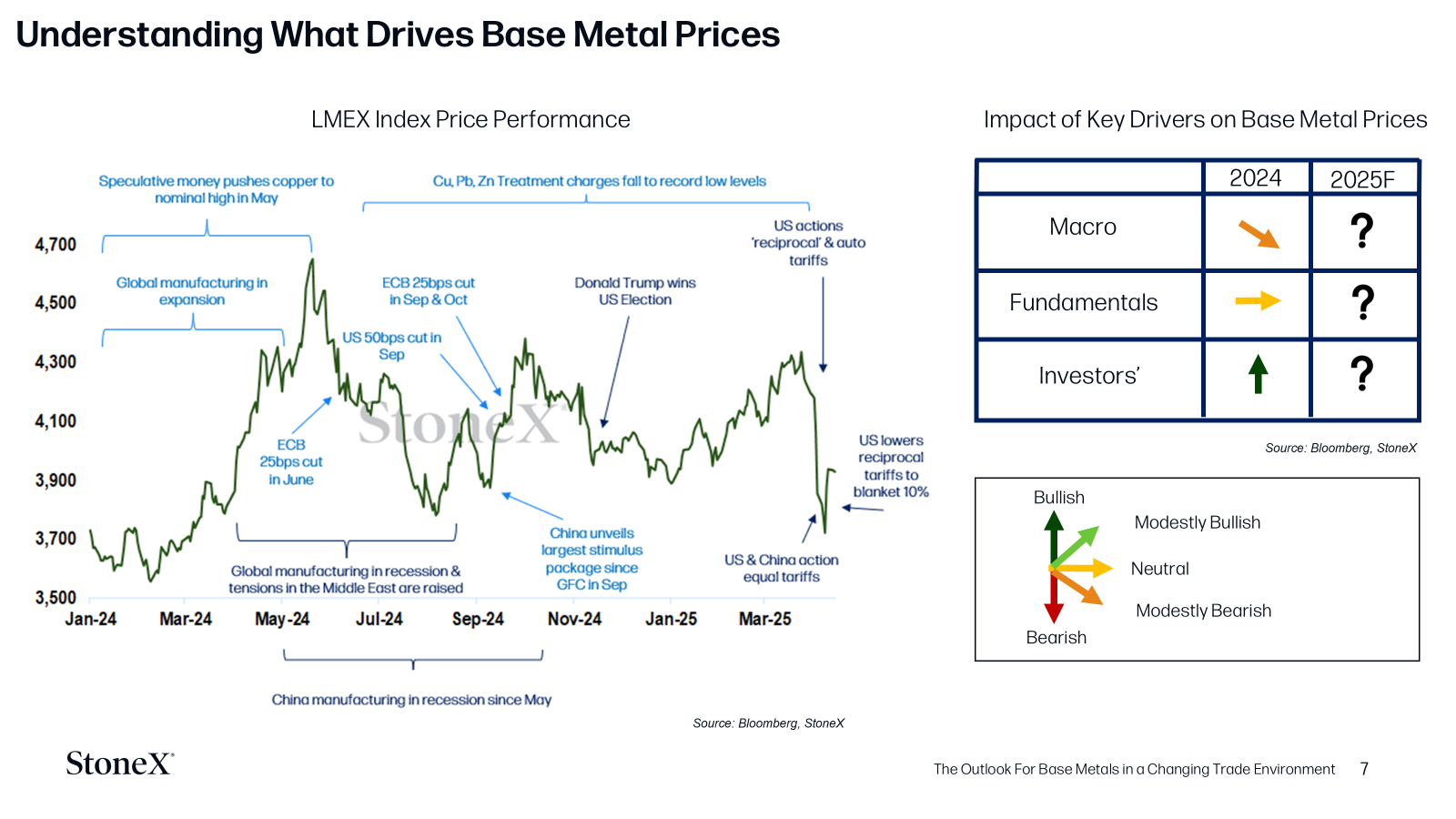
However, to better understand the impact of policy on this market and future base metal prices, we need to understand what drives prices in the first place. Looking at the slide (above), in light blue we have highlighted the key bullish price drivers this year and in dark blue the bearish drivers. What this is showing us is, that prices have been driven by a combination of macroeconomic forces, fundamentals forces and investor forces.
Key takeaway: Changing trade policy can (and already has) impacted each of these key driving forces.
The Impact of Tariffs on Key Price Drivers
We are of the view, that understanding macroeconomic drivers is central in forecasting future price performance, and there are three key area's we will be watching.
1. Firstly, looking at the pace and path of monetary policy
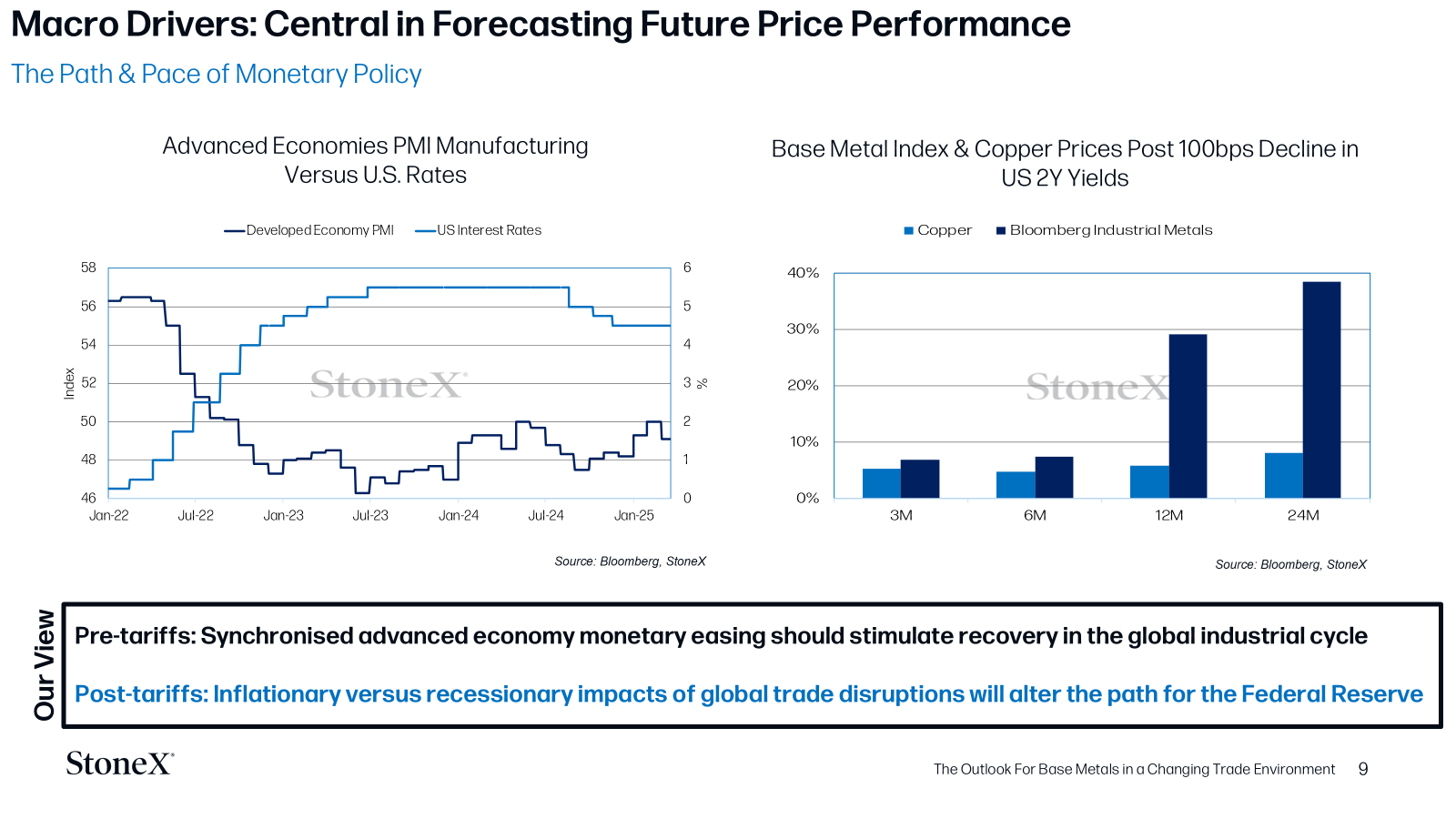 Pre-tariffs, we saw the synchronised, advanced economy monetary easing as supportive for a recovery in the global industrial cycle – with falling yields as holding a net positive impact on base metal prices.
How has our view changed in a post-tariffs landscape?
The path of monetary policy in the west has become more uncertain. Firstly it is too early to judge the impact of current tariffs on the economy (i.e. inflationary vs recessionary), while secondly, the path of tariffs remains highly uncertain. As a result, we have a growing divergence in market expectations, with the bond market pricing in around 1% cuts this year, while the Federal Reserve median outlook is for just 0.5% of cuts.
In our view, despite pressure from US President Trump on Federal Reserve Chairman Jerome Powell to cut interest rates. We expect that the Fed will remain data dependent and continue to hold true to its dual mandate of balancing maximum employment and price stability in the country. Therefore, we forecast we will likely face just 0.5% of cuts this year, with the Fed likely on hold until at least June before a decision can be made on monetary policy action.
Key takeaway: Tariffs have delayed the outlook for cyclical demand recovery
2.The health of China
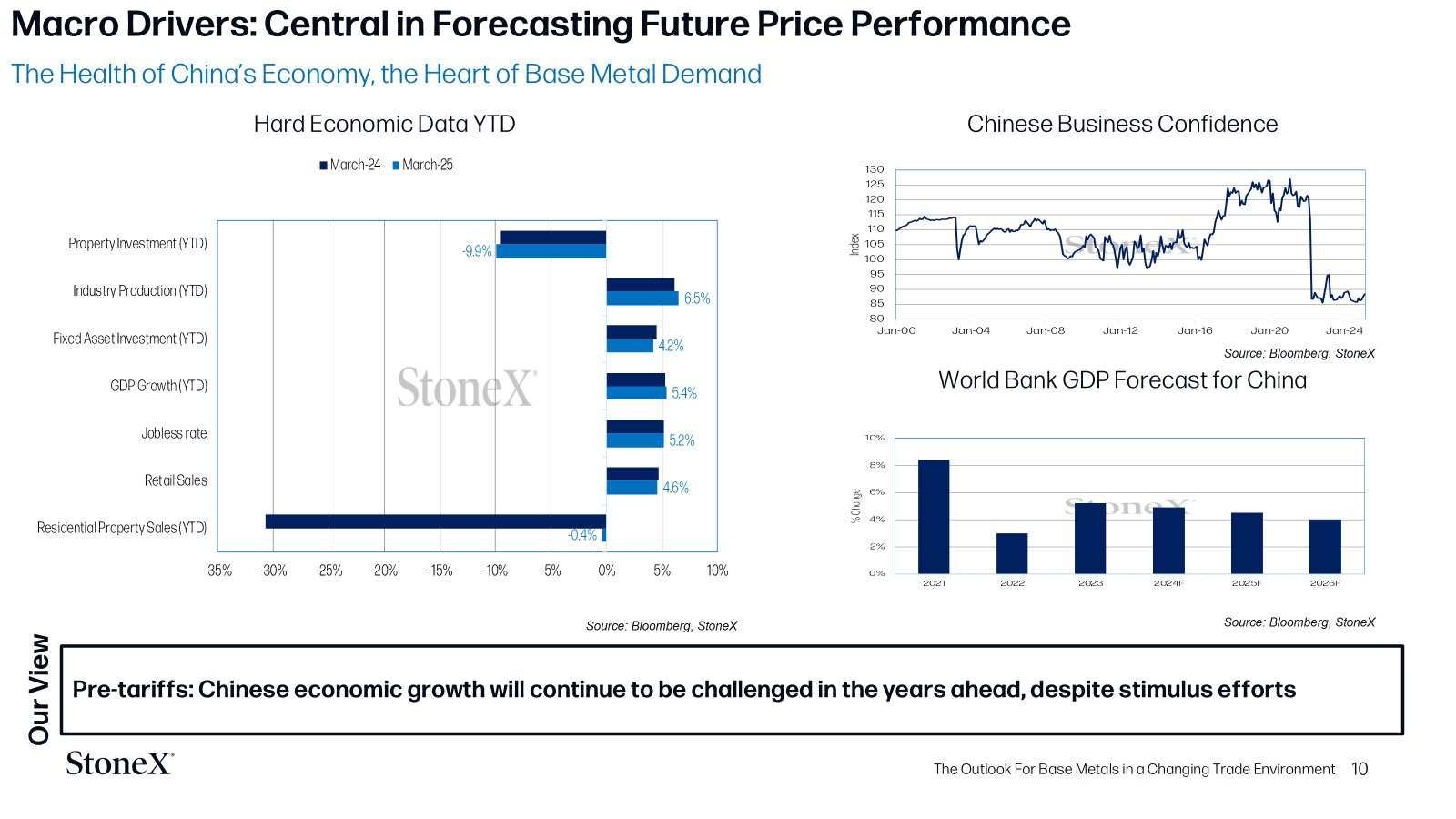
Pre-Tariffs: In our view, despite announced (and future expected) stimulus, we forecast that the economy will face ongoing challenges in reaching its targets, with:
- GDP growth on track to slow Y/Y, given an ailing property sector (which still has not stabilized)
- record low consumer confidence (with 60% of household wealth attached to the property market)
- the threat of future tariffs from the west, challenging one of its key drives of growth, exports.
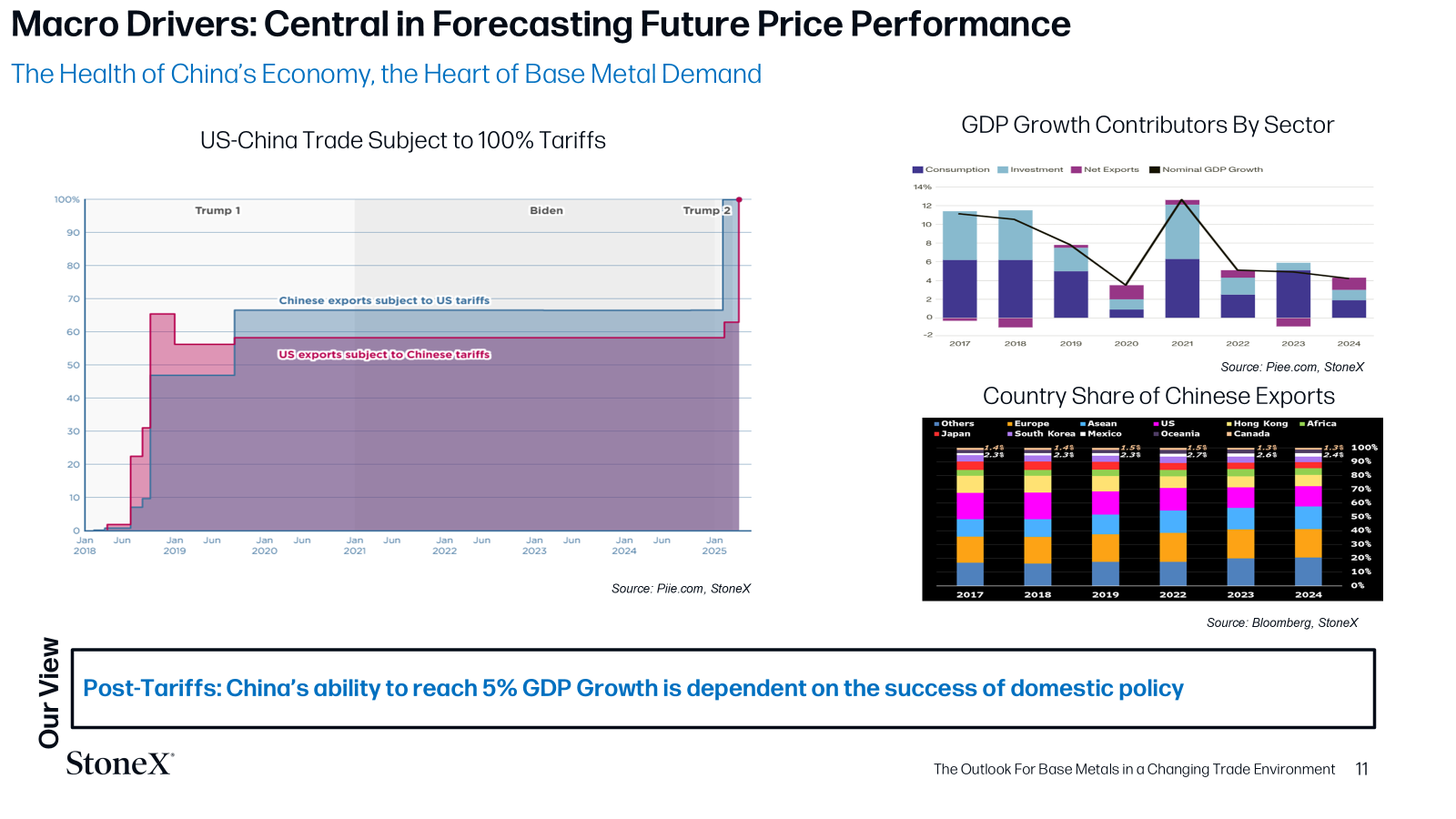
How has our view changed in a post-tariffs landscape?
- The escalation in US-China trade tariffs has resulted in all goods from both countries facing 100% tariffs. For China, this means 15% of all of its foreign trade last year is now facing 100% tariffs. Given that 25% of Chinese GDP growth in 2024 came from robust exports, this will directly negatively impact GDP growth this year. Indeed, we have already started to see an impact on energy and agriculture trade in March, with US imports of LNG and wheat falling to zero. Meanwhile, even copper imports have been impacted (which face zero tariffs), with US exports to China of scrap halving Y/Y, while cargo's of copper concentrate fell 38% Y/Y.
So looking ahead, direct US-China tariffs will negatively impact one of China’s largest growth drivers, exports (with further pain to potentially come from rise of indirect tariffs from other countries).
Key Takeaway: China’s ability this year to obtain its 5% GDP growth target will be highly dependent on the success of domestic policy.
3. The risk of an escalation in ongoing or unknown geopolitical tensions.
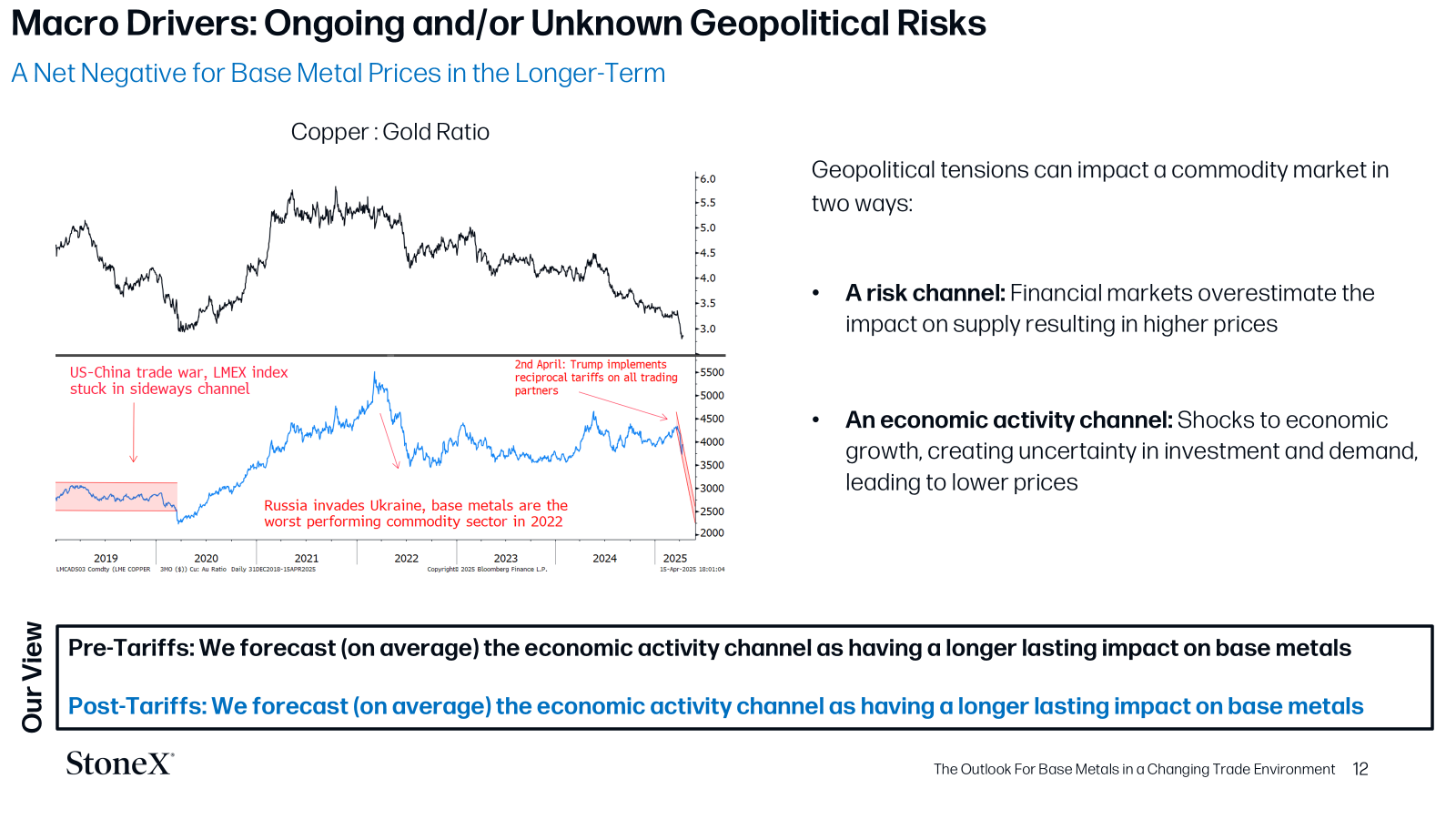
Here, while geopolitical tensions can impact a commodity market in two ways.
- A risk channel which is where financial markets overestimate the impact on supply resulting in higher prices.
Also see
- An economic activity channel, with a shock to economic growth creating uncertainty in investment and demand, leading to lower prices.
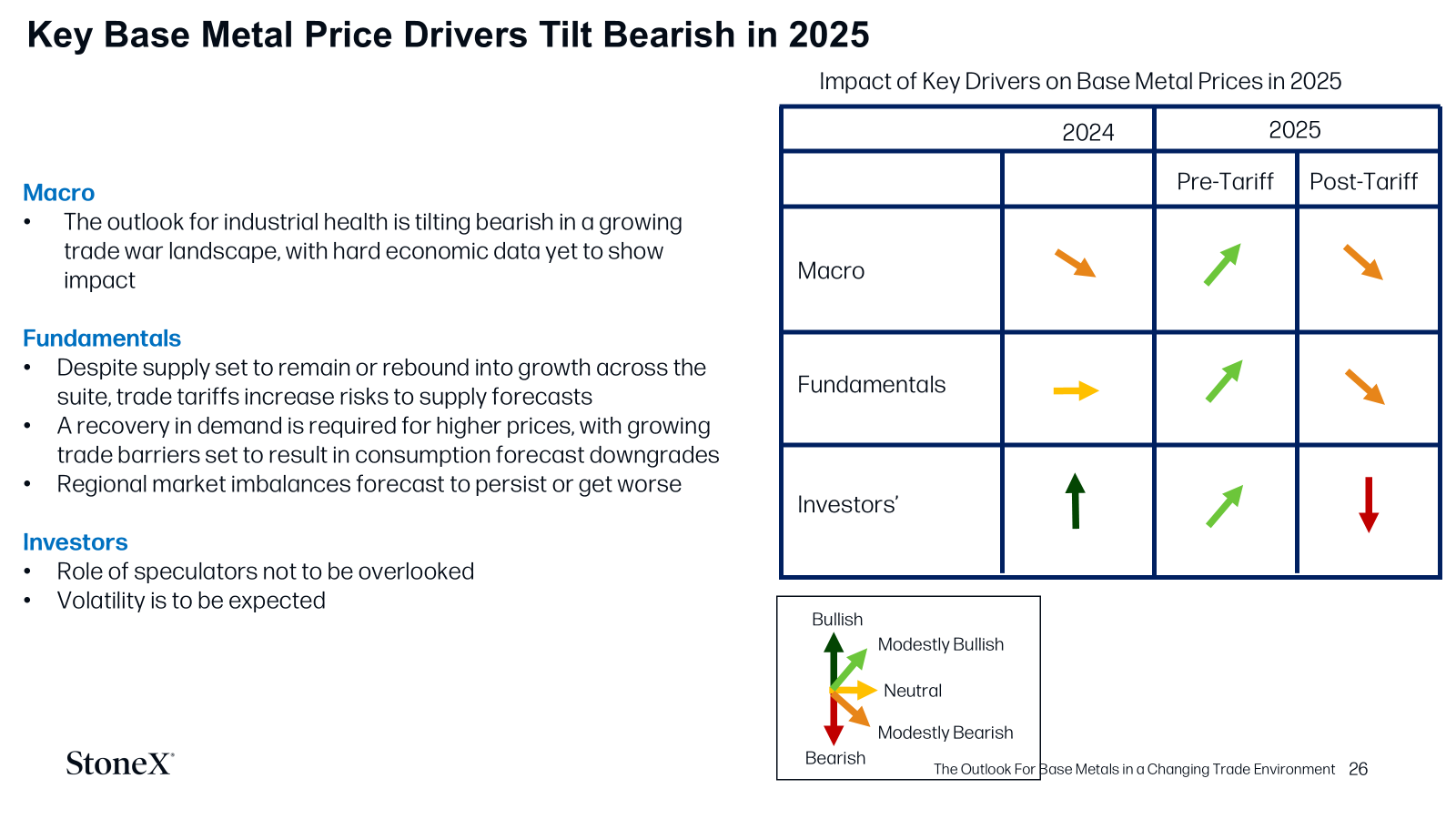
Key takeaway: Our view post-tariffs has not been altered and we see the addition of tariffs as playing a net negative for base metal prices in the longer-term.
Moving away from macroeconomic drivers and onto fundamentals in 2025
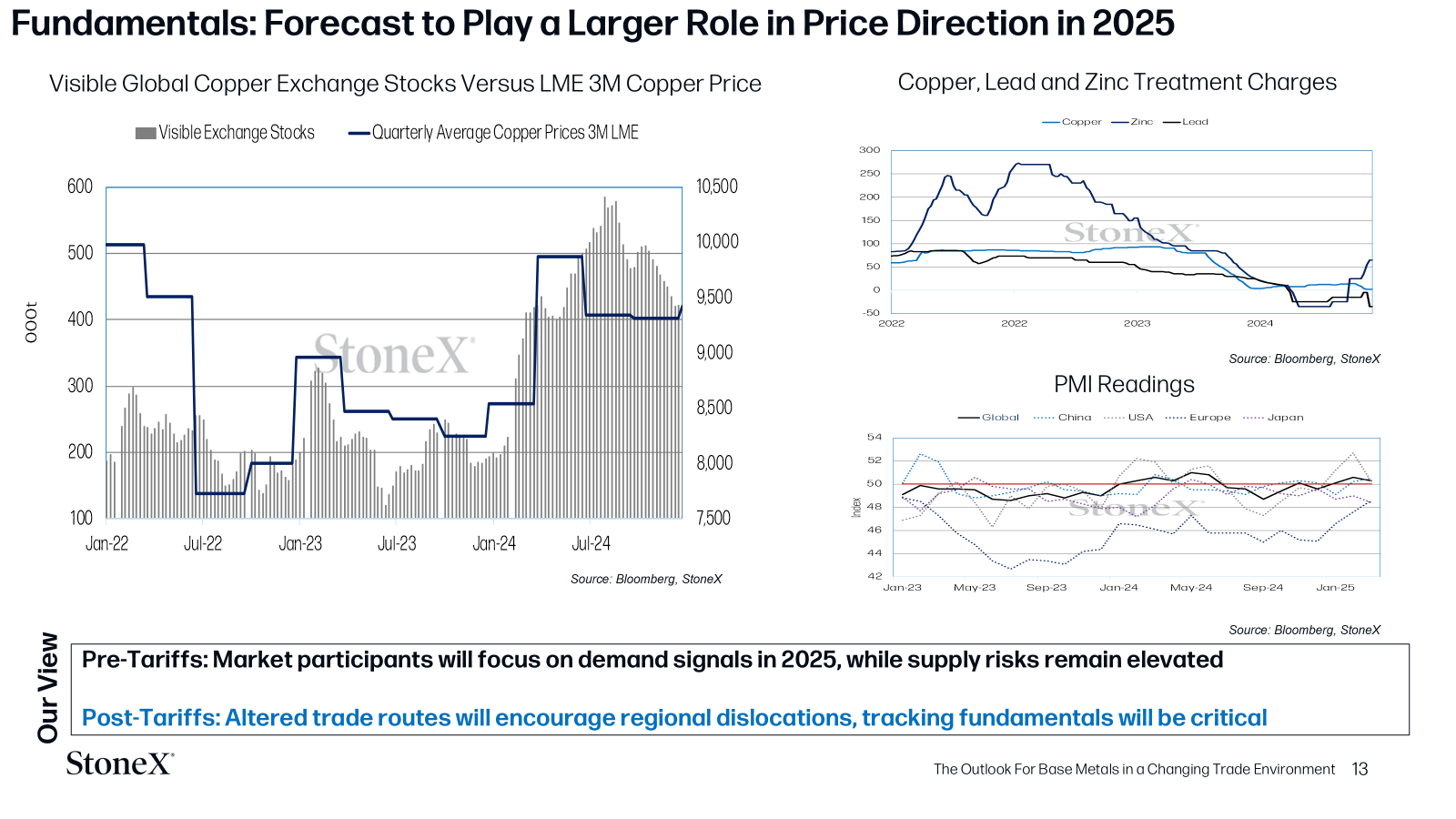
The first thing to say is we expect fundamentals to play a larger role in price direction this year than last year, but why?
The answer is two-fold:
- Firstly, the impact of tariffs is likely to further distort our current S&D outlook, with tariffs historically holding a negative impact on supply, while demand is often downgraded.
-
Secondly, this in turn may result in larger market imbalances, creating a divergence between the micro and macro-outlook. Note, this is something already taking place in the example of copper.
Key takeaway : Altered trade routes will encourage regional dislocations, increased volatility within the fundamentals and this could cause price separation across the suite.
Leaving fundamentals there and turning our attention to our view on the impact of investors on base metal prices
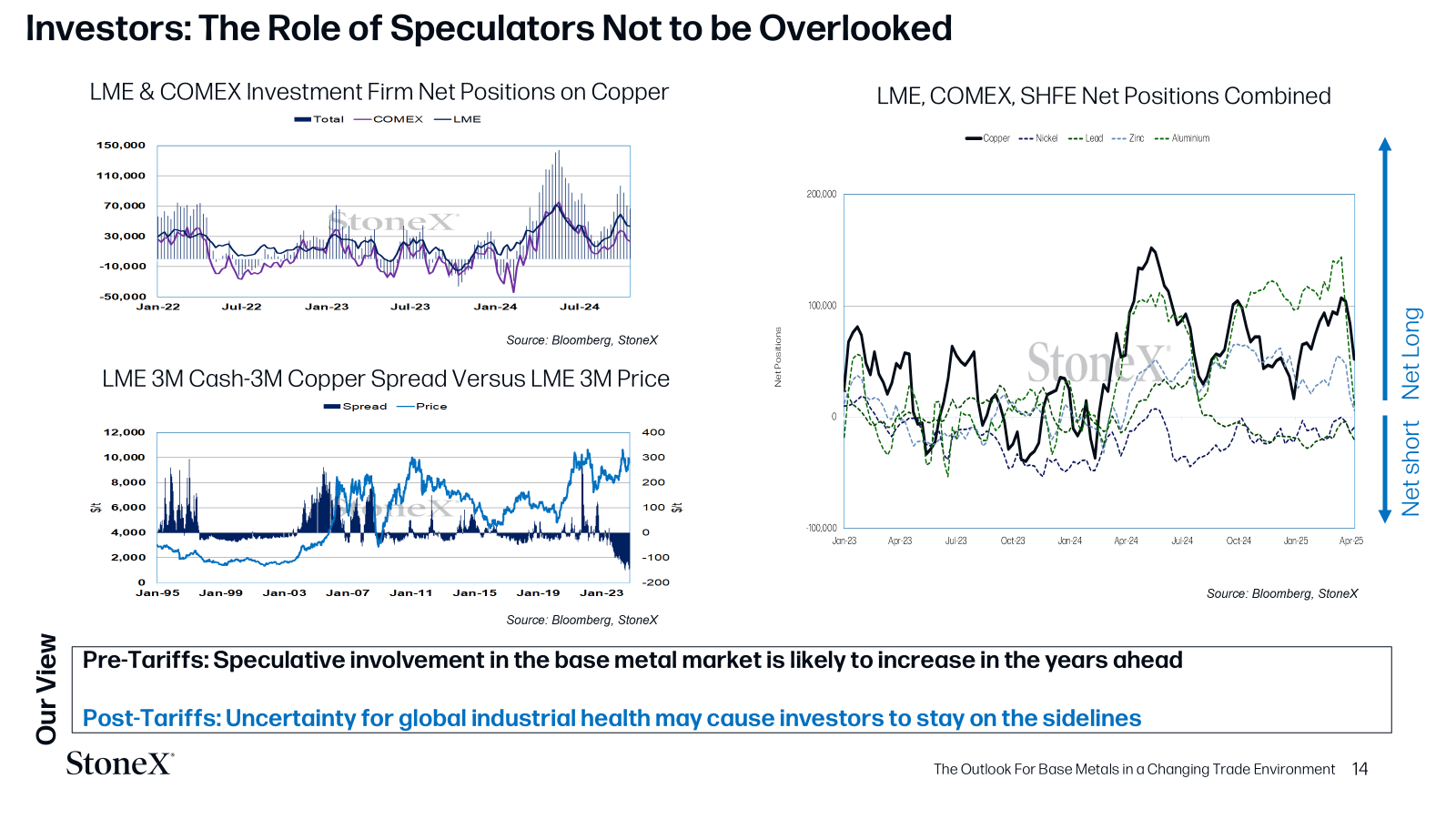
We forecast that the role of investors should not be overlooked in the base metal market, which may cause increased price volatility:
E.g.
Looking at two LHS charts (above), we can see what happened to copper back in May 2024, in which investor interested soared into copper on the LME and COMEX exchanges, resulting in a squeeze on COMEX and a record nominal high on copper. During this period, we had record high copper prices, but historical high contangos in the cash-3M spread - we have previously never seen prices this high in a contango market, demonstrating the removal of copper price action from both the macro picture and fundamentals during that time.
So, it’s important to understand what investor sentiment is for the base metals, as it stands, based on net positions across LME, COMEX and SHFE
- Copper & aluminium are the most favoured by investors
- followed by tin and zinc
- while nickel and lead are the least
Key takeaway: While investors have the ability to distort the market away from macroeconomic or fundamental themes, given the current state of play, heighted uncertainty and resulting potential lack of convection means investors are likely to remain on the sidelines in the near-term.
Case Study - Aluminium
Background
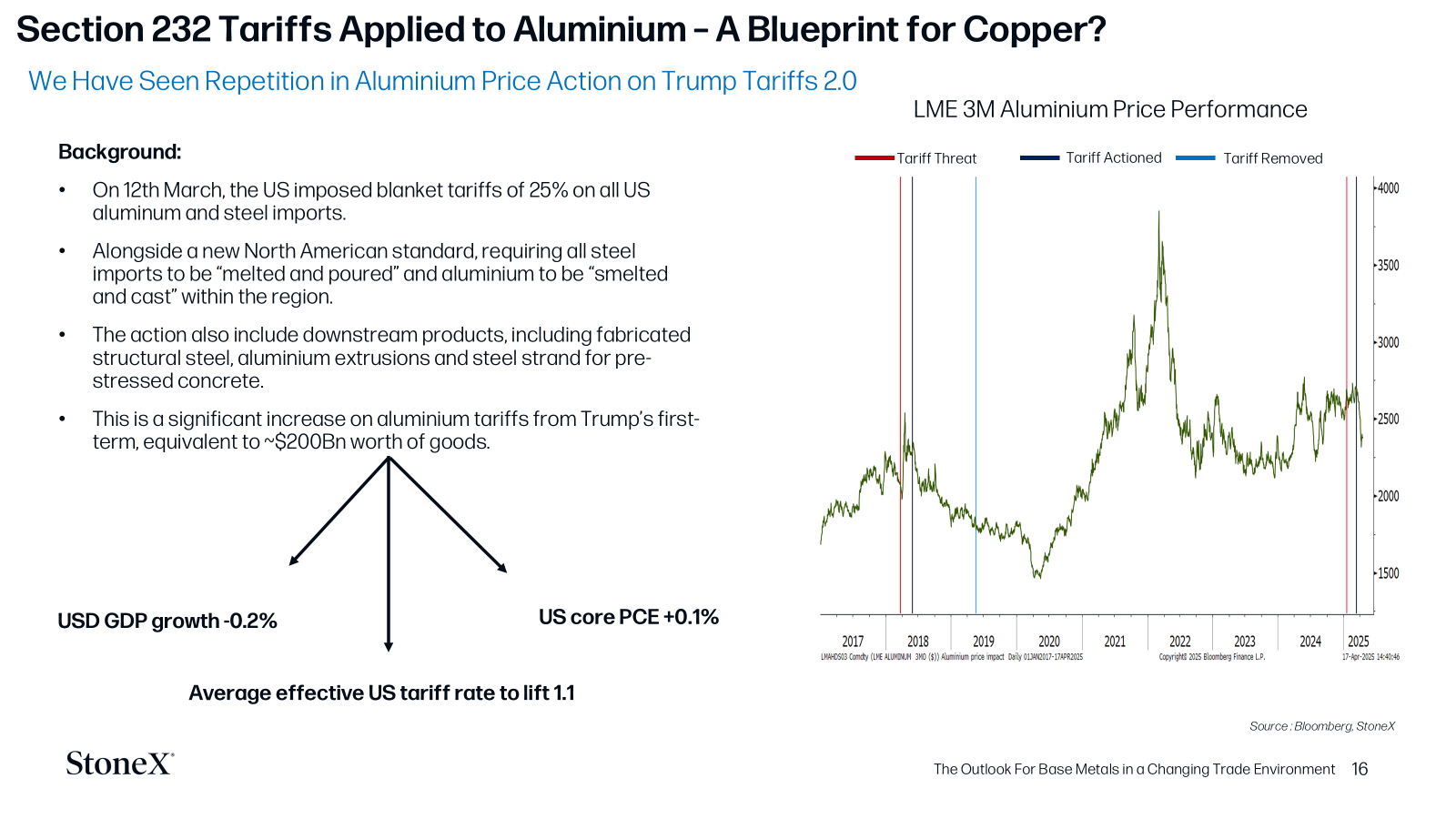
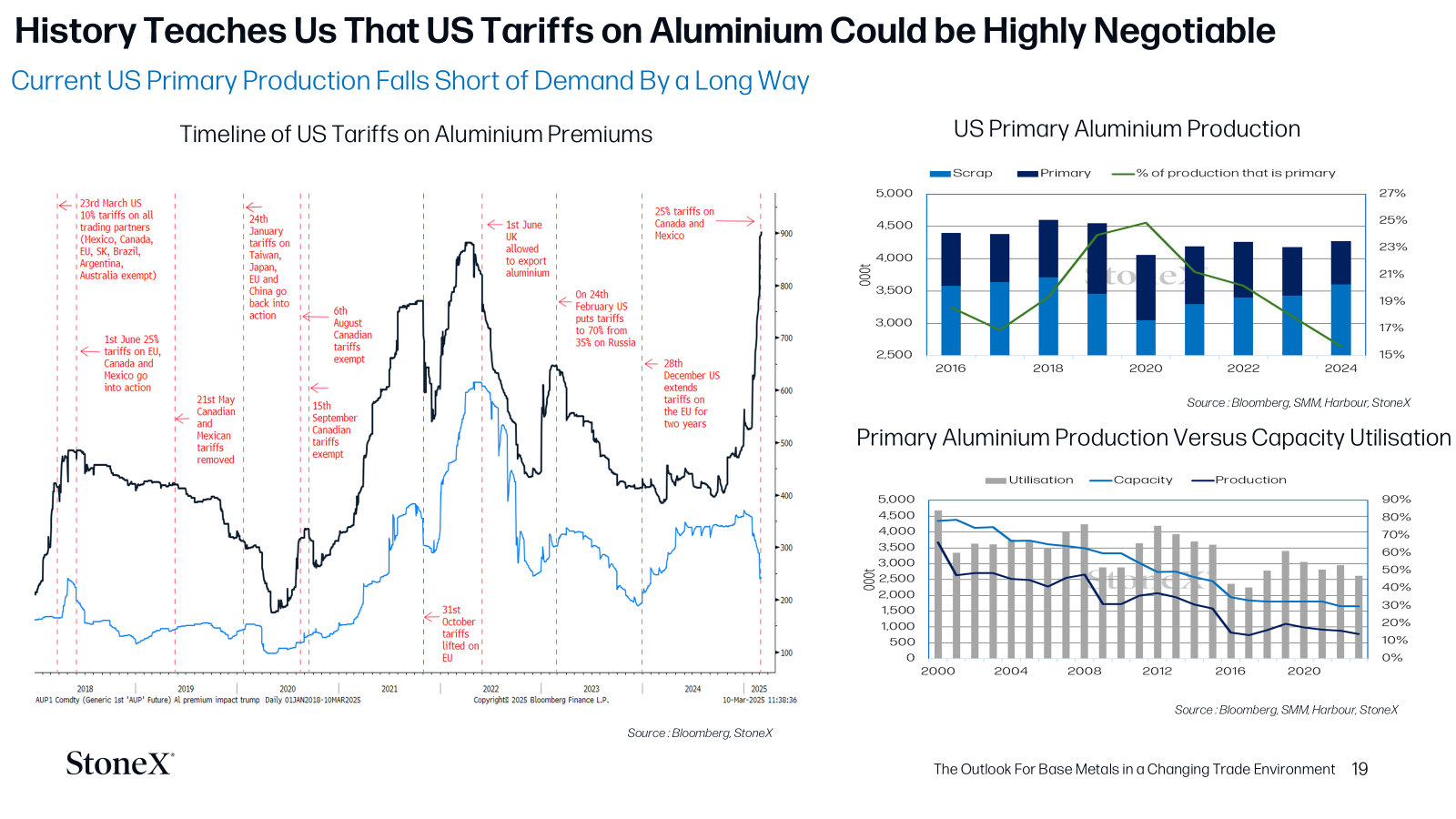
- Aluminium has long been a topic of interest for Trump as part of his goal to increase industrial self-sufficiency in the US, with an import reliance of 82% for aluminium and aluminium parts.
- In President Trump's first-term, the longest stretch of tariffs on aluminium (against all trading partners) lasted from 1st June 2018-23rd May 2019 at 10%, based on Section 232 of the Trade Expansion Act of 1962.
What were the main impacts to aluminium back then?
- Domestic US aluminium prices rose and remained elevated while tariffs remained in play.
- A high US premia attracted units into the US resulting in the EU premium lifting.
- Higher domestic prices marginally helped to boost investment in upstream production over 2017-2019, with output lifting by 350,000t Y/Y and number of upstream jobs rising by 5% Y/Y.
However, ultimately the longer-lasting impact was that higher input price were passed onto the downstream industry and consumers, with the Federal Reserve reporting that the impact of 2018 tariffs not only reduced the overall numbers of manufacturing jobs in the industry but made it more expensive to produce aluminium.
Fast Forward to Where We Are Now?
On 12th March, the US imposed a blanket tariffs of 25% on all US aluminum and steel imports. Alongside a new North American standard, requiring all steel imports to be “melted and poured” and aluminium to be “smelted and cast” within the region. The action also include downstream products, including fabricated structural steel, aluminium extrusions and steel strand for pre-stressed concrete.
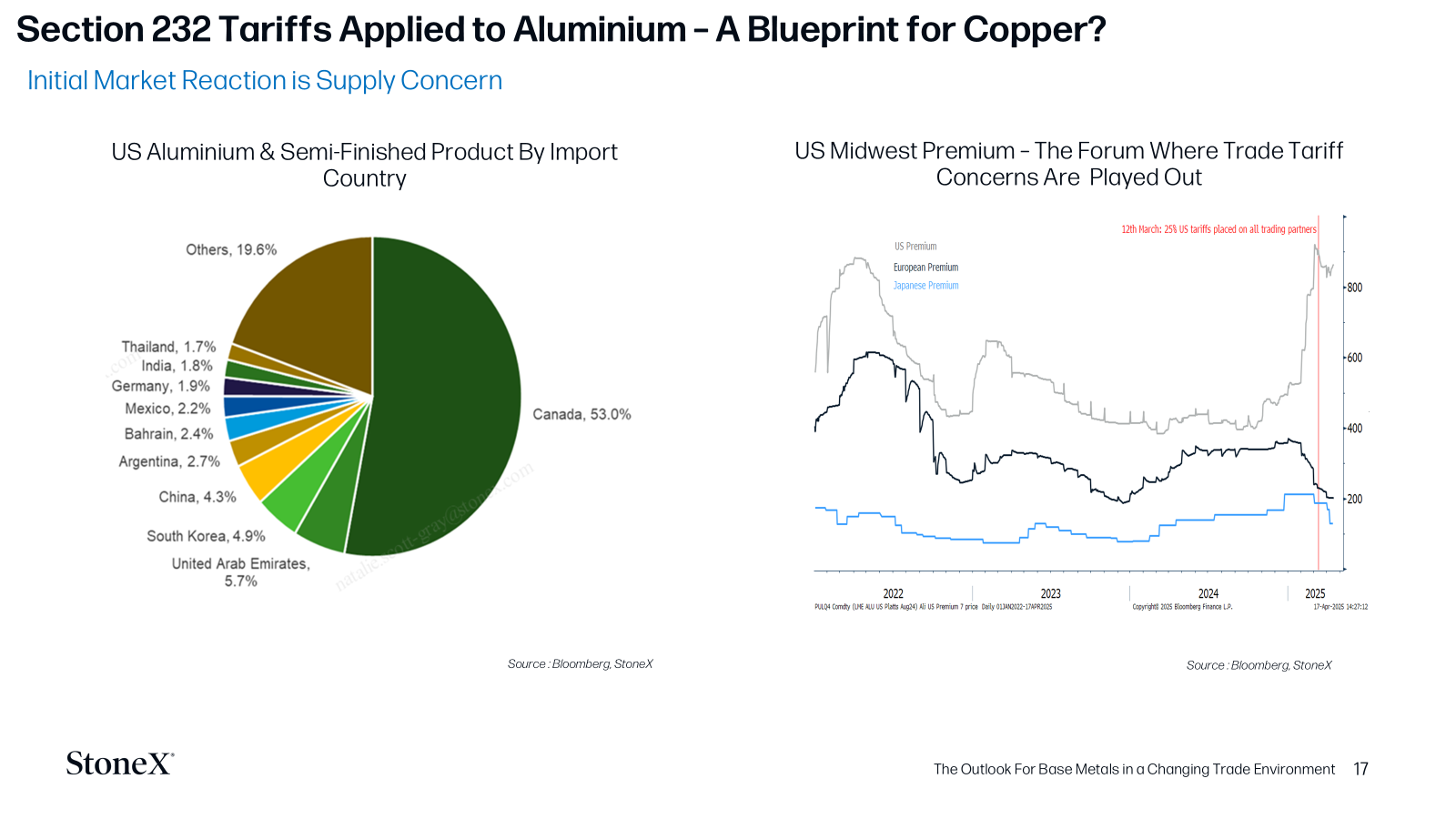
Similarly to the previous tariff period, the initial market reaction was supply concern, with the forum for these risks playing out on the US Midwest premium (which captures the cost of delivered metal on top of the underlying aluminium price).
However, this time around the difference is two-fold…
- The ‘risk’ to supply appears to have elevated given the larger tariff rate and scope of products covered
- Secondly, movements in global aluminium flows have changed.
- The EU premium begun to weaken even before tariffs were implemented, with the market forgoing concerns over fight for units (against a high US premium), instead focusing on the possibility that Canada, the largest importer of aluminium into the US, may divert units into Europe. Given the fact that Europe (since February) no longer accepts Russian units as part of its 16th package of sanctions against Russia, this makes this move lower in the premium even more noticeable.
- Meanwhile, the Japanese aluminium premium also moved usually in this circumstance, with rising trade concerns resulting in China cancelling aluminium tax rebates in December.
Key Takeaway: New trade policy is altering aluminium trade flows in a manner previously unseen.
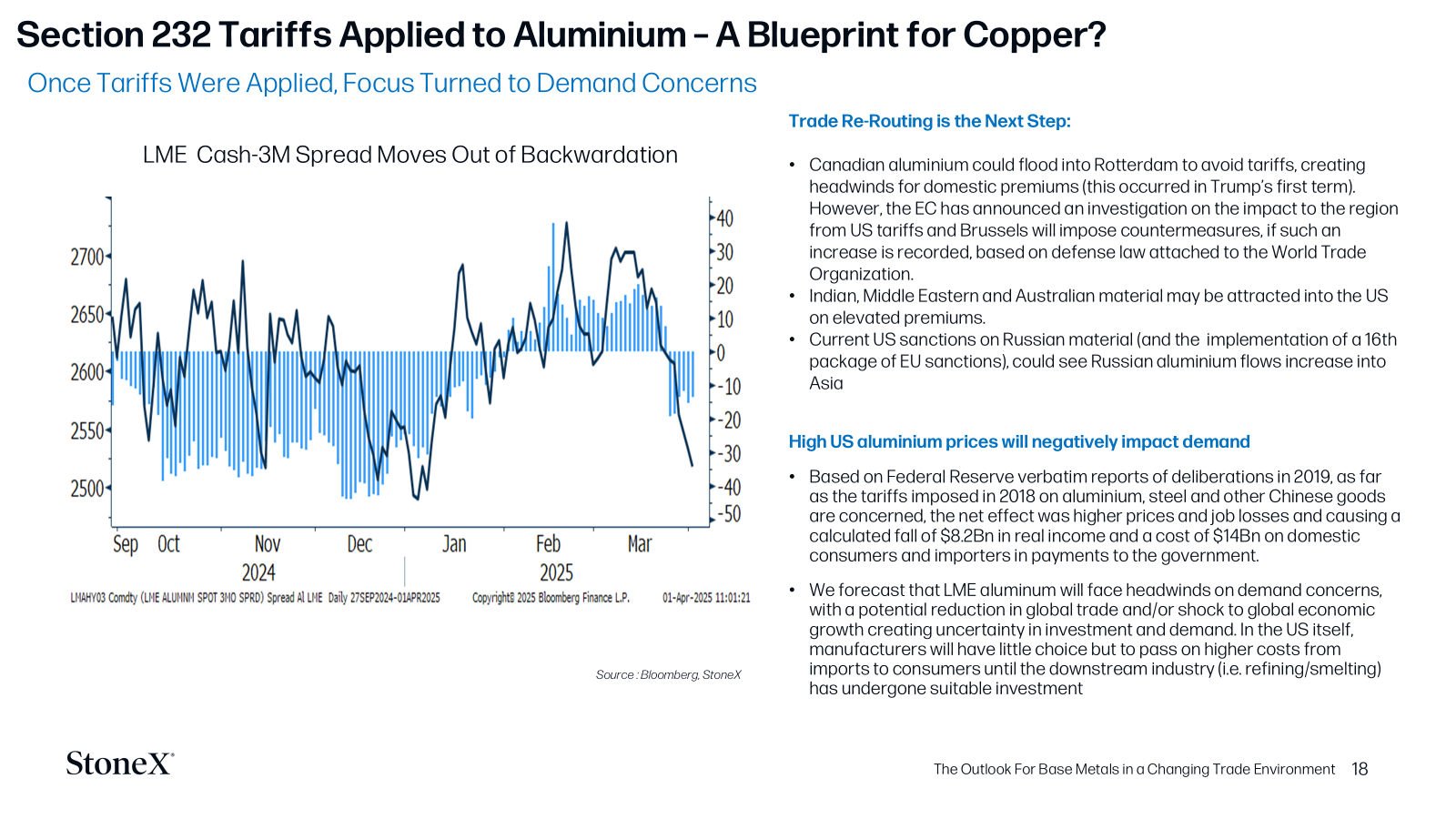
Key takeaway: We forecast that tariffs leave an outlook for aluminium in which we have an increasingly negative demand profile in the US based on high prices, the potential for an oversupplied market in Europe, set against wider trade tariff concerns, likely to constrain global demand.
Case Study: Copper
Looking at what we have seen so far?
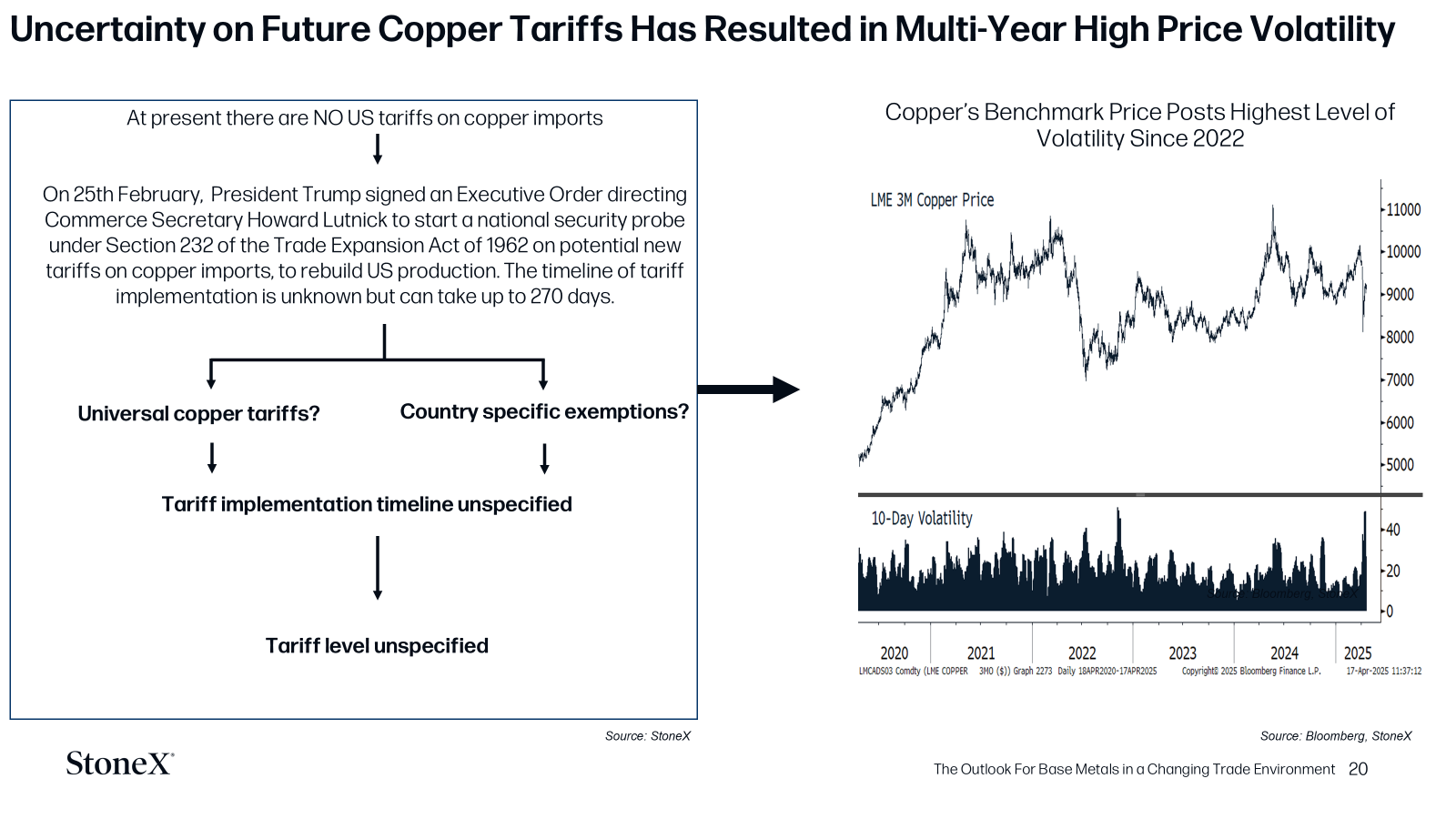
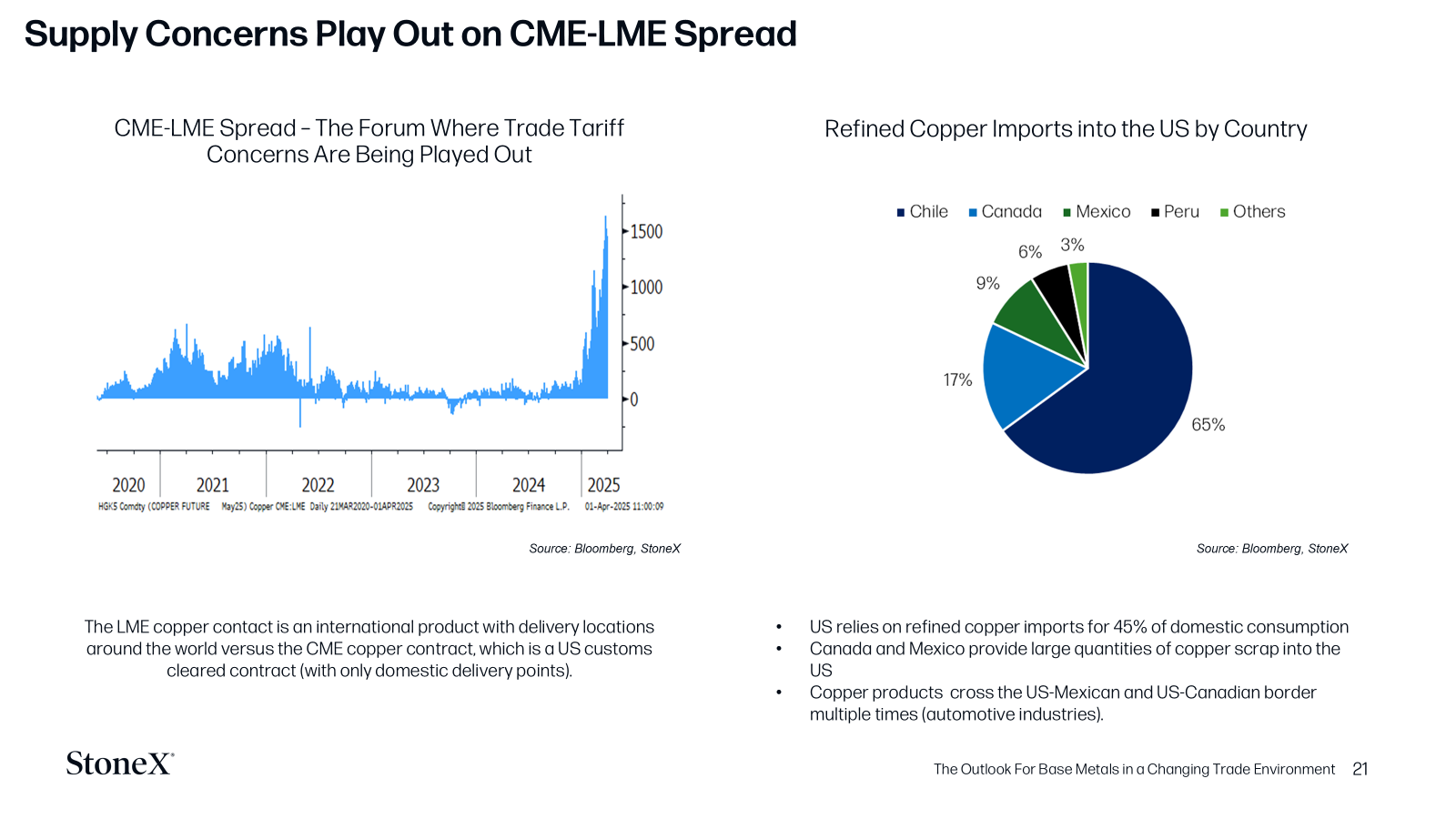
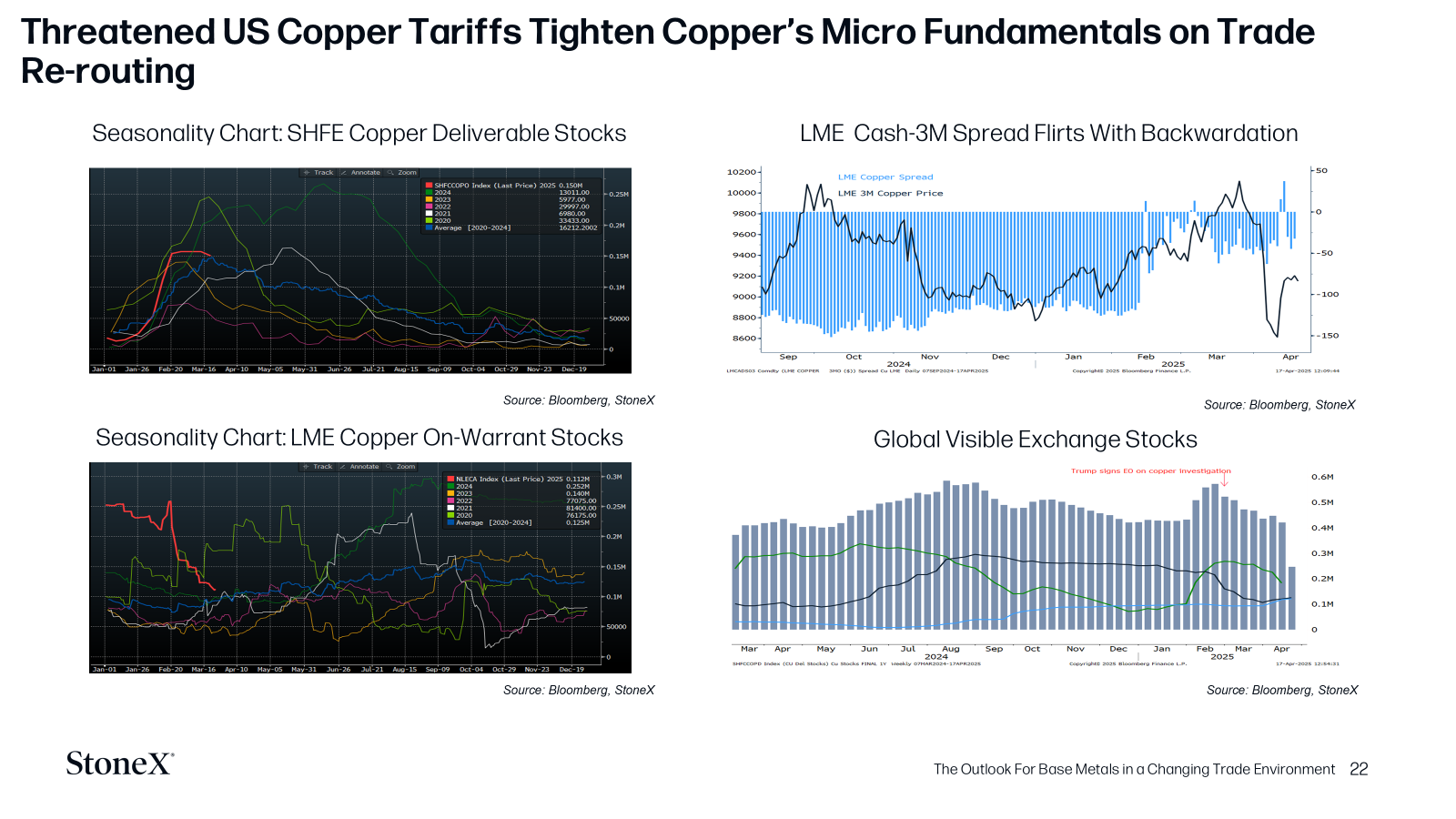
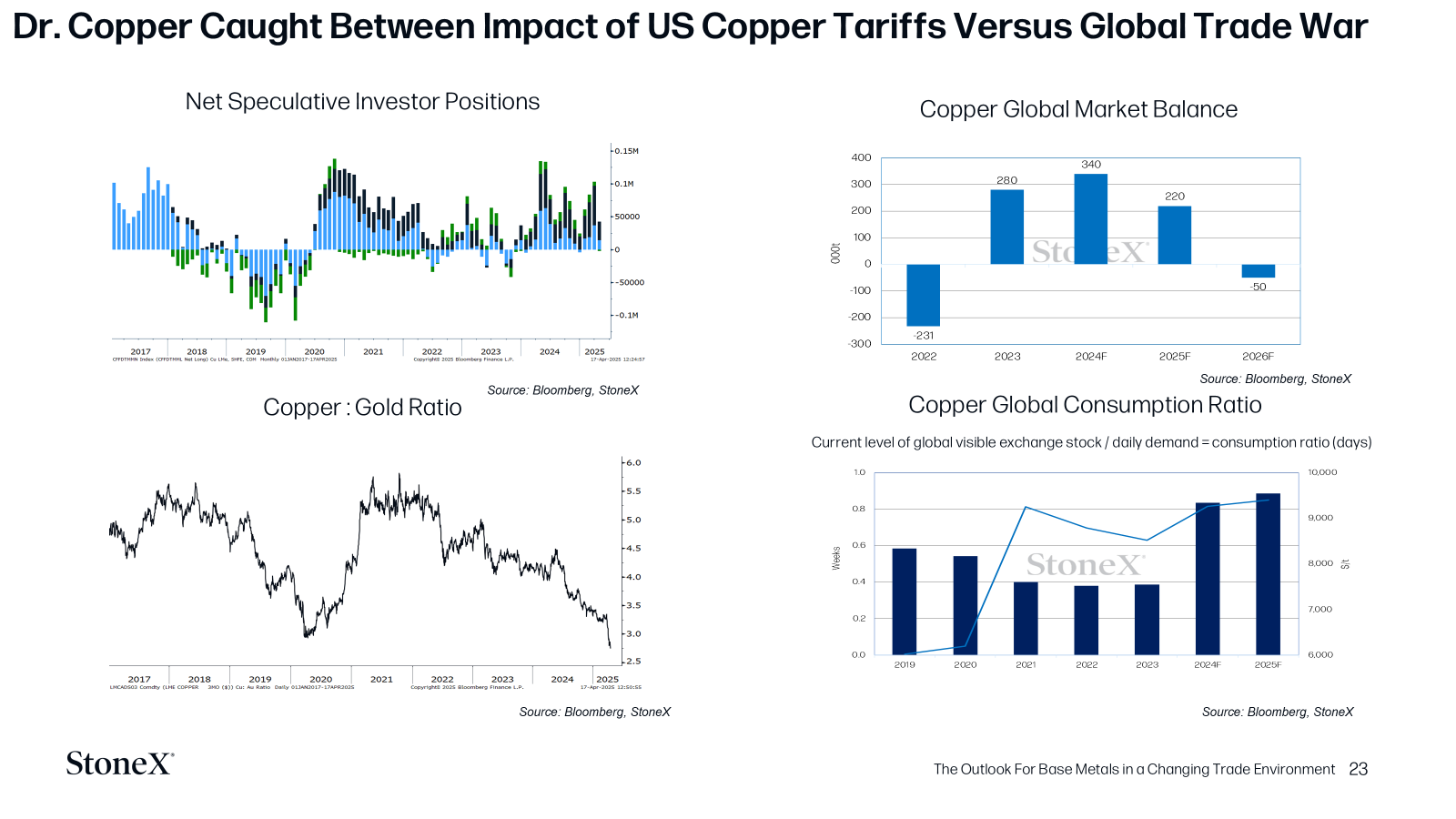
- As with aluminium, the expectation phase for tariffs has resulted in elevated supply risks in the US because of its reliance on imports (at 44% of consumption). We estimate that ~500,000t of copper has been directed towards the US market in recent months, stemming from traditional supply countries as well as markets of last resort (e.g. LME and SHFE).
But where do we go from here?
The copper market appears to be caught between the impact of potential US copper tariffs, which have tightened regional availability of copper, versus the wider macro impact of global tariffs, which are weakening the demand outlook for industrial metals.
In our base case:
Given that the copper market on a global basis is relatively balanced over the next few years, with an improving consumption ratio. We expect that the longer it takes for tariffs to be applied in the US, the higher price support will be maintained in the micro story (given further exaggerated supply tightening ex-US).
Key Takeaway: Given copper’s characteristic as Dr. Copper, this will not be enough to offset, the wider implications of a long-lasting trade war between China and the US.
In Summary