As 2024 Draws to a Close, Supply Disruptions Buoy Base Metal Prices, Offsetting a Clouded Macro Outlook and Reduction in Speculative Long Bets
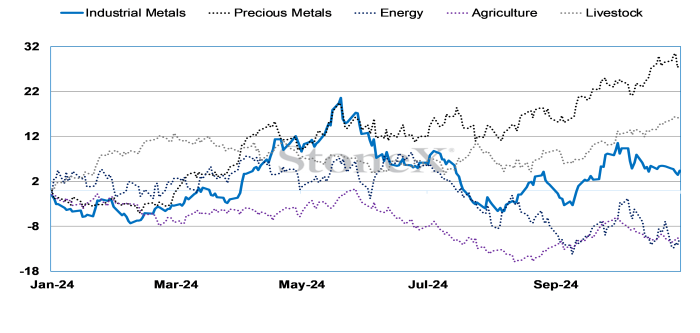
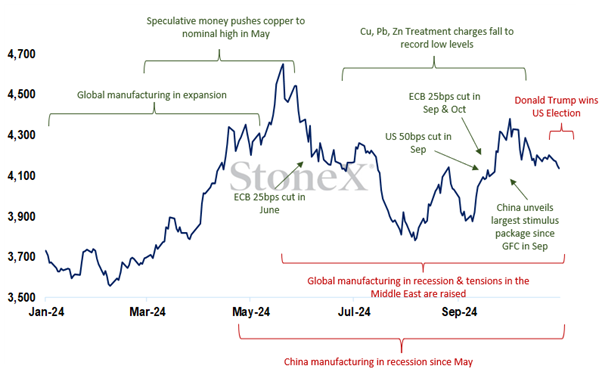
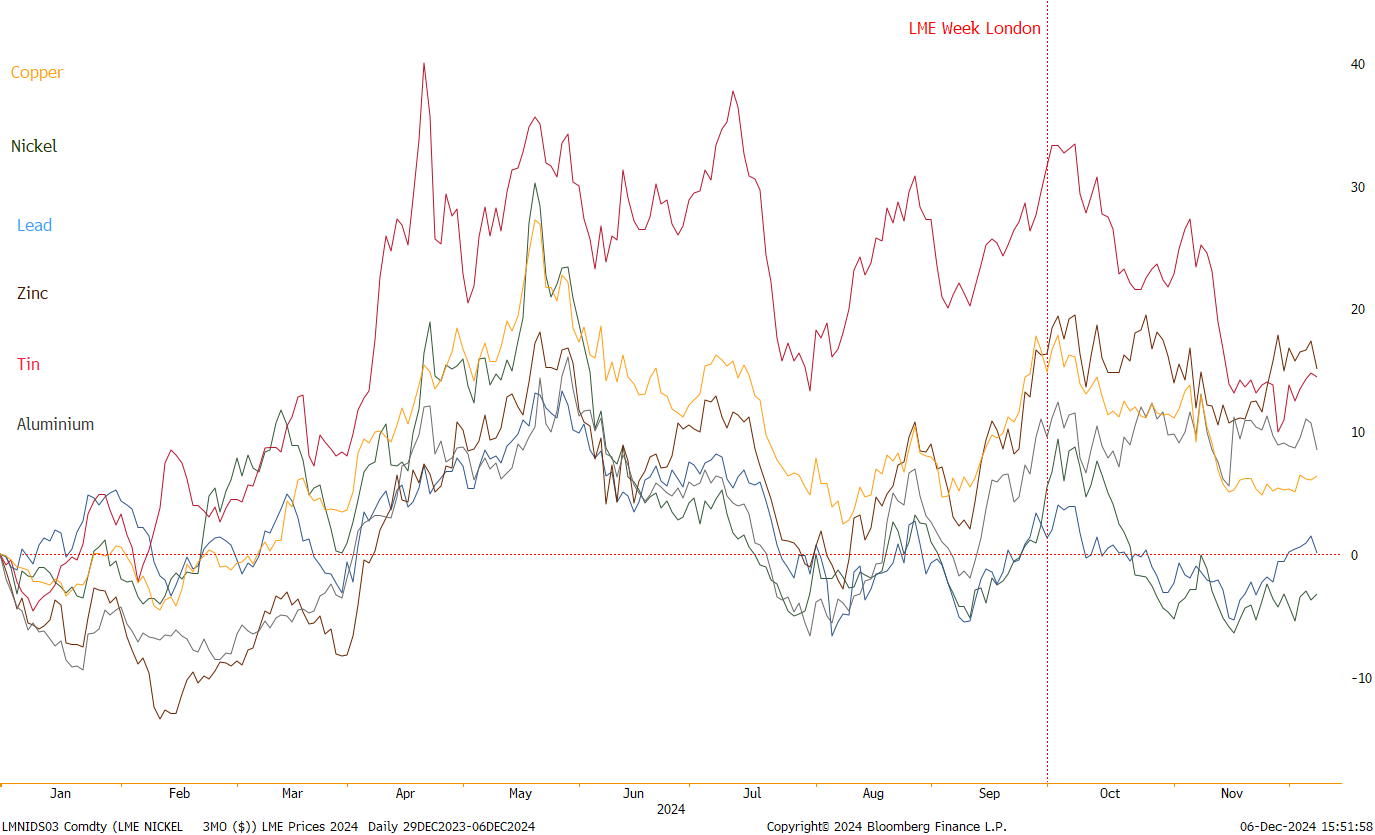
The base metal suite is on track to end the year as the third best performing commodity asset, reversing losses over the prior two years. However, the positive performance in 2024 has arguably been driven by price gains in H1, where investor’s speculative bets buoyed copper to a record nominal high, in tandem dragging up the suite to hold the position as the best performing commodity asset by May. As it stands, H2 2024 has been unfavourable for the suite, with losses of 3% (at the time of writing), with macro headwinds dominating price direction, on a robust US dollar, disappointment over Chinese stimulus and a Trump victory in the US election. While we are of the view that near-term base metal prices will remain at the mercy of these macro headwinds, strengthening fundamental concerns over supply disruptions are providing a lifeline, with supply set to be the area of focus in H1 2025, over demand, in which prospects remain modest. In this article we explore the leading drivers for prices to year-end and the start of 2025.
YTD Price Performance of Bloomberg Commodities By Sector
Source: Bloomberg
LME Base Metal Index Price Journey and Leading Drivers
Source: Bloomberg, StoneX. Positive price driver in green, negative price drivers in green
Price Drivers in 2024 H1 Versus H2 Price Drivers in 2025 Versus 2024
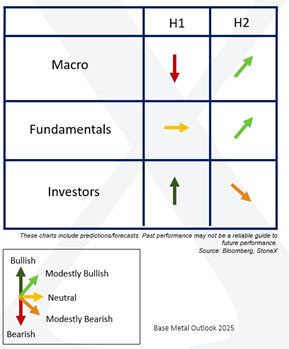
image 1 source
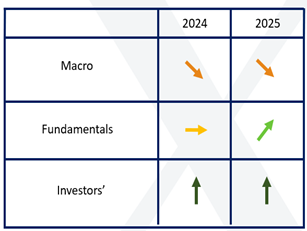
image 2 source
StoneX View to Year-End / Turn of the Year
Macro: Tilting Bearish
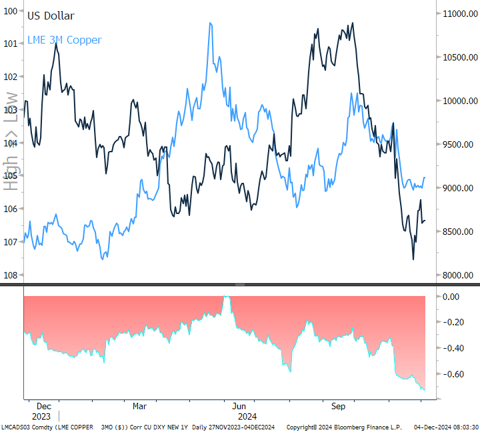
• We forecast that the US dollar will remain at the heart of price direction for the suite to year-end, with the correlation between copper and the US dollar having strengthen significantly following Trump’s victory in the US elections (moving from -0.3 to -0.7 from 4th December). In addition to uncertainty over what a Trump Presidency will bring, there is increasing global political volatility, with enfolding events in South Korea, the collapse of France’s Government, and tit-for-tat trade sanctions between China and the US – all of which are helping to underpin the dollar.
• The outlook for western rate cuts has become more complex, with the market widely expecting that the US Federal Reserve will release a dot plot in December showing a more modest path to cuts in 2025, while the current view for a 25-bps cut in December remains mixed.
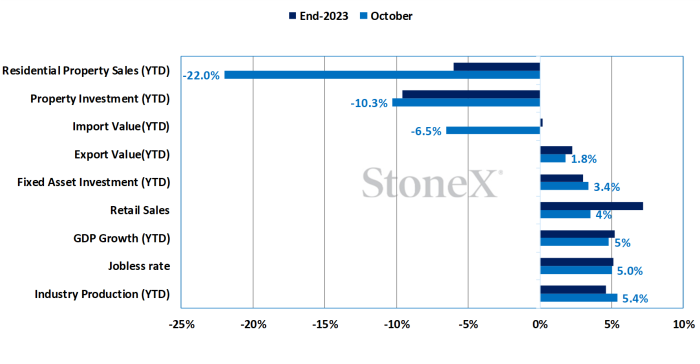
• Meanwhile, it appears as though the market default setting is disappointment when it comes to Chinese stimulus announcements. Considering uneven hard economic data of late, attention will be paid to the upcoming Central Economic Work Conference (CEWC) (which begins on 11th December). Note, the CEWC is an annual two-day closed-door meeting, in which China’s top leaders map out economic targets and stimulus plans for 2025, often seen as a precursor to the Two Sessions meeting in March.
US Dollar Versus LME 3M Copper Correlation
Source: Bloomberg
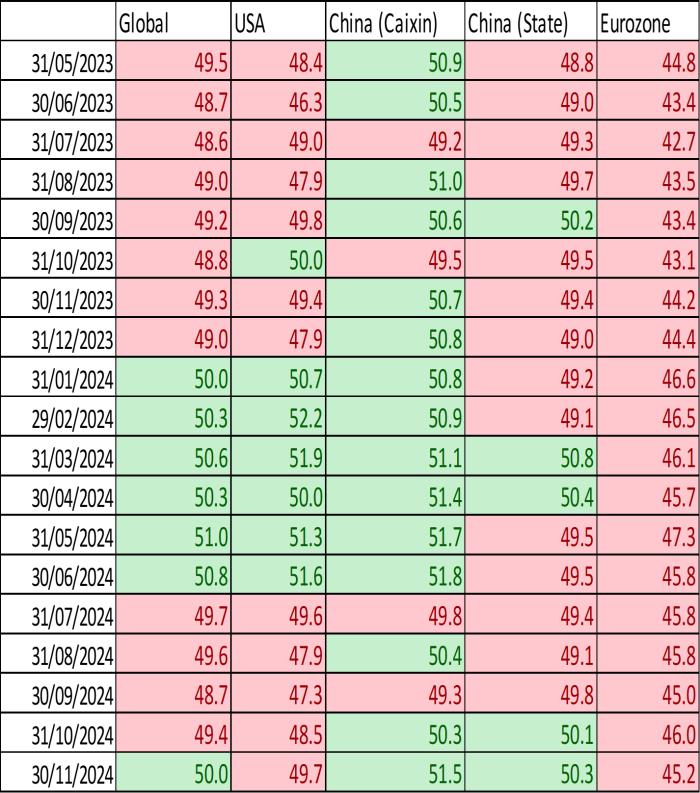
Global PMI Manufacturing
Source: Bloomberg
October Versus End-2023 Hard Economic Data
Source: Bloomberg
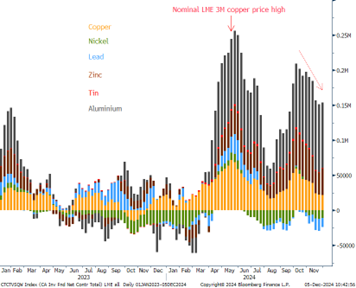
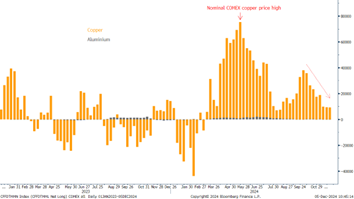
Investors: Speculative Flows - Net Long Positions Have Been Cut Steadily Over Q4
LME Net Positions Combined
Source: Bloomberg
COMEX Net Positions Combined
Source: Bloomberg
Fundamentals
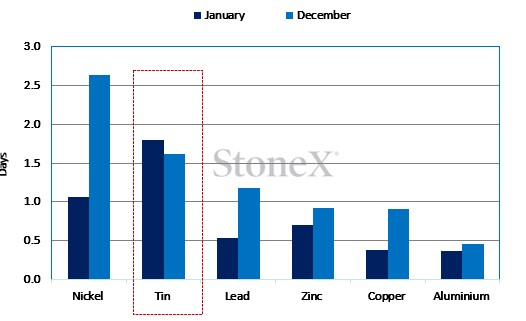
Over the course of the year, base metal raw material output has been under increasing strain, driven by a host of issues from low metal prices, to falling ore grades, social and political unrest and rising natural resource protectionism. However, with a modest demand picture, the level of refined output has maintained at healthy levels.
Modest Demand and Ample Stocks Have Seen the Consumption Ratio Increase Y/Y
Source: Bloomberg
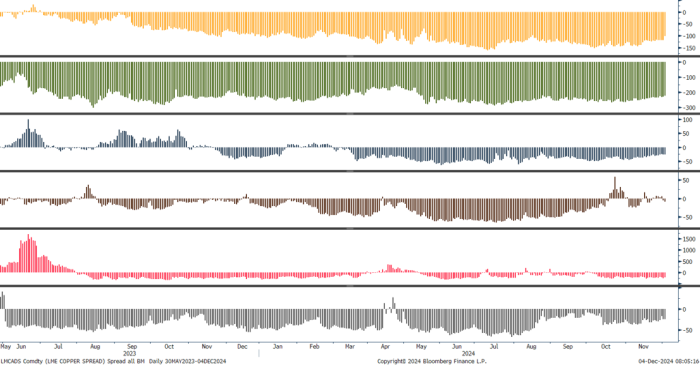
Base Metals Remain in Contango Markets
Source: Bloomberg
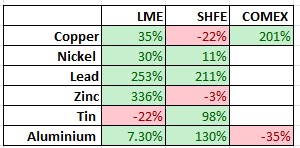
Historical Stock Levels Have Risen Over 2025
Source: Bloomberg
Looking to next year however, the increasing stress on raw material availability will likely have a larger impact on refined supply. Below, we highlight the major risks by metal, ranked from most severe to least severe.
Zinc: Refined Output is Significantly Challenged, With Growing Regional Imbalances
• While the annual zinc benchmark for Treatment Charges (TCs) won’t be decided until March, negative spot TCs are indicating that (similarly to copper), smelter profitability will come under strain next year. Note, 2024’s benchmark was $165/t, down 40% from 2023’s level.
• As it stands, the limited availability of zinc ore in 2024 on the back of three years of contracting mine supply has resulted in zinc being the only base metal to record a decline in Chinese production on a YTD Y/Y basis, down 1.5%.
• Furthermore, while we forecast that zinc refined output will rebound in 2025 (+3.3% from -1.3% in 2024), any disruptions to key mines coming on stream (such as Kipushi in the DRC and Ozerynoe in Russia) will be a focus point. Note, Kipushi is the world’s highest-grade zinc mine, coming online in June 2024. However by October, Ivanhoe announced that forecast production would be halved to 50-70,000t, on the back of operational issues.
Copper: Risks to Refined Output to Remain Elevated in 2025
• The annual benchmark TC between Antofagasta Plc and major copper smelter Jiangxi Copper Co has been set at $21.25/t and 2.125 cents per pound, its lowest level on record and a significant 73% lower than the $80/t set in 2024. The profitability of smelters will be challenged more severally than in 2024. Chinese smelters may opt to cut production or enter into a higher numbers of spot contracts, with forecast accelerating global mine production growth forecast in 2025 (+3.5% from growth of just 1.7% in 2024).
• China's increasing reliance on scrap may face challenges on potential US tariffs, with the US the largest importer to China in 2024 (accounting for ~20% of imports). Chinese copper scrap accounts for ~30% of total Chinese refined output, with China responsible globally for over 50% of refined output.
Aluminium: Risks to Supply Continue to Build on Trade Barriers
• Limited gas supplies in Australia, stranded shipping vessels in Brazil and halted exports of bauxite in Guinea are among some of key driving forces behind alumina’s 140% price jump to a record high in 2024. The knock-on impact of this has resulted in the largest producer ex-China, Rusal to cut production (by 250-500,000t this year), while Chinese smelters in Henan, Guangxi and Sichuan are reported to be extending production curbs in December. Despite refined aluminium within in China on track to post a record year of output (on a YTD Y/Y basis up 5.3%), the impact of sustained high alumina prices will continue to hold a negative impact on production in the near-term. As it stands, SMM forecast that the alumina market will begin to ease in 2025, with expanding capacity focused in India and Indonesia, moving the market into a surplus of 2.7Mt next year and 4.3Mt by 2026.
Tin: Risks to Refined Output in the Hands of Myanmar
• Since August 2023, Myanmar has closed all mining operating at its largest tin mine Man Maw, with 9% of global supply having been removed from our forecast over the period. As a result, we expect that refined tin output will remain below 2023 levels next year, unless the mine is reopened. Chinese stocks which have been used as a cushion have been slowly drained over the course of 2024, with SHFE stocks having fallen by 124% since hitting a peak in May. Meanwhile, LME on-warrant stocks have fallen by 22% over the year.
Nickel: Low Nickel Prices Are Forcing Ex-Indonesian Mines to Close, But Market Set to Remain in a Surplus
- The nickel market is undergoing regional based supply extremes, with mines outside of Indonesia and China being forced to close due negative margins, with LME 3M nickel falling to three-year lows. As a result, close to 400,000t of nickel has been removed from our forecasts. However, with Indonesia (which accounts for 55% of global production) holding the ability to remain profitable at lower nickel prices, refined output in the country remains on track to post another record this year, sustaining the nickel global market in surplus for a third year in 2024.
In Summary
• We forecast that macro drivers will remain central in forecasting future price performance in the near-term, with a bearish leaning tilt as we enter 2025.
• Investors are likely to remain on the sidelines during period of high uncertainty
• Fundamentals are turning more supportive, with a focus on supply constraints in H1, although the longer-term outlook will likely turn to the realities of modest demand, with mine production set to accelerate from weak 2024 levels.
Overall base metal prices are likely to record a heighted period of volatility at the start of 2025, with fundamental supply stories providing arguably the only outright bullish signal in the very near-term.
LME 3M Base Metal Prices
Source: Bloomberg