At the end of February, Brazil's Ministry of Agriculture and Livestock (MAPA) released the monitoring data for the sugarcane crop in the country's North-Northeast until the first half of February/24, a period that is already showing a certain reduction in sugarcane production, in line with the seasonality of the region, which begins its harvesting activities in September and historically ends around April.
With regard to the figures for the current season, the 2023/24 cycle (Sep-Oct) in the NNE shows an accumulated crushing of 52.9 million tonnes up to the first half of February - an increase of 5.3% compared to the same period in the 2022/23 season. With regard to the first half of February, the period registered a processing of 3.11 million tonnes of cane, down 6.6% against 3.35 MMT in the same period of the last crop, which showed an exceptionally long duration.
Two-week sugarcane crushing in the North-Northeast region (million tonnes)
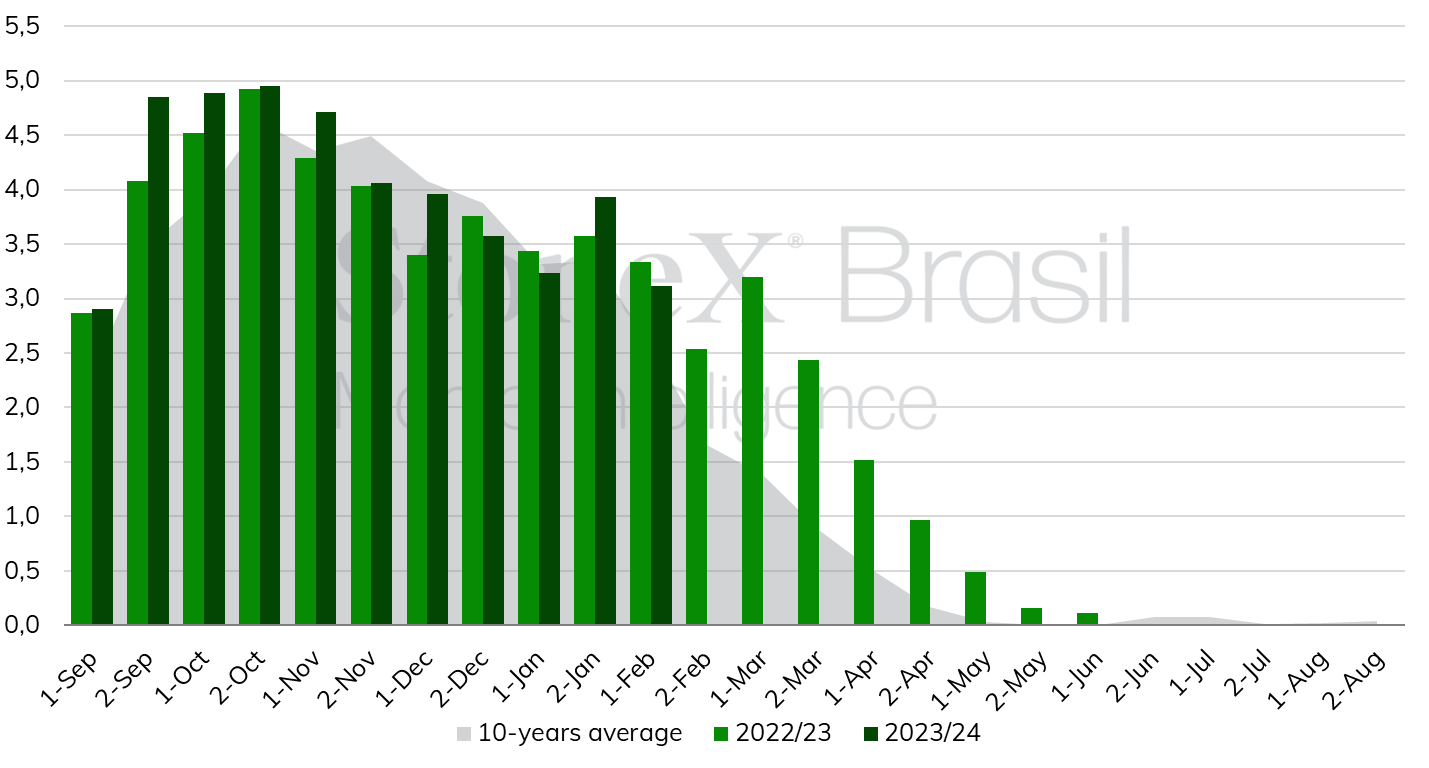
It is worth remembering that the 2022/23 cycle (Sept-Out) in the NNE region ended with processing of 61.54 million tonnes, the highest crushing since the 2011/12 cycle, which recorded processing of 66.05 MMT. The crop in the North-Northeast region, after long years on a production plateau, has shown recovery in recent cycles and so far indicates a better performance than the five-year average. The rains in the region were partly beneficial during the development stage of the 2023/24 cycle, between March and August 2023, despite the expectation that the region will not repeat the crushing recorded in 2022/23.
Considering the weather impact at the beginning of 2024, the increase in rainfall has marked the first two months of the year, which may have had their crushing affected by the interference of precipitation in harvesting activity.
Rainfall in the North-Northeast region, weighted by sugarcane-growing regions (mm)
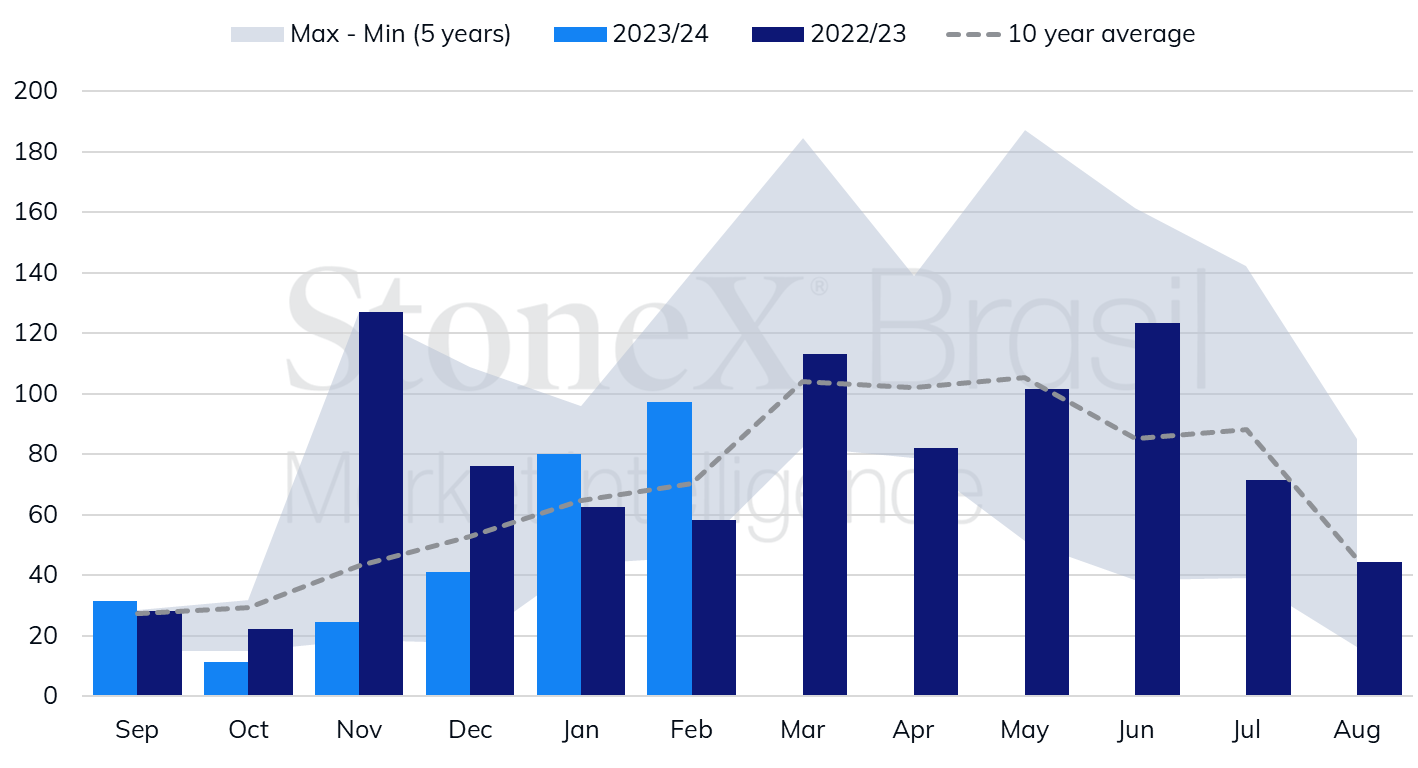
Source: Refinitiv. Design: StoneX.
Despite this, it is worth noting that due to the atypical length of the 2022/23 sugarcane cycle - which in order to reach 61 MMT had a longer harvest, with crushing exceeding 2 MMT by the second half of March/23 - the expectation is that the current cycle will not repeat the same behavior. Even so, due to the higher sugar production mix, estimated at 47.5% this crop, compared to 46.4% in the same period last season, sugar output should remain practically in line with what was seen in 2022/23. So far, considering the period from September/23 to the first half of February/24, sugar production in the region is 13.8% above the annual comparison, at 3.08 million tonnes.
Sugar production in the North-Northeast (million tonnes)
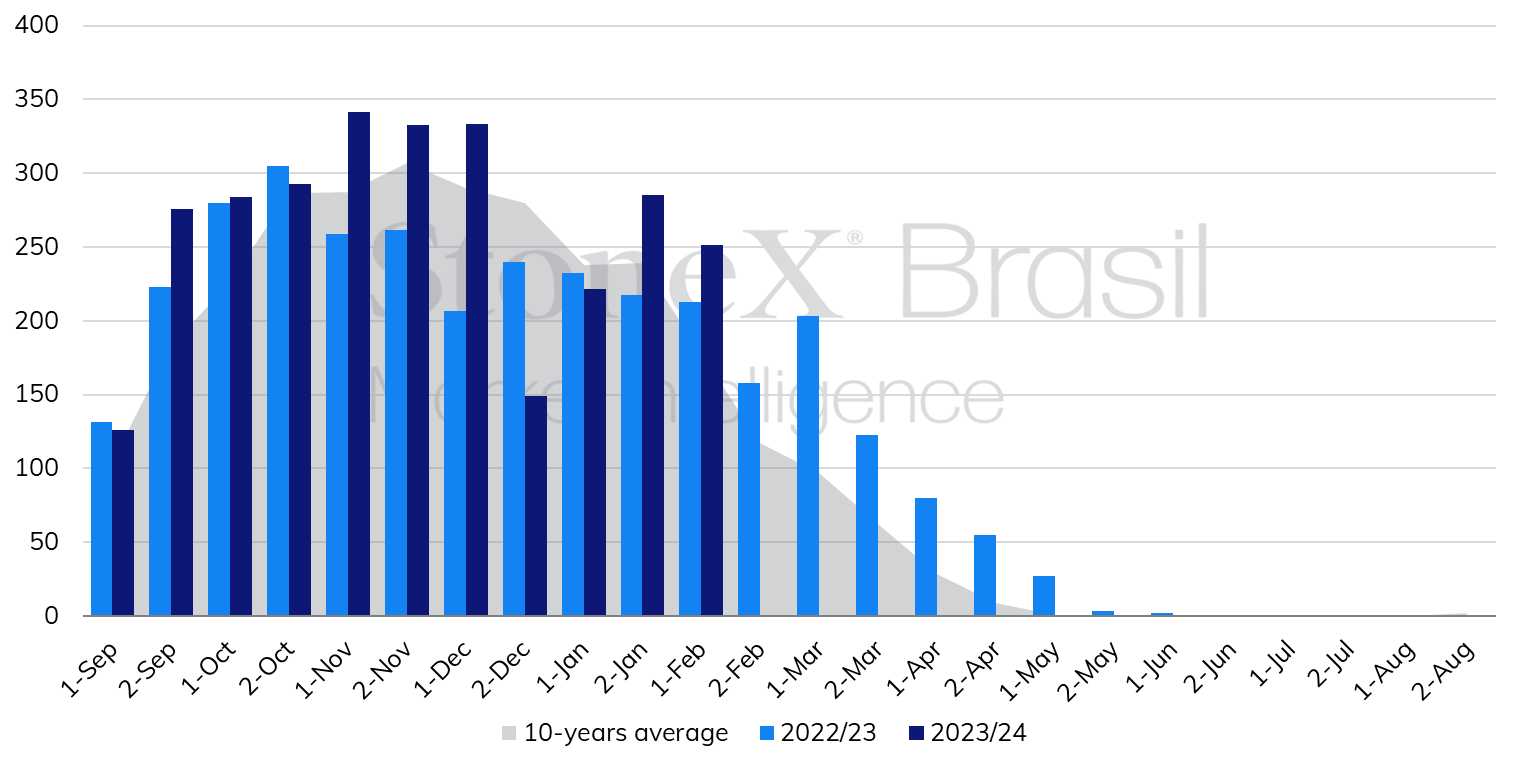

Source: MAPA. Design: StoneX.
Given this scenario, it will be up to the final tail of the 2023/24 cycle to define how the region will perform. If the above-average rainfall persists, and the crop does in fact behave more in line with the region's history, the expectation is for a smaller crush with sugar production very close to that seen in 2022/23, around 3.3 million tonnes.
Daily recap
On Thursday, the prices of raw and white sugar had a day of decline, ending at US¢ 21.28/lb (-0.79%) and US$604.1/t (-1.13%) for the most active raw and white contracts respectively. The bullish sentiment, which spread at the beginning of the week due to speculation of a smaller crop in the Brazilian Center-South - due to drier weather - seems to have cooled down on Thursday. In this context, it is worth mentioning that the result of Brazilian sugar exports continues to surprise the market, indicating growth of 163% in February/24 compared to the same period in 2023. The result reflects the strong availability of sugar stocks in the Brazilian Center-South, which stood at 8.7 MMT until the first half of February, 47% above the annual base.