The Southeast Asian region, where the world's second largest sugar producer India is located, is characterized by the monsoon regime, a rainy season that concentrates around 70% of the country's annual rainfall between the months of June and September. This phenomenon is crucial for the development of the country's agricultural crops and is influenced by the oscillation between the El Niño and La Niña phenomena. Considering the country's history, El Niño is traditionally related to a drier monsoon season, while La Niña tends to be related to a wetter monsoon season.
In 2023, a year impacted by the occurrence of a strong El Niño, rainfall during the Indian monsoon season was 14% below the long-term average for the period in the main producing states, causing water stress and reduced productivity for the country's cane fields, particularly in the southern states of Maharashtra and Karnataka.
Monthly rainfall in India's three main sugarcane-growing states*
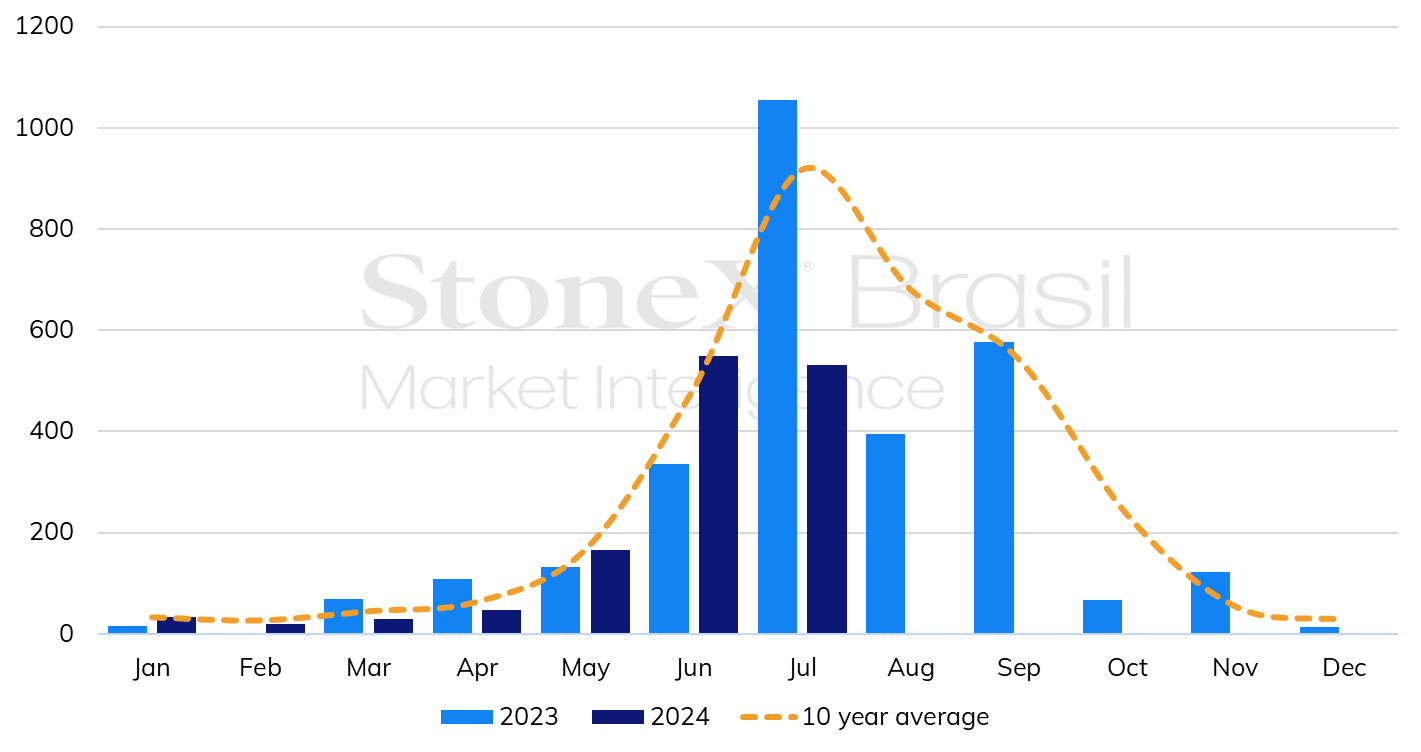
 *Maharashtra, Karnataka, Uttar Pradesh, until July 16, 2024. Source: Refinitiv. Design: StoneX.
As a result, the country's sugar production fell by 3% during the 2023/24 cycle, a scenario that led to changes in both the country's sugar export policy and ethanol distillation. In contrast, 2024 should be marked by a transition from El Niño to La Niña, a weather event that is associated with an improvement in rainfall levels. According to the latest data from the US weather agency NOAA, the probability of a La Niña phenomenon occurring between July and September is 48%, with a slight negative deviation in the Pacific Ocean surface temperature estimated until the end of 2024, a scenario that suggests a mild La Niña.
Forecast deviation in Pacific Ocean temperature (Cº)*
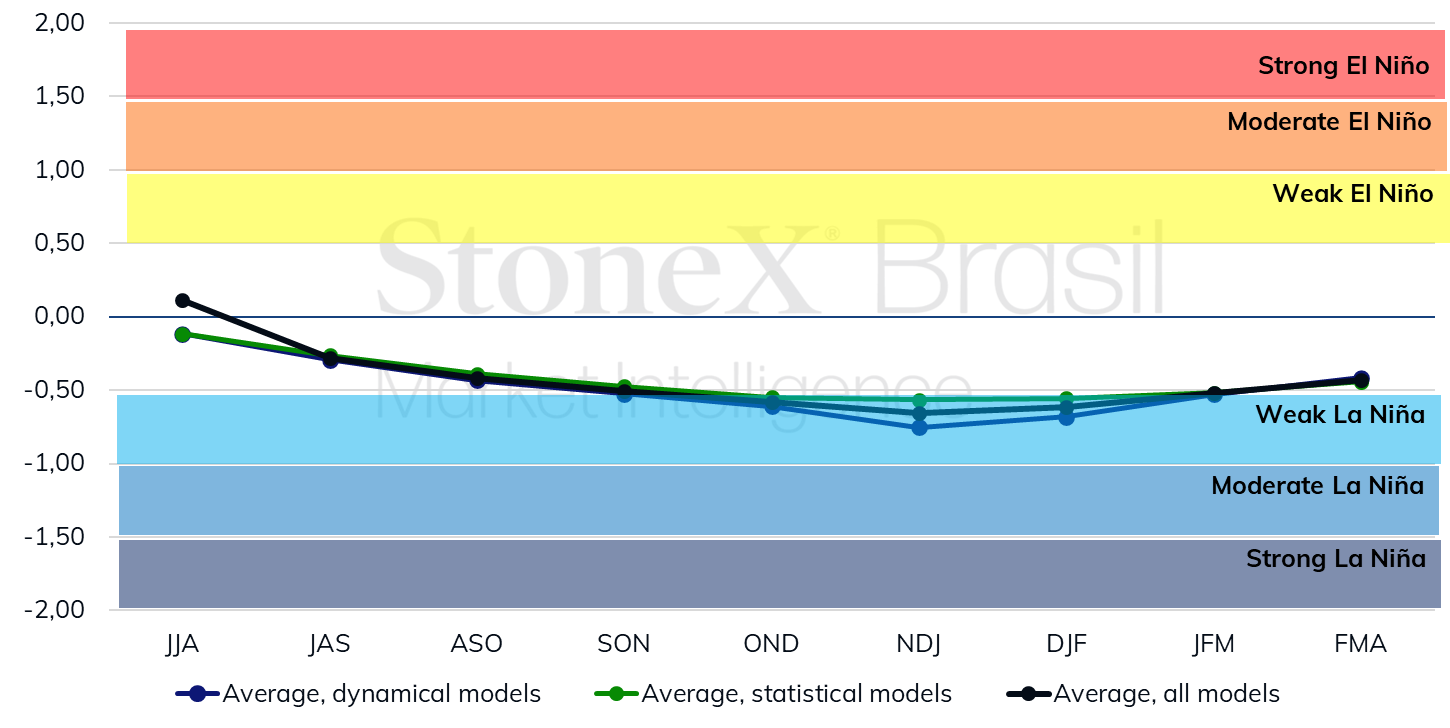 *By moving quarters, JJA = June, July, August. Source: NOAA. Design: StoneX.
Given the changed context of weather phenomena, the rainfall pattern is expected to normalize during the 2024 monsoon season, a scenario that has already occurred in India's main sugarcane-growing districts and, in turn, has had a bearish effect on sugar prices on the international market. Since the start of the current monsoon season, most of India's sugarcane districts have been reporting rainfall close to or above normal, a scenario that should allow for better development conditions for the 2024/25 season (Oct-Sept).
Deviation from normal monsoon rainfall by district (%)
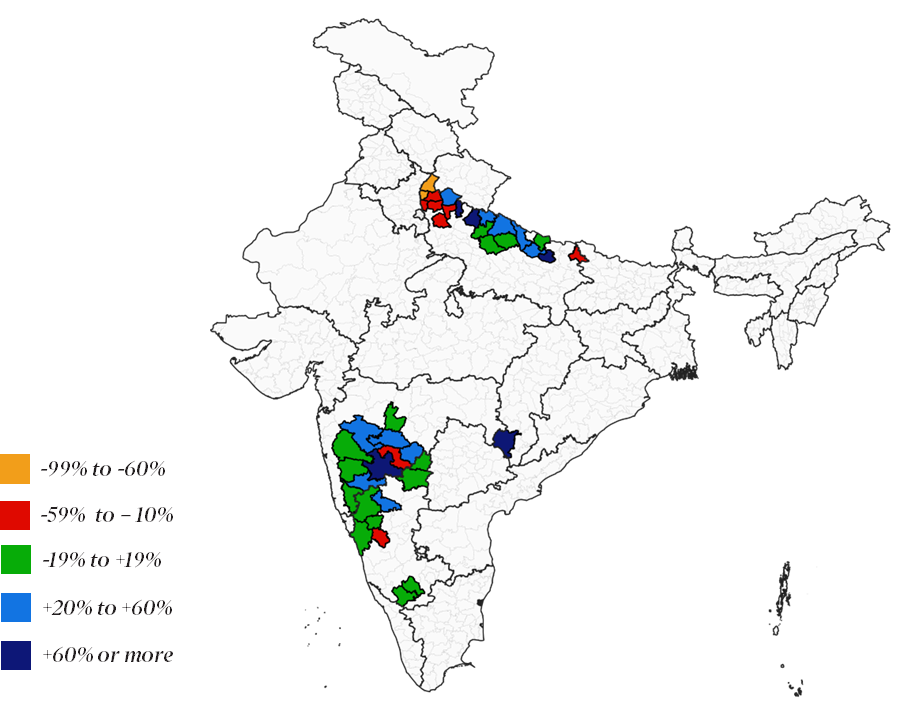 * Until July 15th. Source: GADAS. Design: StoneX.
Despite this, expectations for Indian sugar production in 2024/25 (Oct-Sept) remain limited. Irregular and dry weather during 2023, the planting period for most of the Indian cane fields that will be harvested during the 2024/25 crop, is expected to keep production limited. In addition, the country's ethanol blending policy is likely to act as an adjustment variable, and could direct any surplus production from the country's cane fields towards the biofuel, preventing large increases in sugar production.
Given this situation, even with the expectation of improved weather, StoneX's forecast is for a reduction in production of the Indian crop in 2024/25 (Oct-Sept), estimated at 28.8 million tonnes (white value), compared to 31.8 million tonnes in the previous season.
Summary of estimates for India
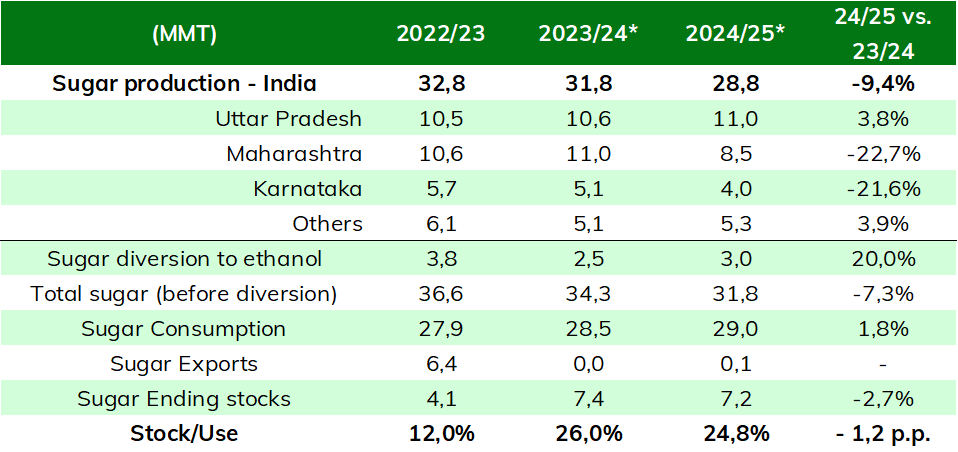 Sources: StoneX, ISMA and others.
Daily recap
On Wednesday (17), the prices of raw and white sugar recorded a day of declines on the futures market. For raw #11 (SBV4), prices fell by 1.33%, ending the day at US¢19.36/lb. For white #5 (SWV4), prices ended the day at US$ 555.70/t (-0.75%). Influencing prices is the prospect of a surplus in the global sugar crop in 2023/24, mainly as a result of Brazil's high production. The advance of the monsoon rains, so far in line with normality, also acts as a bearish factor on prices.