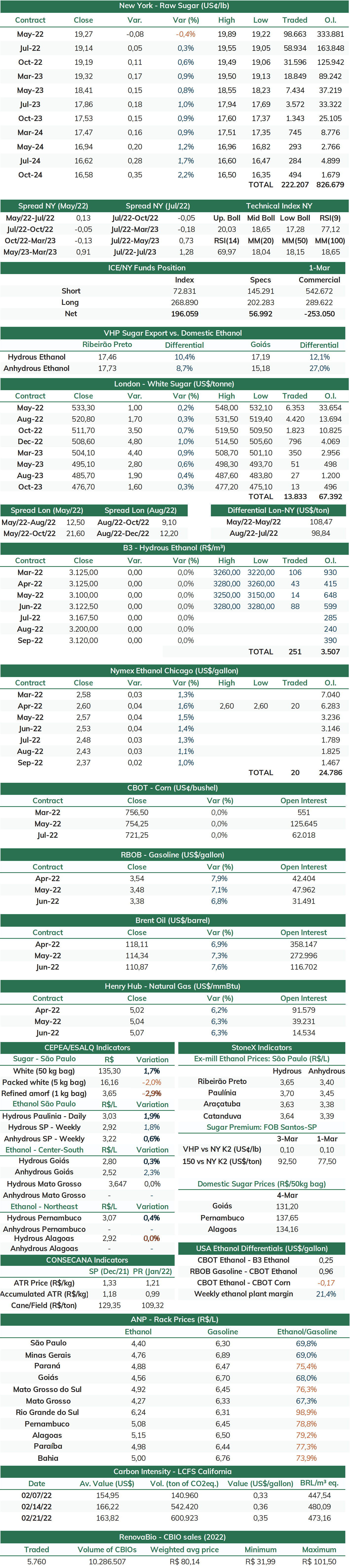
On Tuesday (8), oil prices followed an upward trend, sustained by the prospect that new economic sanctions imposed by the United States and Europe against Russia also involve the energy sector. Threats from the US administration took shape when President Biden unilaterally announced the suspension of imports of oil and derivatives from Russia as a new measure to contain the invasion of Ukraine.
In response, the Russian government advocated suspending the supply of natural gas to European countries, which increases the risk of an energy crisis on the continent. As a result, Brent futures found support in these tensions, in fact breaking the resistance of USD 130/barrel.
This situation brings risks to the Brazilian fuel market, with a focus on the difference between domestic and international prices, a trend that may be intensified depending on the dollar’s movement in a year of presidential elections in Brazil. According to StoneX calculations, the price of gasoline at refineries would need to be increased by BRL 1.2378/liter to be comparable with that of the international market.
The losses continue to be absorbed by distributors, with the complications in fuel imports raising doubt about internal supply. Still, discussions about Petrobras’ pricing policy are open, although less frequent reviews by the company already result in correlation loss between domestic and international prices.
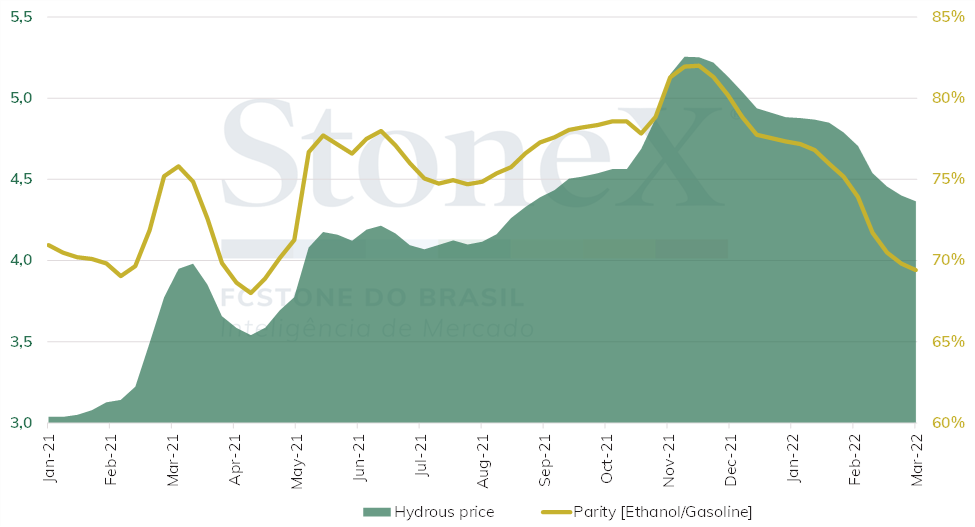
In practical terms, what could be the impact of this situation on the energy market? In the case of ethanol, a possible positive readjustment in the price of gasoline at refineries would act as a bullish factor, since the trading level would fluctuate seeking parity at the pumps and in order to gain attractiveness in relation to sugar. Amid recent oil gains and the recovery of sugarcane productivity in the Center-South region, it seems likely that hydrous will take on a greater role in Otto cycle fuel consumption in 2022.
On Tuesday, for example, the #11 May/22 contract found support at the end of the ICE/NY session, closing with a daily increase of 0.8% at 19.43 c/lb. In parallel, ex-mill hydrous based in Ribeirão Preto was traded at BRL 3.75/liter, equivalent to 18.02 c/lb.
In light of recent facts, it is interesting to evaluate how a possible review of domestic fuel prices could interfere with Central-South plants’ decision of the productive mix. Taking into account the current price difference, and assuming that a readjustment of BRL 0.80/liter on the price of gasoline would be fully passed on to the pumps, ethanol would have room to rise by BRL 0.55/liter, keeping parity with gasoline at 69.4% at São Paulo stations.
Fuel at São Paulo stations (BRL/liter)
Source: ANP. Design: StoneX.
If prices at mills also rose, hydrous would have margin to be traded at BRL 4.30/liter (based in Ribeirão Preto/SP), causing it to operate with a 5.9% premium on the front-month sugar #11 contract. However, it seems unlikely that a readjustment of this proportion will be effective, especially during a year of elections, which has already been marked by final consumers decapitalization.
In addition, this situation would not tend to have a significant impact on the mills’ production mix decision, since much of the 2022/23 crop (Apr-Mar) sugar production has already been fixated. So far, more than 76% of the expected supply has been contracted for export on the ICE/NY, compared to 70% in the same period of the previous cycle. In order for there to be a mix reversal, ethanol prices would need to rally sharply, precisely to offset the costs involved in the operation.
In terms of sugar market fundamentals, it should be noted that the 2021/22 cycle (Oct-Sept) is expected to have a deficit S&D balance, which reinforces the need to direct the Brazilian product abroad, even though the good performance of India’s crop lends some relief to this context (full analysis
here).
In any case, given the volatility observed in the last few sessions, these points will continue to be analyzed closely in the coming days. On Wednesday (9), StoneX’s Market Intelligence team will release the updated crop estimates for the Brazilian Center-South, as well as for the global sugar balance, which will help to shape the prospects for the sector more precisely.