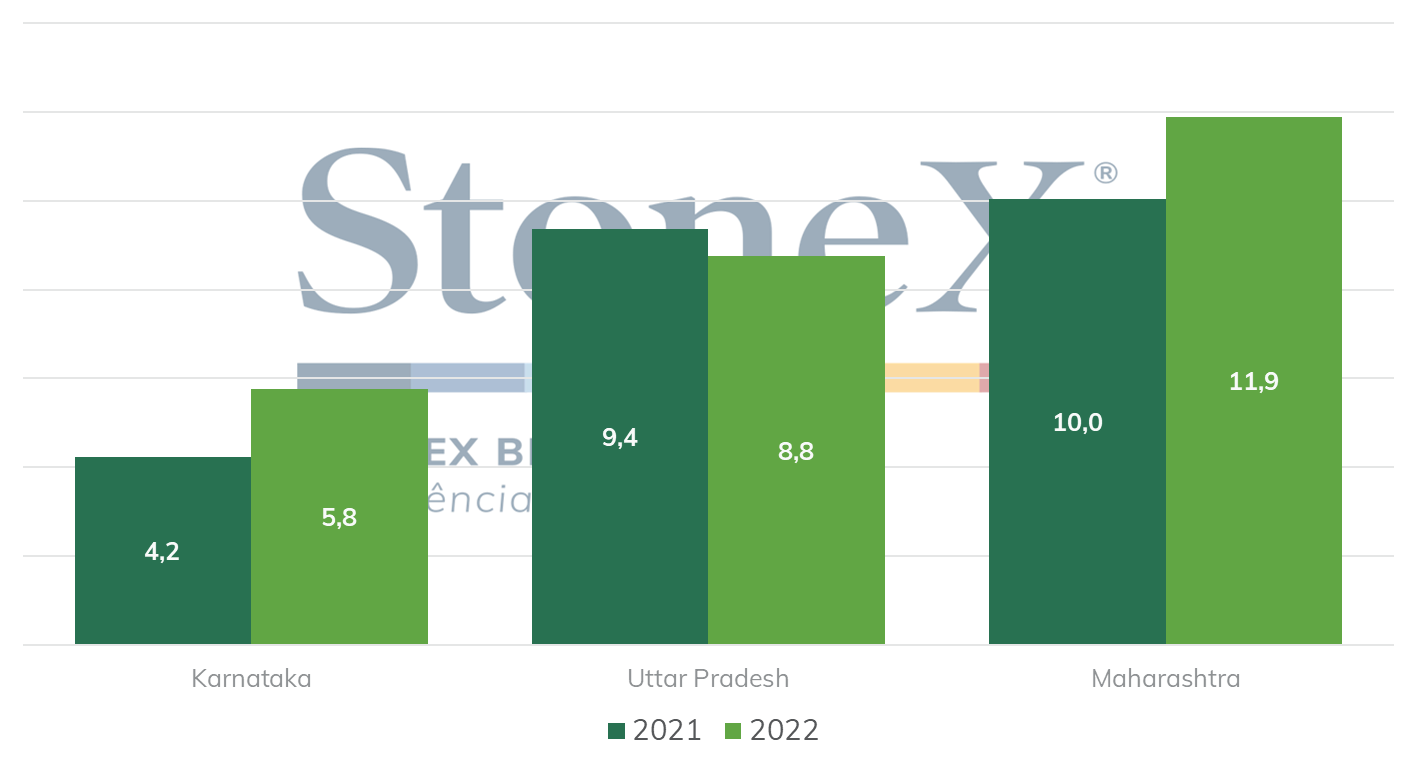
Source: ISMA. Design: StoneX.
With regard to sugar production in the next cycle, which starts in October 2022, perspectives point to an annual growth of 20%, which would result in a scenario of greater comfort for the sugar-alcohol sector, considering a normal monsoon rainfall regime. If that is the case, StoneX contacts in the country indicate that India has the potential to export between 5.0 and 6.0 million tonnes in 2022/23.
According to the India Meteorology Institute (IMD), during March, the states of Uttar Pradesh and Maharashtra recorded well-below average rainfall, with deficits of 78% and 99%, respectively, while Karnataka received 34% more rains than normal. According to StoneX’s monitoring, mild rains are expected for the country over the next 14 days, with an expected volume between 0 and 20 mm. In Uttar Pradesh, however, no further precipitations are expected during this period.
In terms of exports, according to the ISMA, about 7.2 million tonnes have already been contracted for the current cycle, and approximately 5.7 million have already left the country. Given the recent performance, it seems likely that the country has the potential to export 8.5 million tonnes in the current season. However, it is worth noting that the Indian government has recently assessed the possibility of limiting sugar exports in the 2021/22 cycle.
As pointed out in the
previous analysis , our estimates are that India’s productive potential will be close to 33.2 million tonnes of sugar, which would provide room for sugar exports to remain strong. StoneX contacts in the country indicate that the Indian government would be in a comfortable position if up to 9.0 million tonnes were exported in the current cycle.
Still, the recent regrowth of Covid-19 cases in China and the adoption of new measures of social isolation in the country have caused concern for demand. On Monday (4), the moving average of new daily cases reached the historical high, surpassing the 11,000 infections mark. In Shanghai, for example, the Chinese government extended the lockdown measures to all of its 25 million inhabitants. It is clear that in this scenario there is increasing uncertainty about the production chains, which adds to the potential decline in consumption and barriers to international trade.
Also in India, with regard to ethanol production, by March 27, supply reached 4.2 million m³. As long mentioned, India has been a highlight when it comes to developing ethanol production infrastructure, as New Delhi aims to reach E20 by 2025. By the end of March, the average blend rate was 9.6%.
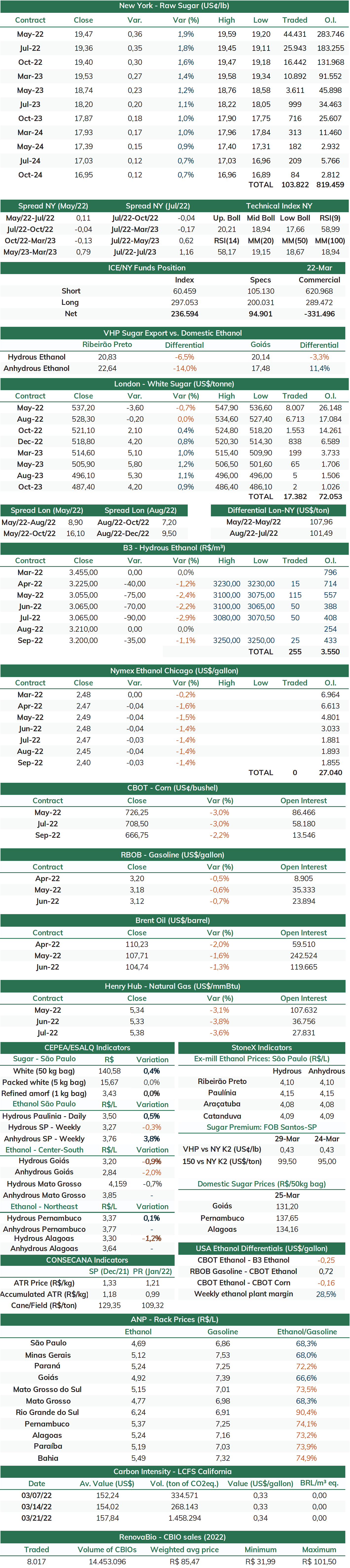
Finally, on Tuesday, the sugar #11 H2 contract closed the ICE/NY session quoted at 19.65 c/lb, accumulating a 0.2% rise from the previous day’s close, following Brent oil’s appreciation. However, in the opposite direction, as pointed out earlier, the positive outlook for the Indian crop as well as for the Thai crop limited the gains in the session.