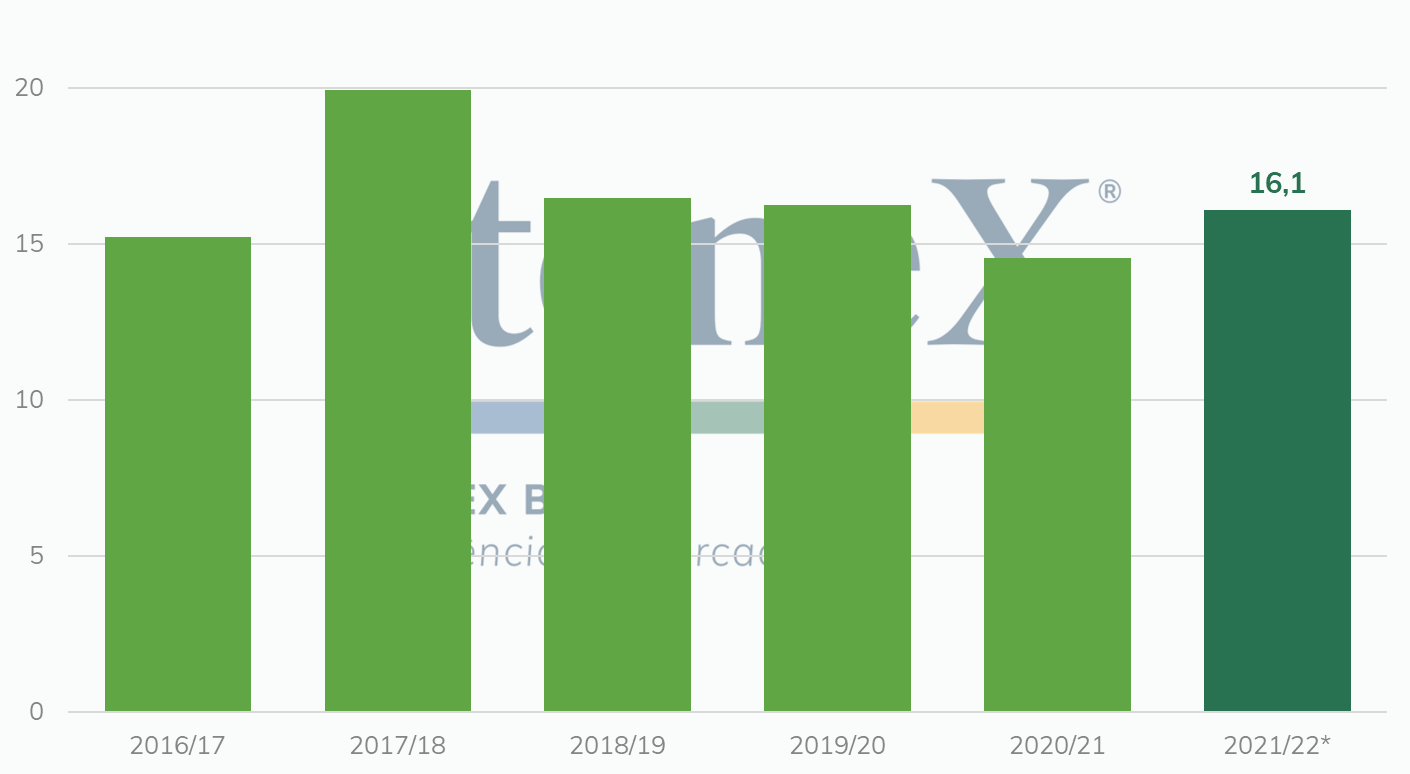
*Estimated. Source: European Commission. Design: StoneX.
In any case, 2022/23 (Oct-Sept) planting, which began in mid-March this year, has benefited from the weather, although some regions in France received below-normal temperatures in early March, which may affect sowing. A positive piece of news for French producers is the new legislation allowing the use of neonicotinoids, following measures adopted in the United Kingdom, although not in Germany. In general, pests that can affect planting usually spread when temperatures are above normal in the period of root development. At the moment, there are no weather forecasts pointing to this scenario, but there is always risk for producers, who seek to manage their crops more efficiently and be able to use the pesticide, even if with restrictions, which may reduce chances of failures like in 2020/21.
For the European sugar market, production in 2022/23 should not have an annual increase, and stocks will continue a slow pace of recovery after the sharp decline of two years ago. In this scenario, increases in sugar production should not be seen in Europe, unlike in India, Thailand and Brazil, for example. On the European continent, therefore, the bullish sentiment for prices may linger, such as it was in the 2021/22 cycle, due to the region’s own supply and demand fundamentals, but also to the production cost throughout the commodity’s chain.
Beet and other crops’ planting is already taking place under very high fertilizer prices, which is something that impacts producer prices. Another important point related to costs is sugar processing, which faced a rise in fuel prices. In Europe, many factories rely on natural gas as a source of energy, whose prices accelerated in 2021 and are at the highest levels in history. Therefore, in the current cycle, sugar production from beet was more expensive, a fact that may be repeated in 2022.
The prospects for the natural gas market depend directly on the results of the war between Ukraine and Russia, the main supplier of the product to the European market. Although there are no direct sanctions on Russian gas, importers are currently promoting a policy of “self-sanction,” in order to reduce purchases due to it damaging their image or fear of possible punishments by Western countries. As such, the war in Eastern Europe should keep energy prices sustained, even with the end of the European winter, a time of seasonally high stocks and falling prices on the continent. If the conflict is resolved and Russia maintains export levels to Europe, the trend is lower prices in the medium term until seasonal demand returns at the end of the year. Therefore, depending on the scenario, fuel costs for sugar beet processing will become more or less expensive, as they are already at historically high levels.