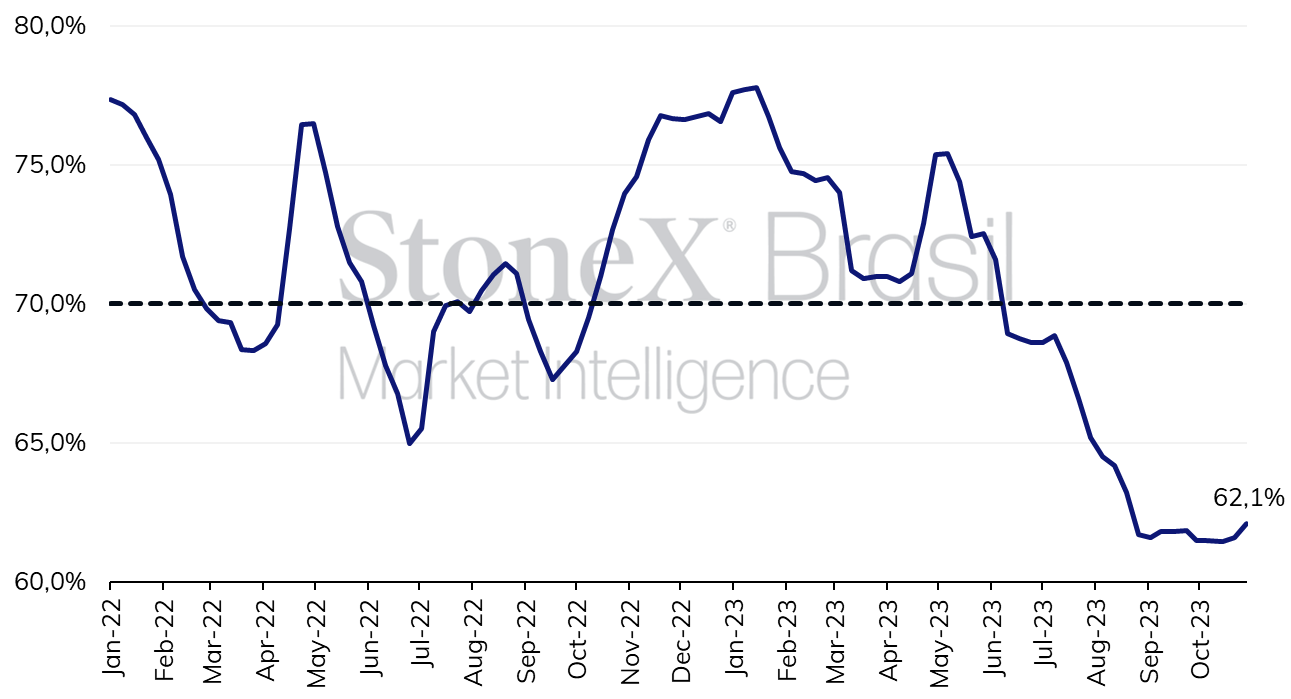
Last week, following Petrobras' negative adjustment of BRL 0.12/liter in the price of gasoline A sold to distributors, regular gasoline at service stations in the state of São Paulo fell BRL 0.04/liter, trading on average at BRL 5.57/liter and, on the other hand, hydrous ethanol remained stable at BRL 3.45/liter, resulting in a subtle increase in parity from 61.6% to 62.1%.
Parity between hydrous ethanol and gasoline in the state of São Paulo (%)
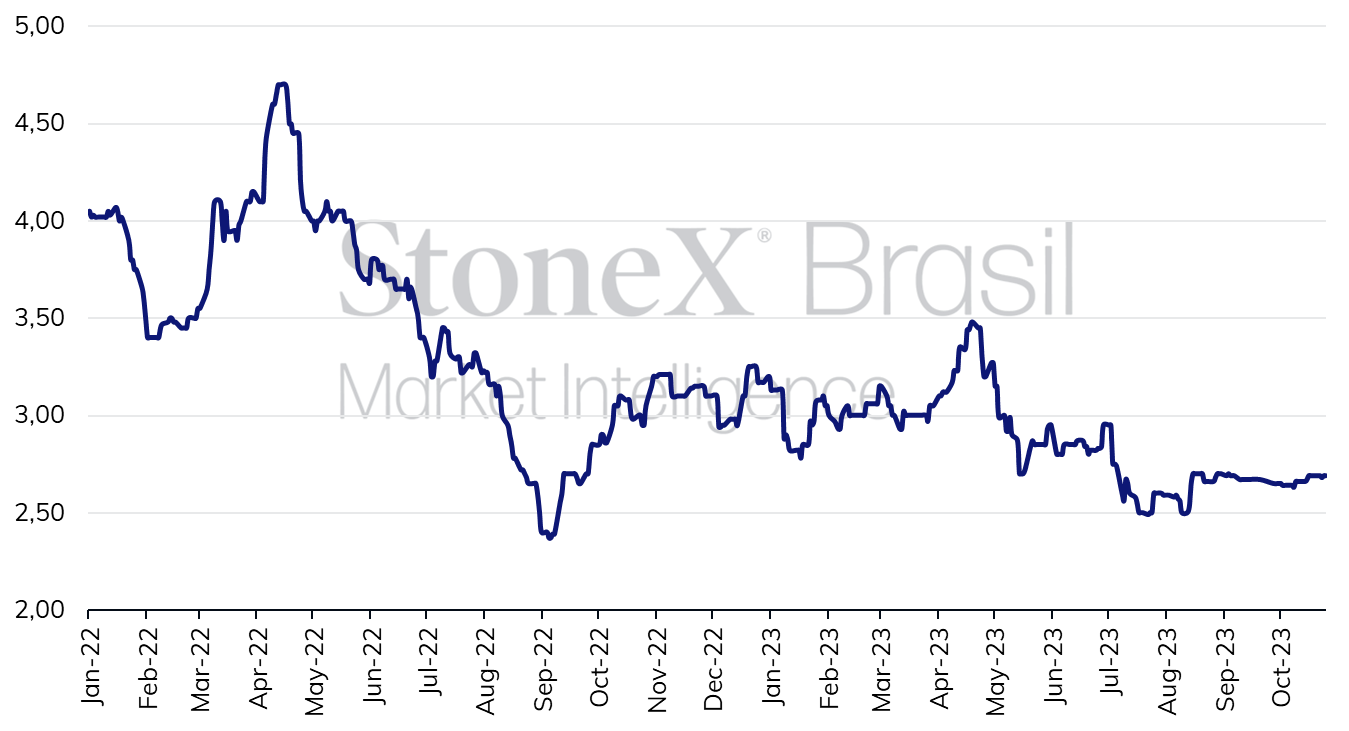
This stability in ethanol is in line with what has been observed in recent weeks, since the product's demand has been high since mid-August, but there is a large supply of sugarcane in the Center-South, a factor that keeps hydrous stocks running high, since in the first few months of the crop, due to the low competitiveness of hydrous compared to gasoline, its consumption was hampered.
In this sense, cheaper gasoline has had little effect on the dynamics with hydrous, since the parity in São Paulo has been below 70% since July, and below 65% since August. On October 31, Brazil's National Petroleum, Gas and Biofuel Agency (ANP) is due to release consumption data for the month of September, and the market expects biofuel consumption in the Otto Cycle to grow significantly, causing ethanol to gain market share, lost since the middle of last year.
With greater demand and a reduction in the milling volumes of plants in the Center-South, a seasonal movement, since the increased volume of rain tends to hinder harvesting operations, the bullish factors should prevail over hydrous from now on. As a result, the product's stocks should start to fall next month, placing upward pressure on prices, given the trend towards stronger consumption in the short term.
Hydrous ethanol price* - (BRL/liter)
On Wednesday (25), UNICA released the figures for the first two-weeks of October in the 2023/24 crop (Apr-Mar), indicating a two-week drop of 25% in hydrous production as the period saw high volumes of rain and around five days of harvest loss, with crushing shrinking to 32.8 million tonnes against 44.8 million in the second half of September. For the second half of October, a high crush is expected, since there is still plenty of cane in the fields, which may explain the stability of ethanol throughout the month. November, on the other hand, should already see a lower daily crushing rate, and the inter-crop period will begin in most mills.
Looking at fuel pricing, the parity between imported and domestic gasoline points to a negative gap of approximately BRL 0.07/Liter, a scenario that does not threaten losses in biofuel demand, since at current levels gasoline would need to be reduced by around BRL 0.20/liter at the pumps, which would have to generate a readjustment of around BRL 0.25/liter by Petrobras, a scenario that is unlikely in the short term.
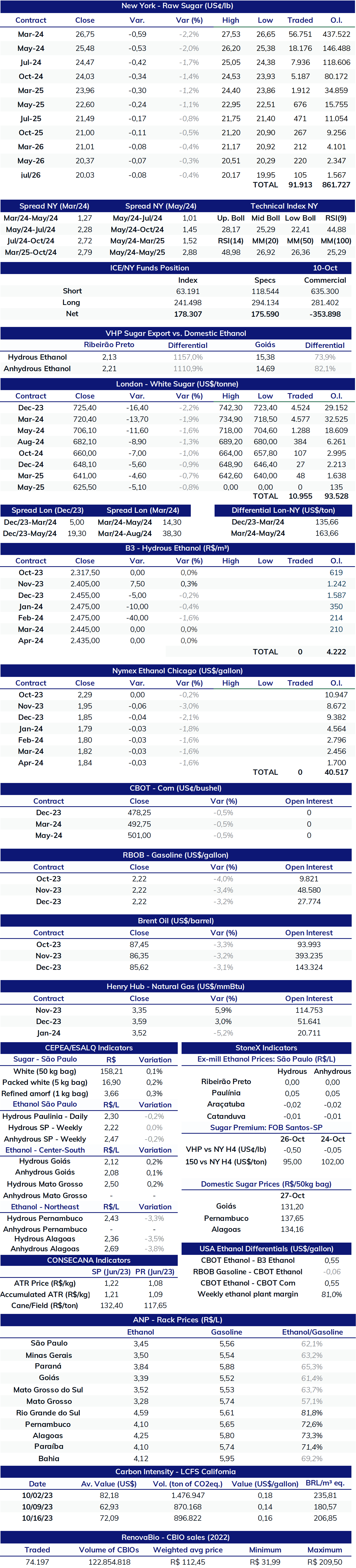
On Monday (30), sugar futures trading was down. For the most active raw sugar #11 contract (SBH24), the day ended at 26.75 c/lb, down 2.16%. For white sugar #5, the trading session closed at USD 725.4/t, down 2.21% on the day. This past week, after raw sugar hit a 12-year high last Wednesday (25), the Commodity Futures Trading Commission's (CFTC) weekly futures position tracking report revealed a decrease in speculators' net long position in the week up to the 24th. With sugar close to an all-time high and the expectation for the first crop monitoring data covering the 2023/24 global cycle (Oct-Sept), the downward movement may have been the result of profit-taking by these agents in the futures market, whose still highly long position can tend towards volatile price movements even without clear changes in the fundamentals.