
Sleepy market wakes up midweek, but still lacks direction
Weekly sugar summary | Analyst's view, by Marcelo Di Bonifacio Filho
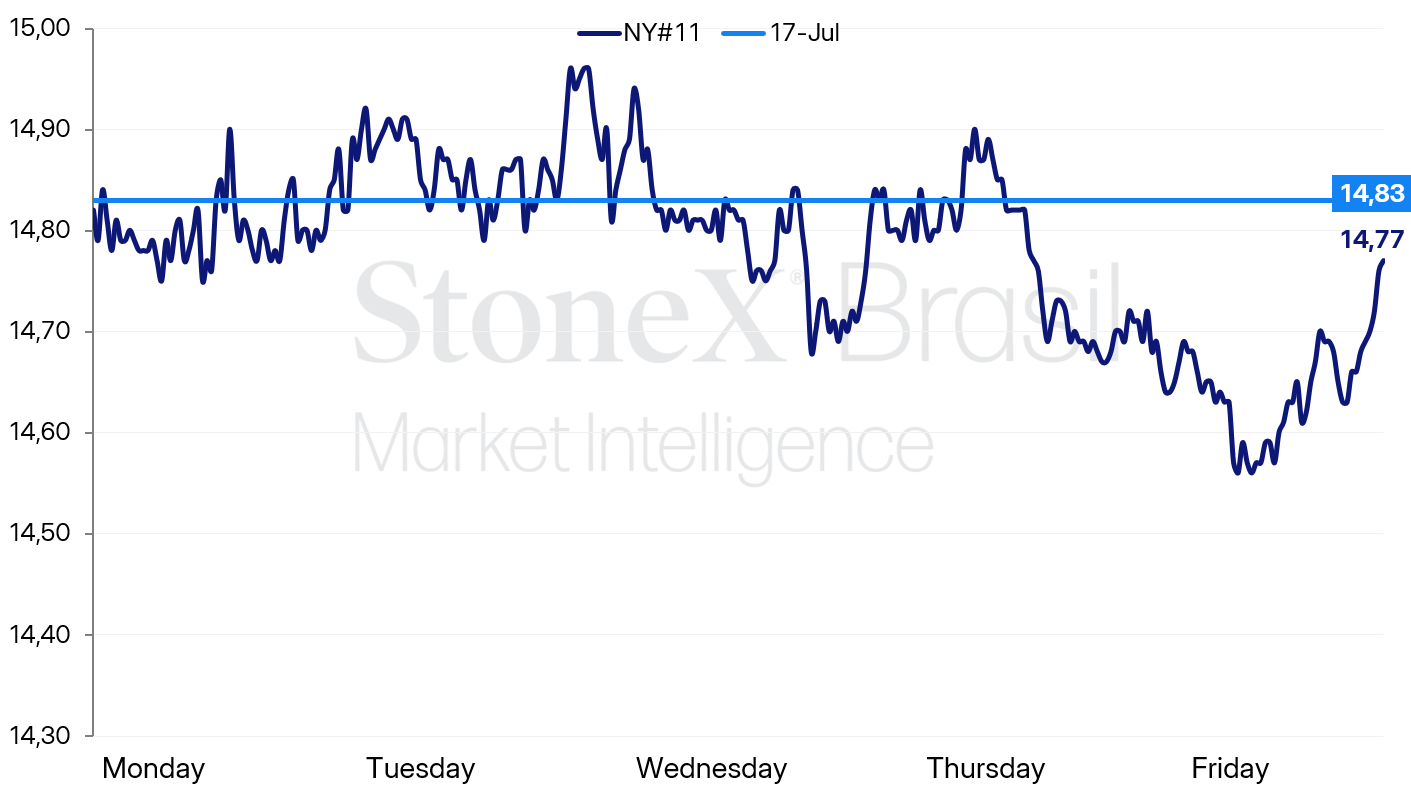
Sugar ends the week with an irrelevant drop of 6 points compared to the previous Friday (17), in behavior very similar to the prior week: low volatility in the first days and a bearish second half of the week, but with no clear direction. October closed at US¢ 14.77/lb but reached US¢ 14.50/lb on Thursday (24).
Between Monday and Tuesday, NY#11 had sluggish sessions, with the SBV6 oscillating in a narrow range of US¢ 14.75-14.95/lb, following the July 17 closing at US¢ 14.83/lb. On Wednesday and Thursday, prices faced significant selling pressure, breaking the 50-day moving average (US¢ 14.76/lb on Wednesday) and seeking the month's contract low, seen on July 16 at US¢ 14.44/lb. Today (Friday, July 24), #11 recovered in a corrective move but did not regain all the week's losses.
Intraday Chart – NY#11 (US¢/lb)
Source: ICE-US. Design: StoneX.
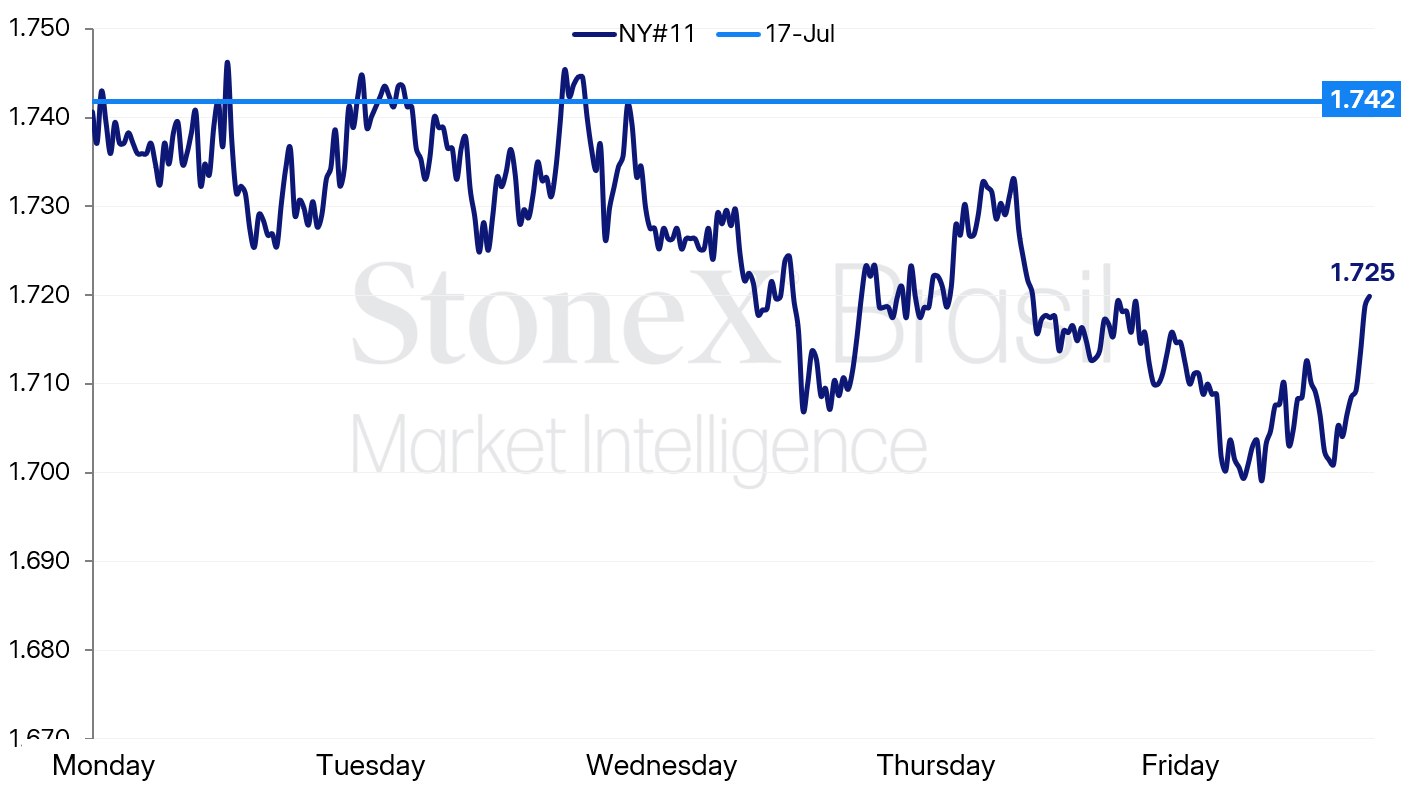
Intraday Chart – NY#11 (BRL/t, with polarization, without premium)
Source: ICE-US. Design: StoneX.
Overall, the market seems unable to find a clear direction and is settling at levels between US¢ 14.50-15/lb, driven by a perspective of sufficient supply from the Center-South but with markets in the Northern Hemisphere facing significant risks. July has been drier, allowing progress in milling in the Center-South, except for the last two days, a topic I will address later. Unlike a rainy June with many lost harvesting days at mills, at least the first half of July saw the harvest in full swing. We understand that milling may have exceeded 50 million tonnes during this period.
The direct impact was on ethanol, whose prices dropped to around BRL 2.60/liter in Ribeirão Preto (SP). With an initially ethanol-heavy harvest and the consequent price collapse in the internal São Paulo market, the market seemed to have found a floor at BRL 2.70/liter for hydrous ethanol (BRL 1.00/liter below what was seen in the off-season), which has now been breached. Demand has yet to gain enough traction for distributors to accept more attractive prices for mills, which are giving in amidst a highly voluminous milling cycle.
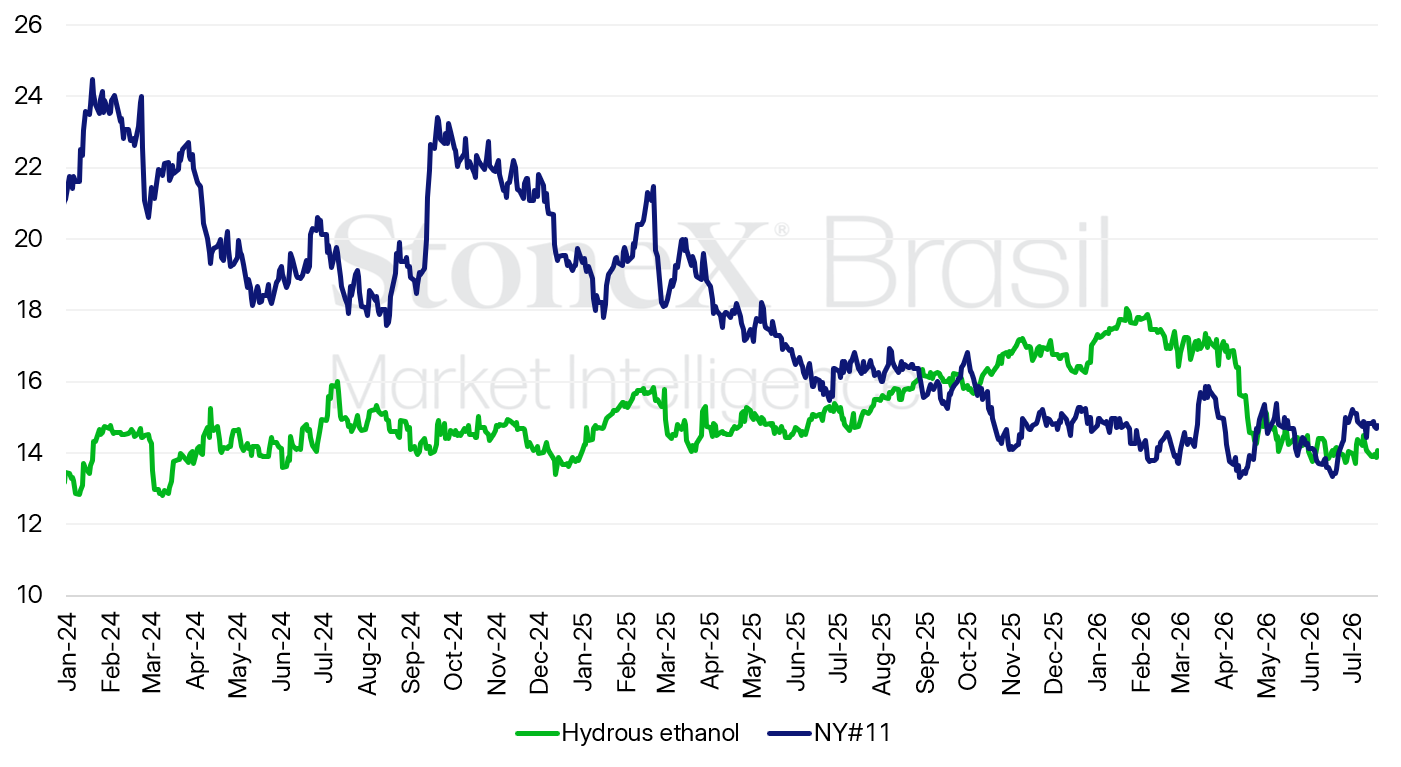
This has been a significant factor in explaining the stagnation in sugar prices. After all, if ethanol prices are falling (and may fall further), any sugar price increases above US¢ 15/lb generate selling pressure from mills, which have the flexibility to “switch the mix.” This week, hydrous ethanol at parity with NY sugar based on Santos exports was quoted, on average, at US¢ 13.94/lb, relatively lower than the range found for October/26.
Parity between NY#11 and hydrous ethanol* (US¢/lb)
*With CBIOs, based on mills in Ribeirão Preto (SP). Source and design: StoneX.
On the other hand, from Thursday to Friday, heavy rains were reported in São Paulo and Paraná states, with positive forecasts for the weekend in some regions. At a peak moment, these precipitations can bring volatility and uncertainty to the market, as they further delay the 26/27 harvest. However, it is important to emphasize that, initially, the rains are expected to be short-lived because forecasts for next week in São Paulo indicate dry conditions, with some rain potentially arriving at the beginning of August.
Adding another bearish signal from the Center-South, export premiums in Santos are below the five-year lows, this week discounting 50 points versus October/26. Interestingly, even with NY prices below 15 cents and the sugar-directed mix only at 42% by June (according to Brazil’s Ministry of Agriculture and Livestock, MAPA), VHP premiums have collapsed, indicating that, despite the increased export supply from mills at this time, it is still challenging to find destinations and active demand capable of absorbing this production quickly and intensively.
Personally, I believe this oversupply in trade flow via Brazilian exports should last until the end of the year, especially since part of the demand advanced imports (notably China) from October to now, and the White Premium dropped more than US$ 10/t this week, further reducing the likelihood and perspective of stronger refined sugar demand.
Next week, we will publish our new estimates for Brazil's sugar-energy crop and the global sugar balance. Stay tuned to our Market Intelligence Portal.
SUGAR WEEK
European Union
Drought continues to worsen beet crop outlook
Prospects for the European Union's sugar production continue to deteriorate over another week. Producers reported that severe drought continues to affect key beet-growing regions in France, Germany, and Poland, the bloc's three largest producers. In addition to climatic impacts, smaller planted areas in response to low prices in recent years also contribute to a scenario of lower potential supply for 2026/27. The market continues to monitor the need for rain in the coming weeks, as water stress has already limited crop development.
Center-South
MAPA data indicate June milling 11.2 million tonnes below last year
On July 20, Brazil's Ministry of Agriculture and Livestock (MAPA) published the Center-South crop monitoring report for the 2026/27 cycle (Apr-Mar), indicating milling of 31.2 MMt in the second half of June, an annual drop of 28.4%. As a result, June totaled only 70.4 MMt of cane, 11.1 MMt below June of last year. This year, last month was strongly impacted by increased rainfall, which caused around 7 lost harvest days on average in the second half alone.
Such a scenario negatively affected TRS, which dropped by more than 10 kg/t, and the mix, which declined on a fortnightly basis. The sugar mix, according to MAPA, is only 42% in the Center-South by the end of June. In the Midwest alone, the sugar mix accumulates 20.7%, 10.4 percentage points below 2025/26.
United States
New import quotas keep attention on trade flows
The United States released the sugar import quota allocations for fiscal year 2027, maintaining access for various exporters to the US market through the tariff quota system. Meanwhile, concerns persist about the impacts of recently announced US trade measures on key trading partners, including Brazil.
Mexico
Sector bets on recovery with expanded exports to US
The Mexican sugar sector remained in the spotlight following the expansion of its export quota to the United States. Industry representatives believe the measure could help mills recover financially after a period marked by low prices and reduced profitability. Nonetheless, the country’s carryover stocks are expected to reach around 1.5 million tonnes by the end of the season, the highest volume in over a decade, reflecting a combination of lower domestic demand and structural export restrictions.
-
ETHANOL WEEK
-
Brazilian domestic market
Weekly movements
-
Hydrous ethanol continues to decline this week at São Paulo mills. In Ribeirão Preto (SP), prices dropped to BRL 2.60/liter (including taxes), hovering around BRL 2.62/liter this Friday due to heavy rains that hit the state. The downward trend and breaking of the BRL 2.70/liter level show that, in the price dispute between distributors and mills, buyers remain comfortable demanding lower prices, likely facing still sluggish end-user demand.
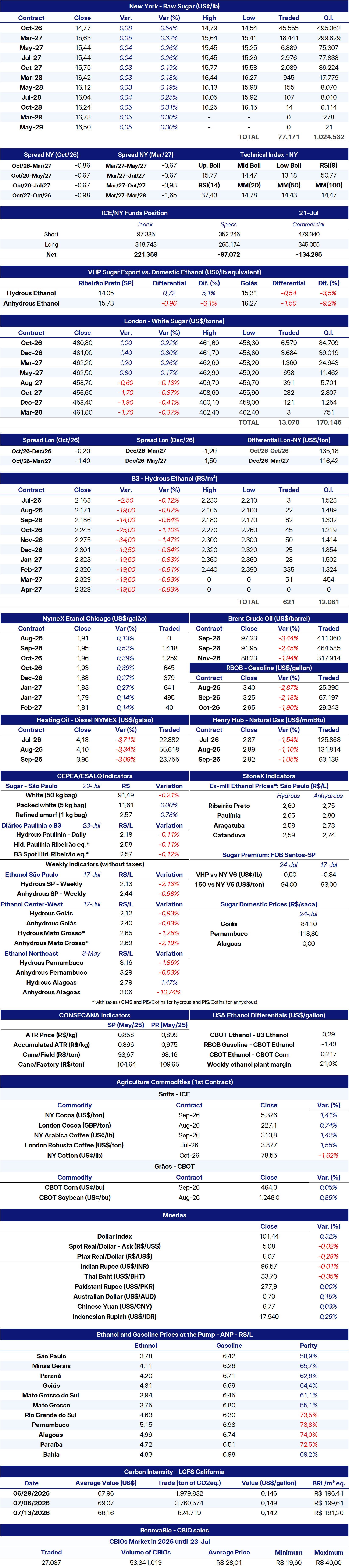
INDICATORS
Sources: ICE, CEPEA, B3, ANP, NYMEX, CBOT, Central Bank of Brazil, California Air Resources Board (CARB), CONSECANA, StoneX. Design: StoneX.


