Quarterly Commodities Outlook is available for free now.  Download your report  →

StoneX logo

Sugar and Ethanol Weekly Report

By: StoneX Intelligence Brazil, StoneX Intelligence Brazil

Production costs: How do recent geopolitical events impact the sugar and energy sector?
 

The last few weeks have been marked by greater risk aversion in the markets, amid tensions between Russia and Ukraine. Faced with the economic sanctions imposed against Russia and market speculation on the possible results of the conflict, crude oil and fertilizer prices have escalated on the international market. 

This movement raises concerns for the Brazilian agribusiness, especially amid the increase in production costs, a dynamic that may be intensified by the bullish factors surrounding the dollar in a year of presidential elections in the South American country. In the case of the sugar-energy sector, fertilizers purchases represented about 21.5% of mills’ costs in the 2020/21 cycle, while the diesel oil share was above 10%. 

As observed in 2021/22 (Apr-Mar), the current year should be marked by a high production cost in the Center-South, which may hinder crop investments not only in Brazil but also in the global market as a whole. In order to draw up a more in-depth analysis, over the following paragraphs we will comment on the prospects for exchange, as well as for the fertilizers and oil markets, in order to assess the possible impacts on the sugar-energy sector. 

Effects of rising fertilizers on production costs
Since last year, fertilizer prices have been on a firm upward trajectory. The extremely favorable exchange ratios in the first half of 2021 encouraged farmers to purchase nutrients, as they were capitalized by a more profitable production as well. The supply side, in turn, did not follow the robust global consumption and the narrow inventory scenario widened supporting prices, which for some nutrients practically tripled in 2021. Potash and phosphate fertilizers remain close to the 2008 highs and the increase in urea also brings concern. 
In this scenario of an increase in fertilizer prices, the exchange ratios were deteriorating in the second half of 2021, also for the sugar-energy sector. Until mid-June, the exchange ratio between hydrous ethanol in São Paulo and potassium chloride (KCI) behaved in line with the five-year moving average. However, between the first week of July and the last of December, the ratio increased by 36%, which means that to purchase of one tonne of KCl, buyers had to spend larger volumes of ethanol. More precisely, at the end of the year, the ratio was 1.35 m³ of ethanol for one tonne of chloride, versus 0.99 m3/ton in early July. This movement also followed the KCl CFR Brazil index, which changed from USD 615/tonne to USD 806/tonne in the same period (+31%).
For sugar, exchange ratios were above average for all of 2021, and in fact soared from July. At the beginning of last year, mills needed one tonne of VHP sugar (Santos-basis) to buy one tonne of urea. At the end of the year, this ratio reached 3 to 1, a direct reflection of urea’s almost tripled price throughout the year. In 2022, potash exchange ratios maintained the levels observed at the end of 2021. In the case of urea, this ratio was improved due to corrections on the market, but still at levels above average and more unfavorable to farmers when compared to one year ago.

In the elucidated context of firm demand throughout the world and limited stocks, the conflict between Russia and Ukraine is another episode that raises tensions in the fertilizers market. Russia is the largest exporter of nitrogen (N), and is the third largest in phosphate (P) and potash (K), and the country has been restricting its exports since December 2021. With the new sanctions imposed on the country, it should become more difficult to negotiate new purchases, mainly due to the issues regarding the removal of Russian banks from international payment systems.

Specifically, the urea and phosphate markets may find some exhaust valves in other suppliers, but the risk of no Russian N and P in the global supply is enough to affect total availability in 2022. However, the K market should be the most critical, particularly since it has another supply-side problem. Belarus is already under US and European Union sanctions for diplomatic issues, measures that directly list KCl-producing companies. With the adverse context in Russia, 40% of the world’s potash supply is at risk, and a lack of the nutrient for the coming months is increasingly being discussed.

Another point to be highlighted involves ammonium nitrate (NAM), a fertilizer used for sugarcane planting. In 2021, all NAM imported by Brazil came from Russia, who banned exports of the nutrient in February. Brazil had a record of 1.5 million tonnes of NAM imported last year, relieving domestic stocks, but if there is need for new purchases, the country should seek other suppliers in a limited global scenario. It is worth noting that, with adequate management, nitrate can be replaced by urea in cane fields.

Finally, uncertainties will hover the availability of NPK for the coming months. According to the Fertilizer Negotiations Survey conducted in February by StoneX, 60% of the total volume of fertilizer needs for this first semester were negotiated in Brazil. It is understood that this move should not be impacted by the nutrients’ tight scenario. For the second half of 2022, the index registered 28% (24% in the Southeast), 15 percentage points less than the same period last year, highlighting the negative effect of high prices on the movement of purchases anticipation that was going on in 2020 and 2021. Furthermore, the scenario is favorable to affect production costs for the 2023/24 harvest (Apr-Mar) and the risk of potassium chloride shortage, as mentioned above, should give a warning to the sugar-energy sector from now on.

Possible aftermath of Russia-Ukraine tensions over the global oil balance
In recent weeks, the market observed a significant appreciation of crude oil, with Brent showing an accumulated increase of 36.7% in 2022. This is largely a reflection of geopolitical tensions in Europe, intensified by the invasion of Russia into Ukrainian territory.
On this subject, the main concern of the market is that the sanctions imposed on the Kremlin, in particular on the country's financial system, with the access to the international payment system known as SWIFT being blocked for some Russian banks, can slow down the flow of oil and natural gas from Russia to Europe.
Even with sanctions not being directed toward the energy sector, many foreign banks have been limiting credit lines creation for importers of energy products that have an interest in negotiating with the major Russian companies in the sector, such as Gazprom and Roslit.
The escalation of conflicts has led to dissatisfaction at some foreign oil companies operating in the country. Earlier this week, BP, Shell and Exxon Mobil announced plans to finalize the operations and joint ventures with Russian companies. In the case of BP, the situation is even more worrisome, since today it holds 19.75% of Rosneft shares, Russia’s largest state oil company. On the other hand, TotalEnergies stated that it will maintain its operations on Russia, but will not make investments in new projects in the country. 
If the Russian invasion continues and economic sanctions intensify, negotiations in the oil and gas sector should be further shaken, even with punishments that are not directed aimed at the sector. With this, a drop in Russian exports, which in 2021 registered about 4.2 mbpd, may further compromise the oil S&D balance, which remains with a deficit.
On the other hand, a factor that may be bearish for prices in the short- and medium-term is taking place in negotiations between the US and Iran to create a new nuclear agreement. In early February, the US moved to restore sanctions waivers for nuclear international cooperation projects, which allows foreign companies belonging to members of the Global Joint Action Plan (JCPOA) to Iran to investigate whether nuclear facilities are not being used to create atomic weapons. This decision came after the last round of talks between the two countries in an attempt to restore the prior agreement and ultimately eliminate the sanctions applied to the Middle Eastern country.
Recently, the International Atomic Energy Agency (IAEA) confirmed that the institution's director general will visit Tehran, the capital of Iran, with the aim of meeting with Iranian officials to address the assurances that Iran will commit to uranium enrichment levels in a future nuclear agreement, which was seen as optimistic by the oil market in terms of negotiations.
Since the Trump administration’s application of new sanctions in July 2018 through July 2020, Iran’s oil production fell by around 1,780 kbpd, from 3,740 kbpd to 1.960 kbpd. As Biden took office, the country has been able to slowly and gradually resume supply, driven mainly by the US desire to resume the nuclear agreement signed between the two nations in the past.
In early 2022, Iran’s total oil supply was 2,503 kbpd. If an agreement between the two countries is reached and the economic sanctions against Iran are removed, oil agents expect the Iranian government to be able to expand its oil supply to pre-sanctions levels, to a total of 3.8 mbpd. Even with actual production operating well below current capacity, Iran has a significant amount of product reserves (between 90 and 120 million barrels), largely stored in oil tankers, which would influence a more accelerated increase in exports.
Even with the possibility of an agreement between the two parties in the short term, the return of Iranian barrels would probably occur more intensely from the second quarter of the year. Therefore, this situation shows that this agreement would not make significant changes to the S&D balance during the first quarter of 2022 which, according to StoneX latest estimates, should remain in a deficit at 0.5 mbpd.
Finally, it is also important to point out that the recent announcement about the release of strategic reserves from member countries of the International Energy Agency (IEA), including the US, in order to reduce oil prices in the short term, ended up having the opposite effect. This is essentially because the volume of barrels announced ended up disappointing oil agents, who expected a greater amount. According to initial information provided by the IEA, 60 million barrels would be released from strategic reserves, half of which would come from the US. 

Prospects for the diesel market in Brazil
In January 2022, demand for diesel reached 4.6 million m³, an increase of 2.1% over the same period last year. This situation suggests that, even with the high price of diesel on the international market, with ULSD NY Harbor reaching USD 3.373/gallon (the highest since March 2012), fuel consumption has been strong in the country.
If Brazil’s GDP rises by 0.04% in 2022, StoneX expects sales of diesel to remain in line with what was observed in 2021. However, this situation may change, given the possible readjustments that will be made by Petrobras on refineries prices. 
In fact, the domestic price difference with international prices continues to be the main point of attention. The last adjustment made by Petrobras for diesel occurred in early February, when Brent reached USD 89.16 bbl. Since then, the company has decided to keep prices unchanged, stating that revisions would be promoted when there were structural changes in the market. Currently, StoneX estimates that Petrobras’ diesel prices to distributors lags by BRL -0.8034/liter.
Estimated difference change according to the increase in diesel prices
image 30743
Sources: NYMEX, StoneX. Design: StoneX.

Keeping the exchange rate and the mandatory renewable volume obligations (RVO) constant, if there is a 10% increase in ULSD, this difference may reach -BRL 1.273/liter. In the case of a 20% valuation, the difference should be -BRL 1.738/liter. Considering an exchange rate of BRL 5.414, the current price difference would be -BRL 1.154/liter. Assuming increases of 10% and 20%, this differential could reach -BRL 1.654/liter and -BRL 2.156/liter, respectively.

This whole situation, in turn, acts as a factor for diesel prices in the domestic market, which can lead to higher transport and harvesting costs, as well as freight costs.

Macroeconomic context

The outlook for the exchange rate in 2022 has risks for both sides, that is, for a more significant appreciation of the Brazilian real and a devaluation. On the one hand, the Russian military invasion of Ukraine is raising global tensions and causing a risk-off behavior and the pursuit of security assets such as gold, public debt securities, and currencies such as the yen, the Swiss franc, and the US dollar. Assets from emerging economies usually perform poorly in times of global stress like these, as investors often withdraw their investments from riskier locations and redirect them to stronger economies.

Moreover, the escalating prices of food, metal, and, above all, energy commodities should pressure inflation rates globally, which can push the Federal Reserve to be firmer in its monetary tightening to try and contain the highest price acceleration in decades in the United States. Higher interest rates in the US make financial securities more profitable, attracting capital there and favoring a dollar appreciation.

However, Brazil still offers a high yield differential with most countries and should also continue to raise its basic interest rate in order to reduce inflationary pressures caused by the increase of commodity prices. The high yield differential helps to attract investors to Brazil and acts in favor of a reduction in the exchange rate.

Finally, since Brazil is an important producer and exporter of various commodities, the recent difficulties created by the conflict in Eastern Europe have attracted a huge flow of investment to the national sector, both through new productive investments, and investments in related shares in the Stock Exchange. Commodity-exporting countries’ currencies, such as the Brazil real, are appreciating against the dollar even as the risk-off behavior grows stronger, given the opportunity for gains that they offer in this scenario.

The prospects for economic activity in Brazil in 2022 are not positive, due to the numerous challenges that should curb the GDP pace of expansion. In the international context, the military conflict between Russia and Ukraine, whose outcome is uncertain at the moment, has reinforced some concerns about difficulties that began with the Covid-19 pandemic, such as global logistics chains overload and cost increase, shortage of major inputs for the durable goods industry, reduced stocks and a mismatch between strong demand and limited supply. In addition, there is the possibility of a reduction in supply of important agricultural, metal and, above all, energy commodities, causing a rapid increase in their prices which will probably be reflected in global inflation rates.

The National Broad Consumer Price Index (IPCA) in 2021 was 10.06%, a rate that is considered high. As such, it is possible that the Central Bank of Brazil will continue its policy of significant monetary tightening, readjusting the basic interest rate (Selic) at a significantly contractionary level in order to try to contain this acceleration of prices and limiting the credit potential for consumption and investment in the country. Moreover, despite the recent reduction in the unemployment rate, average labor income is in sharp decline, with a drop of 10.7% over twelve months. The reduction in wages amid rising interest rates and high inflation erodes workers’ real income, limiting the economy’s ability to recover.

The sectoral indicators of production also reveal weakness in economic activity. In the beginning of the year, there was severe drought in Southern Brazil, which affected agricultural production. Industrial production achieved positive rates in just three months of 2021, while retail sales performed positively in just two of the last six months. Only services have been presenting better results, but their capacity for recovery and growth with vaccination against coronavirus and reopening with the sectors seems to be exhausting. While Internet and related services are highlighted, face-to-face services are still below February 2020 levels.

In the political context, the great focus has been on rising fuel prices. Concerned about the decline in his popularity during the election year, President Jair Bolsonaro, has made Petrobras and its fuel pricing policy a frequent target of criticism. Polls reveal that inflation is one of the topics of major voter concern, and fuels are among the products that suffered the highest price increase and most contributed to the acceleration of official inflation. According to the Brazilian Institute of Geography and Statistics (IBGE), in the last 12 months, ethanol has risen 55.0%, diesel oil is up 45.7%, gasoline is up 42.7%, and car gas is up 35.6%.

After months of criticism and bluster, the Chief of Staff articulated a presentation of two proposed constitutional amendment (PEC), one in the Lower and one in the Upper House, to seek ways to reduce or zero tax rates on fuels and bottled gas in 2022 and 2023 to reduce its price without the need to indicate another revenue or expense cut to compensate for the drop in tax collection, i.e., without having to comply with the Tax Liability Law. However, after examining with the Presidents of the Legislative, it was decided that the focus would be two draft laws that were already under way in the Federal Senate and that deal with the same subject, by Senator Jean Paul Prates (PT-RN), in order to contain fuel readjustments in a faster way that requires a smaller number of votes.

The first project (PL 1472/2021) proposes the creation of a Fuel Price Stabilization Fund, which would be financed by a new oil export tax, in addition to changing Petrobras’ pricing policy for its national costs, rather than international parity. The measure is criticized by the Ministries of Economy and Mines & Energy, who fear an outflow of foreign investment. The second project (PLP 11/2020) changes the taxation format of the ICMS state tax on fuels. It proposes that there is a single-phase rate (i.e., one single taxpayer has the responsibility for recollection over the entire chain) of ICMS for fuels. In this case, the measure faces resistance from governors and mayors, who fear losing tax autonomy. There was not enough consensus to approve the projects on February 23, and the vote was postponed to March 08.

The constant changes in the Budget and government priorities for purposes clearly oriented to the October election reduce the government’s credibility and raise the fiscal risk, which may increase the risk premium requirements of investors and weaken the Brazilian currency. In its January meeting minutes, the Copom warned that “even fiscal policies that have bearish effects on inflation in the short term can cause deterioration in risk premiums, increased inflation expectations, and, consequently, a bullish effect on forward inflation.”

Impacts on the sugar-energy market

Despite the higher production costs, the 2021/22 (Apr-Mar) cycle presented more attractive revenues, which favored the profitability of Center-South plants. The same situation should be observed in 2022, since sugar and ethanol prices should continue to support S&D fundamentals.

In the light of the above-mentioned economic situation for the oil and dollar markets, the expectation is that the price of ethanol will continue to operate at high levels, in order to keep pace with gasoline at stations and make production more attractive compared to sugar. However, the productivity recovery of Center-South sugarcane fields and prospects of comfortable ending stocks in the current crop may still limit higher rates of ethanol negotiation.

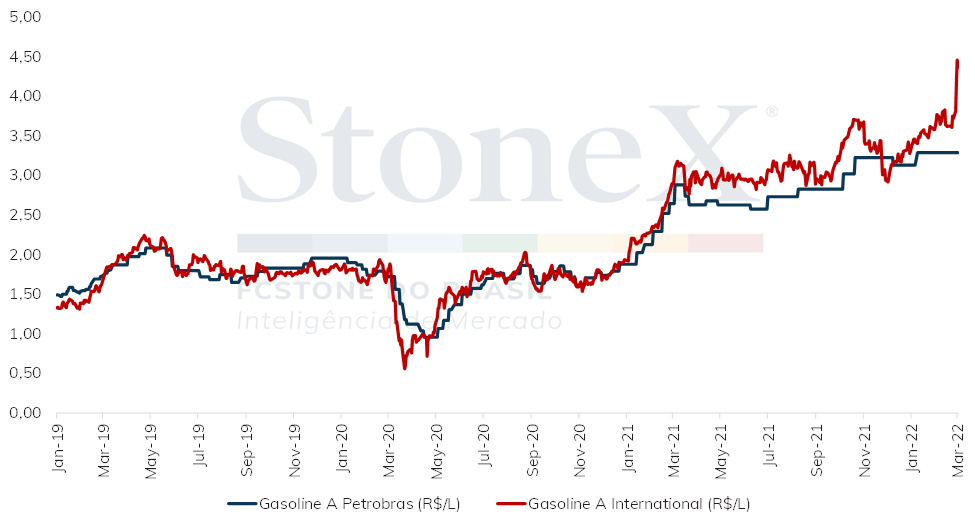
History of gasoline A prices in Brazil and in the international market

image 30741

Sources: CommodityNetwork Traders’ Pro, USDA & StoneX.

From the point of view of consumption, in turn, the expectation is that hydrous will take on a bigger share in Otto cycle fuels’ demand in 2022/23 (Apr-Mar). This trend, in turn, acts as a bullish factor for its prices.

In parallel, the global sugar balance in 2021/22 (Oct-Sept) could have a deficit. Although this context supports international sugar quotes, it is important to emphasize that its S&D balance already operates more comfortably than in the last cycle.

In addition, the recent situation points to dollar index appreciation this year. First, there is a mismatch between the main global economy central banks. Even with the acceleration of price indices in almost all economies, the Central Banks of Japan and the European Union hesitate to increase interests or remove stimuli for their economies. As such, the Federal Reserve is alone in its interest rates increase, expanding the dollar’s yield differential and attracting investments to that currency, to the detriment of the euro and the yen.

Secondly, in addition to offering the prospect of higher future gains, the US currency is seen as a security asset in times of uncertainty, and the worsening tensions and war between Russia and Ukraine also provided many dollar investments as a safe haven for the duration of chaos. Finally, as conflicts occur at the ends of the European Union, this ended up favoring a shift of capital from Europe to the United States, which in turn tends to appreciate the dollar index even further.

Although most fertilizers have already been acquired early for the 2022/23 cycle, some plants may be planning to buy more volume in the coming months, expecting prices to drop. This may make applications difficult, especially KCl, since there are risks of global shortage. Depending on how this situation will turn out, concerns also extend to the 2023/24 season in the sugarcane belt, which may pressure the sugarcane reform rate and the agricultural productivity in the region. The concern also extends to the global market, which may pressure crop investments and interfere in farmers’ planting decisions.


Sugar and Ethanol Week 
High volume of sugar to be delivered against #11 H2 contract
  • The raw sugar H2 expiration, which took place last Monday (28), was marked by a volume of 26,383 lots, or 1.3 million tonnes, to be delivered at the US exchange, with this being the highest level for March contracts. Brazil and Central American countries stood out as the main origins of the product. 
  • This result surprised expectations of lower delivery, while the inversion of the spread between the first two contracts presented losses and demand for sugar in the physical market was strong. The higher availability of the product followed comfortable stocks in Center-South Brazil, as well as the positive advance of the harvest in Central America. 
  • Although the expiration of March/22 gave a bearish tone to the market, strong global demand and the unfolding of the conflict between Russia and Ukraine supported sugar futures. Following Brent’s firm appreciation on the international market, the #11 contract posted a weekly rise of 9.9% closing Friday (04) at 19.35 c/lb on the ICE/NY. However, the 9- and 14-day RSI are already above 70 points, indicating an overbought situation in the market. 
  • In the field of fundamentals, the market also prices excessive rainfall over major sugarcane areas in Thailand, which has been damaging the harvest’s progress. In light of the above-normal rainfall forecast in the coming months, it seems likely that the country has the potential to produce only 10 million tonnes in 2021/22 (Oct-Sept). 
  • On the other hand, the crop in India evolves positively, and expectations now point to higher sugar supply. The ISMA, for example, expects 33.3 million tonnes to be produced in 2021/22, which should result in exports closer to 7.5 million. For the 2022/23 (Oct-Sept) cycle, production in the country should remain at a level close to 31 million tonnes, already disregarding the use of 4.0 million tonnes for ethanol production. With crude oil’s rally, Indian investments for E10 reach should be intensified. 
  • This prospect will still depend on the monsoon regime in the coming months. For the time being, initial forecasts point to normal seasonal rainfall, which should contribute to maintaining India’s role in the global sugar market. 
  • Focusing attention on Europe, the European Commission has positively revised its estimates for sugar production in the current cycle, estimated at 16.1 million tonnes. Considering UK supply, this projection came in line with StoneX figures, which point to about 17.2 million tonnes in 2021/22 (Oct-Sept). 
  • For the 2022/23 crop, beet productivity will still depend on the weather regime and the release of neonicotinoids. Even though France and the UK have approved the use of this class of pesticide, Germany is still not releasing the application, which could harm the country’s productive potential, especially amid high temperatures in the region. 
  • Beet planted area can also be pressured in France and Poland, given attractive prices of competing crops. If implemented, this trend should weigh on the bloc’s sugar supply in 2022/23.


Firm Brent appreciation lends bullish tone to domestic fuel prices
  • Last week, crude oil prices found support in the conflict between Russia and Ukraine, while the release of US strategic reserves also came below market expectations. 
  • With a broad price difference with the international market, the sector evaluates how this situation will be passed on to internal fuel prices. Although Petrobras claims that it will maintain its current pricing policy, the resistance of this strategy tends to be tested this year. 
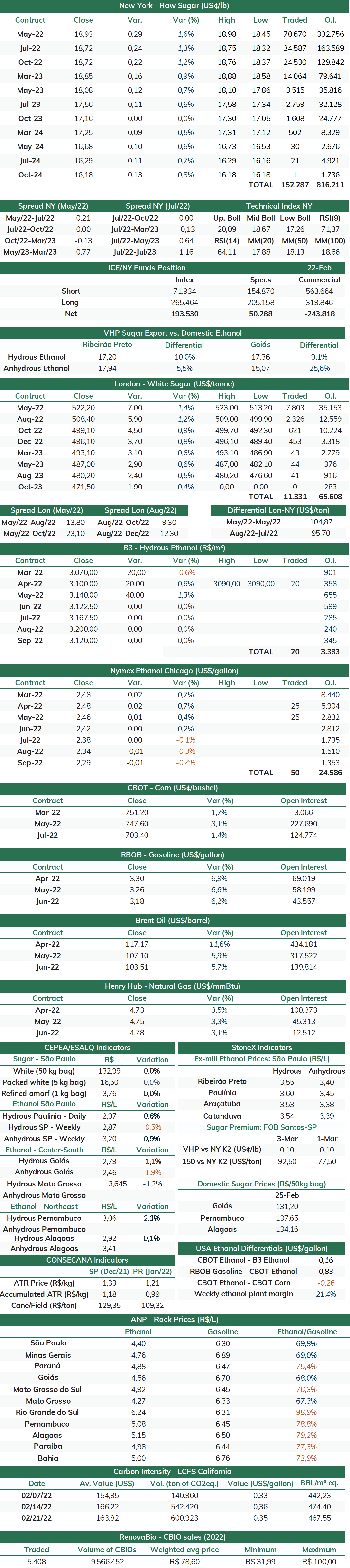
  • In terms of consumption, ANP data showed that ethanol gained competitiveness at São Paulo stations over last week, with the parity between hydrous and gasoline standing at 69.8%. 
  • This context is bullish for alcohol quotes, which should keep their competitiveness at the pumps and seek greater attractiveness in relation to sugar. It seems unlikely, however, that this situation will change the mills’ production mix decision, since fixations are advanced and the global sugar balance should have a new deficit of 1.9 million tonnes in 2021/22 (Oct-Sept). 
  • RenovaBio also stands out in this analysis, with prices of CBIOs reaching levels of BRL 100/CBIO, increasing revenue of Credits sales.
OUTLOOK AND CFTC
Last Friday’s CFTC COT report showed that speculators increased their long balance by 13.3% on the week that ended last Tuesday (1), to 56,992 lots. 
Reflecting this movement, the sugar #11 front-month contract presented a firm appreciation of 2.5% on the ICE/NY between February 22 and March 1. Raw sugar gains on the US exchange also followed the outbreak of the conflict between Russia and Ukraine, which resulted in firm crude oil appreciation. After the report’s reference date, raw sugar’s K2 followed a bullish trend, showing a valuation of 5.5% guided by Brent’s increase, but which may suggest an extension of long bets by specs.
In parallel, index funds increased their long balance by 1.3% in the period, to 196,059 contracts. On the other hand, commercial agents raised their net short positions to 253,050 lots (+3.8%). 
 
Indicators
image 30742


  • Renewable Fuels

The StoneX Group Inc. group of companies provides financial services worldwide through its subsidiaries, including physical commodities, securities, exchange-traded and over-the-counter derivatives, risk management, global payments and foreign exchange products in accordance with applicable law in the jurisdictions where services are provided. References to over-the-counter (“OTC”) products or swaps are made on behalf of StoneX Markets LLC (“SXM”), a member of the National Futures Association (“NFA”) and provisionally registered with the U.S. Commodity Futures Trading Commission (“CFTC”) as a swap dealer. SXM’s products are designed only for individuals or firms who qualify under CFTC rules as an ‘Eligible Contract Participant’ (“ECP”) and who have been accepted as customers of SXM. StoneX Financial Inc. (“SFI”) is a member of FINRA/NFA/SIPC and registered with the MSRB. SFI is registered with the U.S. Securities and Exchange Commission (“SEC”) as a Broker-Dealer and with the CFTC as a Futures Commission Merchant and Commodity Trading Adviser. References to securities trading are made on behalf of the BD Division of SFI and are intended only for an audience of institutional clients as defined by FINRA Rule 4512(c). References to exchange-traded futures and options are made on behalf of the FCM Division of SFI . StoneX is a trading name of StoneX Financial Ltd (“SFL”). SFL is registered in England and Wales, Company No. 5616586. SFL is authorized and regulated by the Financial Conduct Authority [FRN 446717] to provide to professional and eligible customers including: arrangement, execution and, where required, clearing derivative transactions in exchange traded futures and options. SFL is also authorised to engage in the arrangement and execution of transactions in certain OTC products, certain securities trading, precious metals trading and payment services to eligible customers. SFL is authorised & regulated by the Financial Conduct Authority under the Payment Services Regulations 2017 for the provision of payment services. SFL is a category 1 ring-dealing member of the London Metal Exchange. In addition SFL also engages in other physically delivered commodities business and other general business activities which are unregulated and not required to be authorised by the Financial Conduct Authority. StoneX Group Inc. acts as agent for SFL in New York with respect to its payments services business. StoneX APAC Pte. Ltd. acts as agent for SFL in Singapore with respect to its payments services business. ‘StoneX’ is the trade name used by StoneX Group Inc. and all its associated entities and subsidiaries.
 
Trading swaps and over-the-counter derivatives, exchange-traded derivatives and options and securities involves substantial risk and is not suitable for all investors. Past performance of any futures or option is not indicative of future success. Indicators are not a trading system and are not published as a specific trade recommendation. The information herein is not a recommendation to trade nor investment research or an offer to buy or sell any derivative or security. It does not take into account your particular investment objectives, financial situation or needs and does not create a binding obligation on any of the StoneX group of companies to enter into any transaction with you. You are advised to perform an independent investigation of any transaction to determine whether any transaction is suitable for you. No part of this material may be copied, photocopied or duplicated in any form by any means or redistributed without the prior written consent of StoneX Group Inc.
 
© 2026 StoneX Group Inc. All Rights Reserved.

Satellite view of Earth at night showing illuminated cities across Asia and the Middle East

Discover more insights

Our subscribers have access to comprehensive market analysis from StoneX spanning commodities, equities, currencies and more.

Related articles for Renewable Fuels

Perspective: Morning Commentary for August 7

August 7 – The U.S. economy unexpectedly lost 23k jobs in July, dramatically below market expectations of an 80k increase and marking the worst Non-Farm Payrolls print since February. Furthermore, May and June were both revised sharply downward, with combined revisions showing 103k fewer jobs than previously reported. Outside of the healthcare sector, which added 22k jobs in July, the losses were very broad-based. Government payrolls saw the largest decline, shedding 53k jobs in July, the largest seen since October 2025, while June was revised down to show a loss of 10k jobs as well. The private sector at least saw growth, adding 30k jobs in July, now matching the month prior after it was revised down from the 49k initially reported, and substantially missing forecasts of 78k jobs being added. This is a sharp reversal in course from the largely better than expected U.S. labor data seen earlier this week.

Mike Castle
Mike Castle
  • Grains & Oilseeds
  • Energy
  • Dairy
  • Renewable Fuels
  • Cocoa
  • Coffee
  • Cotton
  • Sugar
  • Meats & Livestock
  • Forest Products

Perspective: Morning Commentary for August 6

August 6 – This morning’s stronger-than-expected U.S. labor data offered markets some relief, reinforcing confidence in the economy while giving the Fed greater flexibility to raise rates should inflationary pressures reaccelerate in next week’s July data. Stock futures are pointing to a mixed open to start the day, with the tech-heavy Nasdaq showing the most weakness. The VIX has fallen notably from yesterday’s spike above 18.4 as it starts the day hovering just below the 16-mark. The dollar is quietly higher as it trades just above 99.8, holding in the tight range seen thus far this week as traders continue to digest data to shape expectations for the Fed’s next move, which we’ll dive into in more depth below. Long-term treasury yields have relaxed slightly from their recent spike, with 30-year yields starting the day trading just above 5.19%, while 10-year yields trade above 4.64%, and 2-year yields sit below 4.22%. Crude oil is modestly higher to start the session after sharp declines earlier in the week, with nearby WTI up 1.8% to trade at $76.40 and nearby Brent up 2.4% to trade at $81.40. Meanwhile, the ags are quietly mixed to start the day.

Mike Castle
Mike Castle
  • Grains & Oilseeds
  • Energy
  • Dairy
  • Renewable Fuels
  • Cocoa
  • Coffee
  • Cotton
  • Sugar
  • Meats & Livestock
  • Forest Products

Perspective: Morning Commentary for August 5

August 5 – U.S. equities markets are on fire this week, with both the Dow Jones and S&P 500 setting new all-time highs yesterday with futures indicating further gains again today; the marketplace remains optimistic over a deal with Iran despite no evidence of such as of yet. Crude oil is working on a lower high and low today but remains slightly on the high side on the session, while the dollar is retreating back towards Monday’s nearly two-month low. The ten-year note is steady-to-lower this morning (though solidly lower so far this month) at 4.605%, while the VIX index continues to rebound into mid-week at almost a 17-point reading this morning.

Matt Zeller
Matt Zeller
  • Grains & Oilseeds
  • Energy
  • Dairy
  • Renewable Fuels
  • Cocoa
  • Coffee
  • Cotton
  • Sugar
  • Meats & Livestock
  • Forest Products
StoneX: We open markets

Our market expertise, advanced platforms, global reach, culture of full transparency and commitment to our clients’ success all set us apart in the financial marketplace.

Reach

With access to 40+ derivatives exchanges, 180+ foreign exchange markets, nearly every global securities marketplace and numerous bi-lateral liquidity venues, StoneX’s digital network and deep relationships can take clients anywhere they want to go.

Transparency

As a publicly traded company meeting the highest standards of regulatory compliance in the markets we serve; our financials and record of accomplishment are matters of public record. StoneX’s commitment to “doing the right thing over the easy thing” sets us apart in the industry and helps us build respect, client trust and new partnerships.

Expertise

From our proprietary Market Intelligence platform, to “boots on the ground” expertise from award-winning traders and professionals, we connect our clients directly to actionable insights they can use to make more informed decisions and achieve their goals in the global markets.