How does the FX change tend to influence sugar and ethanol prices?
Preference for safer assets tends to intensify during periods of risk aversion in global markets, a trend that is usually marked by greater dollar search. The conflict between Russia and Ukraine has impacted the position of investors, mainly the developments in the oil sector, which act as a supporting factor for agricultural commodities prices.
In fact, the last few weeks were marked by greater volatility in the oil market, with Brent reaching a high of USD 139.13/barrel. Although bullish factors remain active, S&D fundamentals already point to a surplus starting in the second quarter of 2022, which may lend some relief for crude oil futures in the medium term. In addition to the energy sector, it is important to understand the perspectives for foreign exchange in this context, especially to monitor the profitability of the sugar and ethanol plants and the decisions regarding the productive mix for 2022/23 (Apr-Mar).
Macroeconomic perspectives
The Covid-19 pandemic and its challenge have brought about significant changes to the global macroeconomic landscape. On the supply side, significant overloads accumulated on the global logistics chains and the productive chain of durable consumer goods, which struggled with reduced stocks, order accumulation and productive interruptions caused by lockdown measures to stop the initial contagion wave of the new coronavirus. On the demand side, due to containment measures, policymakers promoted fiscal and monetary policies of economic stimulus in order to avoid an economic recession, which boosted consumption for goods. With mass vaccination and the resumption of activities, demand remained high, while productive and logistical difficulties lingered, resulting in a high, persistent and widespread price acceleration throughout 2021 for most global economies.
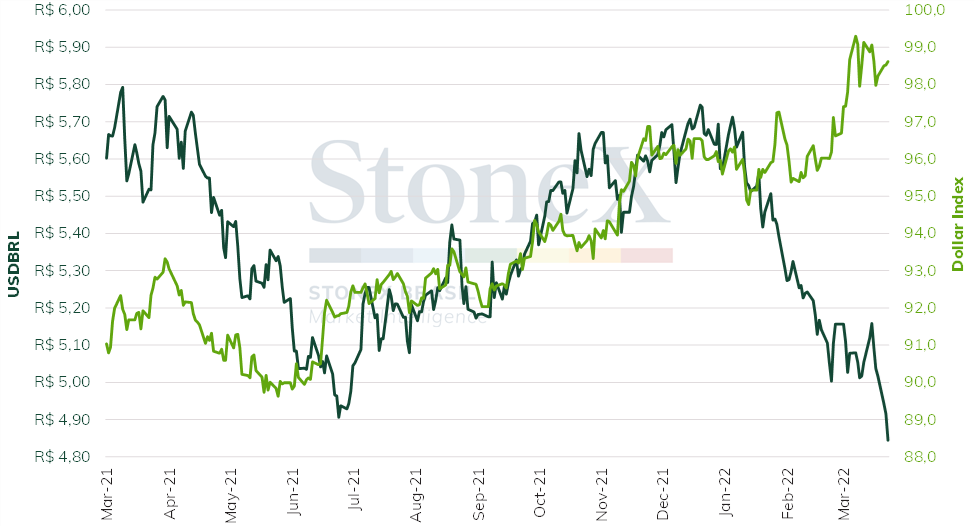
USD (US$/R$) and Dollar Index (points)
Source: Commodity Network Trader’s Pro. Design: StoneX.
In 2022, when the price level was already the main challenge for Central Banks, the start of the war between Russia and Ukraine further increased inflationary estimates for having caused an appreciation of international commodity prices. There is a possibility of reduced global supply of food, metal and energy products due to the infrastructure damaged by the war, mass emigration in Ukraine (a major European commodity supplier), sanctions imposed against Russia (and, to a lesser extent, Belarus), and a general disincentive to trade with Moscow for fear of reputational damage, future sanctions or even difficulty in receiving products. These sudden cost increases (so-called supply shocks) should make the productive chains of various segments of goods and services costlier, which will be passed on to consumer prices and raise the inflationary level.
Faced with this challenge, authorities should use recessive monetary and fiscal policies in an attempt to soften price acceleration and rescue price stability more quickly, though this takes some time. As a result of these policies, the potential for economic growth should be reduced, whether by increased credit, reduced public spending or increased taxation. As such, the macroeconomic scenario for 2022 is very challenging, with the prospect of high inflation and low economic growth.
The combination of the negative geopolitical context and challenging macroeconomic perspectives led to greater caution and risk aversion by financial agents, who seek assets traditionally associated with security, such as precious metals, government bonds, and currencies regarded as safe havens for moments of uncertainty. However, as the Federal Reserve already tightens its monetary stimuli ahead of European and Japanese peers, the dollar has been privileged against other advanced economies’ currencies. There is expectation that the interest rate in the United States will end the year between 1.75% and 2.00% p.a., while the Central Banks of Japan and the European Union do not have plans to raise their basic interest rates this year. As such, the dollar index has already valued by 2.8% in 2022 and, in early March, reached its highest value since May 2020, while currencies such as the euro and the yen devalued against the US greenback.
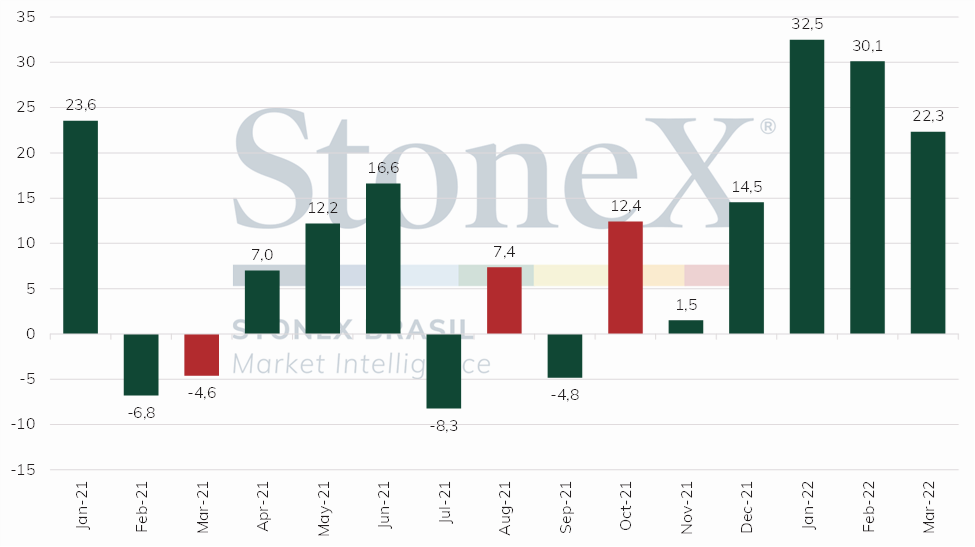
In this scenario of greater caution and risk aversion by agents, emerging economies usually suffer from capital flight and devaluation of their currencies. However, in 2022, Brazil has experienced an opposite movement, that is, a strong inflow of foreign resources. First, these investors are attracted by the diverse exporting capacity of primary products, low relative exposure to the risks offered by the Russian-Ukrainian conflict, and low price of Brazilian assets denominated in foreign currency. It is possible to see this capital inflow through the B3 stock spot market, where net inflow of foreign resources already exceeds BRL 81 billion in 2022, the highest three-month value since 1994, the beginning of the historical series. The investment balance was BRL 32.491 billion in January, BRL 30.129 billion in February and BRL 20.973 billion up to March 22.
Balance of foreign capital flows in B3 – up to March 23 (billion BRL)
Source: B3. Design: StoneX.
The large Brazilian interest rate differential in relation to that of developed countries also contributes to the entry of foreign capital. Facing rapid inflationary acceleration, the Central Bank of Brazil is carrying out an intense monetary tightening process that readjusted the basic interest rate (Selic) by 2.0% p.a. to 11.75% p.a. in a twelve-month interval. The monetary authority still wants to raise interest rates at least once again. Today, the real interest rate (the difference between the nominal interest rate minus inflation) in Brazil is only lower than that of Russia, a country that is struggling to attract foreign investors. This wide Brazilian interest rate differential attracts investors seeking “carry trade” strategies, which means taking a loan at a low-interest country to apply it in a high-interest country. With this, the real is the currency that has the best performance against the dollar in 2022 until March 25, with accumulated appreciation of 14.8% in the period.
How does this dynamic influence the Brazilian sugar and ethanol market?
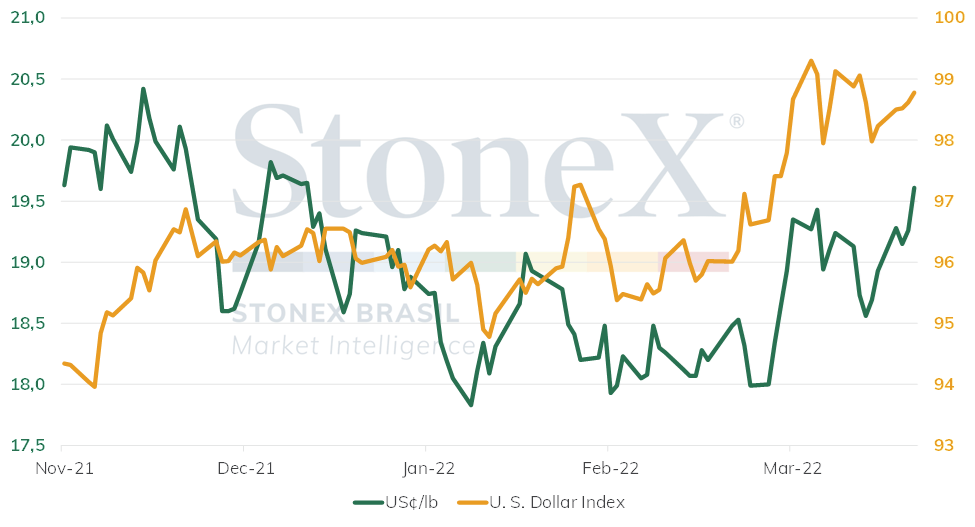
Historically, sugar futures have a negative correlation with the dollar and other currencies. At times of greater risk aversion, for example, speculators begin to search for safer assets, leaving investment in commodities out. However, there are other variables that influence the sugar price formation on the international market, particularly its own supply and demand fundamentals.
Sugar #11 and dollar index movement
Source: CommodityNetwork Trader’s Pro. Design: StoneX.
Regarding the negative correlation with the dollar index, it is worth noting that, in Brazil, the dollar appreciation means a higher income for exporters, serving as an incentive to increase allocation of sugar abroad. Taking into account that Brazil is one of the main sugar producers globally, the appreciation of the US currency means greater availability of the product on the foreign market, making the commodity’s S&D balance more comfortable and pressuring international prices.
For the 2022/23 cycle (Apr-Mar), our projections point to annual recovery of 7.5% in sugar production by the Center-South, estimated at 34.5 million tonnes. This estimate is based on crushing of 565.3 million tonnes, and on the prospect of a sugar-directed mix maximization. Given advanced fixations on the ICE/NY, it seems likely that about 45.5% of cane will be directed to sugar production next season.
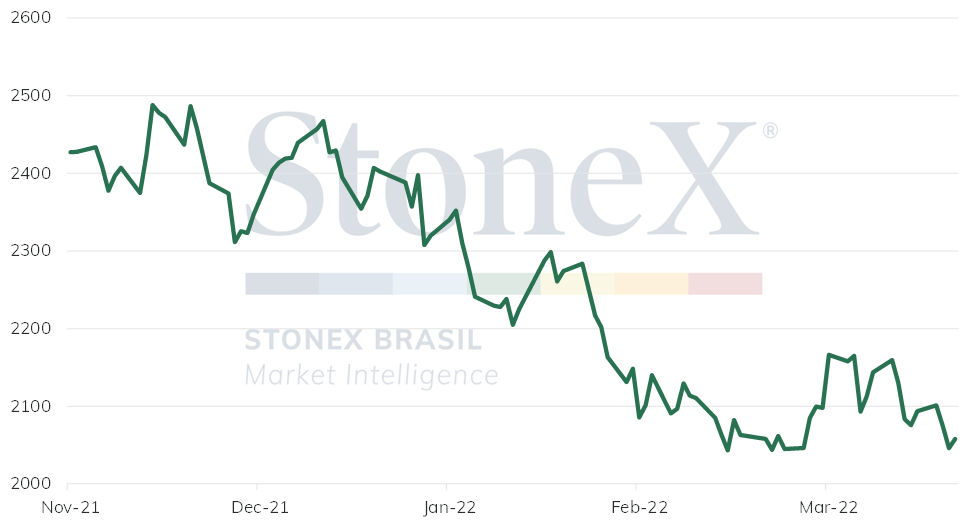
First, the larger procurement of sugar for export is due to the deficit of 1.1 million tonnes projected for the current international cycle. Despite the recent devaluation, sugar #11 prices converted to the national currency still operate at attractive levels, standing close to BRL 2,100/t, which stimulates the commodity’s production by Brazilian mills.
Source: CommodityNetwork Trader’s Pro. Design: StoneX.
Based on the period between October 2021 and September 2022, we expect sugar supply in the sugarcane belt to total 31.4 million tonnes, a volume that represents an 11.9% decrease compared to the previous crop. The attention revolves around the weather performance in the coming weeks, which will be key to define the productive potential of sugarcane fields in the Center-South and, consequently, the participation of Brazilian sugar abroad.
It is worth mentioning that a possible appreciation of the dollar, amid of a year of presidential elections, also has an indirect impact on sugar futures, which is the result of the policy of fuel price parity with the international market. Depending on the exchange rate movement and crude oil futures, Petrobras makes adjustments on the prices of gasoline at refineries, so as to maintain domestic market negotiations equated with the level practiced internationally.
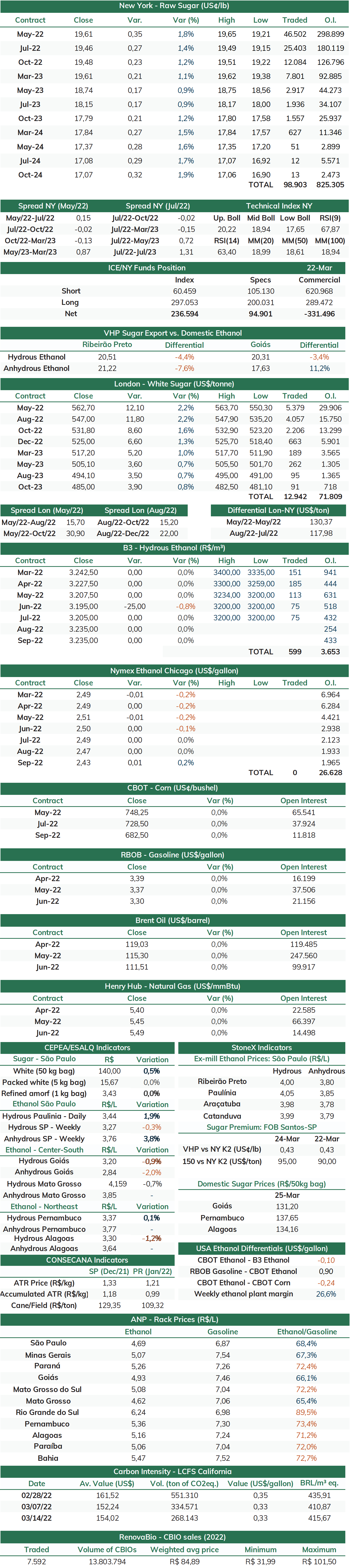
In practical terms, a high dollar could translate into increases for gasoline in the Brazilian market, allowing some margin for ethanol to also rise. However, the readjustments by the company also depend on crude oil prices. In the short term, the price of ethanol can still be supported if Brent’s trading level in Brazilian reais remains high. On Friday (25), for example, the #11 front-month contract operated at a 4.4% discount on ex-mill hydrous based in Ribeirão Preto.
Although the trend is higher for next month, Brent could operate at lower levels throughout 2022, given the prospect of a more comfortable global balance for the commodity. Furthermore, ethanol stocks are at comfortable levels, which together with recovery of the sugarcane fields productivity in the Center-South region, may limit higher negotiation levels.
The prospect of greater cane allocation for sugar production may intensify in the coming years, responding to a lower participation of Indian sugar in the global market. The expansion of corn ethanol production can also provide some relief for the domestic ethanol balance, even though RenovaBio’s liquidity gain can make its production more attractive.
Finally, it is worth mentioning that a possible dollar rally could make ethanol imports impracticable in the coming months, even though the transaction tax has been zeroed until the end of 2022. This perspective is added to the trend of a rising US ethanol, Brazil’s main trading partner, amid a corn rally in Chicago and the upcoming driving season (the period of highest fuel consumption in the country). In parallel, as mentioned above, the price of domestic alcohol can be pressured by the very S&D fundamentals, even though Petrobras’ pricing policy remains a point of attention.
High production costs are a point of attention for sugar supply
- The sugar market is under the influence of the Russian-Ukrainian conflict, which has been going on for a month. On Friday (25), the #11 May/22 contract closed the ICE/NY session at 19.61 c/lb, accumulating a weekly high of 3.6%, a movement that followed Brent oil gains. In parallel, the #5 front-month contract was quoted at USD 562.7/t (+5.0%), taking the White Premium to a level above USD 130/t.
- In India, the international negotiations of the country’s mills have gained strength recently, driven by attractive prices of #11 and #5 on the international market. To date, about 7.0 million tonnes of sugar have already been contracted for export. However, according to sources from India’s government and industry members, the country may restrict its sugar exports until the end of the 2021/22 cycle (Oct-Sept) in order to limit the increase of domestic prices.
- In Thailand, regular rains remain a point of attention for the 2021/22 cycle, since they have hindered harvest work, especially in the Central region of the country, where moisture was 92% above normal in January.
- Despite adverse weather conditions, it seems likely that the country will have an annual recovery of 31.1% in its sugar production, which may reach 9.9 million tonnes in the current cycle. In light of this, sugar exports from Thai mills already reach 2.6 million tonnes between October 2021 and February 2022. See our full analysis of sugar production in Thailand, with prospects for the 2022/23 cycle here.
- Also in relation to the perspective of global sugar supply in Europe, the beneficial weather has contributed to the advance of fieldwork for beet planting, especially in Germany and France. However, as pointed out previously, the mild weather increases the risk of aphid infestation, especially in Germany, a country that has not yet released emergency use of neonicotinoids in 2022.
- Given the possibility of yellow virus and consequent production potential decline, sugar supply across the region may be under pressure in the 2022/23 cycle, reinforcing the role of the European Union as a net sugar importer. High production costs are also worth highlighting, as they can damage investments in crops for yield gains.
- Moreover, the Covid-19 pandemic also remains a point of attention for the market. In recent weeks, increased cases in China has aroused concern, as more severe social isolation policies can lead to a deceleration of sugar imports into the Asian country. See our full analysis here.
Nulled import tax on ethanol and impacts on the energy sector
-
Last week, the Brazilian Foreign Trade Chamber (Camex) decided to zero the ethanol import tax until December 2022, aiming at making fuel prices at Brazilian stations cheaper. Previously, the ethanol tax rate from countries outside Mercosur was 18%. However, it is important to point out that the measure may not have significant actual effects.
-
Until then, if we take as an example the markets of Suape/PE and Paulínia/SP, the price of Brazilian ethanol was 20.2% and 27.6% lower than that of the United States placed in these respective markets. According to our import calculations, despite the measure adopted, spot acquisitions remain unattractive, with the window being closed for the North/Northeast and Center-South of the country.
-
Regarding the RenovaBio program, attention is focused on the slow pace of CBIO production. Considering only the current year generation, the volume of Credits in the market is 10.1% below that recorded in the same period of 2021. This scenario is due to the lower demand for fuels at Brazilian stations, in addition to lower processing of sugarcane during the beginning of the 2021/22 (Apr-Mar) cycle in the Center-South region. In any event, the current year should be closed with a sufficient volume of Credits to meet the target set by the ANP. Access the full analysis here.
Outlook and CFTC
Last Friday’s CFTC COT report showed that speculators increased their long balance by 7.6% on the week that ended last Tuesday (22), to 94,901 contracts. So much so that the #11 front-month contract appreciated by 2.2% between March 15 and 22.
After the reference date, in turn, raw sugar’s May/22 accumulated gains of 2.4% on the ICE/NY, a move that responded to the dollar depreciation and the bullish trajectory of Brent, but which also seems to suggest an increase of long bets by specs.
In contrast, index funds cut their net long positions by 1.0% in the period, to 236,594 lots. Finally, commercial agents also expanded their short balance to 331,496 lots (+1.3%).
Indicators