Quarterly Commodities Outlook is available for free now.  Download your report  →

StoneX logo

Sugar and Ethanol Weekly Report

By: StoneX Intelligence Brazil, StoneX Intelligence Brazil

Russia x Ukraine: How can the conflict impact the sugar and ethanol market?
 
Marina Malzoni
João Pedro Lopes
Arthur Machado
 
Marcelo Di Bonifácio
Ethanol production may be pressured by lower global corn availability
The Russian-Ukrainian conflict raises concerns about spring planting in Ukraine, with some official indicators pointing to a 50% reduction in planted area, to about 7 million hectares. In this context, the country should prioritize wheat production, aiming at food security.
Even though Ukraine has no significant share in global sugar supply, the Russian invasion may impact its grain production, particularly corn, and the country accounted for about 13.1% of the product’s exports in 2020/21. The result of the conflict over planting decisions will signal raw material availability for ethanol distillation in major players, especially in the United States and Brazil. 
Possible impacts over the sugar market

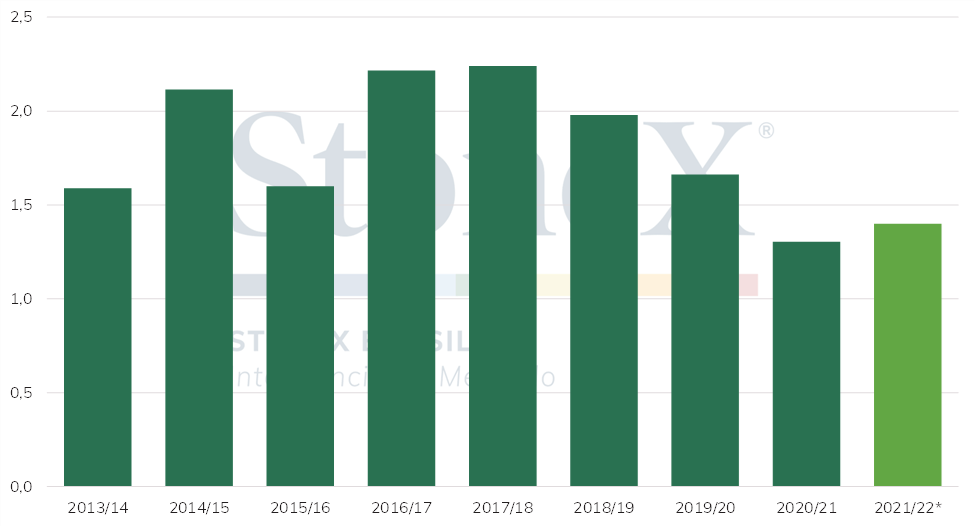
Sugar production by Ukraine corresponded to about 0.7% of global supply in 2020/21 (Oct-Sept). Recent geopolitical tensions bring uncertainty to the country’s beet-planting intentions, which usually begins at the end of March. Although to a lesser extent, a possible loss of beet area could result in a tighter global balance for the commodity in 2022/23.

So far, about 30% of the beet area is at risk, but the market is still waiting for the impacts to be assessed. Initially, considering a loss of 20% in 2022/23, the country could stop producing a volume just below 300,000 tonnes of sugar.

Sugar production in Ukraine (million tonnes)
image 33469
*Estimated. Sources: USDA, IKAR & StoneX. Design: StoneX. 

Wheat’s firm appreciation could also pressure beet area, but it should be noted that most farmers on the European continent have already purchased seeds for the next season. Therefore, there is little room for significant changes regarding the sowing decisions. On a long-term horizon, however, the price relationship with competing crops will be closely monitored in order to assess planting intentions on the European continent in 2023.

Specifically in Russia, damages should be minor, and beet planting also tends to start soon. The concern revolves around the economic sanctions imposed against the country, which can undermine farmers capitalization to purchase inputs, a point of attention for crops’ agricultural productivity. Estimates point to an annual increase of 20% to 25% in production costs.

Finally, barriers in the fertilizer market can also limit agricultural investments for productivity gains in other players. It is still early to estimate the effects of this on the global sugar balance, but these discussions will remain on the radar.

Conflict developments over the corn market

As mentioned, the political tension in the Black Sea should have a major negative impact on region’s spring planting, especially in Ukraine, and it will not be different for corn. In mid-March, the country’s Ministry of Agriculture declared that Ukrainian producers would sow up to 3.3 million hectares in the next season (Oct/22 to Sept/23), against 5.4 million hectares in 2021/22, which would represent a 38.9% decline. In relation to total production, a drop of 50% YoY is already estimated.

Using USDA data as basis and considering the average between 2016/17 and 2020/21, 79% of Ukrainian production is intended for the foreign market. As such, taking into account the weight of exports in the country’s balance and the fact that states tend to prioritize and stimulate the allocation of agricultural production to meet domestic needs in years of limited supply, the trend is that lower corn production would mostly reflect in reduced exports by the country. With this, if this 50% decline over the 2021/22 crop is confirmed, the country would harvest 20.9 million tonnes. Assuming that Ukraine maintains average crop consumption of 6.5 million tonnes as observed between 2016/17 and 2020/21, the country would have 14.4 million tonnes available to export (without considering stocked volumes), almost 10 million tonnes less than average shipments between 2016/17 and 2020/21.

With the reduction of Ukraine’s exportable surplus, the trend is that demand will be directed to the United States, Brazil and Argentina, which, along with Ukraine, form the group of the four biggest exporters. South American countries come from a year of very tight stocks; therefore, the disrupted chain of logistics in the Black Sea has reflected more in increased demand for US corn, which, despite also coming from a season of lower stocks still has a very significant volume capable of meeting occasional demand increases.

The USDA estimates that US shipments will total 63.5 million tonnes in the 2021/22 season (Sept/21 to Aug/22), 6.4 million less than in the last crop, but 5.9 million more than the five-year average. This estimate is calculated by considering Ukrainian exports in 2021/22 at 27 million tonnes. However, with continuing conflicts and logistical problems in the country, it is possible that this volume will be even smaller, increasing international demand for the US grain.

In the case of Brazil, expectations for the volume of exports are also positive. In 2020/21 (Feb/21 to Jan/22), Brazil exported only 20.9 million tonnes, reflecting the safrinha crop failure. With the expectation of record production for the second crop in 2021/22 (91.9 million tonnes) and a total of 118.6 million tonnes, on April 1st, StoneX released its new estimates for the grains crop, projecting that Brazil will ship 40 million tonnes in the current season. Despite the positive perspectives, it will be fundamental to monitor the weather in the coming months, since due to the higher risk involving the safrinha, the scenario may undergo major changes until the end of the season. Therefore, a successful safrinha is key for the country to be able to meet robust international demand and domestic use, currently expected to be 75.5 million tonnes.

In the US, the focus is already on 2022/23 planting, which will begin in this quarter. Last Thursday (31), the USDA released its report on planting intentions, indicating that the country will sow 36.2 million hectares of corn, 1.6 million less than in the 2021/22 crop and 1 million less than expected by the market. Considering the percentage of area that will not be harvested (which covers both abandoned area and that intended for silage) calculated by the Agricultural Forum (8.3%) and 11.4 t/ha yields (in line with the historical trend and considering normal weather), the country would produce 378.5 million tonnes, more than 5 million tonnes less than in the 2021/22 season, which tends to promote another year of strengthened prices, given the expectation of strong international demand and lower supply in the US. However, it is necessary to consider that much of the research was made before the conflict between Russia and Ukraine, and does not account fully for the rally in corn prices. Therefore, it is possible that planted area will be larger than estimated in the planting intentions.

How does this influence the ethanol market?
With crude oil’s rally on the international market, major players aim to increase biofuel blending in their fossil equivalents, in order to reduce dependence on crude oil and, consequently, follow the plans for decarbonization in the transport sector. This trend has already been observed on the European continent, and, with greater emphasis, in India. It is worth remembering that New Delhi achieved an average blend rate of 9.4% in 2022, with plans to increase its flex fleet in the coming years.
However, amid the possible unfolding of the conflict over corn supply, the market is attentive to the availability of feedstock for distillation, especially in regions that depend on corn for alcohol production, such as the US and Brazil. In the case of India, the sector has recently been betting on the expansion of its ethanol production capacity from grains.
For the current global cycle, the impacts should not be significant, since most of the plants acquired corn early. Nevertheless, it will be important to evaluate the prospects for the corn S&D balance in 2022/23 (Oct-Sept), a crop that may be marked by lower supply and high prices.
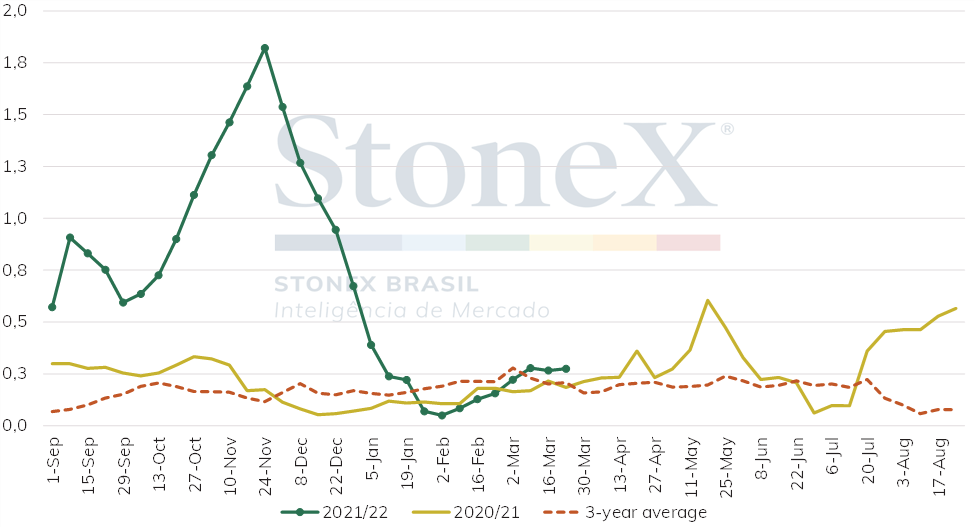
So far, the profitability of corn ethanol plants in the US is USD 0.275/gallon, 48.6% higher in the annual comparison. Despite the firm appreciation of the front-month corn contract in Chicago, ethanol and co-products also posted gains in the period, which limited more significant losses in the operation margin. In case the corn stocks/use ratio is tighter in the coming months, the expectation is that high costs may pressure the profitability of biofuel distillation in the country.
US corn ethanol plants’ profitability (USD/gallon) 
image 33509
Sources: EIA, USDA & StoneX. Design: StoneX.
In the Brazilian market, the returns with alcohol production from the grain are also attractive. StoneX calculations point to a profit of BRL 593.5 per tonne of corn in Mato Grosso, representing an annual increase of 36.1%. Assuming that demand for exports increased, or production was reduced, decreasing internal corn availability between October 2022 and September 2023, a considerable part of this impact would be absorbed by the livestock market, especially when considering the proportionally higher grain increase in relation to the price of the animals, which may pressure livestock confinement intentions, as well as limit the expansion of effective pigs and birds herd. In March, the StoneX market intelligence team produced a special analysis on the subject. You can access the full report here.
It is worth noting, however, that the period of possible price increase may coincide with the sugarcane inter-crop period in the Center-South, when corn ethanol production takes on a greater role. In addition to posing a risk for feedstock availability in 2022/23 (Apr-Mar), the negative effects on plant profitability may also pressure distillation activities in the next season.
Of course, the possible impacts on the biofuel market will depend on the performance of the global corn stocks/use ratio and, mainly, on weather conditions over the coming months. As such, we still expect the corn ethanol supply to be 4.2 million m³ in the Center-South region in 2022/23 (Apr-Mar), a trend that will be constantly revised in our next crop estimates for the region.
In addition to these factors, the analysis of crude oil S&D fundamentals will also be important to draw more assertive perspectives regarding the level of ethanol trading in these players in relation to the cost of corn acquisition. Specifically in the Brazilian market, the 2022/23 crop (Apr-Mar) should be marked by a recovery in sugarcane productivity, leading to a more comfortable S&D balance for ethanol, a trend that is also supported by the decision to zero the ethanol import tax until the end of the current year.

Prospects for the US ethanol import window
In the context of high uncertainty regarding corn supply, as described above, caused both by the conflict in Ukraine and the adverse weather in South America, corn prices have fluctuated sharply, and a predominantly upward trend is seen throughout 2022. In the first quarter of this year, the front-month contract gained about 27.1% in Chicago, to 748.75 cents/bu, and during March alone, corn presented a 13.5% appreciation. In the coming months, US planting, the development of the conflict between Russia and Ukraine and the progress of the countries’ crops will dictate the pace of corn prices and, consequently, impact the ethanol market, since in the US, corn is the main feedstock used in alcohol production.
Since the beginning of the year, demand for gasoline in the US has been slower compared to the last five years.  In 2022, weekly consumption exceeded the historical average only once, which shows lower national demand motivated by high prices of fuel to the final consumer, which in the beginning of March registered the historical high of USD 4.144/gallon.
Estimates from the US Department of Energy (DOE) STEO report indicate that demand for gasoline should continue to operate close to seasonal averages, totaling an annual consumption of 8.91 mbpd, a 0.12 mbpd increase over that recorded in 2021.
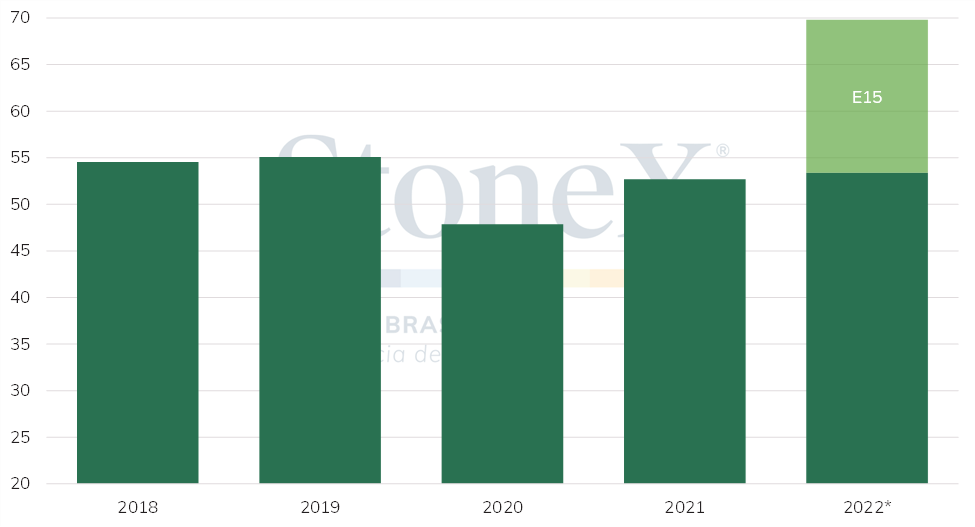
If the ethanol blend rate remains at 10%, the expectation is that its consumption will reach 53.4 million m³ in 2022. In order to contain inflation, rumors point to a possible relaxation of the Renewable Fuel Standard (RFS) policies, precisely to refrain competition from the use of grain for human food.
However, there is still no indication on whether this will be effective. In addition to the uncertainties in this context, the market also pays attention to US plans for electric cars to account for 50% of new vehicle sales in the country by 2030. If this is achieved, it may pressure demand for fuels in general.
US ethanol consumption (million m³)
image 33470
*Estimated. Sources: EIA & StoneX. Design: StoneX.
On the other hand, according to a bipartisan bill presented by congressmen in the US House of Representatives, there is a push for the 15% blend rate to contain inflation. Currently, E15 is banned in the country during the summer, given studies that point to higher levels of pollution in higher temperature days when compared to E10. Still, the measure is considered by the US Congress, mainly to contain the appreciation of gasoline prices throughout the country, which should remain at sustained levels throughout the year.
In the event of a transition to E15, ethanol consumption should be increased. If between January and April 2022 the blend rate remains at 10% and for the rest of the year it increases to E15, demand for ethanol may reach 69.8 million m³ in 2022.
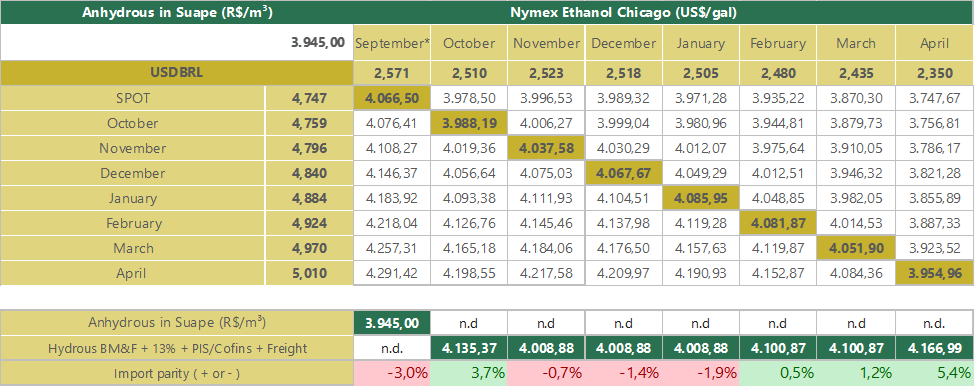
In light of these points for ethanol S&D in the US, it is clear that bullish factors should maintain domestic prices at high levels, especially with the upcoming driving season. This perspective should restrain the Brazilian import window, even with zero tax, which is also supported by a more comfortable Brazilian alcohol balance and the prospect that ocean freight should continue to rise. However, the recent dollar decline opened the margin for US product acquisition to be more advantageous in a few months in Suape/PE, according to our calculations.
Us ethanol import arbitrage in Suape/PE
image 33510
*Spot price in Chicago. ** Ex-mill anhydrous + freight + PIS/Cofins+ cabotage. Design: StoneX. The data, in BRL/m³, refer to last week’s closing. The cells highlighted in yellow refer to the estimated value of ethanol originating in the United States Midwest placed in Suape/PE, considering current and future prices and exchange rate. These values should be compared to the values of B3 ethanol placed  in the region (cells in green).
 
Sugar & Ethanol week  
Week is marked by good performance of the 2021/22 crop in Asian players
  • Last Friday (01), the sugar #11 May/22 contract closed the ICE/NY session at 19.37 c/lb, up 1.2% from the previous week. Similarly, the #5 front-month contract finished at USD 538.50/t in London (+4.3%).
  • The week was marked by concerns about the spread of Covid-19 in China, which tends to affect global port logistics and, consequently, the trade flow of some agricultural commodities. This context, together with the release of strategic oil reserves in the United States, has acted as a bearish force for crude oil futures. In the case of sugar, we have maintained our expectation that Chinese imports will reach around 5.0 million tonnes in 2021/22 (Oct-Sept), but this estimate will be revised depending on the evolution of the pandemic in the coming weeks.
  • In the supply front, attention is directed toward Asia. In India, contracting of sugar for export already reaches 7.5 million tonnes in the current cycle. Given competitiveness gain of the Indian product in consuming players following the rise of ocean freight, the country’s government discusses the possibility of limiting the volume to be shipped abroad in 2021/22. If the measure becomes effective, it would support the sugar futures. 
  • In the next international season, India can export about 5.0 to 6.0 million tonnes, a volume that responds to both the expansion of ethanol production and the prospects for monsoons, which should contribute positively to the productive potential of the country’s sugarcane fields.
  • Pakistan also stands out in this context, given the positive performance of the current crop. With beneficial weather and attractive prices, official sources have already pointed to supply of 7.5 million tonnes of sugar in the current crop, with the sector already aiming to direct a greater volume abroad in the coming months, which tends to make the commodity’s global balance more comfortable.
  • In Brazil, a new crop follow-up by UNICA, referring to the first half of March, showed that crushing was under pressure in the Center-South of the country, totaling 142,300 tonnes, the lowest volume recorded since the 2013/14 cycle (Apr-Mar). With the prospects for the current season already outlined, attention is focused on the weather, which has been favorable to yield gains in the region’s sugarcane fields. In terms of the productive mix, the increase of sugar fixation for export in the US exchange supports our estimate of a 45.5% sugar-directed mix in 2022/23 (Apr-Mar).
Volatility in the oil market continues to take a leading role
  • UNICA data showed a recovery of ethanol consumption in Center-South Brazil. In the first half of March, domestic demand for ethanol was 1.1 million m³, a two-week growth of 14.6%, but an annual drop of 8,7%.
  • Despite anhydrous’ prominence, it is worth noting that the share of hydrous in Otto cycle fuels consumption had a 1.6 percentage point two-week increase, a performance that responds to the price parity between ethanol and gasoline closer to 70% in the region. Nevertheless, uncertainties in the macroeconomic field continue to be a point of attention for fuel consumption.
  • In the coming weeks, the price of ethanol will be guided by the comfortable stocks in the Center-South. However, monitoring FX and crude oil prospects will be important to assess the need for readjustment in refinery prices. 
  • The highlight in this context is diesel, given tightening global stocks. In the US, diesel reserves are already approaching historical lows, a trend that should result in higher production costs in the Brazilian market.
Outlook and CFTC
Last Friday’s CFTC COT report showed that speculators increased their long balance by 2.8% on the week that ended last Tuesday (29), to 97,556 contracts. Despite the Russia-Ukraine conflict, the weaker growth in specs long bets compared to previous weeks was the result of pressure from bearish factors, such as the high level of sugar supply in Asian countries and concerns about the increasing number of Covid-19 cases in China, which may affect global consumption.
In parallel, index funds practically maintained their net long positions in the period, with a slight increase of 0.3% to 237,308 lots. On the other hand, commercial agents raised their net short positions to 334,865 lots (+1.0%). 
 
 
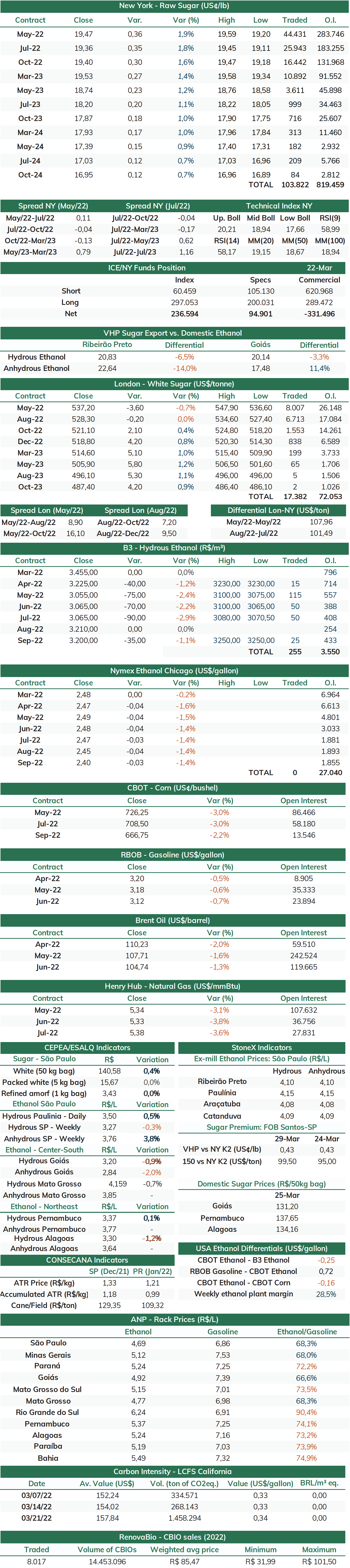
Economic Indicators
image 33511


  • Renewable Fuels

The StoneX Group Inc. group of companies provides financial services worldwide through its subsidiaries, including physical commodities, securities, exchange-traded and over-the-counter derivatives, risk management, global payments and foreign exchange products in accordance with applicable law in the jurisdictions where services are provided. References to over-the-counter (“OTC”) products or swaps are made on behalf of StoneX Markets LLC (“SXM”), a member of the National Futures Association (“NFA”) and provisionally registered with the U.S. Commodity Futures Trading Commission (“CFTC”) as a swap dealer. SXM’s products are designed only for individuals or firms who qualify under CFTC rules as an ‘Eligible Contract Participant’ (“ECP”) and who have been accepted as customers of SXM. StoneX Financial Inc. (“SFI”) is a member of FINRA/NFA/SIPC and registered with the MSRB. SFI is registered with the U.S. Securities and Exchange Commission (“SEC”) as a Broker-Dealer and with the CFTC as a Futures Commission Merchant and Commodity Trading Adviser. References to securities trading are made on behalf of the BD Division of SFI and are intended only for an audience of institutional clients as defined by FINRA Rule 4512(c). References to exchange-traded futures and options are made on behalf of the FCM Division of SFI . StoneX is a trading name of StoneX Financial Ltd (“SFL”). SFL is registered in England and Wales, Company No. 5616586. SFL is authorized and regulated by the Financial Conduct Authority [FRN 446717] to provide to professional and eligible customers including: arrangement, execution and, where required, clearing derivative transactions in exchange traded futures and options. SFL is also authorised to engage in the arrangement and execution of transactions in certain OTC products, certain securities trading, precious metals trading and payment services to eligible customers. SFL is authorised & regulated by the Financial Conduct Authority under the Payment Services Regulations 2017 for the provision of payment services. SFL is a category 1 ring-dealing member of the London Metal Exchange. In addition SFL also engages in other physically delivered commodities business and other general business activities which are unregulated and not required to be authorised by the Financial Conduct Authority. StoneX Group Inc. acts as agent for SFL in New York with respect to its payments services business. StoneX APAC Pte. Ltd. acts as agent for SFL in Singapore with respect to its payments services business. ‘StoneX’ is the trade name used by StoneX Group Inc. and all its associated entities and subsidiaries.
 
Trading swaps and over-the-counter derivatives, exchange-traded derivatives and options and securities involves substantial risk and is not suitable for all investors. Past performance of any futures or option is not indicative of future success. Indicators are not a trading system and are not published as a specific trade recommendation. The information herein is not a recommendation to trade nor investment research or an offer to buy or sell any derivative or security. It does not take into account your particular investment objectives, financial situation or needs and does not create a binding obligation on any of the StoneX group of companies to enter into any transaction with you. You are advised to perform an independent investigation of any transaction to determine whether any transaction is suitable for you. No part of this material may be copied, photocopied or duplicated in any form by any means or redistributed without the prior written consent of StoneX Group Inc.
 
© 2026 StoneX Group Inc. All Rights Reserved.

Satellite view of Earth at night showing illuminated cities across Asia and the Middle East

Discover more insights

Our subscribers have access to comprehensive market analysis from StoneX spanning commodities, equities, currencies and more.

Related articles for Renewable Fuels

Perspective: Morning Commentary for August 6

August 6 – This morning’s stronger-than-expected U.S. labor data offered markets some relief, reinforcing confidence in the economy while giving the Fed greater flexibility to raise rates should inflationary pressures reaccelerate in next week’s July data. Stock futures are pointing to a mixed open to start the day, with the tech-heavy Nasdaq showing the most weakness. The VIX has fallen notably from yesterday’s spike above 18.4 as it starts the day hovering just below the 16-mark. The dollar is quietly higher as it trades just above 99.8, holding in the tight range seen thus far this week as traders continue to digest data to shape expectations for the Fed’s next move, which we’ll dive into in more depth below. Long-term treasury yields have relaxed slightly from their recent spike, with 30-year yields starting the day trading just above 5.19%, while 10-year yields trade above 4.64%, and 2-year yields sit below 4.22%. Crude oil is modestly higher to start the session after sharp declines earlier in the week, with nearby WTI up 1.8% to trade at $76.40 and nearby Brent up 2.4% to trade at $81.40. Meanwhile, the ags are quietly mixed to start the day.

Mike Castle
Mike Castle
  • Grains & Oilseeds
  • Energy
  • Dairy
  • Renewable Fuels
  • Cocoa
  • Coffee
  • Cotton
  • Sugar
  • Meats & Livestock
  • Forest Products

Perspective: Morning Commentary for August 5

August 5 – U.S. equities markets are on fire this week, with both the Dow Jones and S&P 500 setting new all-time highs yesterday with futures indicating further gains again today; the marketplace remains optimistic over a deal with Iran despite no evidence of such as of yet. Crude oil is working on a lower high and low today but remains slightly on the high side on the session, while the dollar is retreating back towards Monday’s nearly two-month low. The ten-year note is steady-to-lower this morning (though solidly lower so far this month) at 4.605%, while the VIX index continues to rebound into mid-week at almost a 17-point reading this morning.

Matt Zeller
Matt Zeller
  • Grains & Oilseeds
  • Energy
  • Dairy
  • Renewable Fuels
  • Cocoa
  • Coffee
  • Cotton
  • Sugar
  • Meats & Livestock
  • Forest Products

Perspective: Morning Commentary for August 4

August 4 – The benchmark Dow Jones Industrial Average surged into the close yesterday to finish almost 700 points higher, at a record close of 53,178 points – easily clearing the previous top from almost a month ago. The S&P 500 is on the brink of its own record as well, while the NASDAQ index is short of June highs but working on a strong three-session rally. All three are pointing to positive openings today. Palantir (a U.S. software company) reported better-than-expected earnings yesterday afternoon post-close to boost the tech sector, though a host of other firms reported strong earnings as well. The ten-year note continues to retreat from Friday’s high, now at 4.67%, with the dollar on the high side of level-par, while the VIX index now under 16 shows reduced volatility.

Matt Zeller
Matt Zeller
  • Grains & Oilseeds
  • Energy
  • Dairy
  • Renewable Fuels
  • Cocoa
  • Coffee
  • Cotton
  • Sugar
  • Meats & Livestock
  • Forest Products
StoneX: We open markets

Our market expertise, advanced platforms, global reach, culture of full transparency and commitment to our clients’ success all set us apart in the financial marketplace.

Reach

With access to 40+ derivatives exchanges, 180+ foreign exchange markets, nearly every global securities marketplace and numerous bi-lateral liquidity venues, StoneX’s digital network and deep relationships can take clients anywhere they want to go.

Transparency

As a publicly traded company meeting the highest standards of regulatory compliance in the markets we serve; our financials and record of accomplishment are matters of public record. StoneX’s commitment to “doing the right thing over the easy thing” sets us apart in the industry and helps us build respect, client trust and new partnerships.

Expertise

From our proprietary Market Intelligence platform, to “boots on the ground” expertise from award-winning traders and professionals, we connect our clients directly to actionable insights they can use to make more informed decisions and achieve their goals in the global markets.